Pinning Python and Node Toolchains Across Developer Machines
Separate runtime pinning from dependency locking to eliminate environment drift across your team.
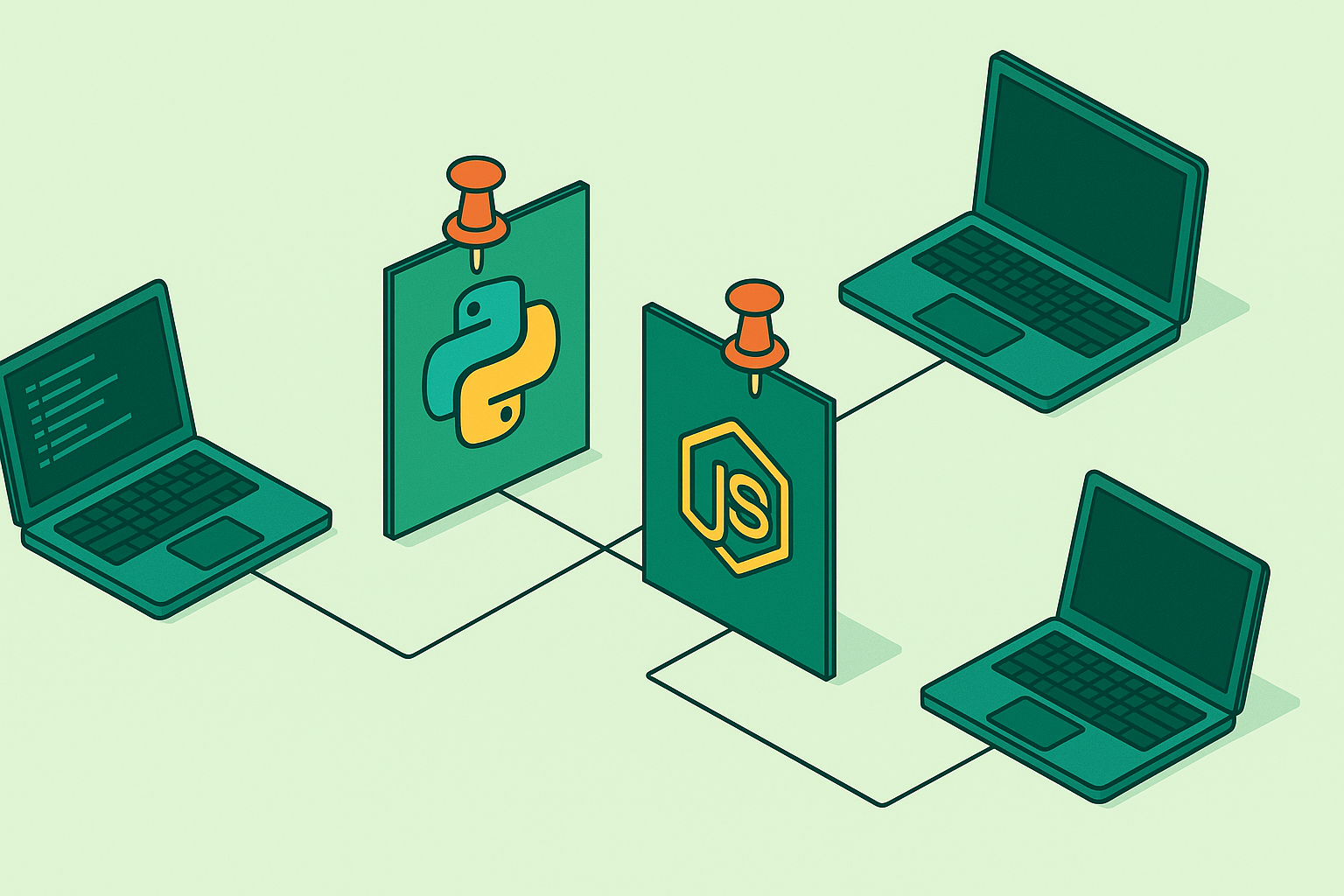
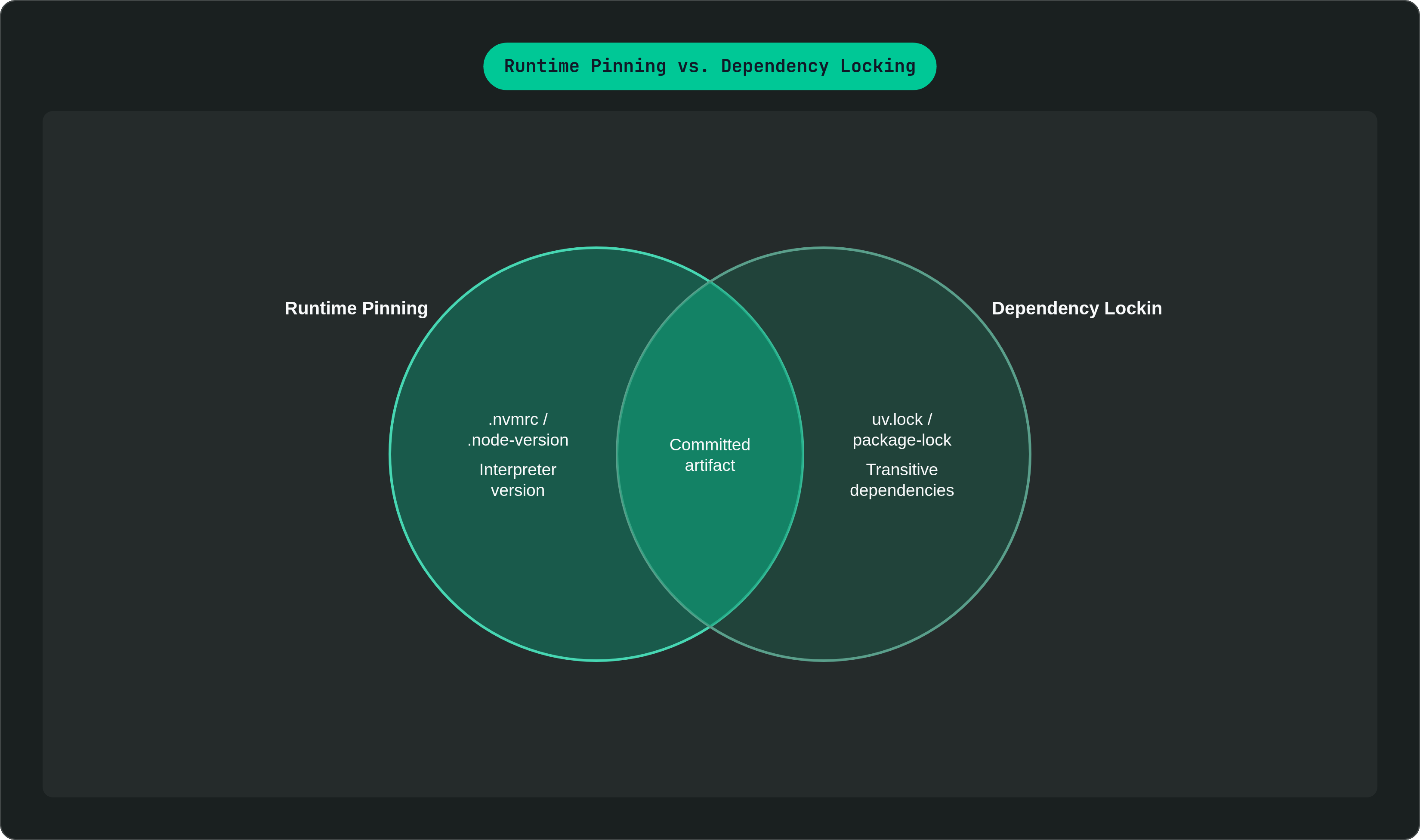
Two distinct concerns get conflated under the word "pinning," and the conflation causes real problems. The first is runtime pinning, declaring which interpreter or engine version the project requires, Python 3.12.x or Node 20.x. The second is dependency locking, freezing the exact resolved package graph, including transitive dependencies, in a file like uv.lock, package-lock.json, or yarn.lock. These are related but independent concerns, and the order matters. Dependency locking only produces consistent results if the runtime is already consistent, because the resolver itself behaves differently across interpreter versions. Runtime pinning is the precondition; dependency locking is downstream of it.
A pin file is a declaration, not an enforcement mechanism. It doesn't install the pinned version automatically unless some tool is configured to act on it. It doesn't propagate to CI unless the CI configuration explicitly reads it. It doesn't touch system-level libraries or C extensions the runtime depends on. What it does provide is a committed artifact in version control: a .python-version, .nvmrc, .node-version, mise.toml, or a volta key in package.json that every tool and environment can consume. That artifact is the coordination mechanism. Nothing more.
The "works on my machine" failure mode is predictable once you've debugged it a few times. Developers reuse old environments rather than re-provisioning from scratch. OS package managers silently upgrade runtimes. New contributors follow README steps that were accurate six months ago. CI runners start from a clean state and enforce stricter configurations, surfacing mismatches that were invisible locally for months. Pinning eliminates that class of failure, but only if the pin file is treated as the authoritative source of truth by every environment that touches the codebase. That condition sounds obvious. It's violated constantly.
Python Runtime Pinning: The Tools Available and What Each One Actually Manages
The Python ecosystem has historically required assembling multiple tools to cover the full lifecycle. That fragmentation isn't really a design failure; it's an artifact of how the ecosystem evolved. Packaging, virtual environments, and interpreter management each developed under separate PEPs, by separate communities, across different eras. The result is genuine confusion about which tool owns which concern, and that confusion has real costs in onboarding time, environment drift, and CI failures that take half an afternoon to trace back to a mismatched interpreter.
pyenv and the Traditional Stack
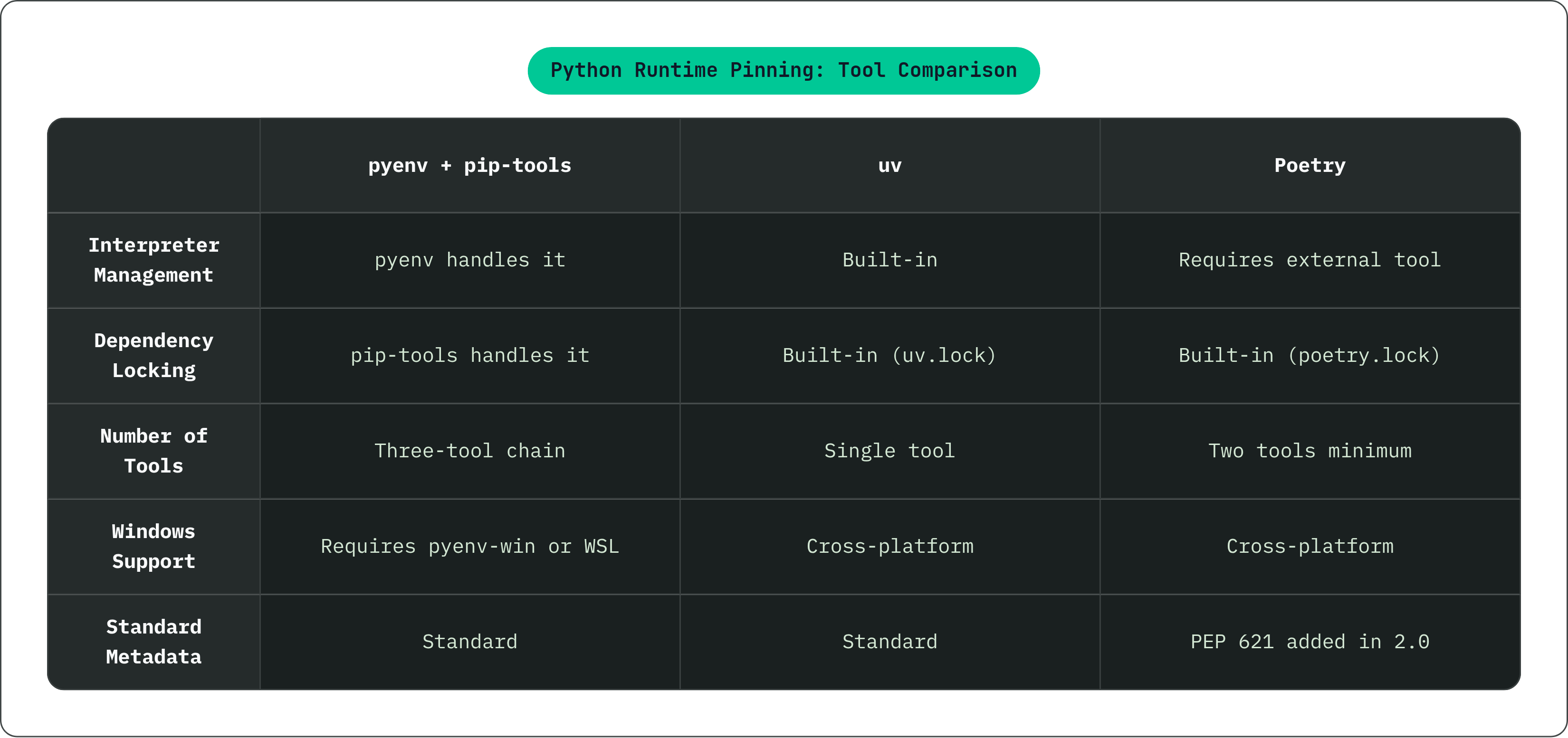
pyenv installs and switches Python interpreter versions by building from source, which means you get exactly the version requested rather than a distro-packaged variant carrying unofficial patches. It pins via a .python-version file in the project root. What it doesn't manage is package isolation; for that you pair it with venv or pyenv-virtualenv. What neither of those manages is the package graph; for that you add pip-tools or a similar locking tool. The result is a three-tool chain, each owning a distinct layer.
It works. The seams between layers create opportunities for drift that accumulate quietly across contributors and deployments. One practical constraint worth stating plainly: pyenv doesn't run natively on Windows, which means teams with Windows contributors need either pyenv-win or WSL. That catches teams off guard during onboarding more often than it should.
uv as a Consolidating Option
uv, written in Rust and maintained by Astral, collapses much of that stack into a single tool. According to Astral's own timed comparisons of uv 0.11.18 against pip 26.0, uv venv completes in roughly 10 milliseconds on Apple Silicon hardware, compared to over a second for python -m venv. That speed difference matters. In CI, where environment creation runs on every build, it compounds across a full day's pipeline runs in ways that show up in your bill. uv python install 3.12 manages the interpreter directly; .python-version pins it at the project level; uv.lock captures the full resolved dependency graph, including transitive dependencies, in a cross-platform format. For a greenfield project or a team willing to migrate, uv replaces the pyenv-plus-virtualenv-plus-pip-tools combination with a single, coherent tool.
Poetry's Position
Poetry unified parts of this stack earlier and deserves acknowledgment. Poetry 2.0, released in January 2025, added PEP 621 support, addressing a long-standing and legitimate criticism about non-standard metadata. The meaningful gap that remains is that Poetry has no built-in Python version management; a separate tool still handles the interpreter itself. That's not a fatal limitation, but the stack isn't fully consolidated, and in practice teams still reach for pyenv or uv alongside it.
The Practical Decision
For a greenfield Python project, uv handles interpreter management and package locking in one tool. Commit .python-version and uv.lock and both pinning layers are covered. For a team on an existing pyenv setup, the lower-friction path is to keep pyenv for interpreter management and migrate package locking to uv or pip-tools incrementally. Either way, both layers must be pinned, and both pin files must be committed.
Node.js Runtime Pinning: What.nvmrc Guarantees and Where It Stops
The .nvmrc file is the most widely recognized Node.js pin artifact. It's a plain text file containing a version string, committed to the repository root. Its ubiquity is a genuine strength; almost every Node.js version manager reads it. Its weakness is that it's purely declarative and passive. The file sitting in the root does nothing on its own.
What.nvmrc Does Not Guarantee
The pinned version isn't installed automatically when a developer enters the project directory. They must run nvm use explicitly, or configure shell hooks to trigger auto-switching. In CI, the file is ignored entirely unless the setup step is explicitly configured to consume it. Without that configuration, the runner uses whatever Node version is preinstalled on the image, which drifts as runner images are updated. I've spent entire afternoons debugging CI failures that turned out to be a runner silently upgrading Node across a point release. The fix was a single line in the workflow file. The diagnostic process was not.
nvm and fnm both read .nvmrc and .node-version. fnm is faster and cross-platform. Neither enforces the version automatically at the project boundary without shell hooks, which places the burden on individual developers to configure their environments correctly. On a team of any real size, that burden is distributed unevenly and honored inconsistently.
Volta's Different Model
Volta takes a materially different approach. It pins Node, npm, Yarn, and pnpm versions into package.json under a volta key and enforces the version automatically on every node invocation within the project directory, without requiring shell hooks. Because package.json is already version-controlled, every collaborator who installs Volta and clones the repository gets the same runtime version automatically. The enforcement mechanism is the tool itself, not the team's collective memory.
A note on Corepack: it's no longer planned to ship bundled with Node.js by default. Teams that relied on Corepack for package manager version consistency should account for this before it becomes a surprise. Per-project package manager pinning through Volta or explicit lockfiles now carries more weight than it did a year ago.
The Gap That Must Be Closed
Whichever local version manager a team uses, the CI configuration must explicitly consume the same pin file. A .nvmrc in the repository that CI never reads is a pin file in name only. It creates an appearance of consistency without the substance of it, which is worse than having no pin at all, because it obscures the gap.
Managing Both Toolchains Together When the Project Is Genuinely Polyglot
Polyglot projects and monorepos amplify the coordination problem considerably. Managing five version managers in five formats carries a real cost. Onboarding becomes a multi-hour sequence of tool installations, each with its own configuration syntax, its own shell integration, its own failure modes. Anyone who has shepherded a new engineer through that process knows how quickly it erodes confidence in the codebase before they've written a single line.
mise as a Single-File Solution
mise addresses this directly. A mise.toml file at the repository root declares all runtime versions across languages. A single mise install reads that file and provisions the full toolchain, replacing sequential invocations of nvm, pyenv, rustup, and similar tools. Clone the repository, run mise install, install packages. That's the onboarding sequence when mise is configured correctly, and it's a meaningfully shorter sequence than the alternative.
mise also maintains backward compatibility with existing formats. It reads .nvmrc, .node-version, .python-version, and .tool-versions when those files are present and compatibility mode is enabled, so migration doesn't require deleting existing pin files on day one. Teams can consolidate gradually, which matters when the alternative is a flag day that never gets scheduled.
asdf provides similar capabilities with a larger plugin registry, and mise is largely compatible with asdf's .tool-versions format. The choice between them matters less than the discipline of committing and consuming a single configuration file.
What These Tools Don't Replace
mise and asdf manage runtime versions. They don't manage package dependency graphs. A polyglot project still needs uv.lock for its Python components and package-lock.json or equivalent for its Node.js components. The runtime layer and the dependency layer are distinct, and both require pinning.
From a platform engineering perspective, a base image or devcontainer with mise pre-installed means developers clone and tools install automatically. The mise.toml in the repository becomes the documentation, because it's the only documentation that cannot drift out of sync with the actual configuration.
Propagating the Pin to CI So Local and Remote Environments Match
The failure pattern is consistent across teams and platforms: the pin file exists in the repository, CI ignores it, and the divergence stays invisible until it surfaces as a build failure that takes an afternoon to diagnose. It's a costly problem with a cheap fix.
GitHub Actions
For Python, actions/setup-python accepts python-version: 'file', which reads .python-version from the repository root. For Node.js, actions/setup-node accepts node-version: 'file', which reads .nvmrc or .node-version. These are one-line changes to an existing workflow file. They close the gap between local and CI by making the CI configuration a consumer of the same pin artifact developers use locally, rather than an independent declaration that will eventually drift.
CircleCI and GitLab CI support equivalent semantics. The specific syntax varies by platform, and it's worth verifying against current documentation rather than assuming the file is read by default.
mise in CI
With mise pre-installed in the runner image, or installed via a CI step, mise install reads mise.toml from the repository and provisions the declared toolchain. One file serves both the developer's local environment and the CI runner. The configuration is no longer split across two systems.
The Single Source of Truth
When a CI configuration declares its own runtime version separately from the project's pin file, those two declarations will eventually diverge. The solution is to eliminate the independent declaration entirely and make CI a consumer of the committed pin. Every environment, local, CI, staging, reads the same file. Any deviation reintroduces the exact coordination problem pinning was meant to solve.
How Pinning Relates to Dependency Security and Why It's Not a Complete Answer
Pinning contributes to security, but it's not a security strategy on its own, and treating it as one creates a false sense of safety that is worse than no strategy at all. Sonatype identified over 454,600 new malicious packages in 2025 alone, bringing the cumulative total past 1.2 million. The resolved package graph is an active attack surface, and its integrity depends on knowing exactly what's in it, which requires both runtime consistency and dependency locking.
What Runtime Pinning Contributes
A consistent runtime eliminates a class of supply chain drift where a CI runner silently upgrades to a runtime version that changes default TLS behavior, module resolution, or standard library APIs. It also makes the build reproducible enough that a hash of the resolved dependency graph is meaningful. You can't verify the integrity of a dependency graph if the resolver itself behaves differently across invocations. Reproducibility is the precondition for auditability.
The Dependency Pinning Debate
A 2025 paper on arXiv titled "Pinning Is Futile" articulated the core tension clearly. Pinning to exact versions guarantees a consistent graph but locks in known-vulnerable versions if the team doesn't update promptly. Floating version ranges keep dependencies current automatically but allow silent graph changes between installs. Neither approach is strictly better, and the paper doesn't pretend otherwise. Both require active monitoring. Tools like Dependabot, Renovate, and Snyk exist precisely because a pinned state isn't a safe state indefinitely. It's a starting point for a maintenance discipline.
EOL Runtime Risk
A container image pinned to an end-of-life runtime tag stops receiving security updates. The image accumulates OS-level vulnerabilities alongside the runtime's own. Vulnerability scanners flag the runtime itself, not just its dependencies. Pinning a specific version is not the same as pinning a maintained version, and for any project with real security requirements, that gap is not academic.
Pin the runtime for reproducibility and consistency. Treat dependency locking as a separate discipline with its own update hygiene. Automate updates where the toolchain supports it, and treat a pinned state as the beginning of ongoing maintenance, not the end of it.
Choosing a Pinning Strategy That the Whole Team Will Actually Maintain
The criterion that matters most is enforcement. A pin mechanism a developer can accidentally bypass is weaker than one the tool enforces at invocation time. A file that must be read manually is weaker than one the toolchain reads automatically. Strategy selection should weigh enforcement above convenience, above familiarity, and certainly above the inertia of whatever the team has used before. Good tooling makes the correct behavior the default behavior.
Decision Points by Team Context
For a single-language Python project on a greenfield codebase, uv handles interpreter management and package locking in one tool. Commit .python-version and uv.lock and both pinning layers are covered. For a team on an existing pyenv setup, keep pyenv for the interpreter and migrate package locking to uv or pip-tools; the migration doesn't need to happen all at once.
For a Node.js project where automatic enforcement is the priority, Volta with a volta key in package.json is the strongest option, because it enforces the version without requiring shell hooks or developer discipline. For a team already on nvm or fnm, commit .nvmrc and fix the CI configuration to consume it with node-version: 'file'. That second step is the one that's almost always missing.
For a polyglot project or a monorepo, mise.toml at the root covers the full toolchain in one file and one command.
Three Artifacts That Must Be in the Repository
Regardless of which tools a team chooses, three artifacts belong in version control: the pin file, the dependency lock file, and the CI configuration that explicitly reads both. The absence of any one of them creates a gap. Drift finds gaps.
The Onboarding Test
The simplest diagnostic for whether a pinning strategy is actually working: hand it to someone who's never seen the codebase and watch what happens. A new contributor should be able to clone the repository and have the correct runtimes installed with a single command. If that's not true, the strategy is incomplete. Run this test deliberately when adopting or changing tooling, because internal familiarity hides the gaps that newcomers find immediately. This is not a theoretical exercise; it should be scheduled.
Maintenance Discipline
Pin files require the same update hygiene as dependency lock files. Runtime versions have end-of-life dates, and an EOL runtime pin accumulates unpatched security issues while falling outside the support window of libraries that depend on it. Schedule regular runtime updates, automate them where the toolchain supports it, and treat an EOL pin with the same urgency as an unpatched dependency. The technical work to update is rarely the hard part. Building the habit before something forces your hand is. Flox, a single-manifest developer environment manager built on Nix that pins the full toolchain, including runtimes and system-level dependencies, identically across laptops, CI, and production, is one approach for teams that want that consistency enforced at the infrastructure level rather than maintained by convention.