Reproducible Environments Across macOS and Linux in the Same Team
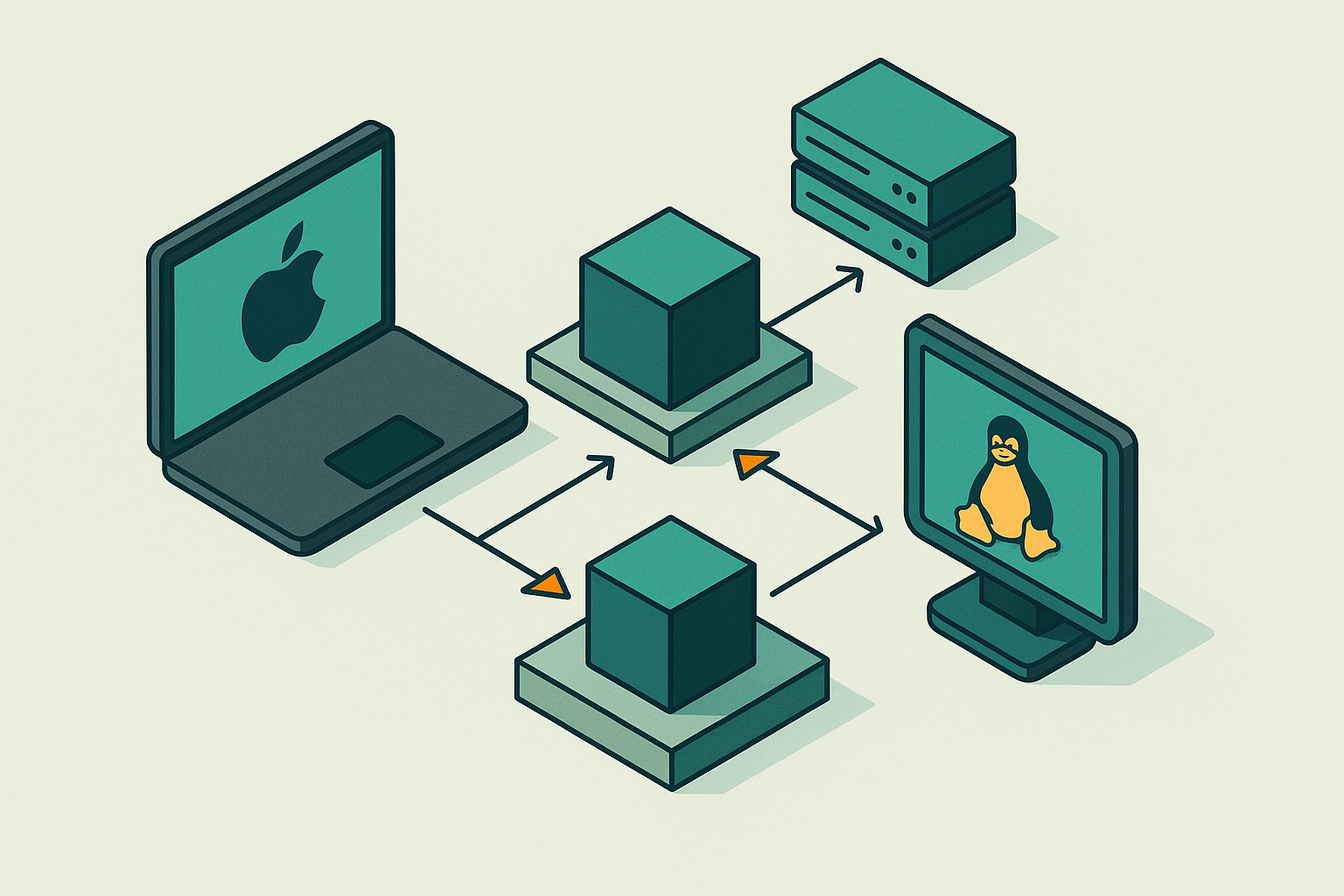
Two developers on the same team, one on macOS, one on Linux, check out the same commit, run the same install script, and end up with different behavior. I've watched this exact scenario burn an entire afternoon more times than I can count. The POSIX resemblance between macOS and Linux is skin-deep, and the gap underneath is structural. Structural problems need structural fixes, not another Slack thread titled "works on my machine."
Both operating systems ship a terminal. Both run bash, or something close enough that nobody notices until an edge case bites. Grep, sed, curl, all present and accounted for. That surface compatibility is exactly what makes the divergence dangerous, because it looks solved. Nobody treats it as a live problem until a build breaks in a way that takes half a day to explain, and by then everyone's already blaming the wrong layer.
How environment drift accumulates across a mixed macOS-Linux team
Drift isn't a single misconfiguration sitting somewhere waiting to be found. It's a process, and it runs continuously for as long as a team has people on more than one platform.
Every developer installs tools on their own clock. The macOS person updates through Homebrew whenever the mood strikes; the Linux person pulls from apt or dnf, or builds from source because the distro package is stale again. CI runs whatever got pinned the last time someone touched the pipeline, which could be eight months old at this point. Three clocks, none synchronized.
The compounding is where it turns ugly. A slightly different Python patch version, paired with a different OpenSSL build, paired with a glibc-linked extension behaving differently on Darwin, produces a bug nobody can reliably reproduce. Someone files a ticket. Another engineer can't repro it. The thread devolves into "what version of X are you on," which should never be a serious diagnostic question inside a mature engineering org, and yet it is, constantly.
None of this is cosmetic. A build that passes on a MacBook and fails in Linux CI isn't automatically a Linux problem; it might be a hidden dependency on macOS behavior nobody wrote down. A security patch applied to one machine has no mechanism for reaching another. Production runs on Linux almost everywhere, so a dev environment that's drifted far enough from Linux stops functioning as a usable proxy for what actually ships.
New hires make it worse. They inherit the existing inconsistency, and because they need something working today, they layer their own undocumented fixes on top of it. The usual stopgaps don't survive contact with this. A shared setup script rots the moment an upstream package changes its release cadence. A README with platform-specific if-statements is only as current as whoever last remembered to touch it, which is rarely. And telling the macOS half of the team to "just use Docker" solves one slice of the problem while adding real friction everywhere else. I've seen that suggestion floated in more than one retro, and it never quite lands the way the person proposing it thinks it will.
What a reproducible environment actually means in this context
Two developers activate the same environment definition, on different days, on different operating systems, and get identical tool versions and identical behavior. Not close enough. Identical. That's the bar, and most teams aren't within shouting distance of it.
Four things make it possible. The environment has to be declarative, a file in version control rather than a sequence of manual steps somebody ran once and never wrote down. It has to be isolated, so it doesn't quietly lean on whatever's already sitting on the host machine. It has to account for multiple architectures, because a real cross-platform claim in 2024 means x86_64 and aarch64 on both operating systems, not "works on ARM" as a vague blanket statement. And it has to be lockable: versions pinned to a resolved state, not latest-as-of-whenever-you-installed-it.
Wrapping everything in Docker gets you partway there, but it isn't the only path, and it isn't the same thing as CI parity either. A pipeline can be perfectly reproducible in isolation while local development stays a mess of one-off patches. Both layers have to converge on the same definition, or the CI reproducibility is just theater.
Apple Silicon trips up a lot of tooling that claims cross-platform support. aarch64-darwin and aarch64-linux are not the same target, despite both technically being ARM64. A tool that treats them interchangeably eventually produces a binary that runs on one and not the other, and untangling why takes exactly as long as you'd guess. I've lost a morning to that particular flavor of confusion, and it's a genuinely humbling way to spend a Tuesday.
The declarative approach matters more than any single tool choice, for one reason: the file in version control becomes the environment. Anyone can rebuild it from scratch, diff it against last month's version, audit precisely what changed, propose an update through a normal pull request. Institutional memory about who configured what and when just isn't required anymore.
The tools available for cross-platform reproducible environments and what each actually offers
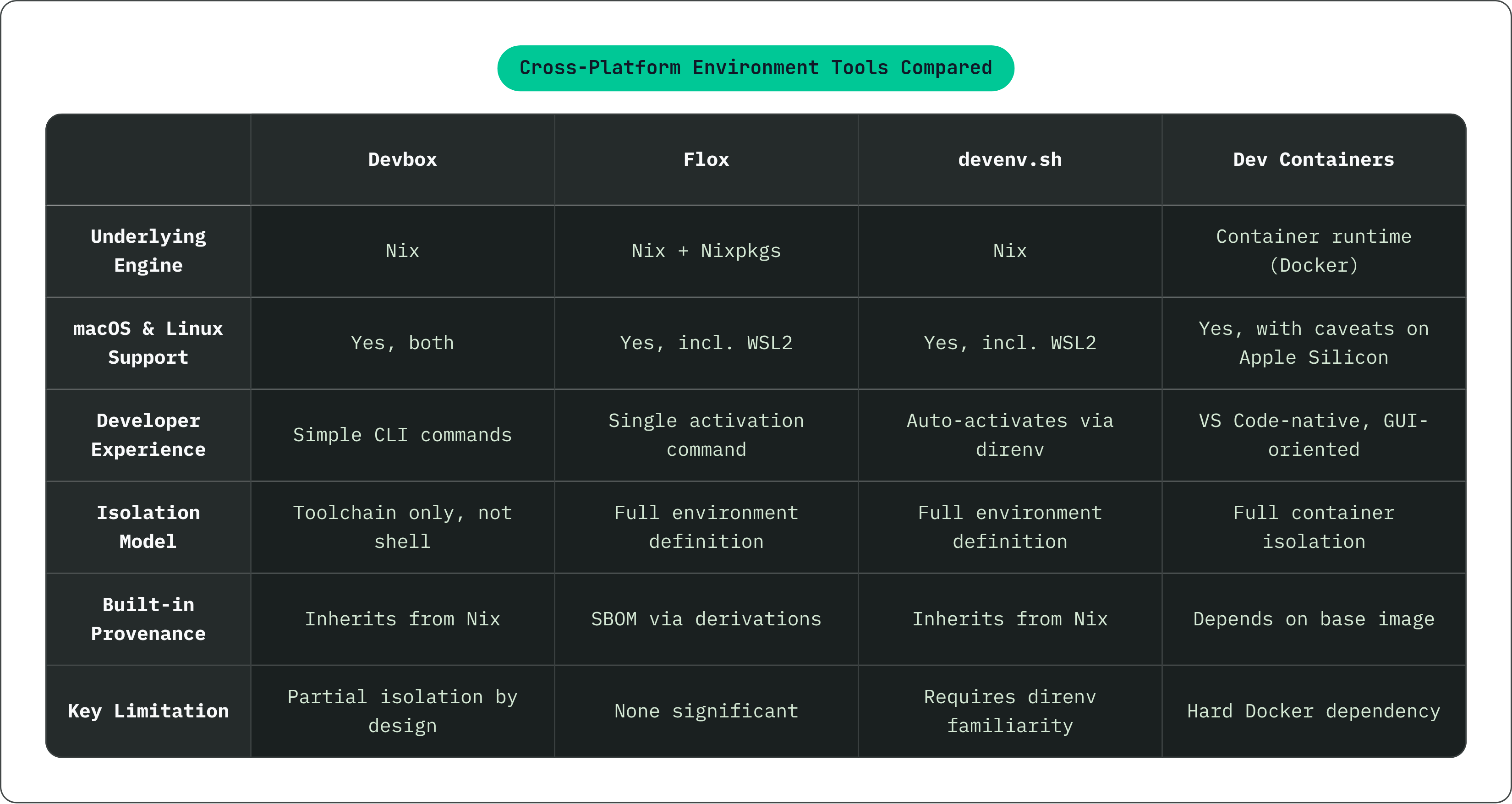
Nix sits underneath most of the serious options here, so start there. Packages are defined as derivations in a functional language, meaning every build input gets fully specified up front. That's what makes the output reproducible by construction instead of by convention. Nix runs on Linux and macOS and treats x86_64 and aarch64 on each as genuinely separate targets. The catch: raw Nix is steep. Pinning a specific tool version is entirely doable, but the syntax and mental model are not what most application developers signed up for on a Tuesday morning.
Devbox takes that foundation and puts a friendlier surface on top. A devbox.json file lists what a project needs, and adding a tool looks like devbox add python@3.12 rather than hand-writing a Nix expression. Isolation here is intentional but partial: the shell and editor stay the developer's own, only the toolchain gets pinned. The same devbox.json produces the same tool versions for a macOS colleague and a Linux colleague, and it can export to a Dockerfile or devcontainer.json later if a team wants that path.
Flox is also Nix-backed, and what sets it apart is how it handles sharing across a team. Environments work identically across macOS, Linux, and WSL2 from a single definition, and the catalog draws on Nixpkgs, the largest single collection of packaged software available to any environment manager, at well over 190,000 packages. A teammate activates with one command and gets the identical setup, no setup guide involved. Because the Nix layer tracks every dependency down to its derivation, provenance and SBOM data come along for free. I'll get to why that matters more than it sounds a couple of sections from now.
devenv.sh takes a similar environment-as-code approach and pairs it with direnv, so the environment activates the moment someone cds into the project directory instead of requiring an explicit shell command. It draws from a large prebuilt package set spanning Linux and macOS, x64 and ARM64, with WSL2 support included.
Dev Containers, the open spec built mostly around VS Code, offer real portability but come with a hard dependency on a container runtime, Docker Desktop or something equivalent. On Apple Silicon that chain gets messier: Homebrew for Linux doesn't support ARM inside a Linux container, which makes Nix the more dependable package manager to run inside that container. A nix-darwin module built for Apple's Containerization framework now lets M-series Macs run declaratively managed native Linux containers without Docker Desktop anywhere in the loop, which quietly removes a dependency a lot of teams had been carrying reluctantly for years.
Worth flagging on its own: a single Nix flake can produce x86_64 and arm64 Docker images from the same definition, simultaneously. For teams shipping container artifacts alongside a dev environment, that erases an entire category of build-it-twice tooling.
Intel Macs are a separate story, and not a happy one for teams still on that hardware. Determinate Systems dropped x86_64-darwin support from its Nix installer as of version 3.13.2, citing usage that had fallen to well under 1% of macOS installs and under 0.01% of installs overall. Teams still running Intel hardware should weigh that now, not discover it mid-migration.
How broken environments slow down onboarding — and what the numbers say
Start with the scale of it. GitLab's research found 44% of organizations report that onboarding a new developer takes more than two months. Two months is a meaningful slice of that person's first year, spent before they've shipped a single thing.
A large share of that time goes to environment setup specifically: chasing the right tool version, resolving a conflict that only shows up on one platform, reading a README that was accurate eighteen months ago and hasn't been touched since. It's not unusual for a senior engineer to burn 15 to 20 hours in that window answering setup questions one Slack message at a time. That cost never shows up on any roadmap, even though it recurs with every single hire.
The cross-platform angle makes it worse. A README written by and for Linux users hands a macOS developer an environment that sort-of works, meaning it runs until it doesn't, and the reverse happens just as often. The divergence stays invisible right up until it isn't.
Automated, reproducible environments change this directly. Teams running a proper activation command report getting a new developer productive in under 30 minutes. Research from Valorem Reply and Cycloid documented one platform engineering team that automated provisioning and compressed a two-week onboarding timeline down to under two hours. That's not a marginal gain. That's a different category of process.
There's a retention piece too, and it deserves more than a footnote: 22% of developers leave within their first 90 days when onboarding isn't structured. A broken Day 1 environment is more than an inconvenience; it's a signal, intended or not, about how the rest of the place is run. A reproducible environment definition in version control is the foundation any structured onboarding gets built on. Skip it, and onboarding stays a manual, person-dependent ritual that gets a little worse every year the team exists.
Why the macOS-Linux gap is also a supply chain security gap
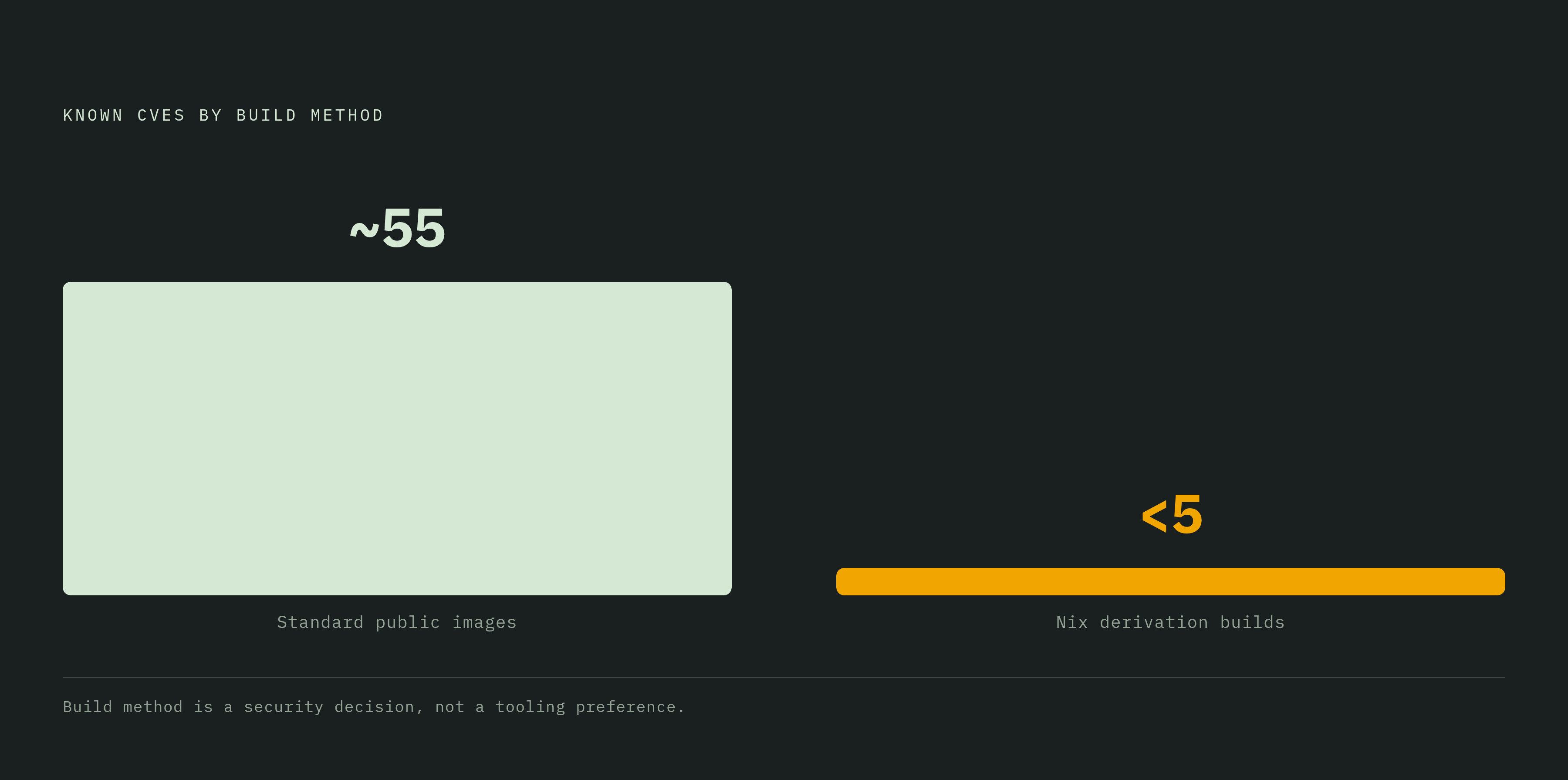
Environment drift is a security problem as much as a productivity one. When every developer installs tools and libraries independently, the team has no single source of truth for what's actually running anywhere. A CVE patched in one person's local Homebrew install can sit unpatched on someone else's machine indefinitely, invisible without a shared, auditable definition to check against.
The build method itself carries measurable risk. Standard public container images typically ship with somewhere around 50 to 60 known CVEs baked in; source-built images using Nix-style derivations bring that down to single digits. How software gets built matters as much as what the code says. That's not a slogan, it's the actual finding.
The CI/CD layer is its own attack surface, and it's already been hit at scale. In early 2025, attackers modified the historical Git tags of a widely used GitHub Action, one relied on by an estimated 23,000-plus repositories, and used the compromise to exfiltrate CI/CD secrets straight into public Actions logs. The pipeline building the software is a target in its own right, not scenery behind the application code.
macOS carries a particular flavor of this exposure. Developers pulling dependencies through Homebrew, or through pip or npm without a lockfile, run a dependency graph nobody has audited, one that probably doesn't match what Linux CI is actually testing against. Ask a mixed team, "are we all running the same version of this library, and is it the patched one," and in most shops nobody answers with any confidence. That only changes with a shared, declarative definition both platforms are held to.
How Nix-backed environments make provenance and SBOMs a structural property rather than an audit exercise
Most SBOMs in production today are compliance paperwork: generated once at the end of a build, filed away, forgotten until an auditor comes asking. The needed shift is away from static snapshots and toward evidence that stays current and can be queried when something actually goes wrong.
The build method decides whether that shift is even possible. If an environment is defined declaratively and every dependency exists as a tracked derivation, the bill of materials falls out of the environment definition automatically, instead of arriving as a scan bolted onto an artifact after the fact. A Nix derivation captures the exact inputs, source hash, build flags, and full dependency graph at the point the environment gets defined. Getting that at definition time, rather than reconstructing it weeks later from memory and old logs, is the entire difference.
There's a regulatory piece too. U.S. Executive Order 14028 requires SBOMs from federal software vendors, and teams producing them as a natural byproduct of the build are simply better positioned to keep them accurate as dependencies shift, compared to teams running a quarterly scan and hoping nothing moved in between. SLSA provenance, cryptographic signing of individual build steps, is the natural complement: the environment definition establishes what went in, and SLSA attestation proves what came out.
The incident-response case makes this concrete. When something like Log4Shell surfaces, a team with a current SBOM and a declarative environment definition answers "are we affected" by querying a dependency graph, in minutes. A team without one is stuck manually inspecting builds across developer machines that were never configured identically in the first place, which is slower and a lot less certain, and frankly a miserable way to spend an incident.
Flox's architecture makes the point well. Because its environments are backed by Nixpkgs derivations, dependency provenance isn't bolted on afterward; every package carries a traceable build lineage as a basic property of how the system works. SBOM generation becomes a structural fact about the environment, not a compliance task someone has to remember to run.
What a platform engineering team actually does to standardize across macOS and Linux
The job isn't forcing everyone onto one operating system. That fight isn't winnable, and it's not worth having. The actual job is making the environment definition the shared contract, so a macOS developer and a Linux developer activate the same thing and get the same result without either of them thinking about what OS the other one runs.
The delivery mechanism is a single activation command, and everything else follows from getting that one thing right. The environment definition lives in version control next to the code it supports, not in a wiki page or a pinned Slack message that scrolled out of relevance months ago. A new developer runs one command, flox activate, devbox shell, or an equivalent, and every tool shows up at the correct version regardless of whether the laptop says macOS or Linux on the lid. No README caveat that starts with "if you're on a Mac." No Slack archaeology. No tribal knowledge required.
That's the real test of whether a team solved this or just hid it for a while. Per-developer fixes always look fine in the short run; they fail the same way eventually, when someone leaves, someone joins, or an upstream package quietly changes its default and the fix doesn't travel with the team. A declarative, version-controlled environment does travel, because it was never tied to one person's machine or memory in the first place. It's tied to the repository, which is the one place a growing engineering team can actually be expected to look.