Pinning Toolchain Versions Across a Monorepo
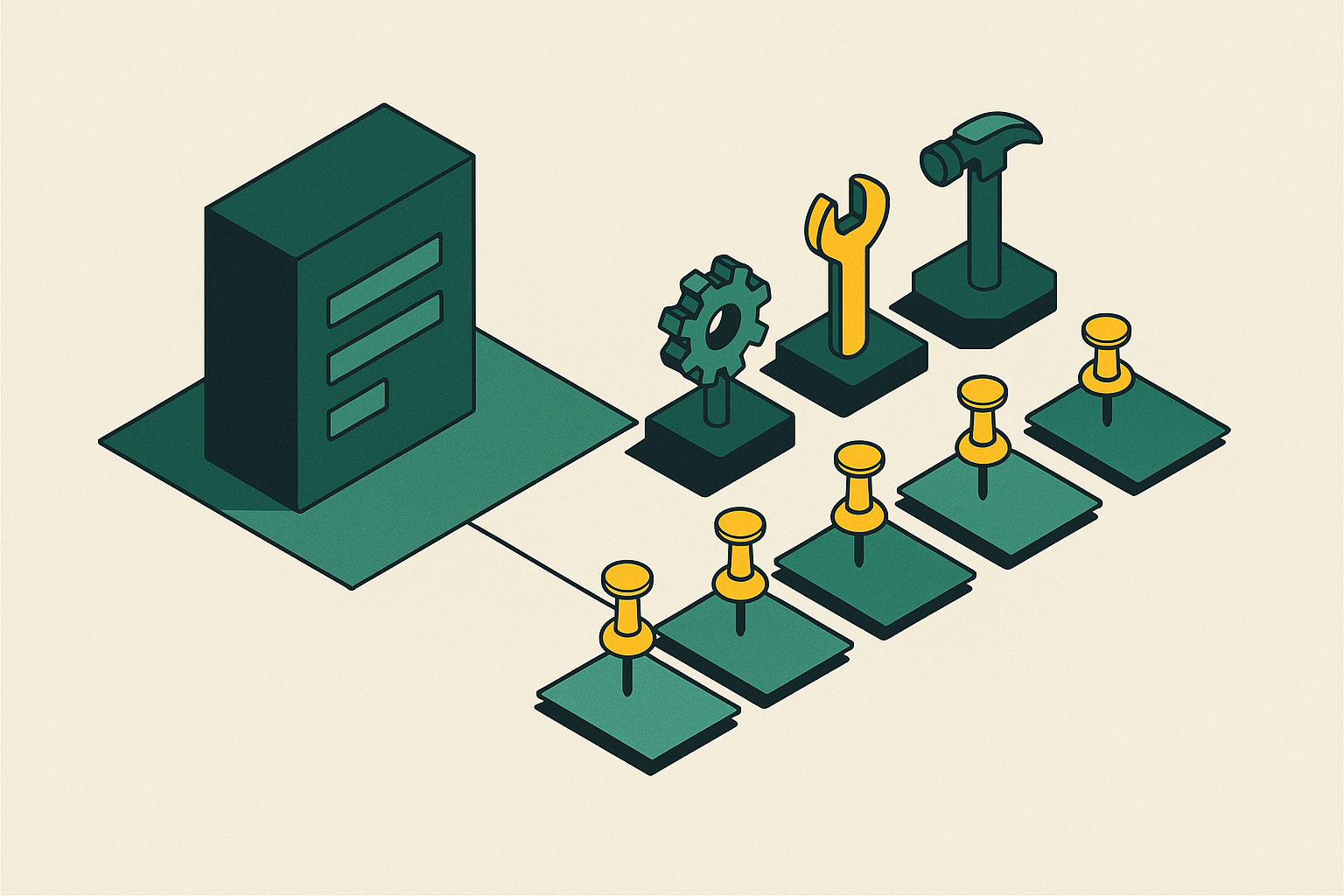
Pinning toolchain versions across a monorepo is a discipline with layers, and it touches language runtimes, package managers, the internal dependency graph, CI enforcement, and how often you actually update the pins. Skip any one of those layers and the drift the others were built to stop just walks back in through the side door. I've watched this happen enough times to stop being surprised by it: a team pins everything they can think of, feels good about it for a quarter, then a build breaks on a Tuesday for a reason nobody in the room can explain.
Monorepos concentrate risk in a way polyrepo setups don't. One repository, many teams, many languages, one shared build graph. A single unpinned toolchain version can take down every package at once, not just the one owned by the team that forgot to pin it. Your monitoring dashboard will tell you services are up. It will not tell you whether the environment that built today's release matches the one that built last week's, and that gap is where the trouble actually lives. Engineers chase the same "works on my machine" ticket over and over, close it, and never fix the actual inconsistency, because the failure hides behind a green checkmark until the day it doesn't.
The Reproducible Builds project has been making this case for close to a decade: a build environment includes the tool versions, the OS assumptions, the file paths, the locale, even the time zone the build runs under, not just a dependency file. A monorepo multiplies that list. You're now pinning the language runtime, the package manager, the build tools, the versions of internal packages that other internal packages depend on, and the CI runner image itself. Miss one and the rest are decoration.
Pinning language runtimes and package managers before touching dependencies
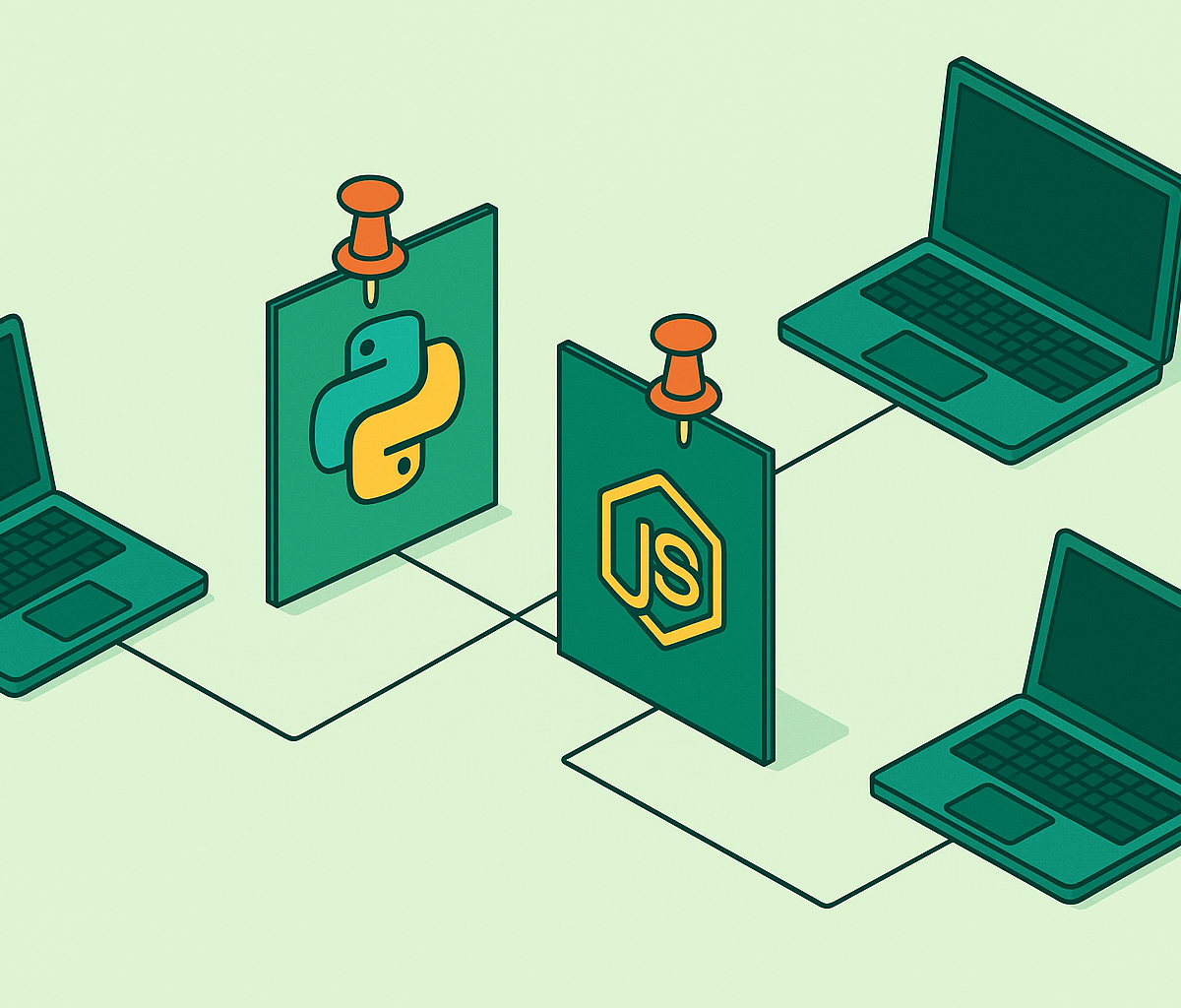
A pinned package.json is worthless if two engineers on the same team are running different Node versions, or one quietly switched to pnpm and never mentioned it. Runtime and package manager come first, because they decide what dependency resolution even looks like. Get this wrong and every pin downstream is sitting on sand.
Node's Corepack reads a packageManager field straight out of package.json and enforces the exact version, for every contributor, every CI runner. An exact string, no negotiating, no caret, no "latest." The patch version matters more than it used to, too. npm's OIDC trusted publishing went generally available on July 31, 2025, and classic tokens get phased out for good on December 9, 2025. That feature needs npm CLI 11.5.1 and Node 22.14.0 at minimum. Pin a workflow to a bare node: 22 and it'll happily resolve to whatever patch is current that week; land on something before 22.14.0 and authentication just fails, with an error message that gives you no hint why. Different CI providers shipping different default npm versions on top of that, and you get divergent lockfiles from what looks, on paper, like an identical manifest.
Python has its own version of the same problem. Pin the runtime separately from the dependencies, with a .python-version file or an explicit interpreter path. Pin every direct dependency with == in requirements.txt. Then treat hash verification via --hash as the next rung up, and here's the part most Python monorepos skip entirely: hash checking is the actual defense against a compromised registry serving a tampered package under a version number you already trust.
Runtime first, package manager second, dependencies third. That order isn't optional. What it doesn't solve is consistency across machines, and that problem gets worse, not better, the bigger the monorepo grows.
Pinning shared dependencies consistently across packages inside the monorepo
Here's the one that catches teams off guard: the same dependency, pinned to two different versions in two different packages, in the same repo. It builds. Its own tests pass. Then three layers downstream something throws a type error or crashes at runtime, and nobody in the room remembers that package A and package B were never supposed to disagree about which version of that library they're running.
pnpm catalogs, shipped in pnpm 9.5 back in July 2024 and tightened up with strict mode in 10.12, fix this for JavaScript monorepos specifically. One catalog declares the canonical version of a shared dependency, every package in the repo points at that catalog entry instead of writing its own version string. The payoff shows up the day Renovate opens an update PR: instead of a dozen PRs, one per package, each needing its own review, there's one PR that updates the dependency everywhere at once, and it merges the second tests pass.
Python doesn't have a direct equivalent, but the idea ports over fine: one shared requirements.txt, or a central pyproject.toml constraints file, that sub-packages inherit from instead of re-declaring their own ranges.
There's a real tension buried in here, and it's worth saying out loud instead of smoothing over. Strict pinning everywhere maximizes reproducibility and stops accidental version bumps from a reset lockfile. But rigid pins on large, stable external libraries make it harder to patch a vulnerability fast, or to pick up a needed feature without a coordinated bump across the whole repo. My rule of thumb: pin internal libraries exactly, because your team controls the release cadence and owns the blast radius. For external libraries, pin the lockfile tight but leave the manifest range a little looser than an exact pin, so a patch-level security fix can land without someone hand-editing every manifest that references the package.
Polyglot monorepos add a wrinkle of their own. Nx and Turborepo live in the JavaScript and TypeScript world; they won't do anything for a repo mixing Go, Python, and Java under one build graph. Bazel and Pants handle that case, enforcing version constraints at the build rule level across languages instead of leaving each language's manifest to police itself.
Making developer machines and CI run the same pinned environment
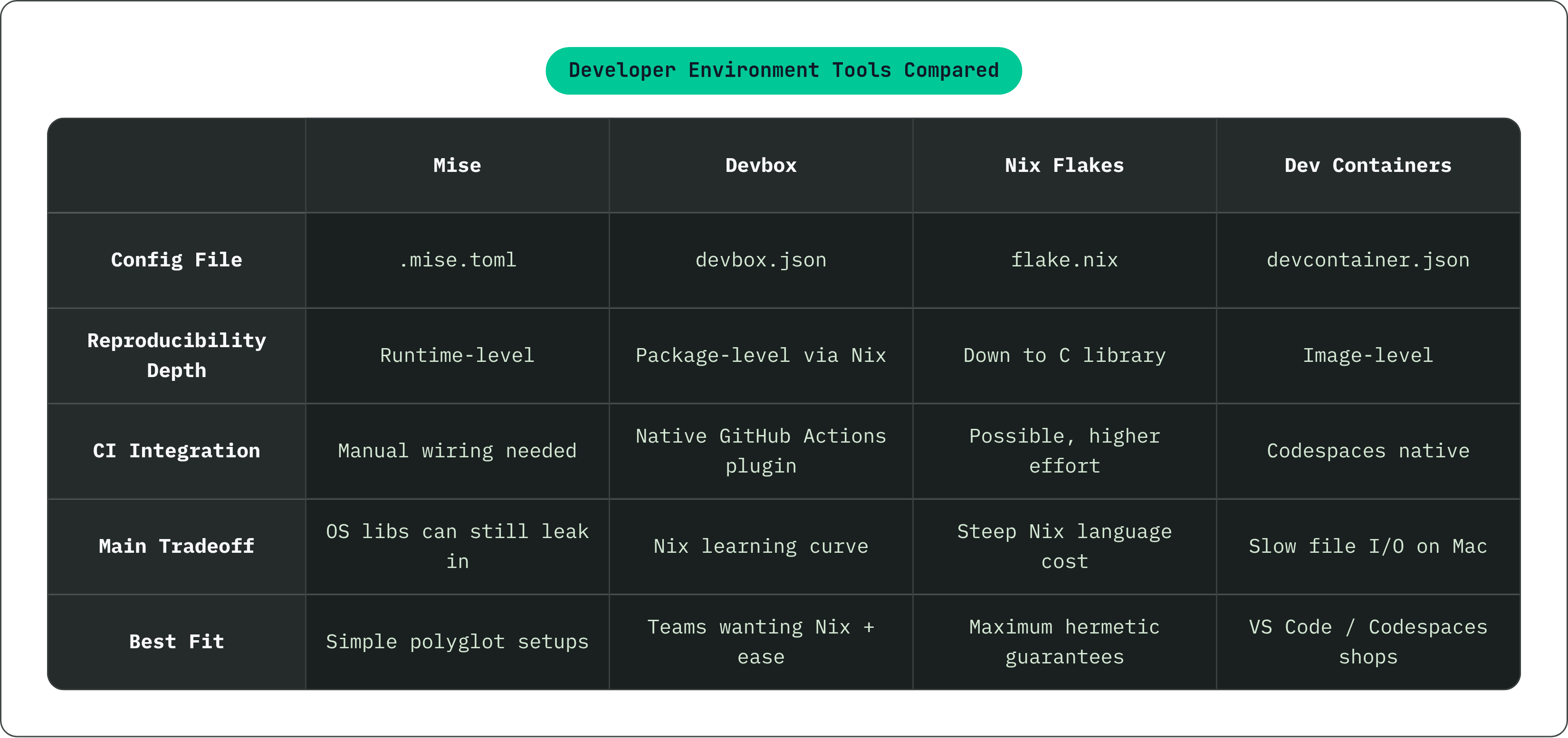
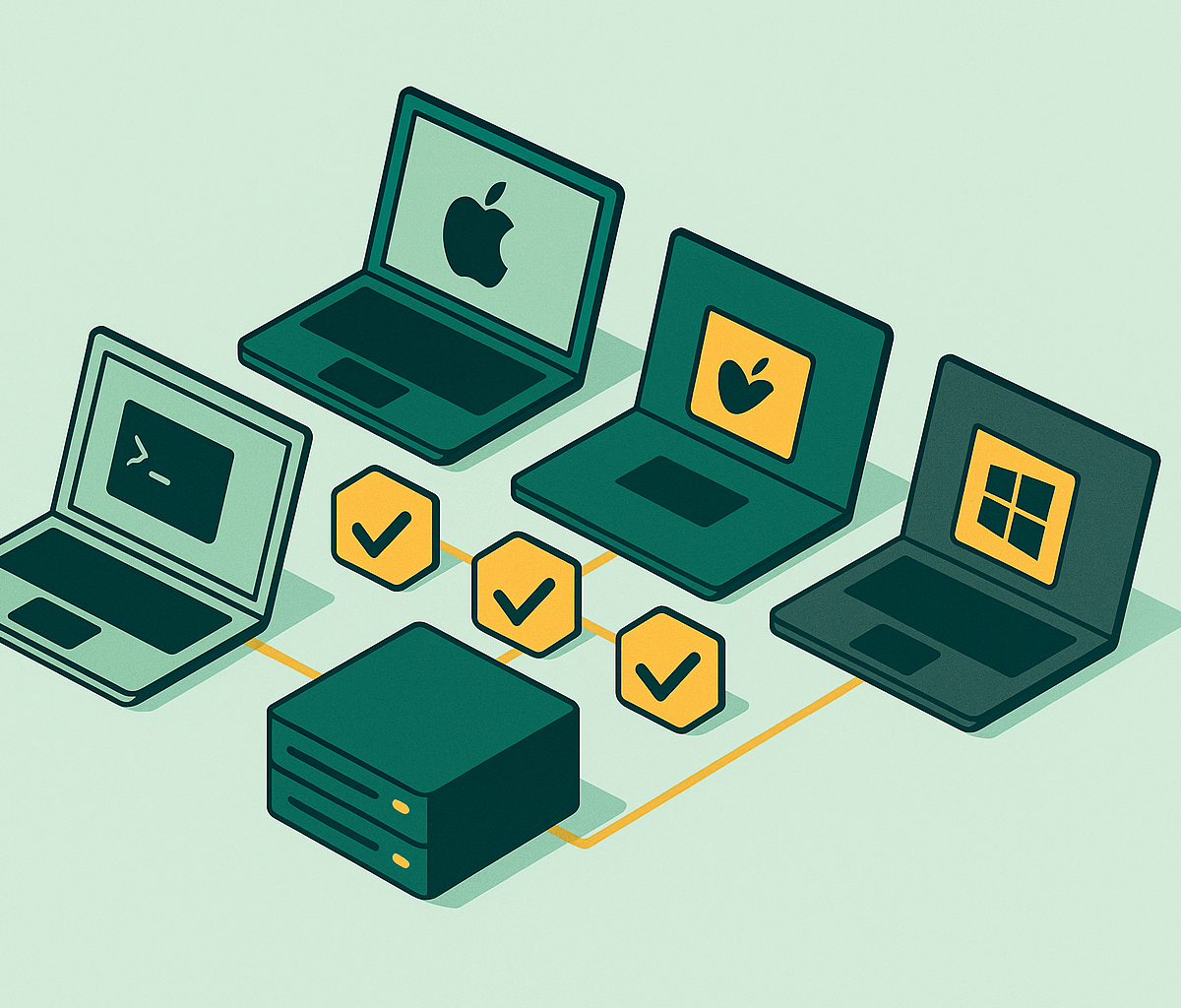
This is where the gap usually opens up. One config exists for laptops, a separate one exists for CI, and the two look nearly identical on paper while getting updated on completely different schedules by completely different people. A developer bumps their local Node because a blog post told them to. The CI image gets bumped six months later, during an unrelated infra sprint, by someone who's never touched that developer's laptop. Neither change gets logged as a toolchain update. Both are now quietly out of sync.
Four tools dominate this space right now, and each trades reproducibility for friction differently. Mise, configured through a .mise.toml file, pins Node, Python, Go, Bun, and uv in one place; it's fast and simple, a solid fit when OS-level dependencies are stable or everything runs inside a container anyway. A minor bump in some underlying system library can still leak in underneath it, though, so the guarantee is shallower than what Nix gives you.
Devbox, built on Nix, describes exact package versions in a devbox.json, and devbox shell spins up an identical environment on macOS or Linux. It plugs into GitHub Actions directly, so CI activates the same environment definition a developer just used on their laptop. Nix Flakes go further still, pinning down to the C library level, working across Linux, macOS, and Windows via WSL. The cost is real: learning the Nix language and its evaluation model is genuinely hard for a team that just wants Python installed so they can get to work. Dev Containers are the low-friction option for teams already in VS Code or Codespaces, though file I/O across the Docker boundary on a Mac can crawl, and editor support outside VS Code is spotty.
Here's a test that cuts through the marketing: run the exact same command locally and in CI. If the output differs, the environments were never actually shared; they were two similar-looking configs maintained by two different people who never checked. Some teams go further still, adopting tooling that makes environment definitions travel with the repo and activate consistently across laptops, CI runners, and different chip architectures. Onboarding a new hire turns into one command instead of a README nobody's touched since the last framework migration.
Whichever tool a team lands on, the bar is the same. The environment definition lives in the repo, version-controlled next to the code it builds. It activates without a checklist. And it produces a shell that's actually verifiable, not just "close enough" to what shipped last time.
Enforcing pins in CI so they can't be bypassed or silently overridden
CI is where enforcement happens, or doesn't. If a pin can get quietly bypassed on someone's laptop, CI is the last checkpoint that can still catch it before it ships.
The checks here are specific, not abstract. Pin the CI runner image to an exact version, never a floating tag like ubuntu-latest, which can change under you with no changelog and no warning at all. Pin the Node, Python, or Go version in the workflow file to the exact version in the repo's toolchain config, not a major-version alias that resolves to whatever patch happens to be current. Validate the lockfile in CI and fail the build outright if it doesn't match the manifest; npm ci, pip's hash-check mode, and pnpm's --frozen-lockfile all exist for exactly this. And reject any PR that touches a lockfile without a matching manifest change, because that pattern is usually the signature of an out-of-band update sneaking in sideways.
This isn't hypothetical risk. Attackers rewrote historical Git tags on a widely used GitHub Action, one referenced by an estimated 23,000+ repositories, and used the mutated tag to exfiltrate CI/CD secrets from every pipeline pointing at it by tag name. Pinning GitHub Actions to a full commit SHA instead of a tag is the direct fix; a commit SHA can't be silently repointed the way a tag can.
Container images need the same treatment. A standard public base image typically ships with something like 50 to 60 known CVEs baked in before your own code even touches it; a minimal image built from source cuts that to single digits. Pinning by digest instead of by tag is lockfile pinning's exact equivalent, one layer down.
Enforcement, at the end of the day, doesn't come in degrees. The build is hermetic and fails loudly on a version mismatch, or it isn't enforced at all. Partial enforcement, the kind that catches mismatches on a good day and misses them on a bad one, is worse than nothing, because it manufactures a confidence nobody questions until the incident actually happens.
Keeping pins current without creating a manual update burden
The obvious pushback: strict pinning means every security patch now needs a deliberate, manual update, and without automation that turns into a real bottleneck fast. Fair point. The fix is automation, not looser pins.
Renovate and Dependabot both watch declared versions across a repo and open a PR the moment something newer, especially a security patch, lands. The centralization from earlier is what makes this automation worth anything. Pin a shared dependency in one canonical spot, a pnpm catalog entry or a shared constraints file, and the bot opens one PR that updates the whole monorepo, merging in one shot once tests pass. Declare that same dependency separately across a dozen manifests, and the bot opens a dozen PRs, and review load goes up with nothing gained in return.
Renovate's documentation says this plainly: pinning dependency versions is strongly recommended for applications, specifically because it turns every update into something explicit and reviewable instead of something implicit that slides by unnoticed.
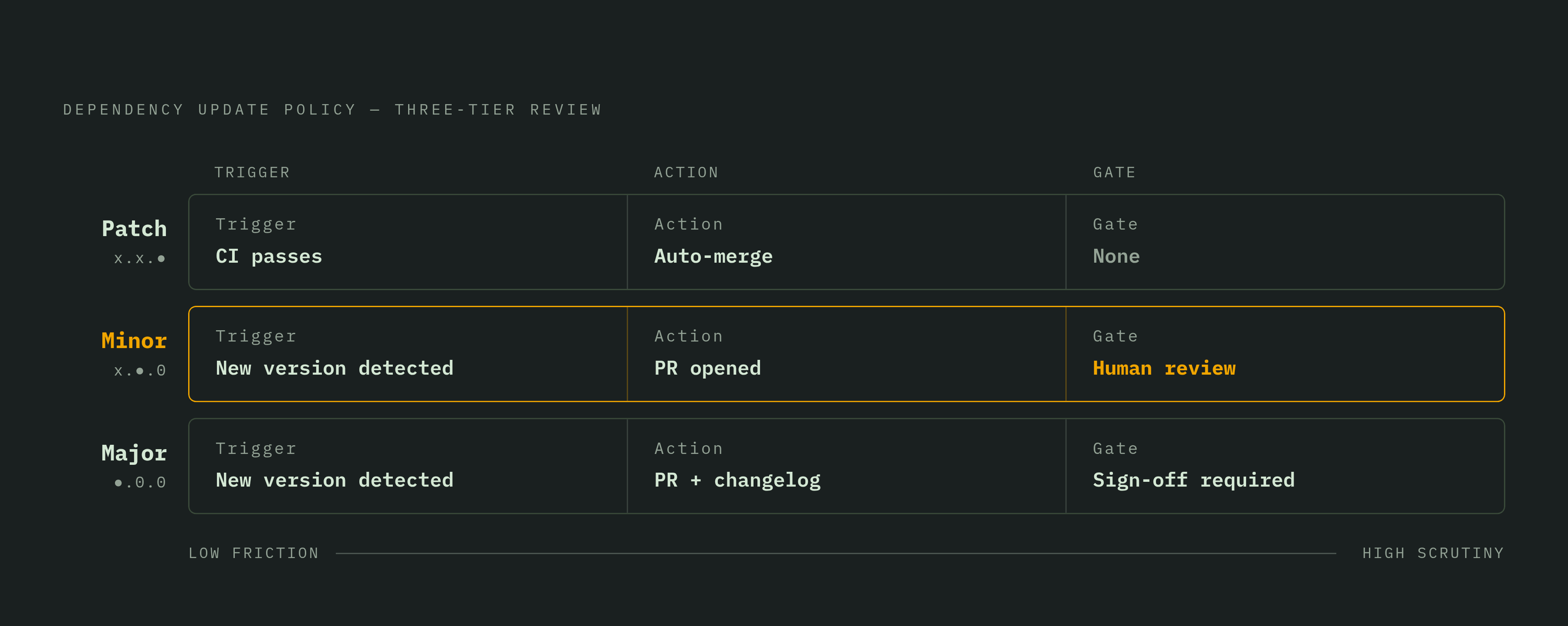
Update cadence should be policy, decided once, not a fresh judgment call every time a bot opens a PR. Patch versions can auto-merge on a clean CI run. Minor versions open a PR automatically but wait for a human before merging. Major versions get a PR with a changelog attached and need sign-off from someone who's actually read the breaking changes. And the toolchain itself, runtime and package manager included, deserves the same treatment: a Node bump is a dependency update like any other, not some informal one-off that gets handled in Slack and then forgotten.
None of this replaces actually checking your work. Schedule clean rebuilds from scratch, periodically, just to confirm the pinned environment still produces what you expect. Drift finds a way in even here, if a base image or a system package gets updated somewhere upstream of your pin without anyone noticing.
What pinned toolchains unlock for supply chain security and compliance
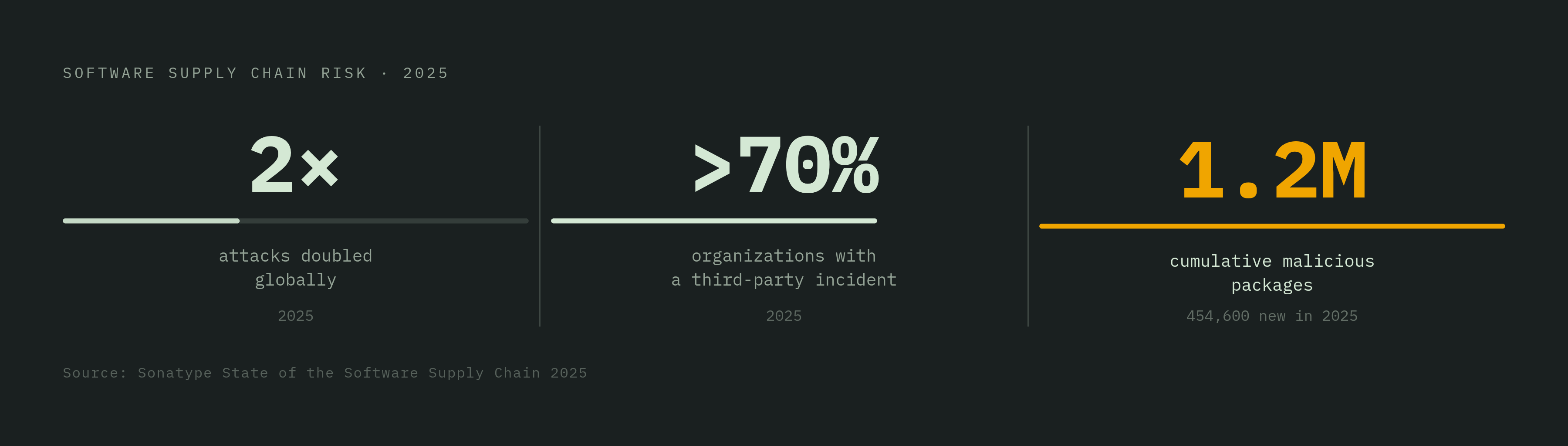
The threat behind all of this stopped being abstract a while ago. Software supply chain attacks more than doubled globally in 2025, and over 70% of organizations reported at least one incident tied to third-party software. Sonatype counted more than 454,600 new malicious packages in 2025 alone, pushing the running total past 1.2 million. Against numbers like that, an unpinned toolchain is a door left open, not a minor inconvenience.
An accurate software bill of materials cannot come out of an environment that drifts. Pinned versions are the precondition for a trustworthy component inventory in the first place; an SBOM generated from a build that might have pulled a slightly different dependency set on a different machine that day is a guess dressed up as documentation, not a record of what shipped.
Most SBOMs get generated once, at the end of a build, and then never opened again. That's a wasted asset, because the actual value sits in continuously checking the component inventory against new security advisories as they come out. SBOM entries enriched with commit SHAs, repo URLs, and SLSA provenance attestations let a security team trace a binary back to the exact source that produced it, instead of just trusting a label someone attached. Open standards matter here, CycloneDX or SPDX for the inventory, in-toto and SLSA for provenance, OSV and VEX for vulnerability data, because they let a team hand evidence to a customer or a regulator without locking either side into one vendor's proprietary format.
The regulatory pressure isn't theoretical either. U.S. Executive Order 14028, from May 2021, requires federal software vendors to produce SBOMs. The EU Cyber Resilience Act extends similar requirements across the European market. NIST SP 800-218 lays out secure development practices across the entire software lifecycle, not just the build step.
Pinned toolchains are the floor everything else stands on. A pinned, reproducible build environment means the SBOM reflects what actually shipped, not what might have shipped on some other machine with a slightly different patch version installed that day. SLSA provenance attestations cryptographically sign each step of a build, and that signature only means something if the environment producing the build is itself pinned and auditable; sign an attestation over a non-reproducible build and you've proven almost nothing. Flox's approach, baking SBOM and provenance generation into the environment definition itself instead of retrofitting it onto a workflow that was never designed for it, points at where this is all heading.
One gap is still worth naming plainly. Storing SBOMs and provenance data alongside the artifact itself, in a repository like JFrog Artifactory, Nexus, or GitHub Packages, closes the loop between what got built and what an auditor can check later. A pinned environment that produces no verifiable provenance record still leaves exactly the gap that auditors, and increasingly automated compliance tooling, are built to go looking for.