Environment Drift as a Security Vulnerability
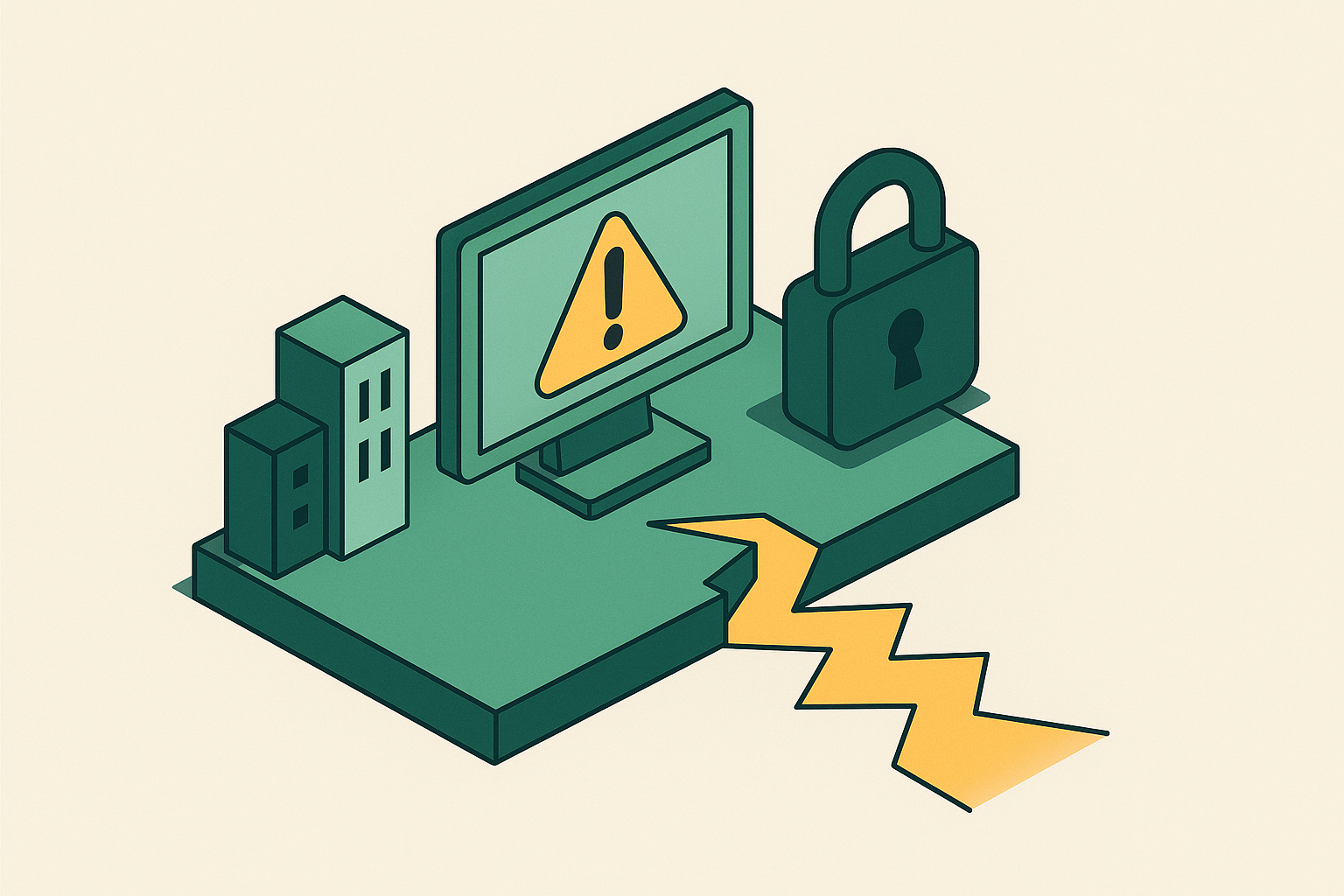
Environment drift deserves the same scrutiny as a zero-day, and honestly, it deserves more. It widens attack surface gradually and quietly, without setting off any of the alarms that phishing attempts or novel exploits trigger, which makes it harder to catch and much costlier to fix once someone finally notices. A zero-day happens to you. Drift is something an organization does to itself, one unrecorded change at a time, until every external threat that follows lands on ground that's already given way. This piece traces where drift starts, why standard security review keeps missing it, and what actually stops it, not the audit theater version of stopping it, the real thing.
Think of a building where the locks get swapped for slightly worse ones every few months. Never all at once, never enough that anyone at the front desk notices. Then one day, none of them hold.
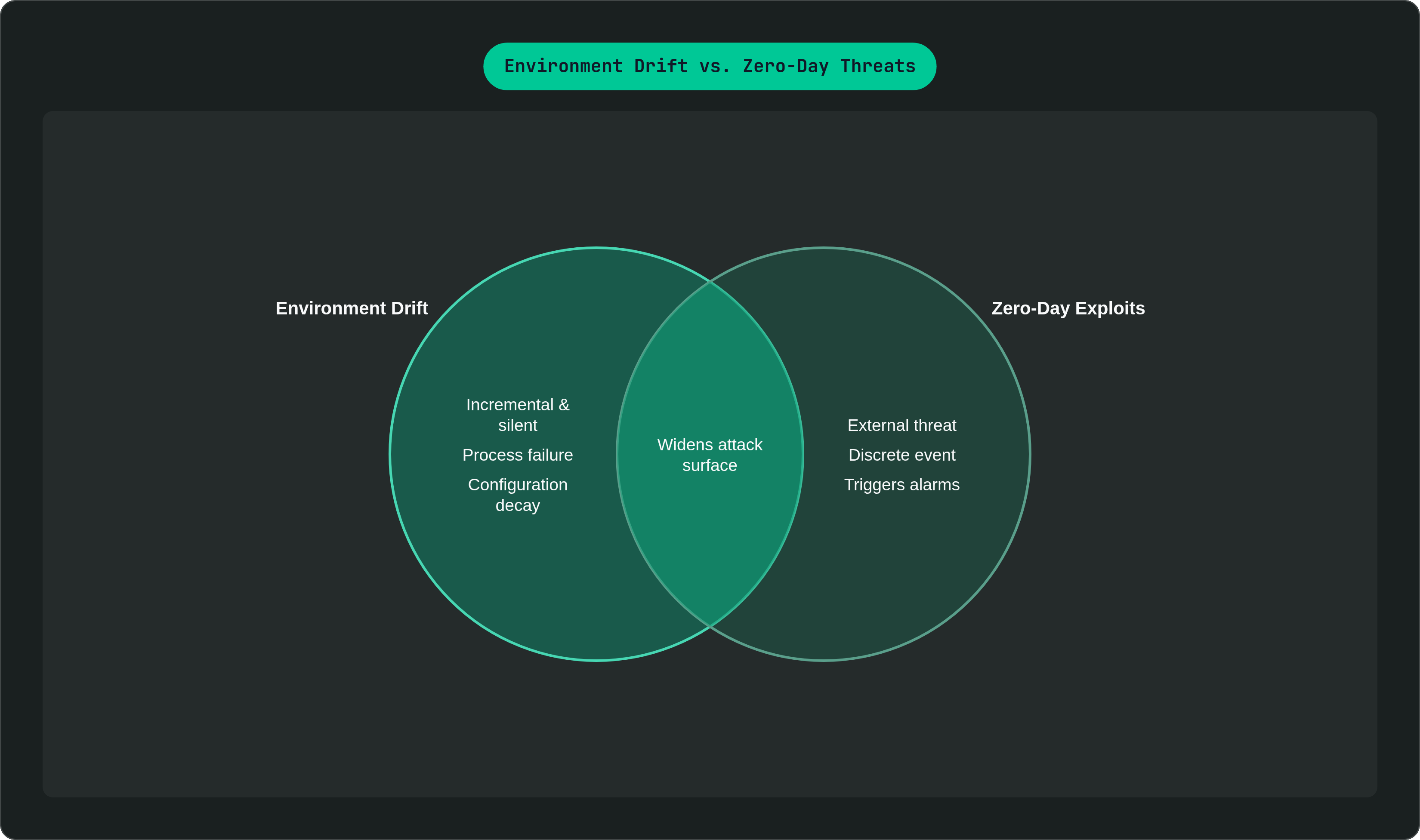
How drift compounds: the mechanics of incremental attack surface expansion
Drift tends to come from the same handful of places, over and over. A developer installs a dependency locally and nobody writes it down anywhere. A sysadmin hand-edits a config at 11pm to kill a fire, then forgets there was ever a fix to document. Policy gets applied differently across dev, staging, and production, so the "same" rule means three different things depending on which environment you happen to be standing in that day. And cloud environments, spun up and torn down constantly, generate their own hidden misalignments simply because there's too much surface area for anyone to track by hand.
None of this is exotic. It's mundane, which is exactly why it works. Most misconfigurations trace back to human error rather than any flaw in the platform itself, and that reframes the whole problem: drift is a process failure, not a software bug, and processes don't patch themselves the way software sometimes does.
Here's the part that actually keeps me up at night: drift compounds. Each small deviation widens the gap between what's documented and what's real, and the wider that gap gets, the harder it becomes to spot the next deviation against a baseline that's already gone noisy. Microsoft 365 alone exposes something like 10,000 distinct configuration elements, and any one of them can nudge an organization from secure to exposed without anyone flipping a switch that looks dramatic. No single shift looks like much. But run the combinatorics on 10,000 elements drifting together over months, and you get an attack surface that grows 25 to 30% purely from configuration decay, no new code, no new feature, nothing anyone would call an event.
Drift is self-obscuring. That's the mechanism worth sitting with for a second: the longer it runs, the less visible any single deviation becomes, because there's no clean baseline left to measure it against.
The detection gap: why drift-induced exposure outlasts discrete exploits
97% of organizations reported a misconfiguration-linked incident in the prior twelve months, according to a Reach Security study from April 2026. That's close to universal. And it's not for lack of tooling, the same study found these organizations run an average of 352 distinct cybersecurity products. So the stack itself is part of the problem. More tools means more surfaces that can quietly wander off from their intended state, and more dashboards nobody has time to actually watch.
The real bottleneck is cadence. Organizations check configurations against baseline about 6.5 times a month, on average. Once something gets flagged, remediation takes more than eight days, which is plenty of runway for an attacker who's already found the crack. And when a misconfiguration actually causes a breach, recovery runs around 250 days on average, longer than most zero-day exposure windows ever stay open before someone patches them.
About 65% of companies run no continuous validation of their security settings at all. They lean on point-in-time audits, which means the environment starts drifting again the second the audit wraps, and it stays drifted until the next one rolls around. That's the whole flaw in the audit model, right there: a snapshot isn't a guarantee, and the space between snapshots is exactly where drift goes to live.
Gartner's finding that 99% of cloud security failures through 2025 traced back to the customer rather than the provider, mostly through misconfiguration, closes the loop. If detection only happens at fixed intervals, the exposure window isn't temporary. It's structural. It stays permanent until the review model itself changes, not just the frequency of the reviews.
Where drift starts: the developer environment as ground zero
"Works on my machine" isn't just an old joke about developer experience. It's a security statement, whether the person saying it realizes that or not, because an environment nobody can reproduce is an environment nobody can audit. Full stop.
Here's how it actually spreads, in practice. A developer installs a package without pinning the version, so what gets installed depends on the machine, the date, and whatever mood the package registry happens to be in that afternoon. A build script pulls a transient dependency at runtime, and afterward there's no record of what actually ended up in the build. Small gaps open up between dev, CI, staging, and production, and eventually the thing that ships to users isn't really the thing anyone tested in the first place.
The scripting ecosystems most teams build on don't help. Unpinned dependencies, transpiler behavior that shifts quietly between minor versions, arbitrary code execution during install hooks, phantom files that show up in one build and vanish in the next. Even teams doing everything "right" with Docker hit a ceiling here: pinning versions inside a container buys you functional equivalence, meaning the thing mostly behaves the same, but not bitwise reproducibility. That last mile needs deterministic build pipelines, content-addressable storage, and registries that actually keep the promises they make about what they preserve. Most setups don't have any of that.
Once you see it, the security consequence is obvious: an environment that drifts quietly between machines is an environment where a malicious change can hide inside what looks like ordinary variation. Homogeneity is a security property in its own right, not just a convenience. Inconsistency is the exact condition drift needs to survive, and every local environment allowed to diverge is one more place for that condition to take root.
When drift meets the supply chain: how untracked dependencies become attack vectors
As configurations drift, unverified components slip in without much resistance: outdated open-source libraries, third-party tools with known flaws sitting in them, packages pulled from a registry with no provenance check attached to the pull.
The GhostAction incident from early 2025 is a clean illustration. Attackers compromised a widely used GitHub Action, one referenced by more than 23,000 repositories. The action was pinned by tag rather than by commit SHA, so every repository trusting that tag automatically pulled the compromised version the instant it shipped. CI/CD secrets got exfiltrated straight into public Actions logs, in plain view. The vector wasn't some clever zero-day. It was a trust assumption baked quietly into how thousands of teams had already configured their pipelines, long before the attack ever happened.
npm has its own version of this story: heavily downloaded packages compromised through maintainer account takeovers, postinstall scripts quietly siphoning environment variables the moment someone runs npm install. Same root cause, configuration trust nobody was actively managing. Standard public container images typically ship with 50 to 60 known CVEs baked in already; minimal, source-built images cut that to single digits. The base image is a configuration decision like any other, and like any other, it drifts the moment nobody's watching it.
The scale isn't abstract, either. Misconfiguration-related issues fueled 9.5 million cyberattacks in the first half of 2025 alone, per a SonicWall report. Drift at the environment level is what hands supply chain attacks their leverage. A pinned, reproducible, auditable environment takes away the ambiguity attackers are counting on.
SBOMs and provenance: what an inventory actually tells you and what it doesn't
A software bill of materials is a machine-readable list of every component, library, and dependency in a piece of software, with version numbers, origins, and licenses attached. Its value is real. During a Log4j-scale incident, a good SBOM lets a team find its exposure in minutes instead of manually crawling through builds and containers hunting for one vulnerable version by hand. That's not an incremental speed difference. It's the gap between a contained incident and a weeks-long fire drill that eats an entire security team's quarter.
Most SBOMs produced today, though, are compliance paperwork. Generated at the end of a build, filed somewhere, never opened again until an auditor comes asking. That pattern is increasingly recognized as inadequate on its own, because an SBOM only tells you what's in your software. Whether any of it got tampered with along the way is a separate question, one answered by attestation frameworks like Sigstore, SLSA, and in-toto instead. Both pieces matter. Neither one substitutes for the other, no matter how complete the SBOM looks.
Teams trying to dodge vendor lock-in tend to land on the same open standards: CycloneDX or SPDX for the inventory itself, in-toto and SLSA for provenance, OSV for vulnerability data, VEX for context on whether a given vulnerability is actually exploitable in this specific build (a lot of them aren't, but you'd never know from the CVE count alone). SBOM entries earn their keep when enriched with repository URLs, commit SHAs, and build provenance attestations, so there's an actual traceable line from the binary running in production back to the source it came from.
Regulatory pressure is pushing adoption faster than the market would on its own. U.S. Executive Order 14028 requires federal software vendors to produce SBOMs, and that requirement has dragged the practice well past its original niche. But a compliance-grade SBOM and a security-grade SBOM are not the same document, even when they're formatted identically on the page.
The next frontier is AI models, which are just another third-party dependency now, except most existing scanners can't read them at all. Model formats like pickle allow remote code execution the moment a model loads, which should alarm more people than it currently does. And weights provenance, meaning who trained the model and on what data, isn't captured by a standard SBOM in any form. ML-BOMs, model bills of materials documenting training data, architecture choices, and safety benchmarks alongside the usual code dependencies, are emerging as the logical next step. An SBOM generated outside the development workflow is a record of what existed at one moment; provenance built into the workflow itself is a continuous guarantee. Different jobs, and neither covers for the other.
Why onboarding is a drift event, and what that costs
Hand a new developer a sixteen-step README with three asterisked caveats, and you get a local environment that diverges from baseline immediately, and invisibly. Nobody sets out to create drift during onboarding. It happens anyway, every time, as a side effect of just trying to get someone up and running before lunch.
Onboarding takes more than two months at 44% of organizations, per industry surveys. For that entire stretch, the new hire works inside an environment nobody has verified and nobody has audited. New developers inherit setups that can't be reproduced cleanly, so they make ad-hoc changes locally just to get things running at all. Those changes almost never get written down, and they certainly don't get reviewed for security implications. They just sit there, quietly making one machine different from every other machine in the company.
Industry median time to first commit runs several weeks. High-performing teams get new hires to a first commit in one to three days. That gap is almost entirely environment setup and access provisioning, not skill, not experience, not how sharp the new hire is. A senior engineer on a senior salary produces close to nothing in their first weeks if they're debugging a broken local setup instead of writing code, and the organizational cost here tracks the security cost almost exactly, dollar for dollar.
Better documentation only goes so far, and teams have been trying that fix for a decade now. The deeper fix is structural: an environment that provisions in a single command removes the entire category of ad-hoc local fixes that create onboarding-driven drift in the first place. The new developer's setup should be identical to everyone else's on day one. Not eventually, not after three weeks of troubleshooting Slack threads.
What systematic drift elimination actually requires
The instinct, once drift gets diagnosed, is to audit more often. Audit twice as often, even. That instinct is wrong, or at least it's aiming at the wrong target: the better response makes drift structurally hard to introduce in the first place, so that catching it stops being the job and preventing it becomes the default state of things.
Three commitments separate systematic elimination from periodic remediation. Environment specifications need to be declarative and version-controlled, so the environment is code, every change is a commit, every commit is reviewable, and the baseline is always recoverable because it lives in version history instead of in someone's head. That specification needs to produce the same environment regardless of architecture or operating system, on a laptop, in CI, in production, which is what actually kills "it worked in staging" as a category of incident, rather than just making it slightly less common. And provenance and SBOMs need to come out as a byproduct of the workflow itself, recorded the moment a dependency enters the picture, instead of reconstructed after the fact from whatever the build happened to spit out.
CI/CD pipelines are well positioned to act as continuous drift validators instead of one-off gatekeepers that check a box and move on. Every pipeline run becomes a check against the specification, and drift that can't survive a pipeline run never makes it to production. Per-branch ephemeral environments, fresh and isolated for every feature branch or pull request, eliminate the whole category of drift that comes from shared staging environments that live for months and quietly accumulate cruft nobody remembers adding.
Platform engineering matters here too, more than it usually gets credit for. Platform teams that ship consistent, extensible base environments give developers a boundary to build inside rather than a blank page to improvise on, and that boundary is what makes the environment auditable at all. Configuration drift and oversight were the root cause behind 55% of cloud breaches in 2025, per DataStackHub research, which says the platform layer is where most of this gets fixed or, more often, doesn't.
AI coding agents raise the stakes further, and this part isn't hypothetical anymore. An agent operating inside a drifted environment doesn't just risk introducing a bad configuration, it can propagate one at a speed no human reviewer can keep pace with. Reproducibility stops being optional the moment agents are writing and executing code alongside people. It becomes the precondition for doing any of that safely.
Flox, built on Nix, is one system built around these exact commitments: environment specifications are declarative and version-controlled, onboarding collapses to a single command, SBOMs and provenance come out as a natural byproduct of the build rather than a compliance chore bolted on afterward, and the same environment behaves consistently across architectures. Strip away everything else and the principle underneath is simple: an environment that can't be reproduced can't be audited, and an environment that can't be audited is an attack surface nobody is actually managing, whatever the dashboard says.