Dependency Pinning Strategies for Stable CI Pipelines
Lockfiles and hashes are necessary but insufficient without pinning your entire build environment.

Pinning means specifying an exact version string rather than a range. Writing 1.2.3 is a pin. Writing ^1.2.0 is an invitation for the package manager to decide. The practical implications of that distinction propagate upward through every layer of a modern software pipeline in ways that routinely catch experienced engineers off guard.
Lockfiles extend the pin beyond the manifest. Where a package.json or pyproject.toml declares intent, a lockfile records resolution: the exact versions of every direct and transitive dependency the package manager resolved at a specific point in time. package-lock.json, Pipfile.lock, Cargo.lock, and their equivalents exist precisely to capture that resolved graph. These files must be committed to version control. A lockfile that lives only on a developer's laptop solves nothing in CI, because CI starts from a clean state on every run.
The transitive dependency problem is where teams most consistently underestimate their exposure. Pinning direct dependencies leaves the tree below them floating unless the package manager resolves and records the full graph into the lockfile. A project with thirty direct dependencies will commonly carry three hundred transitive ones, any of which can vary between runs if the lockfile is absent, ignored, or bypassed.
Content-addressable pinning is the meaningful step beyond version strings. A version number is a label; a cryptographic hash is a commitment to exact bytes. Pinning to a SHA-256 digest rather than to 1.2.3 means the installed artifact can't silently differ from what was tested, even if a registry were compromised and a malicious artifact pushed under the same version tag. That distinction between version pinning and hash pinning becomes load-bearing in the supply chain security discussion.
Layer one: pinning application dependencies and their full transitive graph
Committing a lockfile is the minimum viable pin, but it guarantees less than most developers assume. A lockfile records the intended resolution. It guarantees nothing about what actually gets installed unless the package manager is explicitly instructed to enforce it.
In Node.js, the distinction is precise and consequential. npm ci enforces the lockfile, deleting node_modules and installing exactly what the lockfile records. npm install can re-resolve and update the lockfile if it finds a discrepancy. Running npm install in CI isn't pinning; it's performing fresh resolution on every run while providing the psychological comfort of having a lockfile present. The same gap exists in Python: pip install -r requirements.txt without --require-hashes installs by version string alone. Adding hash verification forces the installed artifact to match the recorded digest, closing the distance between "the right version" and "the right bytes."
Poetry and Cargo handle this more gracefully by default. cargo build consults Cargo.lock without additional flags, and Cargo refuses to proceed if the lockfile is inconsistent with declared dependencies. The discipline varies by ecosystem, but the underlying principle holds across all of them: CI must install from the lockfile, not re-resolve from the manifest.
Recording a version in a lockfile pins the label; recording a hash pins the content. The --require-hashes flag in pip, and equivalent mechanisms in other ecosystems, transforms a version pin into a content pin. For any pipeline where the output actually matters, this is the correct baseline.
One thing the lockfile doesn't cover: the Node runtime evaluating it, the build tool invoking the install step, or the OS libraries the runtime links against. Those gaps belong to the layers that follow.
How build environment drift undermines pinned application dependencies
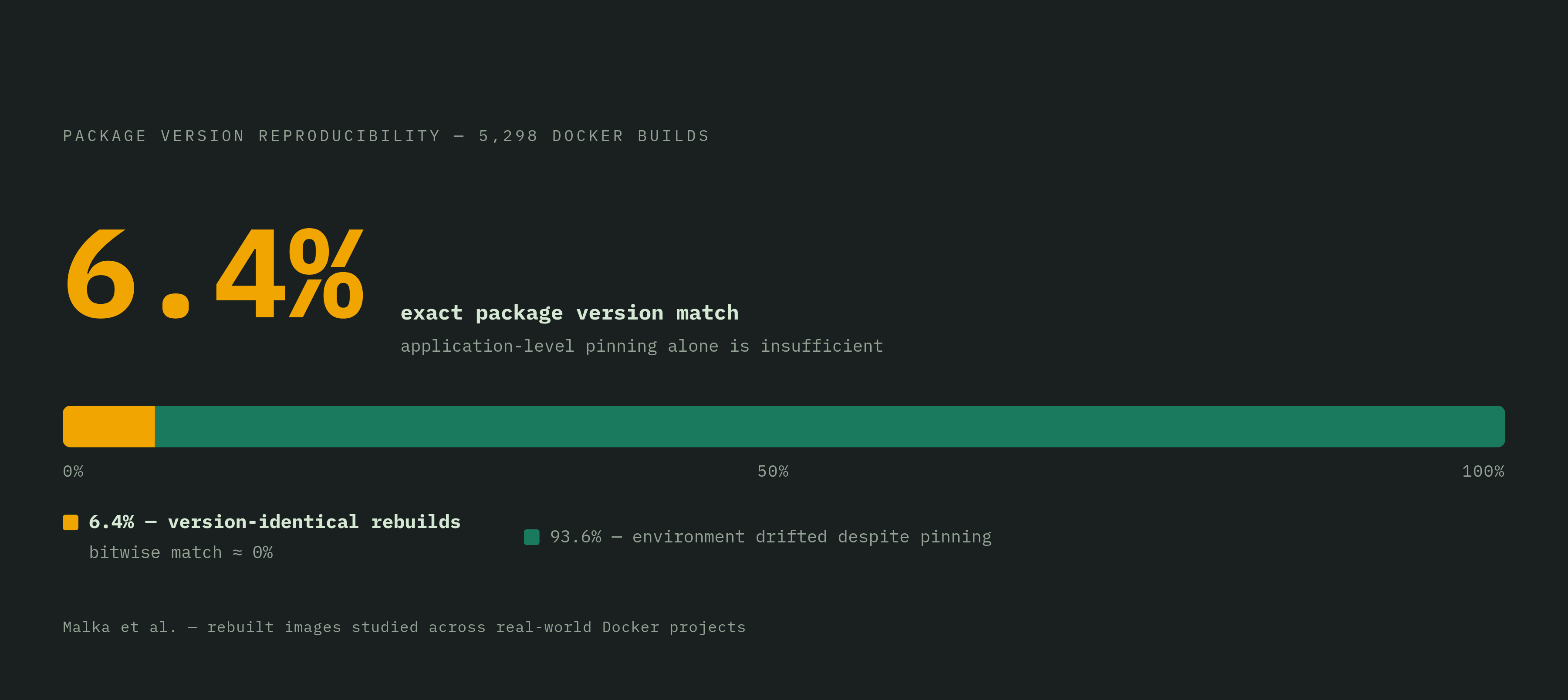
The empirical record here is unambiguous and underappreciated. A study of 5,298 Docker builds by Malka and colleagues found that only 6.4% of rebuilt images matched the original installed package versions exactly; bitwise identity was essentially never achieved. Critically, these weren't reckless builds. Many involved teams that had pinned their application dependencies. The environment surrounding those dependencies varied anyway, and that variation propagated into the output.
The principal causes the research identified are instructive: non-deterministic build steps such as timestamps and cache state, dependency-pinning neglect at the environment level, and package index evolution between builds. A base image that was current when the pipeline was written will pull different system-level packages six months later, even if the image tag hasn't changed. The tag is stable; the contents are not.
A separate body of evidence extends this problem to machine learning. Across 640 LLM-for-software-engineering artifacts examined by Siddiq and colleagues, the absence of machine-readable dependency lists, container specifications, or explicit system and hardware details caused unreproducibility in roughly 21% of cases. The failure mode is identical to the one in conventional software builds; only the artifact type differs.
This convergence across domains matters. The reproducibility gap isn't a tooling peculiarity of any one ecosystem. It's a structural property of how builds behave when the environment isn't treated as a first-class input. Application-level pinning is necessary but not sufficient; the runtime, the compiler, and the OS packages surrounding the application must be pinned with equivalent rigor, or the lockfile's guarantee is conditional on an environment that will silently drift.
Layer two: pinning the toolchain, runtimes, compilers, and build tools
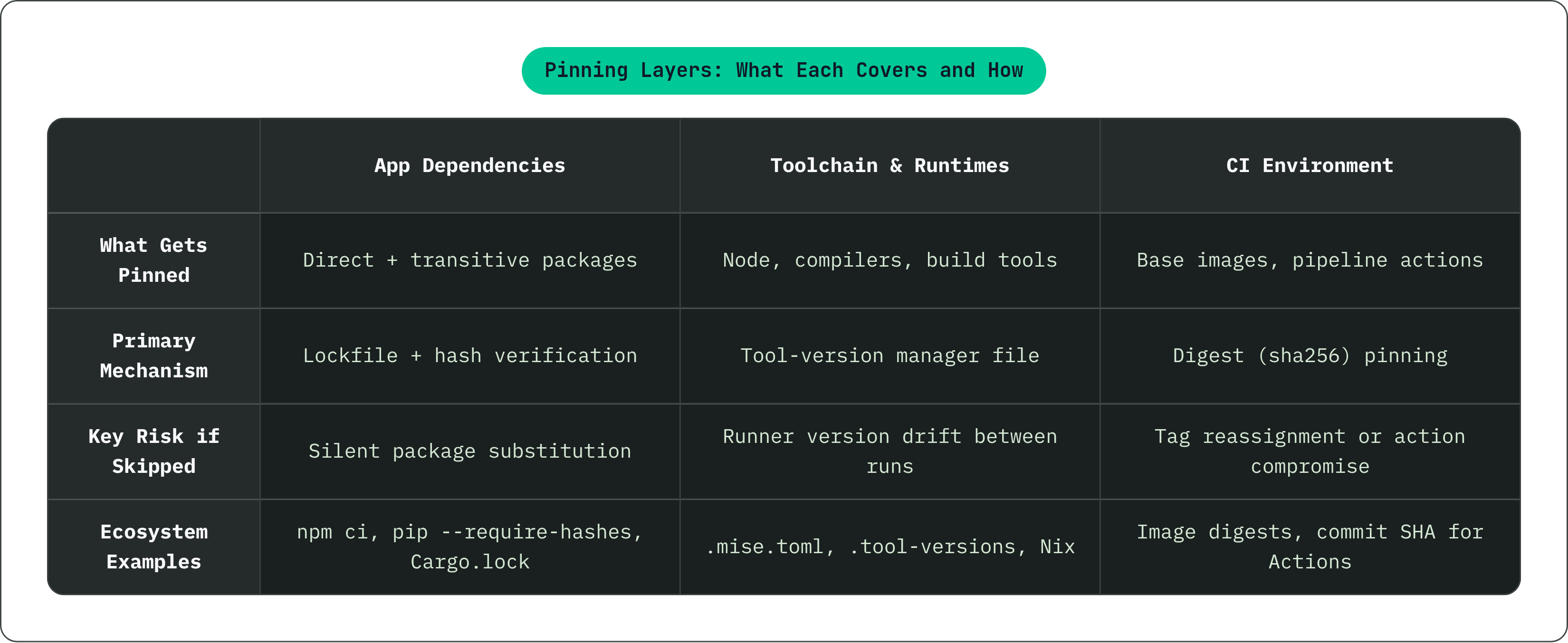
The toolchain comprises everything that runs before the application runs: language runtimes, compilers, transpilers, build systems, task runners, linters, formatters, and test frameworks. Each is itself a piece of software with its own version and its own potential for drift.
The failure mode without toolchain pinning is reproducible in practice and expensive in diagnosis. Two CI runs on the same commit, executed weeks apart, produce different output because the runner's pre-installed Node version received a minor bump between runs. The lockfile hasn't changed. The source code hasn't changed. The output has. Debugging this failure costs real hours precisely because the differing variable is invisible to anyone looking at the source repository. I've watched engineers chase this class of ghost for an afternoon before someone thought to check the runner's changelog.
Tool-version managers address this directly. Files such as .mise.toml or .tool-versions, committed alongside application code, declare exact versions for the runtimes and CLIs the project requires. When CI reads this file and calls the corresponding install command before running any build steps, the toolchain version becomes part of the reproducible definition rather than an ambient property of the runner. The file must be consumed actively; relying on whatever the runner has pre-installed isn't pinning, regardless of how stable that runner has historically been.
Functional package managers offer a stronger guarantee. By resolving every package to a cryptographic hash of its full dependency closure, they make a build a pure function of declared, hashed inputs: the same inputs producing the same outputs, across machines and across time. As of early 2025, the nixpkgs repository contained more than 122,000 packages. Teams willing to invest in the learning curve gain a level of reproducibility that version strings alone can't provide. For teams that want the guarantee without writing in the underlying functional configuration language, wrapper tooling exists that locks every tool to a specific package repository commit, achieving the same outcome through a more accessible interface.
The toolchain that evaluates the lockfile must itself be pinned. A lockfile whose evaluation depends on an unpinned runtime is a conditional guarantee, and conditional guarantees fail at the worst possible moments.
Layer three: pinning the CI runner environment, base images and pipeline actions
Two distinct surfaces require attention at this layer: the base container image used by CI jobs, and any reusable CI action or pipeline component pulled in during the run.
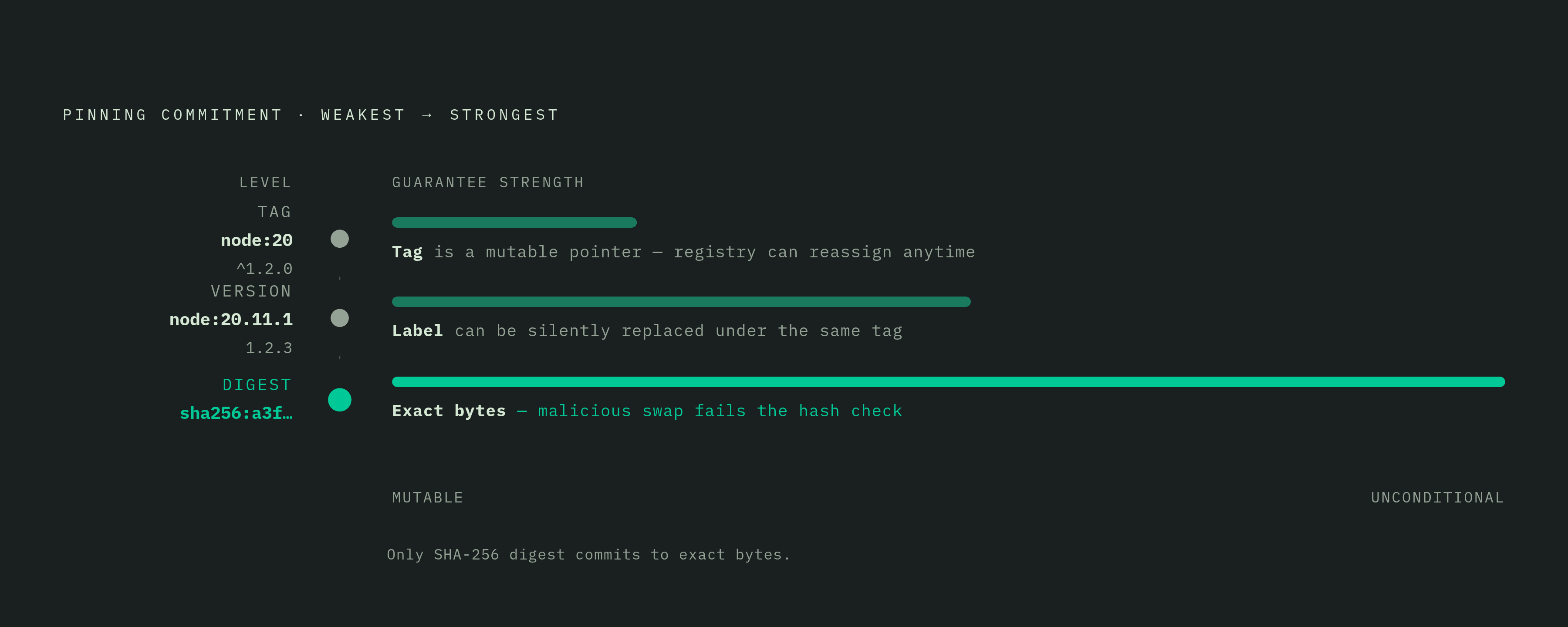
Referencing node:20 or ubuntu:latest means the image pulled on the next run will differ from the one pulled on the last. Tag pinning is an improvement; node:20.11.1 is more stable than node:20. But a tag is a mutable pointer that a registry operator can reassign. Digest pinning, referencing an image by its sha256 hash rather than its tag, is the correct practice. The image behind a digest can't change; a different image carries a different digest. The tag becomes documentation for human readers; the digest is the actual pin. Standard public images commonly ship with fifty to sixty known vulnerabilities, while source-built or minimal images reduce that count to single digits, making the base image choice simultaneously a reproducibility decision and a security posture decision.
The reusable action problem warrants more attention than it typically receives. In March 2025, StepSecurity disclosed that attackers had modified historical Git tags of a widely used GitHub Action. Every repository referencing that action by tag automatically pulled the compromised version, affecting an estimated 23,000 or more repositories. CI/CD secrets were exfiltrated. The mechanism was straightforward: consuming repositories had pinned to a tag, and a tag isn't a pin.
Commit SHA pinning is the correct mechanism for GitHub Actions and equivalent reusable pipeline components. A commit SHA is immutable; a tag is not. The practical objection that SHAs are unreadable is valid but easily resolved: pin to the full SHA and document the human-readable version in a comment on the same line. OpenSSF's pin-github-actions can automate this discipline at scale.
When the CI environment is non-reproducible, the artifact it produces can't be trusted to be identical across runs. An artifact that varies by run can't be promoted through environments with confidence. The entire value proposition of a promotion-based deployment model depends on environment reproducibility.
How supply chain security turns pinning into provenance
Software supply chain attacks more than doubled globally in 2025. Over 70% of organizations reported at least one incident linked to third-party software during that period, with global costs reaching $60 billion and projections extending to $138 billion by 2031. Sonatype identified over 454,600 new malicious packages in 2025 alone, bringing the cumulative total past 1.2 million. Content-addressable pinning at every layer is the first line of defense: a malicious package published under a legitimate version number fails the hash check before it executes, provided you pin to a hash and verify it.
SBOMs, software bills of materials, provide the inventory layer. A machine-readable SBOM lists every component, library, and dependency in a build artifact, including versions, origins, and licenses. During a Log4j-style incident, an SBOM lets a team identify exposure in minutes rather than manually inspecting build outputs across hundreds of services. CycloneDX and SPDX are the open standards to prefer; both have broad tooling support and satisfy regulatory requirements without vendor lock-in.
SBOMs have a limitation worth stating plainly. An SBOM tells you what is in your software; it doesn't tell you whether the build process that produced it was tampered with. The SolarWinds attack is the canonical example. Attackers injected malicious code into the build pipeline itself. An SBOM would have correctly listed all declared components and shown nothing amiss, because it reflects what was declared, not what the build process actually executed.
Provenance attestations fill that gap. Frameworks such as SLSA, Sigstore, and in-toto record how an artifact was built: which source commit, which build system, which inputs, under what conditions. SBOM entries enriched with repository URLs, commit SHAs, and build provenance attestations create traceability from binary back to source. The OSV database and VEX documents extend this further, enabling teams to communicate not just that a vulnerability exists in a component, but whether it's actually exploitable in their specific deployment context.
The regulatory environment has moved to reflect this reality. U.S. Executive Order 14028 requires federal software vendors to provide SBOMs. The EU Cyber Resilience Act extends similar obligations across a broader class of software. NIST SP 800-218 defines secure development practices across the full software development lifecycle. These are current requirements affecting any organization that supplies software to government or operates in regulated markets.
Content-addressable pinning at all three layers is what makes provenance attestations meaningful. If you didn't pin, you can't attest with confidence what actually ran.
Keeping pinned dependencies from becoming an ossification problem
A fully pinned pipeline has a genuine tension at its center. Pinning prevents unexpected changes, but it also means security patches don't arrive automatically. A pinned dependency carrying a known critical vulnerability isn't safer than an unpinned one; in some respects it's more dangerous, because its presence is invisible without active scanning. The answer is automation, not looser pins.
Dependabot and Renovate Bot represent the operational model: they open pull requests for dependency updates on a defined schedule, and CI validates each PR against the full test suite before any human reviews the merge. Update PRs are safer than floating ranges because they're explicit, reviewable, individually testable, and reversible. A floating range absorbs the same update silently, without a reviewable artifact and without the opportunity to catch a regression before it lands in the main branch. I have a strong preference for the PR model precisely because it makes the change visible at the moment it can still be stopped.
The update cadence should vary by category. Security patches warrant immediate automated PRs with priority labeling; the pipeline should surface these within hours of a CVE being published against a pinned version. Minor and patch updates can be batched weekly or biweekly to reduce review noise. Major version upgrades require deliberate manual review; the automation's role is to surface them, not merge them autonomously. Toolchain version updates follow the same logic as major application upgrades: reviewed deliberately, tested rigorously.
Vulnerability scanning against pinned SBOMs converts the SBOM from a compliance artifact into an operational tool. Scanning pinned components against the OSV and NVD feeds identifies when a pinned version has become dangerous, triggering the update workflow before the vulnerability is exploited. Generating the SBOM during the CI run rather than as a post-build afterthought means the inventory reflects what the build actually used.
There's a secondary benefit to the update PR model that teams often overlook. If a Renovate-generated PR can be tested and merged cleanly, the environment is reproducible enough to absorb changes safely. If updates routinely require manual environment repairs, the reproducibility gap is revealing itself through the update process, which is actually the most useful place to discover it.
Closing the loop between local environments, CI, and production
The structural gap most teams leave is this: CI is pinned, the production deployment environment is controlled, but developer laptops run whatever was installed at onboarding time. Bugs that reproduce in CI but not locally persist because the local environment isn't governed by the same definition as the pipeline. "Works on my machine" is an environment consistency problem, not a knowledge or effort problem, and framing it as the latter leads to the wrong interventions.
Onboarding surfaces this gap in measurable terms. High-performing engineering teams target one to three days from a new hire's first day to their first meaningful commit. The industry median sits at multiple weeks. GitLab research found that nearly half of organizations report onboarding taking more than two months. That gap is largely attributable to environment setup complexity, not to the difficulty of the domain knowledge itself, and the cost is direct: salary weeks during which a person is learning the environment rather than contributing to the product.
The fix is to treat the environment definition as a first-class artifact shared across local development, CI, and production. A pinned toolchain file committed to the repository should be the same file a new developer activates on their first day. If CI reads .mise.toml to get Node 20.11.1, a developer's local environment should read the same file and install the same version. The definition isn't duplicated; it's shared. The onboarding script becomes: check out the repository, run the environment setup command, run the build.
Container-based development environments extend this further. Defining the full development environment as a committed container specification means the environment is version-controlled, reviewable, and reproducible by the same mechanisms as the application code. A developer joining three years after the project started activates the same environment the original team used, without archaeology into undocumented local setup steps.
When the artifact is built in a pinned CI environment and deployed to a runtime environment whose version is declared in the same repository, the full chain from source to production becomes traceable. A bug in production can be reproduced locally and in CI with confidence, because the environments are governed by the same committed definitions. The pipeline isn't a sequence of handoffs between environments that happen to resemble each other; it's a single reproducible definition instantiated in different contexts, which is the architecture Flox, a single-manifest developer environment platform built on Nix, uses to run identical, hash-pinned dependencies across laptops, CI, and production. Getting there is front-loaded work and continuous maintenance. The alternative is builds that fail mysteriously, incidents traced to dependency drift, and onboarding measured in months.