Golden Path Templates for Developer Onboarding at Scale
Standardized templates accelerate developer onboarding from weeks to days.
Fifty-five percent of organizations had adopted platform engineering as of 2025, per Google Cloud and ESG research, with 90% of those planning further expansion. Gartner projects that 80% of large organizations will run dedicated platform teams by 2026. The numbers are real, but they obscure how unevenly the discipline has matured across the organizations they count.
What teams are actually building varies considerably by tenure. A platform team in its first year typically produces a handful of paths: microservice scaffolding, CI/CD setup, infrastructure provisioning, observability integration. Three or four years in, the same team maintains hundreds of granular paths covering data pipelines, ML workloads, serverless patterns, and front-end stacks. The catalog grows as the platform proves its value and earns enough organizational trust to expand its scope. That trust, once broken by a bad template or a stale environment spec, is genuinely difficult to rebuild. This is the central political economy of platform work, and most teams discover it only after they've already broken it once.
The CNCF defines a golden path as "a templated composition of well-integrated code and capabilities for rapid project development." The vending machine framing is operationally useful: developers select what they need, and the platform delivers a uniformly packaged result. Platform teams make decisions about tooling once so that individual developers don't have to rediscover them repeatedly. The cognitive overhead of choosing between competing tools, reconciling version conflicts, and deciphering tribal knowledge simply doesn't exist when a well-designed path is in place.
Per Red Hat's guidance, a minimal golden path contains a repository template with pre-wired best practices, a CI pipeline developers can run themselves, and a CD or deployment mechanism, ideally GitOps-based. The list is modest. Knowing what belongs in the template isn't the hard part; keeping it accurate over time is.
The shift currently underway is from documentation-driven onboarding to platform-driven onboarding. Confluence checklists don't disappear; their content becomes executable infrastructure, and the portal becomes the interface through which a new developer first encounters it. Gartner's 2025 research associates internal developer platforms with updates shipped 40% faster and operational overhead cut roughly 50%. Pulumi's "write once, consume anywhere" pattern illustrates how this scales across polyglot teams: a platform team authors shared infrastructure in TypeScript, and application teams consume it in Python, Go, YAML, or whichever language they work in. The canonical definition lives once; the surface area expands without proportional platform team growth.
The onboarding productivity gap that golden paths are trying to close
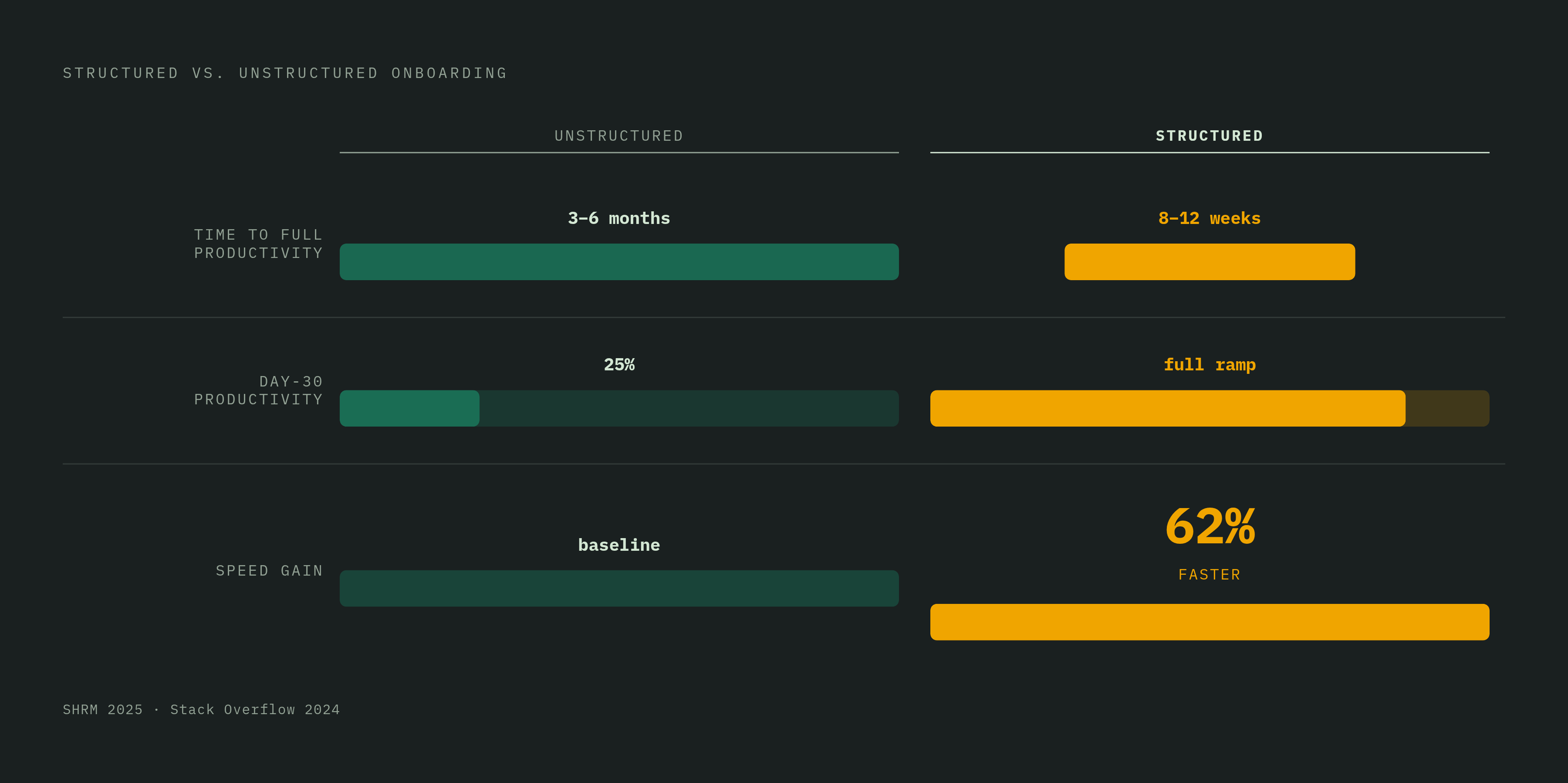
Without structured onboarding, new hires reach only 25% productivity in their first 30 days, according to SHRM's 2025 research. The industry average time to full productivity without structure runs three to six months; with well-designed onboarding, that window compresses to eight to twelve weeks. Stack Overflow's 2024 Developer Survey found structured onboarding produces 62% faster time-to-productivity.
I have watched a new engineer spend four days on what should have been a half-afternoon problem. The service wouldn't start locally. The code was correct. The engineer was not slow. The README described a setup that matched no currently running version of any dependency in the repository, and nobody had updated it, because nobody knew it was wrong until someone new arrived and tried to follow it. That's not an edge case. It's the default outcome when environment setup lives in documentation rather than in executable form, and I have seen versions of it more times than I can attribute to bad luck.
The retention dimension is equally consequential. SHRM's 2025 data shows that 20% of employee turnover happens within the first 45 days. Jobvite's 2025 research puts the share of developers who leave within 90 days at 22%. Replacing a single developer costs $200,000 to $300,000 when recruiting, lost institutional knowledge, and re-onboarding are factored in.
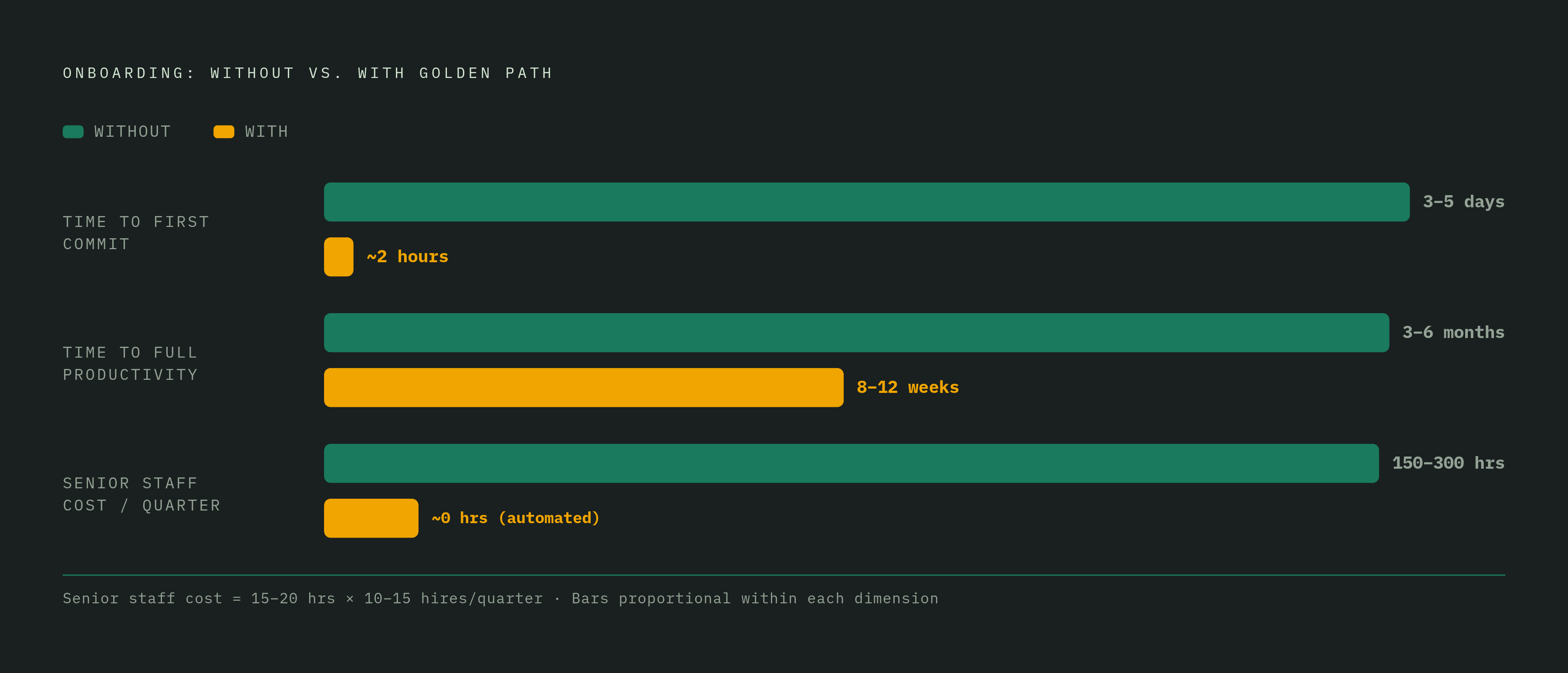
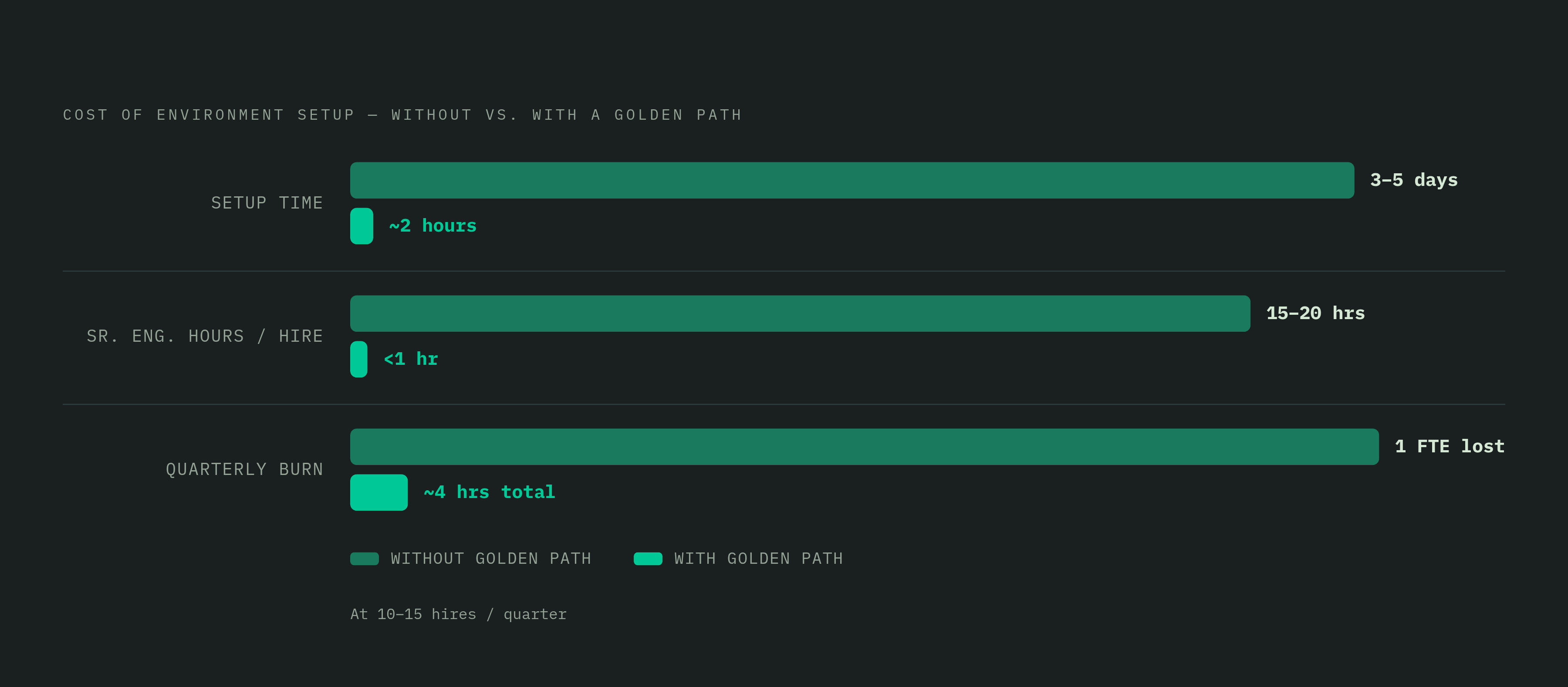
The specific blocker golden paths are designed to eliminate is environment setup. Without a path, configuring a development environment takes three to five days. With one, the same setup resolves in roughly two hours. That delta isn't a quality-of-life improvement; it's the difference between a developer who ships something in week one and one who spends that week wondering whether the problem is them or the tooling.
There is also a hidden tax on the rest of the organization. Every manual onboarding sequence costs a senior engineer or platform team member 15 to 20 hours, according to research from Valorem Reply. At 10 to 15 hires per quarter, that's effectively a full-time role consumed by hand-holding rather than building platform capabilities. The hours are real; they just never surface in any budget conversation, because they're distributed quietly across senior engineers who absorb them without flagging it as overhead.
Well-designed golden paths also provide escape hatches. Transparency into the underlying tools and the ability to deviate deliberately, with that deviation visible to the platform team, is what separates a path that earns adoption from one that engineers route around the moment it inconveniences them.
Why the environment layer is where golden paths most often break down
The moment a developer clones a template, that instance begins diverging from the canonical golden path. Every local modification, every dependency installed outside the declared manifest, every OS-level difference between workstations widens the gap. This isn't a failure of discipline; it's the natural behavior of software environments over time.
The drift accumulates fastest in the developers most invested in the platform. Early adopters carry the longest drift window before the template is updated, because they started using the path before the team had fully hardened it. The team members most committed to the platform are the ones whose environments most reliably no longer reflect it. That irony compounds quietly for months before it surfaces.
The empirical scale of this problem is significant. In a study of 5,298 Docker builds, only 6.4% of rebuilt images matched the original installed package versions exactly. Bitwise identity between builds was virtually never achieved. The principal causes were nondeterministic build steps, dependency-pinning neglect, and repository evolution between builds. For non-containerized environments, the most common drift cause is simpler: a developer installs something locally and never records it.
This is the central failure mode of golden path templates that get the workflow right but ignore the environment. The template can define a perfect CI pipeline, a clean GitOps deployment flow, a well-structured repository. None of it matters if the environment it provisions drifts after day one.
Common platform team failure modes compound the problem. Service catalogs without automated sync become dead weight, accumulating stale entries that developers learn to distrust. Over-abstraction hides drift behind additional layers of indirection, so debugging requires understanding two systems instead of one. Without clear ownership, nobody knows when a template's environment specification is stale. It decays quietly until something breaks in production, and then the investigation reveals that the canonical version and the running version diverged months ago, and there is no good record of when or how.
What reproducible environments actually require and why most tooling falls short
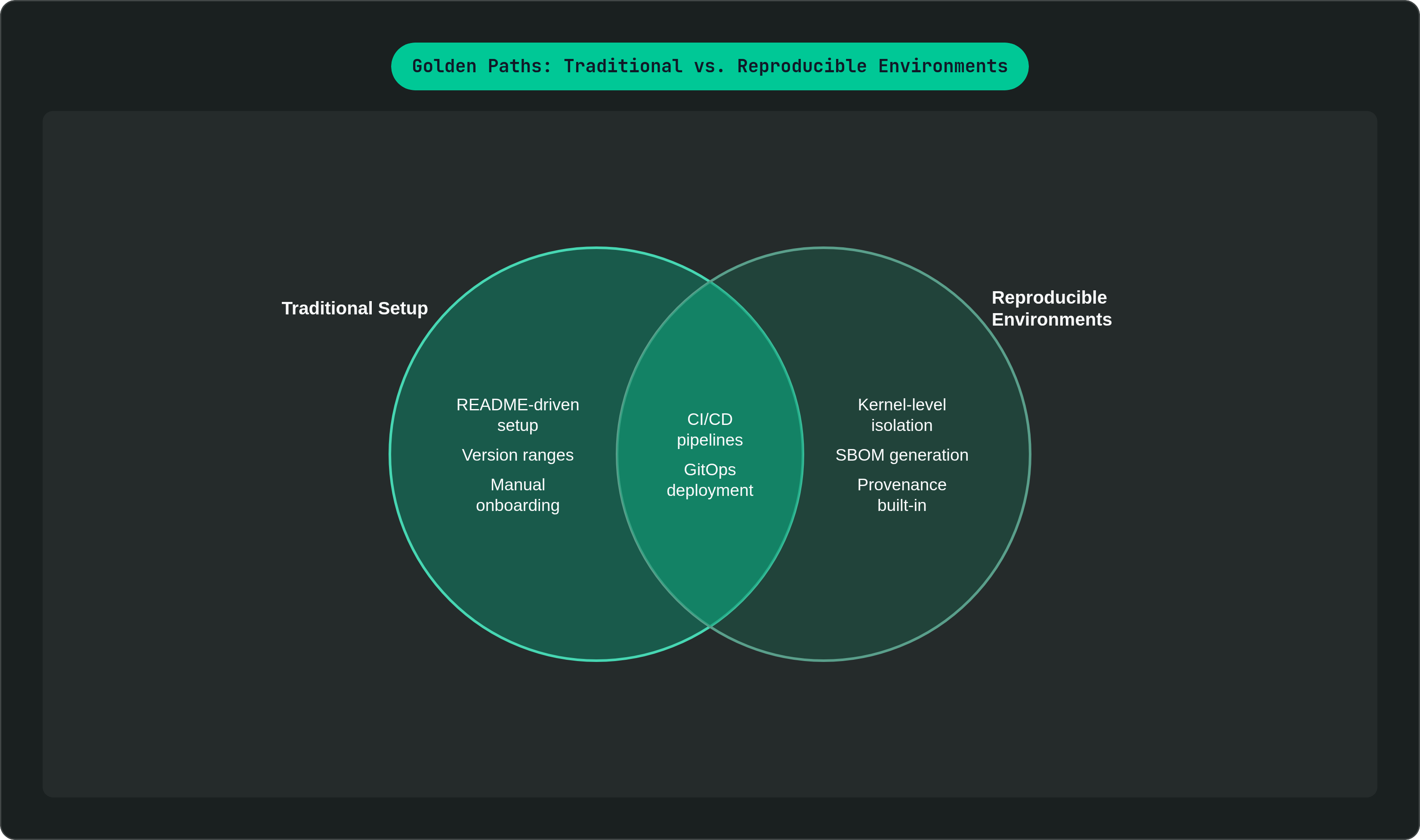
The goal is every developer, every CI runner, every server working from the exact same set of tools, libraries, and dependencies. "Close enough" is what produces the "works on my machine" class of failures that golden paths are supposed to make impossible, and it's a more common destination than most platform teams care to admit.
Conventional approaches fall short in predictable ways. Dockerfiles without pinned digests reproduce the workflow, not the artifact: the next build pulls whatever the upstream registry serves at that moment. README-driven setup encodes the desired state in prose, and is only as reliable as the last human who remembered to update it. Version ranges in package manifests, the caret syntax in npm or tilde in pip, are deliberate non-reproducibility; they invite any compatible version, which means any build can silently pull something different than the last one. None of this is carelessness, exactly. These tools were designed for flexibility, not fidelity, and that mismatch is the problem.
Reproducibility-first architectures address this differently. Functional package managers treat every build as a pure function of explicitly declared, transitively hashed inputs. Isolation is enforced at the kernel level, preventing contamination from the host system. Every dependency's hash is known before the build starts, so any deviation is detectable rather than merely discoverable after something has already gone wrong downstream.
The practical consequences of getting this right are substantial. Onboarding becomes clone-and-go, with no arcane setup documents and no version mismatch debugging. CI flakiness decreases because deterministic environments eliminate the class of intermittent failures caused by dependency drift. Incident response improves because the ability to rebuild a past version exactly becomes possible rather than approximate.
When the dependency graph is fully hashed from the outset, the environment has an identity, not just a process for producing one. That distinction matters more than it sounds.
The supply chain security case for building provenance into every template
Open-source code is present in 96% of analyzed codebases, according to Harvard Business School research published in 2024. The blast radius of a single compromised or vulnerable component is therefore nearly universal. Supply chain attacks doubled in 2025, with global costs reaching $60 billion and projections pointing toward $138 billion by 2031.
A 2025 example makes this concrete: a self-replicating worm compromised over 500 npm packages by hijacking developer credentials across CI/CD pipelines and publishing poisoned versions downstream. Perimeter defenses and code review were insufficient. The attack surface was the supply chain itself. Verizon's 2025 Data Breach Investigations Report found that the share of breaches involving third parties doubled year-over-year to 30%.
Regulatory pressure has moved from optional consideration to procurement requirement. Executive Order 14028 ties federal purchasing to SBOMs and signed provenance. The EU Cyber Resilience Act and CMMC 2.0 push organizations from manual audits toward queryable, continuous systems of regulatory evidence. These aren't abstract compliance exercises. They reflect a recognition that the dependency graph is the attack surface, and that documentation-based audits of that graph are structurally insufficient.
Software Bills of Materials enable what reproducible environments make possible: an exact inventory of every dependency, so when a vulnerability like Log4Shell surfaces or an npm worm spreads, exposure is identified in minutes rather than hours of manual container inspection. If the environment specification is locked and content-addressed from the start, generating a complete and accurate SBOM becomes a byproduct of the build, not a separate audit step bolted on afterward.
Provenance built into templates from day one is fundamentally different from provenance retrofitted onto drifted environments. The retrofit produces incomplete attestation because the inputs were never fully declared. What can't be declared can't be hashed. What can't be hashed can't be verified. The audit looks complete, and it isn't, and under current regulatory frameworks that gap is increasingly something organizations are held accountable for.
How platform teams should structure golden path templates to enforce environment consistency
The environment specification belongs inside the template repository, not in a separate wiki or a verbal hand-off during onboarding. If it's not in the repository, it's not part of the path. This isn't complicated as a design principle; the execution, however, is where teams consistently underestimate the work.
The template repository should encode a declarative, locked environment manifest specifying exact package versions with hashes, not ranges. It should expose a single activation command that any developer on any supported operating system or architecture can run without additional steps. And the same manifest must be consumed by CI, with no separate environment definition for pipelines.
That last requirement is where many otherwise well-structured templates fail silently. The local and CI environments are defined separately, they drift apart over weeks, and nobody notices until a merge gate fails in a way that can't be reproduced locally. The developer assumes they broke something. They didn't. The environments stopped being the same thing, and nothing was watching for that.
Multi-architecture support is a prerequisite, not a nice-to-have. A golden path that only works on Intel Mac or only on Linux is already broken for a meaningful portion of the team before anyone has done anything wrong.
The separation of concerns between platform team and development team matters here. The platform team owns and evolves the base environment layer: toolchain versions, security policies, dependency constraints. The development team extends within those guardrails without needing to understand the underlying package management system. This distinction is what makes extensibility viable rather than dangerous, and it's what keeps the template maintainable as the platform team's attention is distributed across a growing catalog.
If the environment specification is declarative and versioned in the repository, pulling an upstream template update becomes a diff, not a migration. The platform team can reason about what changed; developers can evaluate whether the update affects their extension layer.
The metrics to instrument from launch are specific: time-to-first-commit, template-to-production lead time, adoption rate of the golden path versus manual alternatives, and policy violation trends. These are the feedback loop that tells the platform team whether the path is working or quietly decaying.
Where AI coding agents change the environment consistency requirement
AI coding agents are running inside development environments right now, executing builds, running tests, making commits. This is the current state in a growing number of engineering organizations, and the environment requirements it creates aren't fully accounted for in most existing template designs.
An agent operating in a drifted or underspecified environment produces inconsistent outputs in the same way a human developer would, but at higher velocity and lower visibility. A developer notices when something unexpected happens and asks why. An agent doesn't necessarily surface that observation; it proceeds. The inconsistency accumulates rather than gets investigated. At the velocity agents operate, a contaminated or drifted environment doesn't produce a discrete incident so much as a slow, invisible degradation in output quality that is very hard to attribute after the fact, and nearly impossible to reverse-engineer once enough time has passed.
Anthropic's Model Context Protocol, released in late 2024, is emerging as the standard interface for giving AI agents structured access to tools and context. A golden path environment that exposes MCP-compatible surfaces gives agents the same well-defined tooling boundary that human developers receive. The environment is the contract between the platform and the consumer, regardless of whether that consumer is a person or an agent.
For template design, the implication is direct: agent-accessible environments need the same locked, auditable dependency graph as human-facing ones. A human developer who installs something outside the declared manifest is likely to notice and record it. An agent won't. The undeclared installation becomes part of the ambient environment, invisible to the provenance layer, and there is no recovery path that doesn't involve reconstructing what the environment contained from incomplete evidence.
The security dimension follows from this. An agent with ambient access to an unlocked environment is a supply chain attack surface. The same SBOM and provenance requirements that protect human-driven workflows protect agent-driven ones. The threat model doesn't change because the operator isn't human; in some respects it becomes more acute, because an agent's velocity means a compromised environment can propagate damage faster than any human operator could catch it.
Platform teams building golden paths now should treat AI agents as first-class environment consumers. Designing for agent access as an afterthought produces the same category of problem as designing for reproducibility as an afterthought: a retrofit that looks complete and isn't.
What adoption and failure patterns reveal about making golden paths stick at scale
The core failure mode isn't technical. If the golden path is slower, clunkier, or more opaque than doing it manually, developers will route around it, and the platform team won't know until something breaks in production. The adoption rate of the golden path versus manual alternatives is the most honest signal of whether the path is functioning, and most platform teams don't track it closely enough. They track template downloads. They don't track how many developers quietly set up their environments by hand three weeks later because the template stopped working for their use case.
Several specific patterns kill adoption. Over-abstraction tops the list: when the path hides so much that debugging requires understanding two layers of indirection rather than one, developers stop trusting it and start working around it. Staleness is equally corrosive; a template whose environment specification hasn't been updated to reflect current security policy erodes trust faster than no template at all, because it creates the illusion of correctness while delivering none of it. Underneath both of these is the same structural failure: no designated owner, no update cycle, no accountability when the template quietly stops reflecting reality. The template becomes organizational debt that looks like infrastructure.
What sustains adoption is simpler to describe than to execute. The environment activates in one command. CI uses the exact same environment specification the developer ran locally. SHRM's 2025 research found that structured onboarding improves retention by 82% and productivity by 70%. The environment layer is what makes those gains durable past the first week. Without it, the structured onboarding experience degrades as soon as the developer's local setup begins to drift from the canonical state. The onboarding looks successful; the problems surface later and get attributed to something else, usually the developer.
Treating platform engineers as builders of shared infrastructure rather than authors of documentation is what makes this sustainable. The environment specification is a product. It has owners, versioning, and a feedback loop from the developers consuming it. When that framing takes hold organizationally, the template update cycle becomes a normal part of platform team operations rather than a deferred maintenance task that accumulates quietly until something breaks publicly.
When the environment layer is right, the golden path delivers what it promises: new developers productive in hours rather than weeks, CI results that faithfully reproduce local results, and a security posture auditable from the first commit. Flox, a developer environment platform that uses a single manifest.toml to pin identical, reproducible dependencies across laptops, CI, and production, is one concrete implementation of this approach built on Nix.