approaches to sharing and activating reproducible dev environments across teams
Machine-executed specs in version control beat human-readable instructions every time.

A README describes what a human should do, and humans skip steps, misread instructions, run things out of order. A flake.nix or a devcontainer.json gets executed by a machine the same way every time. That's the difference between infrastructure and a suggestion. For an environment to be shareable at all, its definition has to sit in version control next to the code, so it travels with every clone automatically.
Pinning separates "same package name" from "same bits." An unpinned dependency list might ask for python 3.11 or node 20, but the exact patch version that resolves on a Tuesday in March won't necessarily match what resolves on a Thursday in June, especially across different registries. The config file looks identical; what actually got installed doesn't. Pinning to immutable versions, or better, content-addressed digests, is what makes a spec reconstructable instead of merely descriptive. Scripting ecosystems make this worse than it should be. Package manager hooks run arbitrary code at install time, transpilers drift between minor versions, and a stray leftover file from a prior install can quietly change what the next resolution spits out.
Hermetic evaluation is the one teams get wrong without noticing, and it's a quiet failure because nothing in the diff tells you it happened. An environment has to build from the spec alone, nothing ambient leaking in from the host. The Reproducible Builds project has documented this exact failure mode for years: file paths, locale settings, time zones, OS assumptions, none of it shows up in a config diff, because none of it was ever in the config. An environment that only works because something happens to already be installed globally on the build machine is running on luck, not design.
Traceability tends to be the first thing that quietly disappears. Every change to an environment definition needs an author, a reason, a review trail, same as application code. Skip that, and the spec drifts from what's actually running until something breaks in a way nobody can explain.
Portability across platforms isn't a nice-to-have; it's part of the sharing requirement itself. A spec that only works on one OS fails half the team the moment someone shows up with different hardware. macOS and Linux parity needs to be designed in from day one, and increasingly so does aarch64, given how many engineers are on Apple Silicon now.
Declarative config files and lock files as the unit of sharing
A declarative config describes desired state, not a sequence of steps. It says what should exist, not how to get there, which is what makes it a contract. Anyone who checks out the repo inherits the same promise about what their environment contains, without running or interpreting a procedure themselves.
The lock file turns that promise into something precise. The config expresses intent: this project needs this library, roughly this version. The lock file records the exact resolved inputs, commit hashes, content digests, whatever the tool uses to nail something down to one immutable artifact. Committing the lock file to Git is the actual act of sharing. It freezes the environment at a known-good state and hands that frozen state to everyone at once. Updates become explicit, reviewable changes instead of silent drift that surfaces three weeks later as a test failure nobody can explain.
One problem shows up constantly, and it's structural: separate configs for local dev and for CI. It seems reasonable at first, since CI has different hardware and different install-time constraints, so teams write a second, parallel definition just for it. That second definition is exactly how drift gets baked into the infrastructure instead of staying an individual annoyance. If the same declarative file and lock file govern both, "it passed locally" is actual evidence about what CI will do, not a hopeful guess.
Pinning alone won't keep any of this healthy over time, either. Scheduled clean rebuilds, tearing the environment down and reconstructing it from the spec on a regular cadence instead of building incrementally, catch the cases where the spec has quietly rotted against upstream even though the repo itself never changed.
Nix flakes as a team-sharing primitive
Plain nix-shell, pointed at a Nix channel, has the same problem as an unpinned package manager: it resolves differently on different machines and different days, because channels move. Two people running the identical command can compare notes and find their results don't match. I've watched this happen on a team of four people, all supposedly running "the same" shell.
Flakes close that gap. A flake.nix declares the environment as a pure function of explicit, versioned inputs, with no ambient channel state involved. The flake.lock that comes with it records the exact commit hash for every one of those inputs. Commit that file to Git, and everyone who runs the flake gets identical bits, not just identical package names. The structure is standardized too: a contributor who already knows flakes knows exactly where to look, instead of hunting through a bespoke shell script someone wrote two years ago and never touched since.
The cross-architecture story here is genuinely good. The same devShell declaration runs on macOS and Linux with no second config to maintain, which matters a lot for teams split between Apple laptops and Linux workstations. Even cross-compilation, which tends to get fragile inside containers, can be handled by declaring host and target platforms explicitly in the flake.
Pair a flake with direnv, and the last manual step disappears: walk into the project directory and the environment activates, walk out and it unloads. No way to accidentally keep working in the wrong shell because you forgot to switch back.
Fluency here doesn't come free. The Nix language is functional and lazy, a paradigm most engineers have never touched, and building a comfortable mental model takes real weeks, not an afternoon. Error messages are frequently opaque enough to make you question your career choices, with a single syntax mistake easily producing screens of unrelated stack trace. Getting a team fluent enough to author and maintain flakes on their own is a genuine investment, and Apple Silicon support, while much better than it used to be, still snags on certain packages. For teams unwilling to ask every engineer to become a Nix author, Flox is worth mentioning as an on-ramp: it keeps the same lock-file and hermetic-evaluation guarantees but lowers the authoring bar, at the cost of trusting one more abstraction layer.
Dev containers and cloud environments as a sharing approach for broader teams
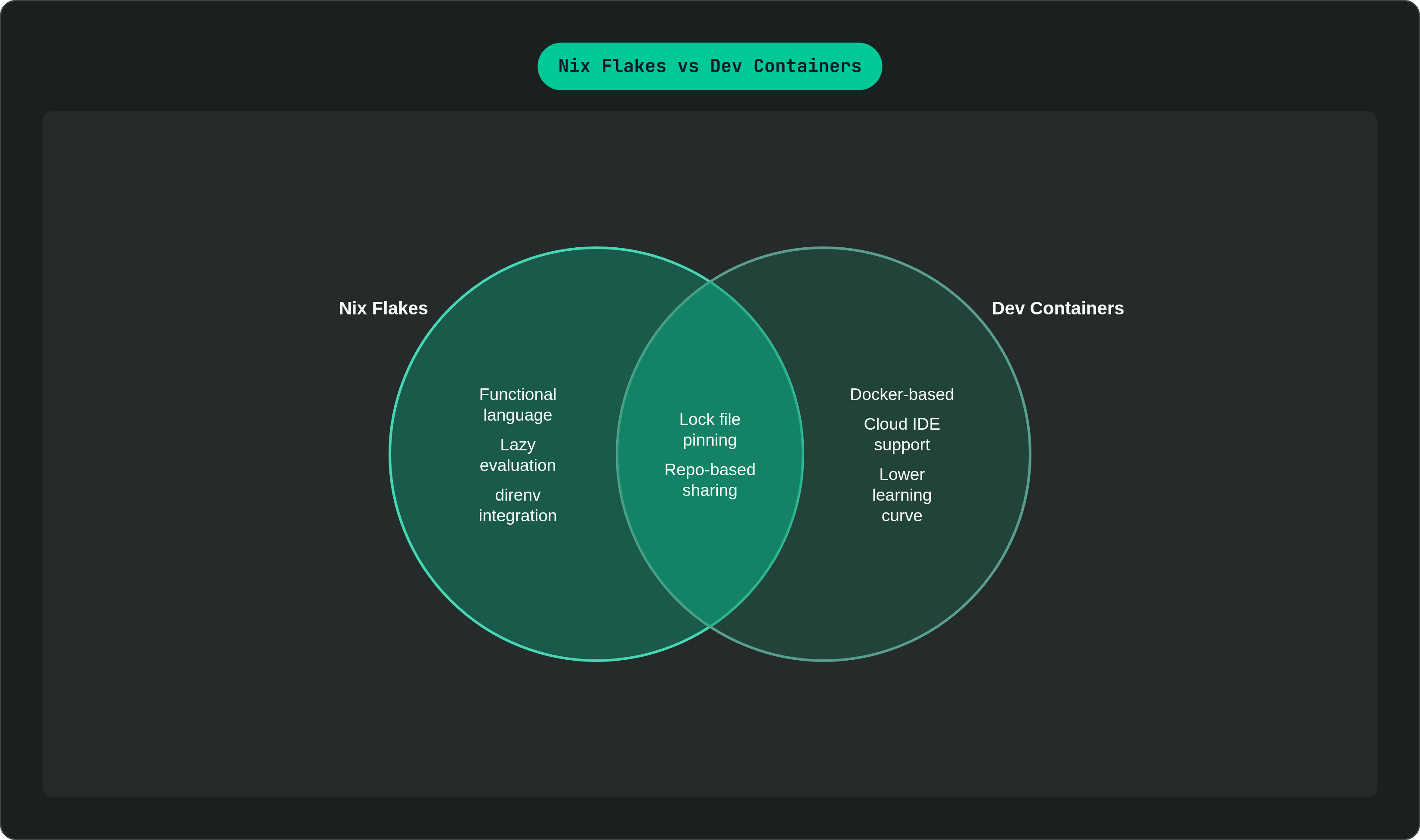
devcontainer.json takes a different road to the same place. It defines a container environment that VS Code, and a growing list of compatible editors, spins up automatically on clone. The same definition works locally, inside GitHub Codespaces, and inside various cloud IDEs, so it travels with the repo the way a flake does, just through Docker instead of Nix. For teams already fluent in containers, the barrier to entry sits well below learning the Nix language from scratch.
The tradeoffs are real. File I/O across the Docker boundary on macOS runs noticeably slower than native disk, and that turns into a real problem on large codebases with heavy file-watching or frequent rebuilds. Reproducibility here still depends entirely on pinning discipline: an image tag like latest, or even a named version tag with no digest, reintroduces the exact ambient-state problem that plagues unpinned package managers. A container is only as reproducible as the diligence behind the image reference it points to, and not one bit more.
Cloud development environments push further by taking local setup off the table entirely. A managed workspace gets provisioned centrally and accessed remotely, so a new hire gets a fully configured environment without installing anything locally. The onboarding pitch is compelling, but the tradeoff is dependency: on network connectivity, on one vendor's platform, on cost that scales with headcount. The underlying spec still has to be rigorous, because a cloud instance built from a loose definition drifts exactly the way a local one does. Moving compute to the cloud relocates an unpinned dependency. It doesn't fix it.
There's a standardization gap here that doesn't get talked about enough. Survey data on internal developer platforms in 2025 found only a small minority of organizations using the same tooling consistently across every team. A container spec sitting in a repo isn't the same thing as the whole org actually using it. Availability and adoption are two different problems, and solving one says nothing about the other.
Across every version of this, Nix-based, container-based, cloud-hosted, the underlying requirement doesn't change. The definition lives in source control, it's pinned, and activating it is close to automatic. Which mechanism you pick matters less than whether those three things are actually true.
One-command activation and how it changes team adoption
A correct spec sitting in the repo isn't the same thing as a team using it. A flake.nix or devcontainer.json that needs a multi-step manual dance to activate gets skipped the first time someone's under deadline pressure, and once it's skipped once, the local workaround it was supposed to kill comes right back. Adoption scales inversely with friction. If activating the right environment means remembering which of three commands to run, only the engineers who already know the codebase well will run it correctly, which defeats the entire purpose for new hires.
One-command activation looks like this in practice: git clone, cd, one command, and the developer has a correctly configured shell, no prerequisite installs beyond a single bootstrapped tool. Pair that with direnv or an equivalent hook, and even that one command disappears, since activation happens on directory entry. The goal is structural: a new contributor shouldn't be able to accidentally work outside the declared environment, because there's no easy path to doing so.
That compounds directly into onboarding math. Organizations that automate provisioning have compressed onboarding from weeks to hours, and environment setup is usually the single biggest chunk of that timeline before automation touches it. Manual, multi-step activation means senior engineers absorb the support cost, answering the same Slack question for the fifth time this month. One command, and that cost drops to nearly nothing.
A handful of tools have specifically gone after this activation layer, each trading something for something else. Devbox wraps Nix underneath, offering a simpler command surface while still producing a genuinely reproducible environment, with direnv integration for automatic activation. The cost is an abstraction layer between the developer and the actual Nix machinery. mise manages runtime versions through a declarative config with a lower reproducibility bar than Nix-backed tooling, but a correspondingly lower cost of entry, which fits teams that don't need full hermetic builds. Other tools similarly go for one-command activation with full Nix-backed reproducibility running underneath, built so the developer never has to understand the Nix layer to benefit from it, though that convenience means trusting one more vendor's layer stacked on top of Nix.
The activation step, honestly, is a decent proxy for how mature the org actually is. A sixteen-step README full of platform caveats is evidence the sharing problem never got solved. One command is evidence that it did.
Keeping the shared environment consistent as the codebase evolves
Environment definitions age the same way any other part of a codebase does. The setup that worked cleanly at kickoff drifts as dependencies release new versions, deprecate old APIs, and occasionally break backward compatibility outright. A committed lock file handles drift between developers at a single point in time; drift over time is a separate problem, and the lock file itself needs deliberate updating, tested before it lands, not trusted blindly because it worked last time.
Teams need an actual process here: who owns updating the environment definition, on what cadence, and how changes get checked before they hit everyone else. Treating environment changes with the same rigor as application code covers most of it. Lock file bumps go through pull requests, not silent commits straight to main. Review should ask the obvious questions: does it still build clean on macOS and Linux both? Does CI pass against the new definition, not just the old one?
CI is what makes any of this trustworthy instead of aspirational. Running CI against the exact environment definition developers use locally is what gives a green checkmark actual meaning. Run CI against a different spec than local dev uses, and that checkmark tells you less than it looks like it does. Scheduling a full clean rebuild in CI, not on every PR but on a regular cadence, catches the slow rot that incremental builds tend to hide.
This circles back to the single-config point from earlier: maintaining separate specs for local dev and CI is a structural source of drift no matter how carefully either one is pinned on its own. What a developer runs locally should be exactly, not approximately, what CI consumes.
Communication matters more than most teams give it credit for. When the environment changes, developers need to hear about it before they hit the breakage, not after. A silent lock file update that invalidates a local cache is small technically, but it's a trust event. It teaches engineers the shared environment can shift under them with no warning, which is precisely the feeling that sends people back to personal workarounds. Changelog entries, clear PR descriptions, an automated ping when the definition changes: none of it is expensive, and all of it heads off the bigger cost later.
Platform engineering patterns that scale environment sharing across many teams
Everything so far works fine inside one team. Scaling it across an org with many teams needs a different frame: environment definitions as internal infrastructure that a platform team owns and publishes, not per-team config that every group reinvents from scratch. A platform team maintaining a vetted base gives every product team a real starting point instead of a blank page and a Slack channel full of tribal knowledge that lives in three people's heads.
This works best as an extensible base, not a mandate. Product teams should be able to layer their own tooling on top of a shared, centrally maintained foundation, rather than getting forced into one identical environment that doesn't fit what they're actually building.
The golden path idea, familiar from deployment infrastructure, applies just as directly here. A documented, supported path that produces a working environment in one command is the environment equivalent of a golden deployment path. Platform teams should measure success by how rarely developers feel the need to go off that path, not by how many configuration knobs they've exposed. More knobs usually means more surface area for drift, not less. Organizations that have invested in mature internal developer platforms report real reductions in both onboarding time and the sheer cognitive load of just getting to a working state.
Self-service ties this together. Developers shouldn't have to file a ticket and wait to get a working environment. Access, credentials, tooling, all of it should be provisioned as part of the environment definition itself, so getting set up is a technical step and not an administrative one.