Platform Engineering vs SRE Scope and Responsibility Boundaries
Platform Engineering builds for developers; SRE ensures production stays reliable for users.
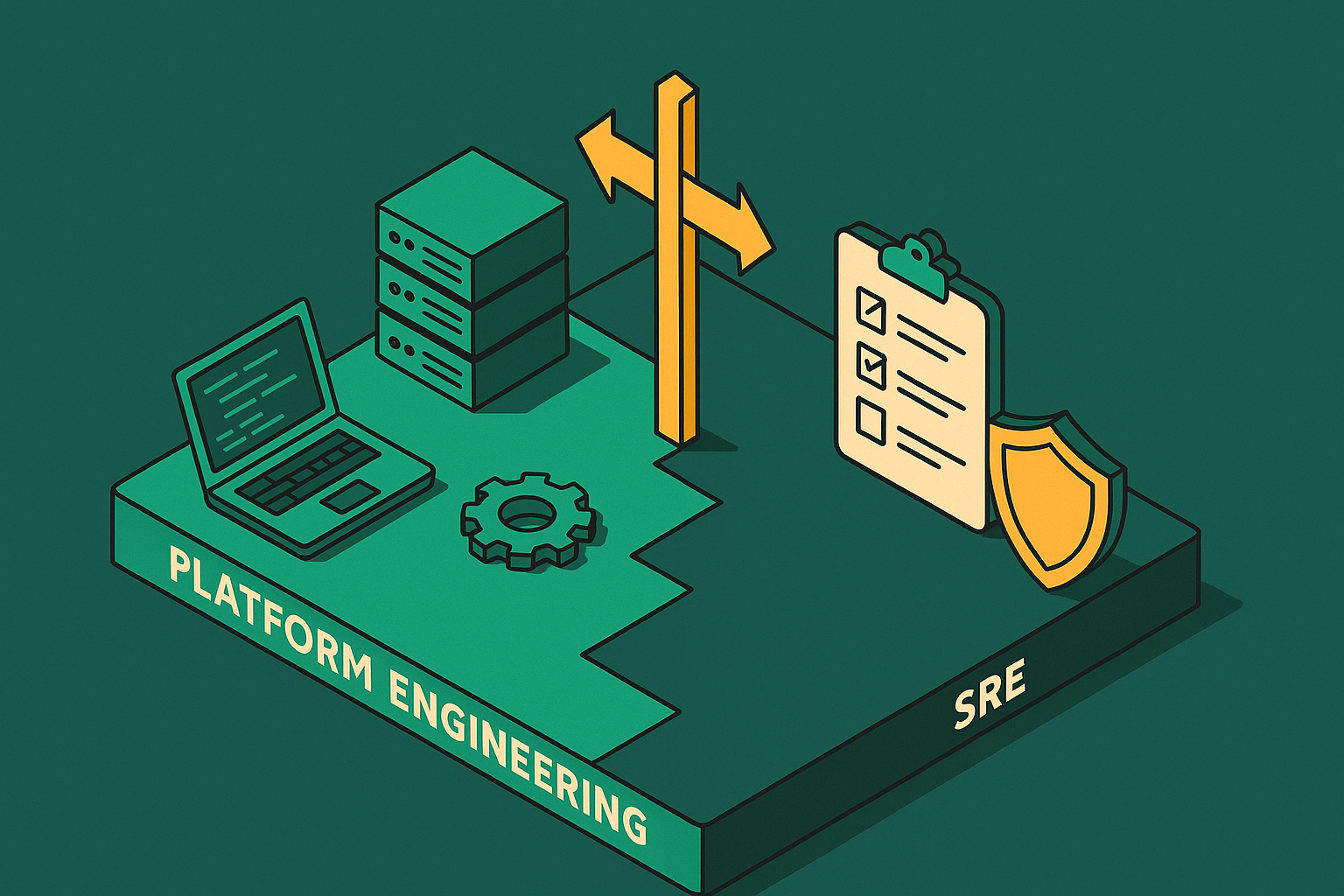
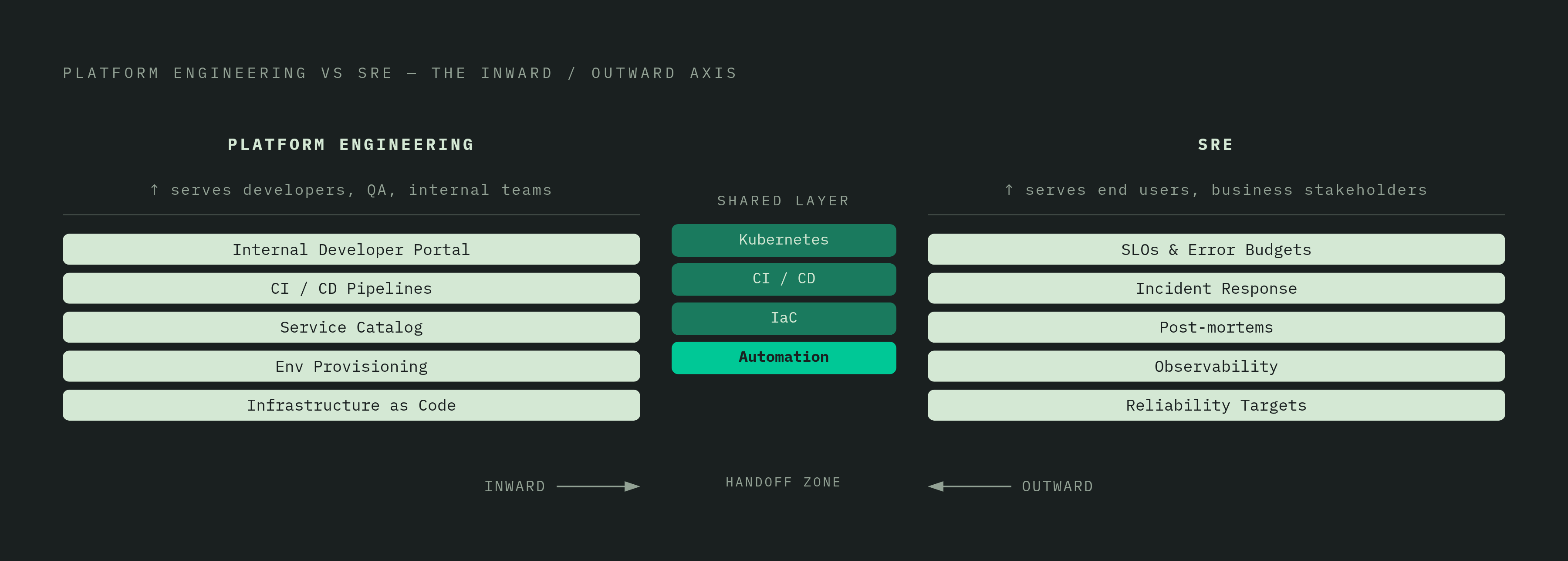
Platform Engineering and SRE keep getting confused for the same job wearing two different name tags, and that confusion costs organizations real money in duplicated headcount, stalled handoffs, and arguments about who's on call for what. The two functions split along a single axis: Platform Engineering builds inward, toward developers, while SRE faces outward, toward the people actually using the product in production. Once that direction is fixed, most of the "who owns this" fights resolve themselves without a reorg or a new job title.
The confusion is not accidental. A June 2026 career guide on Medium pointed out that "Senior DevOps Engineer" at one company maps to "Platform Engineer" at another and "SRE" or "Infrastructure Engineer" at a third, with no consistent mapping between title and actual duties. One practitioner summary serves as an anchor, if not a full definition: DevOps is the why, SRE is how you keep things reliable, and platform engineering is how you scale that reliability and make it usable by everyone else. That line is useful precisely because it names three different jobs instead of pretending there's one. What follows applies the inward/outward frame to scope, to metrics, to the handoff zones where teams actually trade responsibility, to org structure, and to the shared tooling problems, like environment consistency and supply chain security, that neither team can solve alone.
What Platform Engineering is responsible for, and who it answers to
Platform Engineering's customer is internal: developers, QA engineers, and other technical staff who need infrastructure without needing to become infrastructure experts themselves. That's the framing Octopus uses, and it's the right one. The team is serving the people building the product, not end users of the product. It's serving the people building the product.
The job, concretely, involves designing and maintaining internal developer platforms (often shortened to IDPs), writing and owning infrastructure as code, integrating and running CI/CD pipelines, curating a service catalog so teams aren't reinventing deployment patterns from scratch, automating environment provisioning, and setting up the compliance and security guardrails that let developers move fast without triggering an audit finding six months later.
The mindset that separates a real platform team from a pile of shell scripts is treating the IDP as a product. That means gathering feedback from the developers who use it, iterating on rough edges, and measuring adoption the way a product manager would measure feature usage. Octopus offers a clean example: building a Kubernetes platform so application developers can deploy and manage services without needing to become Kubernetes experts themselves. The orientation is proactive. Platform teams build capability ahead of friction.
Gartner, cited in the Medium career guide, projected that by 2026 nearly 80% of software engineering organizations would have dedicated platform teams. It's close to standard practice now. It's close to standard practice.
What Platform Engineering does not own matters just as much as what it does. Production reliability belongs somewhere else. End-user SLAs belong somewhere else. It does not run incident response for live systems. Those all belong somewhere else, and naming that boundary early is what makes the next section make sense.
What SRE is responsible for, and who it answers to
SRE answers to a different constituency: the end users who depend on the system staying up, plus the internal stakeholders, developers, business leaders, who need someone accountable for the SLA. Both Octopus and Tigera frame it that way, and it lines up with how the discipline was built.
SRE originated at Google as an attempt to apply software engineering discipline to operations, with one governing priority: keep production reliable. That gave rise to error budgets, service-level objectives, automation aimed at eliminating repetitive operational toil, and a structured approach to incident response built around blameless post-mortems.
Day to day, SRE work covers monitoring and alerting, capacity planning, incident response, automating the operational tasks that used to eat an engineer's afternoon, building resilience patterns into systems before they fail, and leading the post-incident reviews that are supposed to make the second occurrence of a failure less likely than the first. Octopus's example is concrete: monitoring application performance, setting alert thresholds for critical conditions, and automating the rollout of code changes so a bad deploy gets caught before it reaches everyone.
Success gets measured in SLOs, error rates, availability percentages, and response-time metrics: mean time to detect, mean time to recover, on-call burden, and uptime as the end user actually experiences it, not as a dashboard claims it. Tigera's breakdown of the space shows the tooling leans observability-heavy: Prometheus, Grafana, Datadog, chaos engineering frameworks, log analytics platforms.
The clarifying point is sequence. SRE measures and maintains the reliability of services running on platforms that Platform Engineering built. One team builds the road. The other one is responsible for what happens when traffic hits it.
Where the two roles overlap and where the boundary holds
The overlap is not imagined. Both disciplines work in Kubernetes, both live inside CI/CD systems, both write infrastructure as code, both automate to cut down on manual toil, and both apply an engineering mindset to problems that used to be handled by hand. Tigera's comparison of the two disciplines makes that shared ground explicit.
That shared ground is exactly where the trouble starts. Because both teams touch infrastructure, write code, and talk to development teams daily, one function tends to bleed into the other inside any organization that hasn't drawn a clear line. The Medium career guide describes years of "a weird dance of overlapping responsibilities, salary bands that make no sense, and recruiters who couldn't explain the difference," which is a blunt way of saying the industry has not been careful about this.
By 2026, the guide notes, the convergence has gone further: DevOps Engineers increasingly pick up responsibilities shaped like those of a reliability-focused engineering role, and Platform Engineers increasingly do both DevOps and that kind of reliability work under one title. Titles have stopped being reliable signals. What matters is the actual tech stack and the actual responsibilities, not what's printed on the offer letter.
Even so, the directional frame holds the boundary in place if you apply it strictly. Platform Engineering owns the platform's own reliability and the developer experience of using it, but not the reliability of whatever application gets deployed on top of it. SRE owns production reliability and the user-facing SLA, but not the design of the self-service infrastructure developers consume to get there. One practical signal for organizations running both functions: keep separate telemetry pipelines for platform workloads (internal controllers, provisioning services) and application workloads. That separation lets SREs diagnose user-impacting issues without wading through noise generated by the platform team's own iteration cycle.
The overlap is a coordination problem. It is not a mandate to merge the two roles into one job description, however tempting that looks on an org chart with too many boxes.
How the two teams hand off to each other in practice
The relationship is sequential. Platform Engineering builds the foundational layers, the provisioning systems, the CI/CD pipelines, the service catalog, and SRE measures, maintains, and improves the reliability of whatever runs on top of those layers. Octopus and Tigera both describe the relationship this way, and it matches how the work actually flows in practice.
Platform teams do not make SRE teams redundant. As the Medium guide puts it, an organization still needs "people running your infrastructure, optimizing and maintaining it," even after someone has built a self-service layer on top of it. The self-service layer changes who does the repetitive requesting. It does not remove the need for someone watching production.
The handoff gets cleanest when platform engineers own observability and alerting for their own platform systems, catching issues in the platform layer before those issues cascade into application-layer incidents that land on an SRE's pager. That's the expert tip Octopus offers, and it's a good one: nobody wants a provisioning failure to surface first as a customer-facing outage.
Platform SLOs are the coordination mechanism that makes this work without constant meetings. When a platform team defines SLOs for the platform itself, API uptime, provisioning latency, deployment success rate, SREs get a clear target to monitor against, the same way they'd monitor any other production system. Without that, SRE ends up guessing at what "the platform is healthy" is supposed to mean.
The richest collaboration happens earlier than incident response, though. SREs are important stakeholders in how a platform gets designed in the first place, because their production experience tells the platform team which reliability primitives actually need to be exposed to developers, and which ones are cosmetic.
The Medium guide described this playing out as a growth arc. At five developers, one person wears the DevOps hat: CI/CD, deployments, all of it. At a larger headcount, an SRE joins and downtime falls substantially. Later still, a platform engineer builds internal APIs, and developers start spinning up test environments far faster than before. Each step didn't replace the last. It added a layer that the previous headcount had no time to build.
How each team measures whether it is doing its job
SRE's metrics point outward, toward production: SLOs, error rates, availability percentages, mean time to detect, mean time to recover, on-call load, and uptime as end users experience it. Both the Medium guide and Tigera's comparison land on the same list, which isn't surprising given how long SRE has had to standardize around error budgets and SLOs as codified practice.
Platform Engineering's metrics point inward, toward adoption and efficiency: deployment frequency, lead time for changes, how fast a new hire gets onboarded, self-service adoption rates, and developer satisfaction with the platform itself.
The picture gets uneven. The fourth State of Platform Engineering Report, drawing on a survey of 518 engineers worldwide, found that 29.6% of platform teams track no success metrics at all: no DORA metrics, no developer satisfaction surveys, no cost benchmarking. Nearly three in ten platform teams are operating without any way to demonstrate the value of the thing they built.
That gap has consequences beyond a bad look in a budget review. Without adoption and satisfaction data, a platform team has no defensible way to prioritize which friction point to remove next, and no evidence to point to when leadership asks whether the investment paid off. SRE doesn't have this problem, largely because it inherited decades of measurement discipline from its origins at Google. Platform Engineering is still building that culture from scratch, and the January 2026 numbers suggest it has a long way to go.
For any organization running both functions, the two metric sets need to stay separate. Platform health and application reliability answer different questions, and averaging them together, or worse, using one as a proxy for the other, hides exactly the information each team needs to do its job.
Where environment consistency sits on the boundary
Environment consistency sounds like a small technical detail until it causes an outage at 2 a.m. The challenge is straightforward to state: every developer's laptop, every CI runner, and every production server needs to run the same tools, libraries, and dependency versions. When they don't, teams lose hours to debugging problems that only exist because two environments quietly drifted apart.
The scale of the problem is worse than most engineers assume. A study of 5,298 Docker builds, conducted by Malka and colleagues, found that only 6.4% of rebuilt images matched the original set of installed package versions exactly. Docker makes deployment easier. It does not make deployment reproducible, unless base images and every package version get pinned deliberately, which most teams skip.
This sits squarely on the boundary between the two disciplines, but the ownership tilts toward Platform Engineering. Environment provisioning is explicitly part of the platform remit: the whole point of the platform is to abstract this complexity away so developers never have to think about it. SRE, meanwhile, inherits the consequences when the abstraction fails. Environments that drift between staging and production are a well-known source of outages, and an outage caused by drift is still an incident SRE has to respond to, triage, and write up in a post-mortem, even though the root cause sat one layer upstream.
That makes environment consistency a boundary problem with a clear upstream owner. If Platform Engineering doesn't solve it at the source, SRE absorbs the cost downstream, in the form of incidents that trace back to a dependency mismatch nobody caught. Declarative, reproducible environment tooling, approaches that define environments in versioned manifests, pin dependency versions precisely, and support instant rollback, address the problem at the platform layer instead of leaving SRE to diagnose it after production has already broken.
The downstream cost of drift is measurable, and it isn't small. An empirical analysis by Coakley and colleagues in 2023, covering 780 runs across four software containers and thirteen hardware types, found more than 6% test-accuracy drift for binary classifiers and more than 8% drift for LSTM models, driven purely by environment changes with no change to the underlying model or code. That's drift crossing the line from a platform inconsistency into a production reliability problem, which is exactly the failure mode the boundary is supposed to prevent.
Supply chain security responsibilities across both teams
The threat landscape gives this section its urgency, and the numbers are not subtle. Sonatype identified more than 454,600 new malicious packages in 2025, with 99% of them concentrated in the npm ecosystem. The cumulative total of known malicious packages has passed 1.233 million. The ReversingLabs 2026 Software Supply Chain Security Report puts malware growth on open-source platforms at 73% year over year.
Container images make this concrete at the platform layer. Standard public container images typically ship carrying 50 to 60 known CVEs out of the box, which means the choice of base image, a decision Platform Engineering makes and is responsible for vetting, sets the security floor for everything built on top of it.
Machine-readable inventories of every component, library, and dependency inside a piece of software have moved from best practice to regulatory obligation. The EU's Cyber Resilience Act put its first reporting obligations into effect in September 2026, requiring manufacturers to report actively exploited vulnerabilities and severe security incidents for products with digital elements. A separate CRA requirement, mandating SBOMs in machine-readable format, applies starting December 2027. In a certain country, an executive order signed in May 2021 already requires federal software vendors to provide SBOMs as a condition of doing business with the government.
Ownership of SBOM generation belongs to Platform Engineering, because that's the layer controlling the build process and the dependency management pipeline. SBOMs work best when they're built into the development workflow from day one, not bolted on afterward as a compliance exercise ahead of an audit.
SRE is the consumer, not the producer. When a new CVE gets disclosed, SRE teams use the SBOM to figure out which deployed versions are actually affected, which makes the SBOM the bridge connecting the platform layer to production reliability. But generating the document is the easy part. The Medium career guide is direct: the hard part is having the governance, the continuous scanning, and the remediation workflow to act on what the SBOM reveals. An SBOM nobody reads is a compliance artifact, not a security control.
One concrete pattern makes the handoff faster: attaching input-derived hashes to deployments. When a CVE disclosure hits, teams can identify affected deployments by matching the hash, rather than grepping through logs or rescanning every image from scratch. That's a platform-layer investment, and it pays off almost entirely at the SRE layer, during exactly the moment when speed matters most.
Organizational structures that make the boundary work, and failure modes when they do not
Centralizing all infrastructure work inside one team is the failure mode that gave rise to Platform Engineering as its own discipline. The dynamic is familiar: concentrate everything in one team and every request adds context switching, every exception adds cognitive load, and eventually teams stop shipping and start waiting in a queue. That bottleneck is not a staffing problem solvable by hiring one more person into the same centralized team. It's a structural problem that requires splitting the work along the inward/outward axis this piece has been describing.
The reality on the ground is messier than a single platform team serving the whole company. The fourth State of Platform Engineering Report, the same survey of 518 engineers, found that more than half of companies already run multiple platforms, segmented by team: frontend, backend, data, and AI each with their own. That contradicts the assumption that one platform ought to serve every need across an organization.
The structural implication is that the Platform Engineering/SRE split is not the only division that matters. Platform Engineering itself may be segmented by value chain, and each segment can end up with its own relationship to SRE, its own SLOs, and its own handoff pattern. There's no single template.
What ties the successful examples together isn't org chart placement, it's discipline. Spotify, Netflix, and Monzo are known to invest heavily in internal platforms, reflecting a view that developer experience matters to business outcomes, which is why they fund platform work as a product line rather than a cost center. The product mindset is what separates a platform team that developers actually want to use from one that gets quietly routed around.
Healthy structure, pulled from the sources here, looks consistent: the platform team treats the IDP as a product with real users and iterates on feedback, SRE sits as a stakeholder in platform design without being folded into the platform team itself, platform SLOs exist and SRE monitors against them, and telemetry stays separated by workload type instead of getting mixed into one dashboard nobody trusts.
Asking one team to do both jobs at once is the failure mode. Production reliability work is reactive by nature, urgent, and it always wins the argument for attention in the moment. Platform improvement work is proactive, and it loses that argument every time it competes for the same hours. The two jobs run on incompatible rhythms, and folding them into a single team doesn't create efficiency, it creates a team that never gets to the platform work because the pager keeps going off.
The Minimum Viable Platform approach argues for the opposite instinct: start small, iterate fast, and stand up a narrow platform function early rather than waiting until scale forces the issue on you. Waiting for pain to force the reorg is a more expensive way to arrive at the same conclusion.
How to diagnose which boundary problems
Most disputes between these two teams are actually one of four questions in disguise, and naming which question is being asked resolves the argument faster than any reorg.
Is this a build problem or a run problem? If the complaint is about how hard something is to set up, provision, or deploy for the first time, it's a Platform Engineering question. If the complaint is about something that's already running and behaving badly, it belongs to SRE. Confusing the two is the single most common source of a misdirected ticket.
Is this a metrics gap or a coordination gap? A team with no visibility into whether its work is landing, the 29.6% of platform teams tracking nothing at all is the clearest example, needs a measurement fix before it needs a process fix. Adding another meeting on top of a missing dashboard just adds a meeting.
Is the drift upstream or downstream? Environment consistency problems and supply chain issues both tend to appear at the SRE layer, as an incident or a CVE response, while the actual defect sits in a platform decision made months earlier, an unpinned dependency, an unvetted base image. Tracing the incident back to its origin, rather than patching it where it surfaced, is what prevents the same failure from recurring under a different name.
Is this a title problem or a responsibility problem? The Medium guide's own account of the confusion shows how inconsistently "DevOps Engineer," "Platform Engineer," and "SRE" get applied across the industry, so a boundary dispute framed around job titles is usually a distraction. Asking who the work actually serves, developers building something new, or users depending on something that already exists, tends to reveal the right owner without further debate.