DAST vs SAST in Secure Software Development Lifecycles
SAST and DAST catch different vulnerabilities at different stages, so secure development needs both.
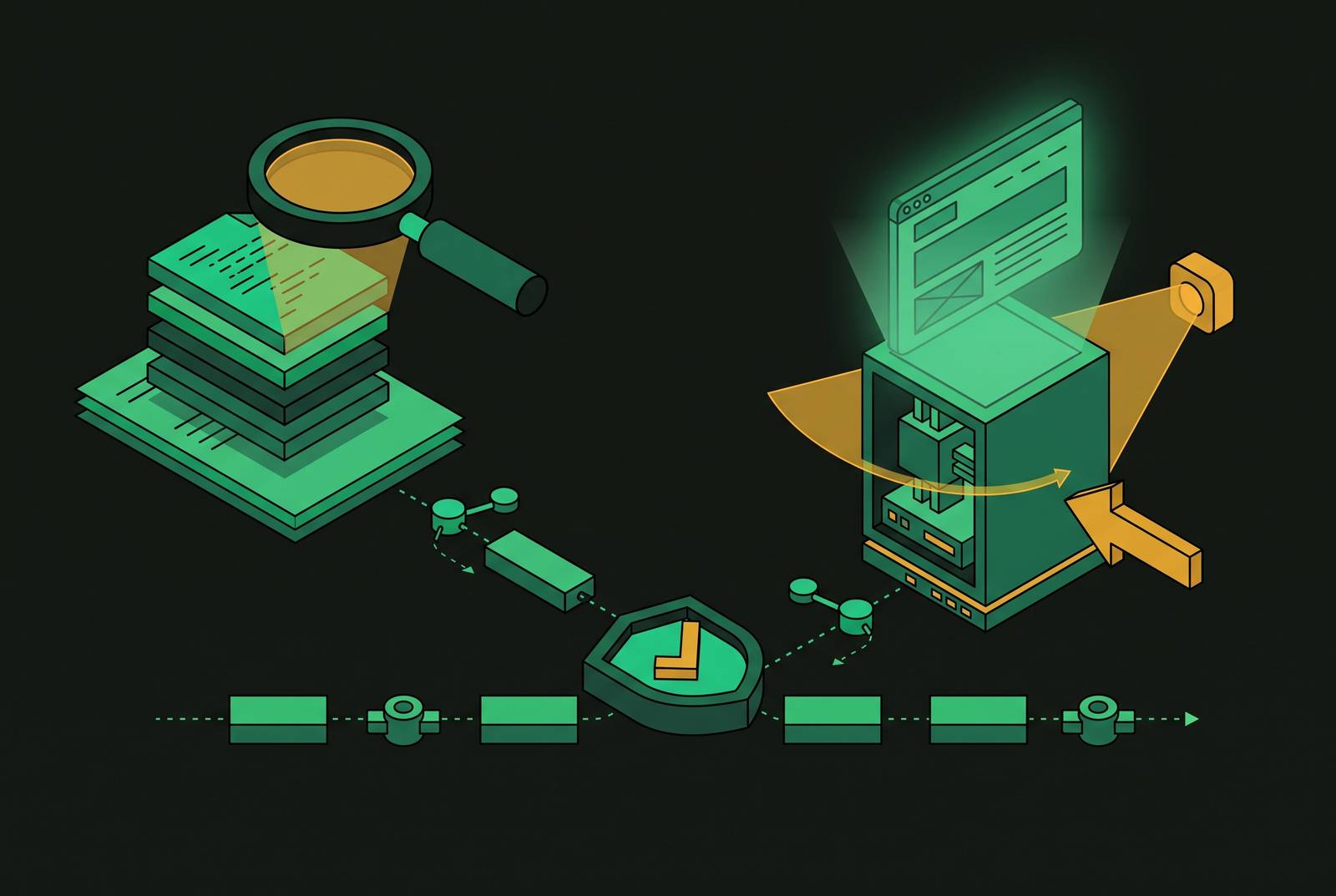
SAST (static application security testing) and DAST (dynamic application security testing) solve two different problems, not one problem twice. SAST reads code before it runs and traces how data moves through it. DAST attacks a running application from the outside, the way an intruder would. A secure development pipeline needs both, placed at the right point in the process, because each one is structurally blind to what the other sees.
SAST is white-box work. It reads source code, bytecode, or compiled binaries without ever executing the application, tracing data flow to catch injection flaws, cross-site scripting, buffer overflows, insecure API calls, and unsafe deserialization. It also does pattern matching to catch hardcoded secrets sitting in a config file where they never should have been typed in the first place. DAST is the opposite approach entirely: it interacts with a live, running application from outside, throwing real attack payloads at it the way an actual adversary would. That's how it catches things static analysis structurally cannot, like authentication flaws, weak session tokens, misconfigured servers, broken access controls, and business logic bugs that appear only once a user is actually clicking through a workflow.
SAST cannot observe runtime behavior, full stop. It has no idea what happens once the application is deployed onto real infrastructure with real configuration. DAST, meanwhile, cannot open up the code and point to a specific line where a flaw lives. Neither one is a superset of the other; they cover different windows in the software lifecycle, and a team relying on just one is accepting a blind spot by default. No single method offers full coverage on its own, per Synack: SAST catches issues before code ever runs, DAST validates behavior once the application is live.
Two related technologies extend this foundation rather than replace it. IAST and RASP add runtime instrumentation and production-level defense, respectively, but they build on the SAST/DAST split rather than making it obsolete. That layering gets its own treatment further down.
What each method catches, and what it misses
SAST's biggest advantage is timing. It flags code-level vulnerabilities at commit time or during a pull request review, long before the application gets built, let alone deployed. That means developers get file-and-line feedback right inside their IDE or CI pipeline at commit time. Because it's reading source rather than watching execution, SAST can also examine code paths that a running test might never actually trigger. OX Security notes that plenty of tools ship with rule sets already mapped to OWASP Top 10, PCI DSS, HIPAA, and GDPR, which gives compliance teams a head start they'd otherwise have to build manually.
None of that comes free. SAST tools flag potential issues without any runtime context, so false positives pile up fast, and alert fatigue becomes a real operational cost once developers start ignoring the scanner. The tooling also has to be tailored to whatever language or framework a team is running, and it stays fundamentally blind to runtime risk: environment-specific behavior, configuration drift, business logic flaws. None of that lives in the source code where SAST is looking.
DAST picks up a lot of what SAST misses, because it tests the thing as it actually runs. Session handling, server configuration, and third-party dependency behavior in production are only visible once the application is live and being poked at. It simulates an attacker's actual path rather than flagging a theoretical pattern in code, and because it doesn't need source access, it works across any stack, which matters a great deal for third-party components, legacy systems, or closed-source software nobody on the team can read the internals of. It also verifies something SAST simply cannot: that the deployed environment itself isn't the vulnerability.
The tradeoff is visibility and timing. DAST can confirm a flaw exists, but it often can't say exactly where in the code it lives, which leaves remediation guidance frustratingly vague for a developer trying to fix it. Everything DAST finds gets found after the code already exists, sometimes after deployment, and fixing anything post-deployment costs more than catching it at commit time. DAST also needs a running application and dedicated test infrastructure, which slows pipeline cadence in ways SAST doesn't.
The overlap is where the complementary framing actually earns its keep. Both methods can surface SQL injection and cross-site scripting, but through entirely different mechanisms: SAST flags the vulnerable code pattern sitting in the source, DAST confirms whether that pattern is actually exploitable once the system is live. A team running only one tool gets exactly half that answer, and won't know which half until something breaks.
Where SAST and DAST belong in the SDLC pipeline
SAST's natural home is early, as early as a developer's fingers on the keyboard. Integrated into the IDE, it gives feedback while code is being written, not after. Pre-commit hooks (tools like Semgrep and Gitleaks fall into this category) catch vulnerabilities and secrets before code ever enters the repository, and the CI build step runs SAST automatically on every commit or pull request, enforcing shift-left security without anyone having to remember to run a scan manually. The underlying principle is old and well established: the earlier a flaw is caught, the cheaper it is to fix. SAST is just the concrete implementation of that principle at the level of a single line of code.
The build phase adds another layer. This is where SBOMs get generated, artifacts get signed with tools like Sigstore or Cosign, container images get scanned, and SLSA provenance gets verified, a sequence that reflects increasingly common 2026 pipeline recommendations. Findings from the SAST stage feed into this step too, flagging which components deserve closer scrutiny before they're packaged and shipped downstream.
Staging is where DAST does its work, because DAST needs something running to attack. Dependency scanning and fuzz testing typically get folded into the same CI stage, and DAST validates something SAST cannot even in principle: that the assembled, configured, deployed application doesn't have runtime vulnerabilities that code review missed entirely.
The order matters. SAST narrows the field of known code-level risk before DAST goes probing for what's actually exploitable at runtime, and running them in that sequence cuts down on noise, prioritizing the findings that are both present in code and confirmed dangerous in practice. When that sequencing breaks down, the cost is visible fast. OX Security notes that SAST, DAST, and IAST scanners running as isolated, siloed gates generate alert volumes nobody coordinates, which stalls development and forces teams into manual triage they don't have the headcount for. The tools aren't the problem there. The lack of pipeline integration is.
The IAST and RASP layer, and where they fit
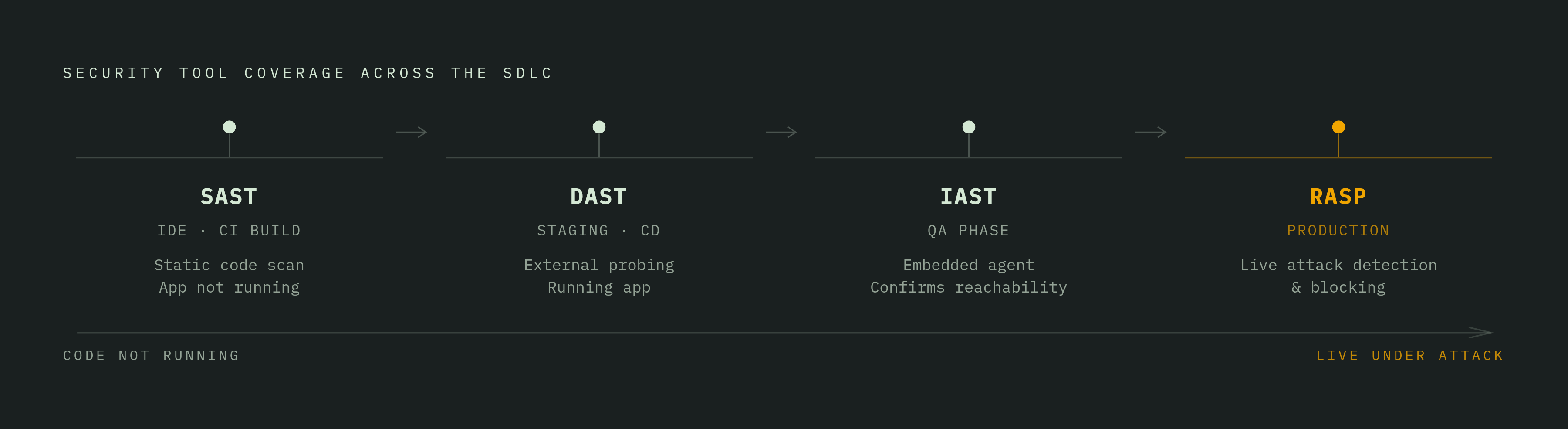
IAST, interactive application security testing, is in a gray zone between the two. An instrumented agent runs inside the application during QA or testing, combining code-level visibility with actual runtime context. It can confirm a vulnerability is reachable rather than just theoretically present somewhere in the code. That reachability confirmation is what keeps IAST's false-positive rate low compared to SAST running alone.
RASP, runtime application self-protection, lives inside the application in production and detects and blocks attacks as they happen, in real time, operating in the one part of the lifecycle SAST and DAST can't reach at all.
Laid out in sequence: SAST examines non-running code from inside the IDE or CI build step, catching flaws at the earliest possible point. DAST tests a running app in staging from within the CD pipeline, proving exploitability from the outside. IAST runs as an embedded agent inside a running, instrumented app during QA, confirming reachability with a low false-positive rate. RASP runs embedded in production, defending against live attacks as they happen. SoftwareSecured notes that RASP can also create a false sense of security within a development team that starts leaning on it instead of fixing root causes earlier.
Both of the newer layers carry real limits. IAST needs agent setup and specific language support, which isn't trivial to roll out across a polyglot codebase, and RASP adds latency risk in production. RASP belongs at the end of the chain as a last line of defense rather than a substitute for catching problems earlier. Coverage across the full SDLC requires layering all four, because each one is blind exactly where the others see clearly.
How AI-generated code and API-first architectures change what DAST must cover
AI coding assistants write code fast, and that speed is exactly the problem. These engines generate output based on statistical probability, not security logic. They frequently reproduce outdated patterns and pull in vulnerable dependencies without anyone consciously deciding to use them. OX Security notes that the result buries AppSec teams under a pile of unprioritized security debt that legacy DAST tools and manual triage queues were never built to keep pace with.
The practical fallout is that DAST becomes essential for checking whether AI-generated code actually behaves safely once it's running, because static analysis of AI-synthesized code blocks is necessary but nowhere near sufficient on its own.
API-first architecture adds a second pressure point. A typical enterprise application now exposes over 150 API endpoints, and legacy DAST scanners built to crawl HTML links simply don't see REST, GraphQL, or gRPC endpoints, they were never designed to look for them. Modern tools like StackHawk handle GraphQL and gRPC without much trouble, while older scanners genuinely struggle here. Anyone evaluating DAST tools in 2026 should be checking specifically for schema import support and compatibility with modern authentication patterns.
Supply chain attacks now span the entire gap between commit and runtime, and recent incidents make that concrete. The GlassWorm campaign hid its payload in invisible Unicode characters inside IDE extensions, while the Shai-Hulud worm executed on install across more than 440 npm packages. Standalone SAST can't see live cloud behavior once that payload is running, and standalone DAST can't trace a runtime exploit back to the poisoned dependency that caused it. Running both together is what closes that gap, not either one alone.
The productivity upside is real too. Escape's buyer's guide reports that one manufacturing company cut manual triage time by over 1,000 engineering hours a year after moving to a continuous DAST approach. PandaDoc's Director of IT and Security noted that developers were pushing significantly more code into production, a volume increase that simply outpaces what manual review can handle.
Supply chain security and SBOMs as the connective tissue between SAST and DAST
The exposure here is bigger than most teams want to admit. The Datadog State of DevSecOps Report 2026 found that 87% of organizations are running services carrying at least one known exploitable vulnerability, and 42% of services depend on libraries that nobody actively maintains anymore. None of that is a code-level flaw SAST alone can fix, and none of it is a runtime flaw DAST alone can surface. These are failures of dependency management and provenance, a different category of problem entirely.
SBOMs are the inventory layer that makes this tractable. A software bill of materials gives security teams an exact record of every dependency sitting inside a build, and during an incident like Log4j, that record lets a team find its exposure in minutes rather than manually crawling through builds and container images one at a time.
This is no longer optional in a lot of contexts. The EU's Cyber Resilience Act triggered its first reporting obligations in September 2026, requiring machine-readable SBOMs that capture at least the top-level dependencies for products with digital elements (full SBOM obligations don't land until December 2027, so September's deadline is narrower than it sounds). On the US side, Executive Order 14028 has since been rescinded, and the CISA Secure Software Development Attestation Form is now optional under OMB M-26-05, but both helped establish the federal push toward SBOMs and verifiable build practices that federal suppliers now operate under.
SLSA is the provenance framework that complements the SBOM's inventory function. SLSA v1.2, released in November 2025, added a Source Track alongside the Build Track that's been in place since v1.0. The graduated path, from Level 1's basic provenance up through Level 3's fully hardened and isolated build environments, lets teams adopt this incrementally instead of all at once.
The connection back to SAST and DAST is direct: SAST flags code-level risk in a given component, DAST confirms whether that risk is exploitable at runtime, and the SBOM is what lets a team instantly identify which deployed versions are affected the moment a new CVE lands, without grepping through logs or rescanning every image in the registry.
SBOM generation, signing, scanning, and attestation each produce their own artifact, and security teams are still stitching those together by hand more often than any vendor pitch admits, and this doesn't function as one clean workflow yet for most teams. SBOM generation, signing, scanning, and attestation each produce their own artifact, and security teams are still stitching those together by hand more often than any vendor pitch admits.
There's a newer wrinkle forming on top of all this. As AI models and training datasets become application dependencies in their own right, a traditional SBOM doesn't capture that risk surface at all. CISA and G7 partners published minimum elements for an SBOM for AI in May 2026, though it's voluntary guidance rather than a mandate, and the EU AI Act's transparency duties are in effect in August 2026. Pickle injection remains a live attack vector for model files distributed in formats that allow remote code execution the moment they're loaded, which is a genuinely different threat model than anything a standard SBOM was built to catch.
Environment reproducibility as the prerequisite for trustworthy SAST and DAST results
None of this matters if the environment running the scan keeps shifting underneath it. A study of 5,298 Docker builds found that only 6.4% of rebuilt images matched the original's installed package versions exactly. Bitwise identity across rebuilds was almost never achieved. If the build environment changes between one scan and the next, the SAST and DAST findings from those two runs aren't actually comparable, no matter how similar the reports look.
The security consequence is straightforward once you sit with it. Nondeterministic environments mean a security team can't reliably audit a fixed, immutable snapshot of what's actually deployed, and CVE response depends entirely on knowing exactly what's running. Reproducibility isn't a nice-to-have there; it's the precondition for the whole exercise making sense.
The familiar "passes locally, fails in CI" bug class extends straight into security testing too. A vulnerability that appears in a developer's local environment might not appear in CI at all if the dependency tree resolves differently between the two, and a SAST finding that varies depending on which environment ran it isn't something a team can act on with any confidence.
A handful of tools are converging on this problem from different angles. mise handles entry-level language version pinning, useful for teams starting from a clean slate. Devbox offers stronger reproducibility guarantees for teams whose mise-based setups have started drifting after months of accumulated changes. Devcontainers and Gitpod enforce identical, container-isolated setups across every contributor on a team, cloud-based or otherwise. Bunnyshell automates ephemeral, per-pull-request environments as a service, cutting down on both configuration time and staging inconsistency. Nix-based approaches go further still, offering declarative, hash-anchored environments with input-derived reproducibility and access to a large catalog of pinned historical package versions.
What this buys a security team specifically: a new engineer onboards without environment variance skewing their first scan results, audit snapshots become genuinely reliable, and input-derived hashes can be attached directly to a deployment, enabling fast CVE discovery and hash-level blocking or patching without having to rescan every image from scratch.
There's also a shift underway in what counts as the actual unit being promoted through a pipeline. Declarative manifests, with atomic edits, pinned references, and instant rollbacks, are starting to replace the older build-scan-tag-push cycle built around container images, though distroless OCI images still get produced when a workflow genuinely needs them. The two approaches aren't in competition so much as serving different points in the same pipeline.
Reproducible environments are what make scan results deterministic and auditable in the first place. Without that foundation, a team is validating whatever happened to be running at the moment the scan fired. It's validating whatever happened to be running at the moment the scan fired, which is a much weaker guarantee than most security reports imply.
Tool selection across the SAST-DAST spectrum in 2026
Picking tools in this space starts with recognizing that no single product covers the full lifecycle, which is exactly the point this piece has been building toward. A team's SAST choice should match its language stack and its appetite for tuning rule sets, since out-of-the-box compliance mappings to OWASP Top 10 or PCI DSS save real time but still need calibration against a specific codebase's patterns to keep false positives from drowning developers in noise.
DAST selection in 2026 has a sharper filter than it did even a few years back: does the tool understand GraphQL and gRPC, and can it handle modern API formats rather than relying on crawling links the way older scanners do. A tool built for an older architectural style of web app from a decade ago is going to miss most of what a modern API-first application actually exposes, regardless of how well it scores on legacy benchmarks.
IAST and RASP round out the stack for teams that have already gotten SAST and DAST integrated cleanly into CI/CD and are looking for the reachability confirmation and production-layer defense those tools add. Neither one is worth adopting first. They're refinements on a foundation.
The honest throughline across all of it: SBOM generation, SLSA provenance, and reproducible build environments are what make every one of these scan results trustworthy over time, and teams that treat those as separate infrastructure projects rather than part of the same security pipeline are going to keep finding that this year's scan and next year's scan aren't actually measuring the same thing.
Sources
- SAST and DAST Tools: Still Essential Security Testing Tools in 2026
- SAST vs DAST vs IAST: Key Differences Explained (2026)
- What Is the Difference Between SAST and DAST in Application Security Testing?
- SAST vs DAST vs IAST: Which Testing Method Wins Where in 2026
- ox.security
- stackhawk.com
- ainformat.com
- checkmarx.com