Canary Deployment Rollout Strategies in Kubernetes
Kubernetes needs extra tools to safely route traffic percentages to new versions.
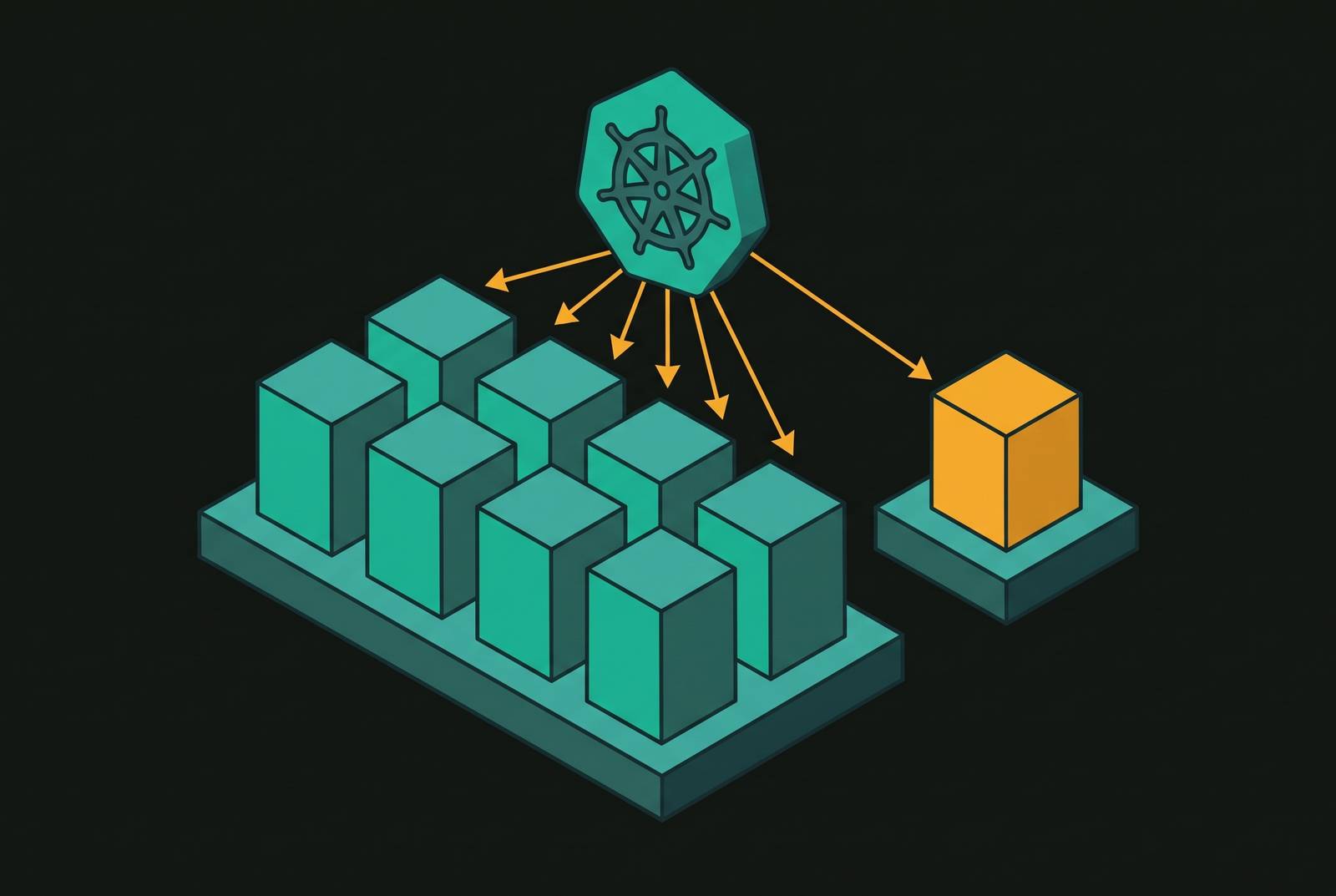
Kubernetes gives you no built-in way to send 5% of live traffic to a new version, watch error rates for a period, and pull the plug automatically if something looks wrong. That's the actual gap this piece is about: canary deployments are a well-understood pattern, but Kubernetes itself only understands replica counts, not traffic percentages, not request headers, not error budgets. Closing that gap takes layered tooling, and which layer you reach for depends on how precise your rollout needs to be.
A canary deployment routes a small slice of production traffic, typically 5 to 10 percent, to a new version and validates it against real user behavior before promoting it further or rolling it back. It's named after the birds coal miners carried underground: a canary that stopped singing meant something toxic was in the air before the miners could smell it themselves. That's the right frame for the whole strategy. Canary deployment is a detection mechanism first and a deployment pattern second.
A rolling update replaces pods progressively until every instance runs the new version, but it never holds two versions at a deliberate, configurable split, which separates it from two patterns it gets confused with. A rolling update replaces pods progressively until every instance runs the new version, but it never holds two versions at a deliberate, configurable split. It's a migration, not an experiment. Blue-green deployment switches all traffic at once from one environment to another, which demands double the infrastructure and skips the gradual validation window. Canary sits between the two: two versions running side by side, with traffic distributed on purpose and observed before the switch becomes permanent.
The standard Kubernetes Deployment object has no concept of traffic percentage. The standard Kubernetes Deployment object has no concept of traffic percentage. It manages replica counts and rollout strategy for pod replacement, full stop. It cannot hold a canary at 10% while checking error rates against a threshold, and it cannot back out on its own if those checks fail. Kubernetes runs the overwhelming majority of container workloads in production today, with 82% of container users running it in production according to Canary Deployment on Kubernetes: Progressive Rollout Explained, so that gap between "roughly ten percent of pods" and "precisely ten percent of traffic, gated on real metrics" carries real consequences at scale. The rest of this piece walks through the four layers that fill it: replica ratios, Ingress annotations, service mesh routing, and automated analysis controllers, each one built to solve what the layer below it can't.
The replica-ratio method's mechanics and limits
The simplest form of canary in Kubernetes doesn't touch any specialized tooling. Run two Deployment objects that share a common label, say app: myapp, one deployment on the stable image and one on the canary image. Point a single Service at that shared label. The Service has no idea it's routing to two different versions; it just load-balances across every pod that matches the selector.
So the stable Deployment runs myapp:1.0.0 across nine replicas, the canary Deployment runs myapp:1.1.0 across one replica, and both carry app: myapp in their pod labels. Ten pods total, one of them canary, and roughly ten percent of requests land on the new version. Want to push that to 20%? Scaling the canary Deployment to two replicas and the stable Deployment down to eight shifts the split. Every adjustment to the traffic split is a manual replica count change, not a configuration value.
That's also where the method runs out of road. It can't target specific users or route based on request headers, since the Service load-balances blind to who's asking or what version they'd prefer. Percentage granularity is capped by your replica count. With three total replicas, the closest you get to a clean split is 33% and 67%, so there's no way to land exactly on 10%. There's no automatic rollback either. Deciding the canary has failed and removing that Deployment is a manual act, and there's no metric gate holding the rollout at 10% until someone or something confirms error rates look fine.
None of that makes the method useless. It works when replica counts are low, when a service mesh is absent from the stack, and for internal tools or low-stakes workloads where imprecise traffic math is an acceptable risk. It's also a reasonable proof of concept before a team commits to mesh infrastructure it may not need yet. But once the required percentage granularity falls below what your replica count can express, or once you need to route by header instead of by chance, replica ratios stop being sufficient.
Ingress-level traffic splitting without a service mesh
Ingress-level canary moves the split out of pod math and into configuration. Instead of one Service selecting a shared label across two Deployments, you run two separate Services, a stable one and a canary one, and the Ingress controller decides how much traffic goes to each based on annotations rather than replica counts.
With ingress-nginx, that looks like a canary Ingress resource carrying nginx.ingress.kubernetes.io/canary: "true" alongside nginx.ingress.kubernetes.io/canary-weight: "10". Ten percent of traffic goes to the canary Service, full stop, independent of how many pods sit behind it. Changing the weight annotation changes the split immediately, no scaling operation required. This layer can also be combined with header-based rules, letting an internal team hit the canary directly before it's exposed to any percentage of real users.
The limitations here are just as concrete as the gains. Annotation syntax isn't part of the core Kubernetes API; it's specific to whichever Ingress controller is running, and the exact keys differ between controllers, so a canary config built for ingress-nginx won't port cleanly to a cluster running a different one. Promotion and rollback are still manual: something has to update the weight and eventually delete the canary Ingress once the rollout finishes. And there's still no native tie-in to metrics. Gating a weight increase on Prometheus error rates means bolting on external tooling, because the Ingress controller itself doesn't watch dashboards.
This layer fits teams running a compatible Ingress controller who want a real percentage instead of a replica approximation, without taking on a service mesh. It stops being sufficient the moment routing logic needs to reach past the edge, into cookies, user identity, or header-based rules applied consistently across every service in the stack, since Ingress only controls what happens at the front door.
Service mesh traffic rules: precise, per-request control with Istio
A service mesh moves the routing decision to a different point in the request path entirely: the sidecar proxy attached to every pod, rather than the Ingress controller at the edge or the scheduler assigning replicas. Every request carries metadata the mesh can inspect, and that's what makes per-request routing possible instead of per-pod approximation.
Istio implements this with two resources working together. A DestinationRule defines subsets by pod label, for instance version: stable and version: canary, turning ordinary label selectors into named targets the mesh can route to. A VirtualService then expresses the actual weighted split, say 95% to the stable subset and 5% to canary, and that weight is enforced by the mesh regardless of how many replicas back each subset. One canary pod can legitimately receive 5% of all traffic; the mesh is counting requests, not pods.
Header-based routing is a separate, additive capability. A VirtualService match block can send any request carrying x-canary: "true" to the canary subset no matter what the weight is set to. Header-based routing enables targeted access to the canary subset independently of the traffic weight setting. That's something neither replica ratios nor basic Ingress weighting can offer with the same precision.
None of this comes free. Running a mesh means a sidecar proxy attached to every pod, a control plane to operate, and a configuration model with a real learning curve. That overhead is the price of precision, weighed against the routing granularity actually required, rather than assumed as a default for every workload. Once the mesh is in place, though, something still has to decide when 5% becomes 25% and when 25% becomes 100%. That decision is what rollout controllers exist to automate.
Argo Rollouts: replacing the Deployment object with a controller that understands canary steps
Argo Rollouts doesn't wrap the Deployment object, it replaces it. The Rollout custom resource is a distinct CRD, reconciled by its own controller, and it understands canary progression as a first-class concept rather than something bolted on with annotations.
Progression is declared as a sequence of steps. A setWeight step sets the canary's traffic percentage at that point in the rollout. A pause step halts progress, either for a fixed duration like ten minutes or an hour, or indefinitely until someone issues a manual promote command. The controller works through these steps in order and won't move to the next one until the current step's conditions are met. A typical sequence: setWeight: 10, pause: 1h, setWeight: 20, pause indefinitely, waiting on a human.
By default, when traffic routing is configured, the stable ReplicaSet stays scaled to 100% for the full duration of the canary. If the rollout gets aborted, traffic snaps back to stable instantly, with no pod cold-start delay in the way. The cost is resource duplication: at peak canary weight, both ReplicaSets are fully scaled, which behaves a lot like a blue-green footprint even though the traffic split looks like canary. Argo Rollouts also supports scaling the stable ReplicaSet down as canary weight rises, which matters for clusters with high replica counts or bare-metal environments where adding node capacity mid-rollout isn't an option.
A related but distinct knob is setCanaryScale, which sets the canary's replica count independent of its traffic weight. That separation is useful: it lets a team scale the canary to full capacity for load testing while setWeight stays at zero, so no public traffic reaches it yet, or route internal testers to the canary by header while its production weight remains zero. It's also a place to get burned. Mismatched scale and weight values can leave a small number of canary pods absorbing a disproportionate share of traffic, ten percent of pods taking in ninety percent of requests, for instance, which is the opposite of what a cautious rollout is supposed to do. Setting matchTrafficWeight: true restores the expected behavior of keeping pod scale and traffic weight aligned.
Without any traffic management integration configured, Argo Rollouts falls back to the same replica-ratio math described earlier, with the same coarse granularity ceiling. Fine-grained control at low replica counts still requires wiring in a traffic layer like Istio or an Ingress controller underneath the Rollout. Version 1.10.0 shipped August 27, 2026 per the project's GitHub releases, and a critical security issue, CVE-2026-82277, disclosed in late August 2026, affected the Argo Rollouts dashboard specifically. That's a patch to prioritize, not defer. On the workflow side, Argo Rollouts pairs naturally with Argo CD, so rollout configuration lives in Git, promotions happen declaratively, and the controller continuously reconciles the cluster against whatever state Git says it should be in.
AnalysisTemplates and metric-gated promotion: automating the go/no-go decision
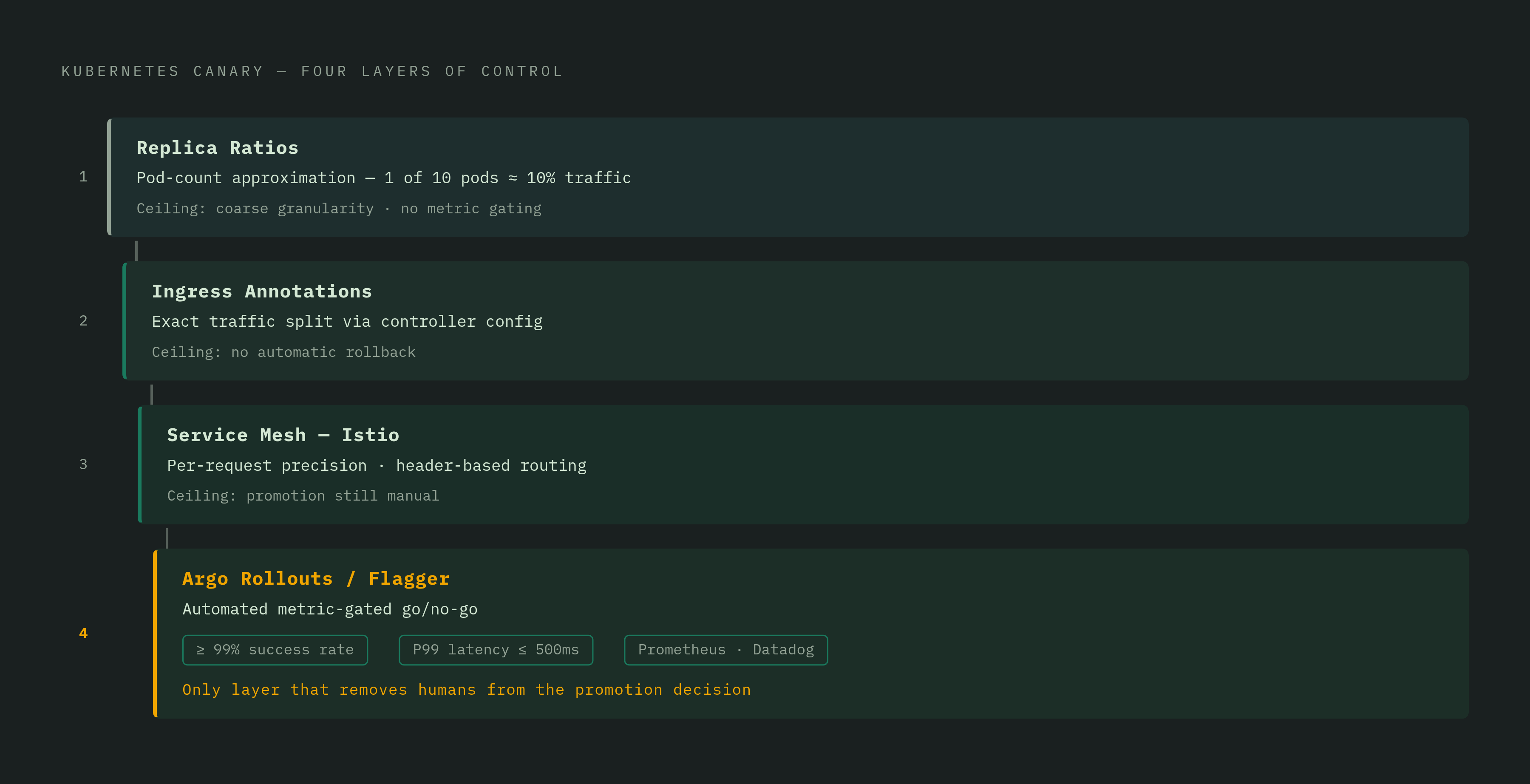
A pause step with a fixed timer still assumes a person is watching a dashboard, deciding whether error rates look acceptable, and promoting manually. That works at low deployment frequency. It stops working once a team ships several times a day and nobody has the bandwidth to babysit every gate.
An AnalysisTemplate is the fix: a CRD that queries a metrics provider, Prometheus, Datadog, CloudWatch, whatever's already in place, on a set interval, and compares the result against a defined threshold. The Rollout controller checks the analysis result before advancing past each step, so promotion becomes conditional on real data instead of on elapsed time.
Flagger's implementation makes the pattern concrete. Its Canary CRD wraps an existing Deployment and takes over both traffic shifting and analysis. A typical configuration runs analysis on a configurable interval, tolerates a configurable number of consecutive failed checks before triggering rollback, caps canary weight at 50%, and increments traffic by a configured step per successful interval. The metrics checked are exactly the ones an operations engineer would check by hand: request-success-rate held above a 99% minimum, meaning error rate under 1%, and request-duration held under a 500ms ceiling at the P99 percentile. If a request breaches either threshold at any step, the rollout pauses or aborts and traffic routes back to stable, without anyone needing to be at a keyboard when it happens.
The metrics for gating aren't limited to infrastructure signals. Conversion rate, bounce rate, and revenue per session are all valid AnalysisTemplate inputs, which matters because the engineers shipping a new version aren't always the ones who'd notice its business impact first. Wiring the CI/CD pipeline into this loop is straightforward: kubectl rollout status --timeout=10m blocks the pipeline until the rollout finishes successfully, until the ten-minute timeout expires, or until Kubernetes marks it failed via the server-side progressDeadlineSeconds setting (600 seconds by default), whichever comes first. No polling loop required on the CI side; the handoff to the Rollout controller is a single blocking command.
Multi-target and parallel canary progression across clusters and regions
Automated analysis solves the go/no-go decision within a single cluster. It says nothing about what happens when a canary needs to run consistently across several clusters or regions at once, and that's where uncoordinated rollouts create their own kind of risk: a canary that clears analysis in one region while a sibling deployment in another region is quietly failing, or users in different geographies ending up on different versions for longer than anyone intended.
Google Cloud Deploy addresses this with a controller-and-child model. A single rollout target can be made up of two or more child targets, clusters in separate regions, for example, and every child target receives the same canary percentage at the same time. Only the controller rollout can be advanced directly; child rollouts advance automatically in lockstep when the controller does. Failure handling follows a specific set of rules: if some child rollouts fail while at least one is still IN_PROGRESS, the controller stays IN_PROGRESS as well. If at least one child succeeds while others fail, the controller moves to HALTED, assuming later phases remain, or to FAILED if the failure happens during the stable phase. That HALTED state exists specifically to hand the operator a decision window: ignore the failure, retry it, or cancel the rollout.
There's an asymmetry at the job level, too. Failed jobs can only be retried inside child rollouts, never at the controller level, and the controller rollout can be cancelled outright, while individual child rollouts cannot be cancelled directly. That design keeps the controller as the single point of control for the overall rollout, while still giving each region's rollout enough independence to fail, retry, and report status without one bad cluster silently masking problems in another. It's the coordination layer that the other four layers, replica ratios, Ingress weights, mesh rules, and analysis gates, don't address on their own, because all of them were built to answer "how much traffic goes to the canary," not "how many places is this canary running, and are they all telling the same story."