Internal Developer Platform Core Components and Architecture
How to connect platform components so they actually reduce developer friction instead of adding it.
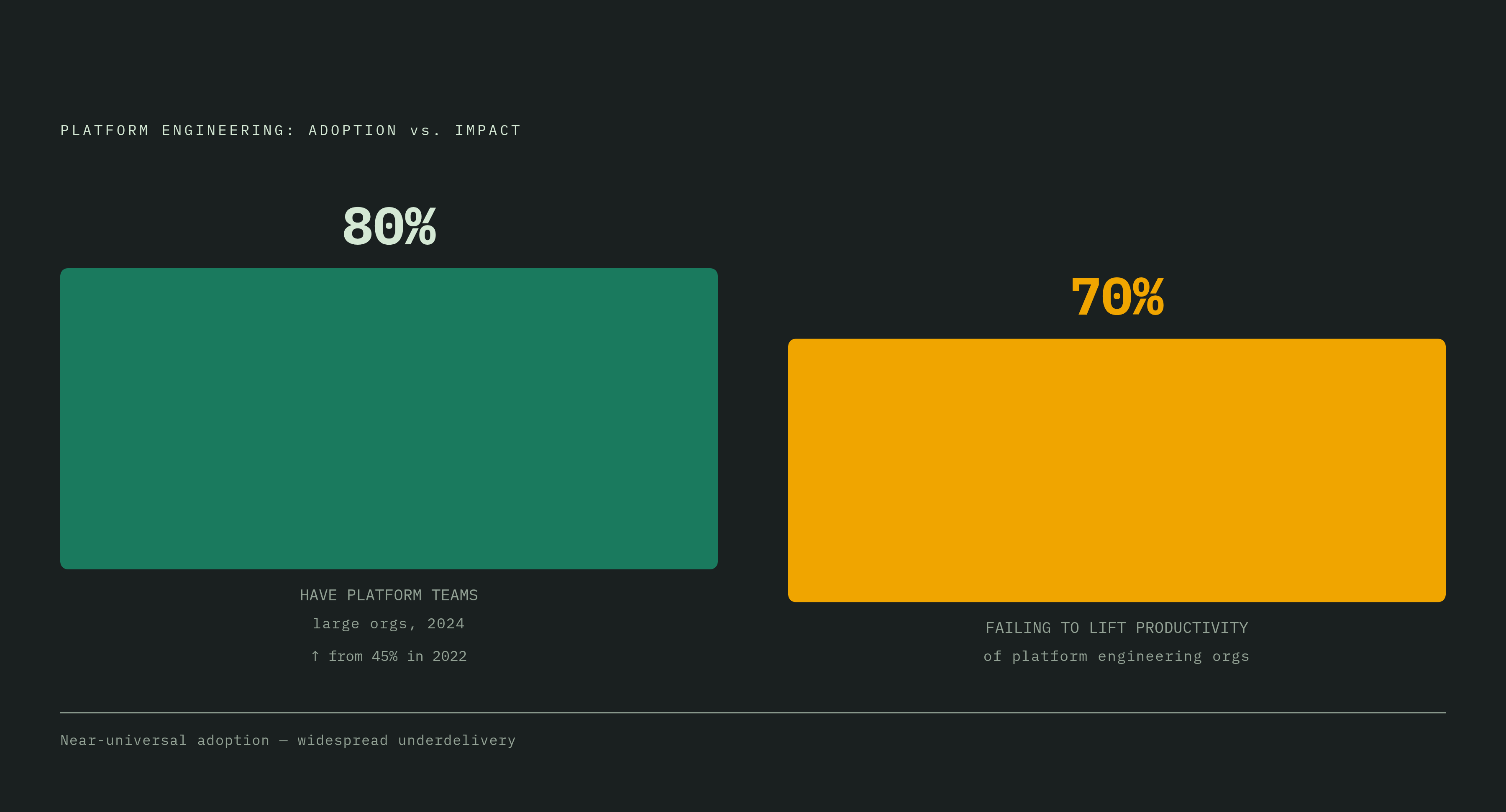
A well-designed internal developer platform doesn't emerge from assembling the right set of tools. It emerges from understanding how those tools must connect. Platform engineering has crossed firmly into the mainstream. 80% of large software engineering organizations now have dedicated platform teams, up from 45% in 2022, per Gartner. Yet 70% of organizations with platform engineering investments report their platform is failing to deliver meaningful impact on developer productivity. The components exist in most of these organizations. What's absent is the integration discipline that turns a collection of tools into a coherent system. This piece maps the core components of an internal developer platform and explains how they must interconnect, because a component that doesn't integrate cleanly with the rest produces drift and dependency, not self-service.
The central job of an internal developer platform is to create a self-service layer that absorbs infrastructure complexity while standardizing delivery workflows. Abstraction done poorly, though, is just opacity, and opacity is its own kind of failure. There is a meaningful difference between hiding the right things and hiding everything.
What belongs below the abstraction line is which cloud account is being used, which Kubernetes namespace a workload lands in, and which Terraform module fulfills a database request. What belongs above it is enough surface area for developers to reason about what they're requesting and what they'll receive. A developer should be able to declare "I need a PostgreSQL instance" and have the platform fulfill that request, whether the underlying mechanism is Amazon RDS, Google Cloud SQL, or an in-cluster operator. They don't need to know which. They do need to know what they got, what its connection semantics are, and where to find it. Most failed platforms collapse that distinction, and once you've seen it happen, you recognize the pattern immediately: a beautiful abstraction that leaves developers more confused than the raw API would have.
The "platform as product" mental model disciplines this work. The platform team has customers: the development teams who depend on it daily. It has a roadmap driven by user needs, not technology preferences. And it has an unambiguous adoption signal. If developers are bypassing the platform, going directly to infrastructure or opening tickets, the platform has failed them. Low adoption isn't a cultural failure on the part of developers. It's a product failure on the part of the platform.
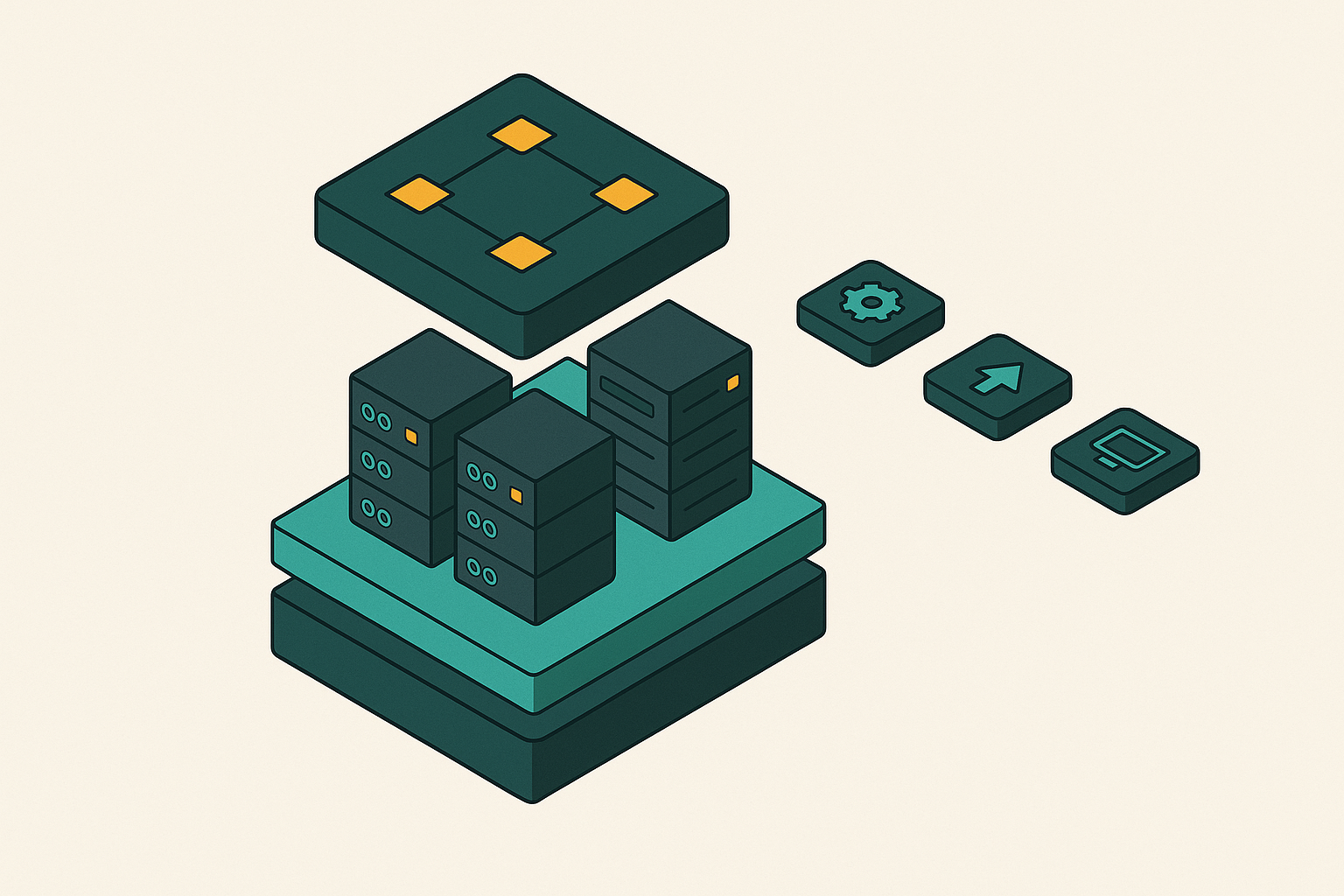
Modular design is what makes this sustainable over time. Each platform capability, CI, secrets management, observability, deployment, is delivered as a service with a clear API. This composable architecture allows individual components to evolve or be replaced without requiring a full rebuild. The AWS multi-account model illustrates the structural principle well: the IDP lives in a shared services or tooling account with controlled, policy-governed access to workload accounts. Isolation is architectural, not procedural.
Application Configuration Management as the Platform's Connective Tissue
Configuration management isn't the act of storing config files. It's the mechanism by which the platform knows what state every environment should be in and can enforce that state continuously.
When configuration is version-controlled, every change has a record, an author, and a diff. Production can be replicated exactly in staging or QA because both environments are driven from the same source of truth, not from institutional memory or undocumented manual steps. The GitOps operational model puts this into practice at scale. Git becomes the authoritative source, and the platform continuously reconciles actual infrastructure and application state to declared state. When something drifts, the system corrects it or alerts on it. The 2025 landscape reflects how thoroughly this model has taken hold. 93% of organizations are using or planning to use GitOps, and Argo CD and Flux CD, both CNCF graduated projects, are the dominant reconciliation engines.
Architecturally, configuration management must connect to three adjacent components to function properly. It must connect to infrastructure provisioning, so that environment specifications drive what gets created, not just what gets configured after the fact. It must connect to deployment pipelines, so the pipeline knows precisely which configuration to apply at which stage. And it must connect to the secrets layer, so credentials are injected at runtime from a governed store rather than hardcoded in config files that live in the repository.
Configuration drift is the characteristic failure mode, and it doesn't announce itself. It accumulates quietly. Environments that started as identical copies gradually diverge because changes were made out-of-band, outside the version-controlled path. You notice it when a bug manifests only in production, or when a security control present in one environment is silently absent in another. By then, the forensic work is genuinely miserable: hours of diff-hunting across environments that were supposed to be identical. I've been in those postmortems. The root cause is almost always the same. Someone made a change directly, it seemed harmless at the time, and six weeks later it wasn't. Configuration management is what prevents that accumulation, which is precisely why its absence propagates damage across every other component in the platform.
Reproducible Environments and Why Drift Is a Reliability and Security Problem, Not a Process Complaint
The empirical data on environment reproducibility is sobering. In a study of 5,298 Docker builds, only 6.4% of rebuilt images matched the original installed package versions exactly. Separate research analyzing 780 runs across four software containers and 13 hardware types found greater than 6% test-accuracy drift for binary classifiers and greater than 8% for LSTM models caused purely by environment changes, not by changes to the model or training data. The environment changed nothing visible and broke everything measurable. That's a reliability failure, and it's also a security problem: an unknown environment is an untrusted build environment.
The reproducible environments conversation centers on approaches offering different depths of guarantee. The Dev Containers model defines the environment in a .devcontainer/devcontainer.json file, runs it inside Docker, and integrates with GitHub Actions via the devcontainers/ci action for CI parity. It's a strong guarantee, but only as strong as image pinning discipline. The common failure mode is floating tags. A team using node:20 finds the image silently changes on the next pull. That team doesn't notice until they're staring at a flaky test that passes locally and fails in CI, and the divergence is six weeks of unpinned pulls in the wrong direction. No single visible breakage marks the moment things went wrong.
Deeper guarantees come from hash-based dependency resolution, where every package is identified by a cryptographic hash of its inputs: source code, dependencies, build flags, compiler version. Identical inputs produce identical outputs. That's a stronger statement than most teams appreciate until they've been burned by its absence. Cross-architecture compilation, building for ARM from an x86 host, becomes a first-class capability rather than a workaround. This matters concretely because macOS ARM developer machines and x86 Linux CI runners are the dominant pairing in most engineering organizations, and environments that behave differently across that boundary silently undermine CI signal.
What reproducibility requires at the IDP level isn't a single tool choice. Environments must be defined in version-controlled files. Dependencies must be pinned to specific versions or cryptographic digests. The same environment definition must govern local development, CI, and staging, rather than separate scripts maintained in parallel by different teams with different assumptions. Trustworthy deployment pipelines require knowing what environment produced the artifact. A meaningful software bill of materials requires deterministic build inputs. Reproducibility is foundational, and the components that depend on it degrade in direct proportion to how carelessly it's implemented.
Deployment Pipelines and the CI/CD Layer That Connects Code to Production
The pipeline's job in an IDP is to automate the path from committed code to running workload, with quality and security gates enforced at each stage rather than concentrated at the end. DORA's 2025 outcome data quantifies the payoff: organizations with mature platforms achieve 3.5x higher deployment frequency and 4x shorter lead times. Those gains come from removing the manual coordination that slows delivery, the ticket to provision an environment, the approval chain to run a security scan, the operational dependency to promote an artifact to production.
Environment-pipeline coupling is where many platforms quietly undermine their own value. When the CI environment diverges from the development environment, test results aren't fully trustworthy. A test that passes in CI and fails in production is worse than one that fails consistently, because it consumes confidence that wasn't warranted. The CI environment must be derived from the same definition as the developer's local environment. Teams that treat this as a convenience rather than a correctness requirement tend to learn the distinction during incidents, which is the worst possible classroom.
The specific pipeline capabilities an IDP must provide are worth naming. Self-service pipeline provisioning ensures teams don't wait for platform engineers to create a pipeline for each new service. Standardized stages, build, test, security scan, artifact publish, deploy, must include platform-enforced gates that individual teams cannot bypass. Artifact promotion is particularly critical: the same artifact that passes staging is what gets deployed to production. Rebuilding at promotion time breaks the chain of trust and reintroduces exactly the environment variability that reproducibility practices are designed to prevent. Rollback and recovery paths must be built into the pipeline design from the start, not retrofitted after the first production incident.
DORA's introduction of Reliability as a fifth metric reinforces the underlying point. Elite teams are distinguished not just by deployment speed but by how much of their work is net-new versus reactive. High rework rates, the proportion of time spent fixing defects rather than building features, frequently trace back to environments and pipelines that introduce defects rather than catch them.
Pipeline reliability also depends on the configuration and secrets layers being stable. A pipeline that reaches out to a secrets store that has drifted, or applies configuration from a branch that diverged from the expected state, will fail in ways that are genuinely hard to diagnose because the failure modes become entangled. Untangling them takes far longer than preventing the drift would have.
Software Supply Chain Security as a Structural Component, Not a Scanning Step
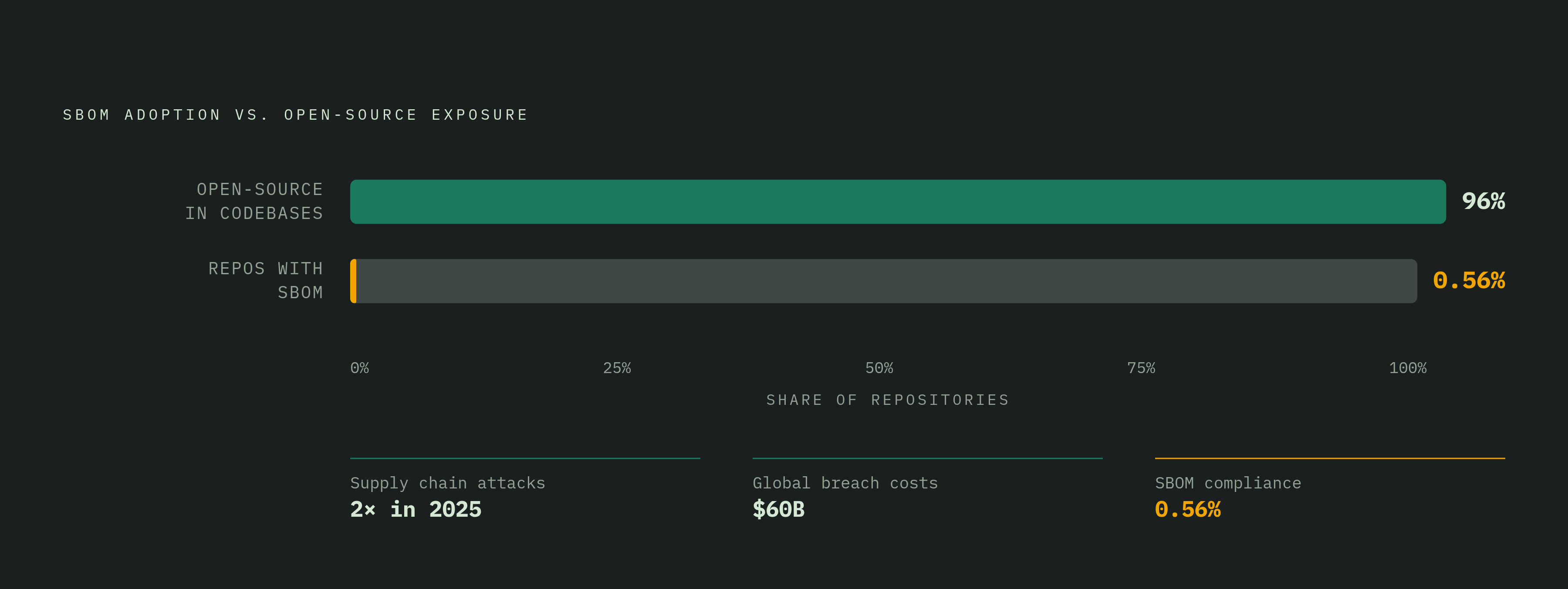
Supply chain attacks doubled in 2025. Global costs reached $60 billion. Verizon's 2025 Data Breach Investigations Report found that the share of breaches involving third parties doubled year-over-year, reaching 30%. A 2024 Harvard Business School study found open-source code present in 96% of analyzed codebases, which means a single malicious or vulnerable package can propagate through a substantial portion of the software ecosystem before detection. A September 2025 npm incident made this concrete: a self-replicating worm compromised over 500 packages by hijacking developer credentials across CI/CD pipelines. Perimeter defenses and code review were insufficient. The attack vector was the build environment itself.
The architectural response requires two complementary instruments: software bills of materials and build provenance attestations. They answer different questions and cannot substitute for each other.
An SBOM answers what is in this artifact. It's an exact inventory of every dependency, transitive and direct, that went into a build. When Log4Shell was disclosed in late 2021, organizations with SBOMs could assess their exposure in minutes; organizations without them spent days or weeks doing manual inventory. That gap, days versus minutes, is the operational argument for SBOMs in a single data point. Build provenance answers a distinct question: where was this artifact built, by what system, from what source? SLSA provenance attestations cryptographically sign this information, attesting to the build's inputs, outputs, and environment. SLSA Build Level 3 is the current bar for artifacts entering production environments with meaningful security requirements.
The adoption gap is severe. Only approximately 0.56% of popular GitHub repositories contain SBOMs created in accordance with formal security or compliance policies. Among those generating SBOMs, most are producing compliance-snapshot artifacts: generated at build time, filed away, and never acted on. A static SBOM has a low value ceiling. The value increases substantially when SBOMs are queryable, stored alongside artifacts in the artifact repository, and integrated with automation that triggers on new CVE disclosures. When a new vulnerability is published, the system should answer immediately: which of our production artifacts contain this package at this version? Without that integration, the SBOM is a document. The difference between a document and a capability is the difference between knowing you should be worried and knowing exactly what to do about it.
Regulatory pressure is raising the floor. Executive Order 14028 ties federal purchasing to SBOM and signed provenance requirements, which propagates those requirements to vendors and their enterprise customers. Open standards are the right foundation: CycloneDX or SPDX for SBOMs, in-toto and SLSA for provenance, OSV for vulnerability data. Open standards avoid lock-in and allow evidence to be shared with regulators and customers without translation overhead.
The same practices extend to machine learning pipelines, which have become a meaningful attack surface. Sonatype identified malicious packages specifically targeting the ML ecosystem in 2025. SBOMs for model dependencies, provenance for model weights, scrutiny of packages from model registries: the supply chain isn't a software-only problem, and the security architecture of the platform needs to reflect that.
Infrastructure Provisioning and the Resource Abstraction That Enables Genuine Self-Service
Provisioning is where the self-service promise either delivers or collapses. If a developer has to open a ticket, wait for a platform engineer, or navigate cloud console permissions to get a resource, the IDP hasn't achieved its stated purpose. The ticket queue is the tell. If tickets are flowing, self-service isn't working.
The declarative model is the right approach. Developers express intent: a PostgreSQL instance, a message queue, an object store. The platform translates that intent into infrastructure calls using approved templates or operators. Implementation details stay below the abstraction line. Infrastructure-as-code tools, Terraform, Pulumi, Crossplane, cloud-native operators, provide the underlying mechanism. The IDP's job is to wrap those mechanisms in guardrails and expose them through a sanctioned, self-service interface.
The separation of concerns between platform and development teams matters more than it might seem. Teams that blur it tend to pay for it, either in cost sprawl or operational bottlenecks, usually both. Platform engineers define the approved resource catalog: what can be requested, with what configuration options, within what cost and compliance boundaries. Development teams self-serve from that catalog. They get genuine autonomy within a governed envelope, not unconstrained infrastructure access and not a ticket queue. The McKinsey reference architecture presented at PlatformCon 2023, derived from analysis of hundreds of real platform implementations, treats provisioning as a first-class layer with its own API surface rather than a script library bolted onto the pipeline.
The AWS multi-account model remains the structural illustration worth understanding. The IDP lives in a shared services account with controlled access to workload accounts. Isolation is architectural. It doesn't depend on everyone following the right process; it depends on the account boundary itself.
Provisioning must be tightly coupled to configuration management. What gets provisioned should be driven by the same version-controlled definitions that govern environment state. When infrastructure and application configuration can drift independently, diagnosing failures becomes genuinely difficult. Both teams will spend time arguing about what changed before anyone looks at the actual cause. That argument is entirely preventable.
Observability, the Feedback Loop That Makes the Rest of the Platform Actionable
Observability in an IDP isn't application monitoring with a new name. It covers the platform itself. Are pipelines healthy? Are environments drifting from their declared state? Are developers encountering friction that sends them off the self-service path? These are platform questions, not application questions, and they require instrumentation at the platform level.
The three signal types serve distinct functions. Conflating them is a practical mistake you only make once before you learn to regret it. Metrics describe quantitative state over time: deployment frequency, lead time, error rates, resource consumption. Logs provide event records that support diagnosis when something has gone wrong. Traces supply request-level context that crosses service boundaries, essential in distributed systems where a failure in one service manifests as a symptom somewhere else entirely. Using only metrics is like navigating by altitude: you know you're descending, but you don't know why, and you definitely don't know how to stop.
DORA metrics are the platform's own observability layer. Deployment frequency, lead time for changes, change failure rate, and mean time to restore are the canonical measures of platform effectiveness. The platform should instrument itself against these metrics, not just application workloads. A platform team that cannot answer how its platform performs against these measures doesn't have enough information to improve it.
Observability also closes the environment consistency loop. Drift that doesn't surface in tests frequently surfaces first in production metrics: anomalous error rates or latency spikes that trace back to a dependency version difference between staging and production. Without observability, that connection is invisible, and the incident postmortem will be longer and angrier than it needed to be.
For the platform team, observability data is product management data. Which self-service paths are heavily used? Which are being bypassed in favor of direct infrastructure access or ticket queues? Where are developers spending time that should be automated? These answers drive the platform roadmap. A platform team that isn't instrumenting adoption and friction is prioritizing by intuition, which is to say they're guessing, and guessing is expensive at platform scale.
Alerting is only as valuable as the context it carries. An alert that fires without telling the on-call developer which environment, which version, and which recent change is implicated forces a diagnostic process that reintroduces the operational dependency the platform was designed to eliminate. Good observability makes alerts actionable. That distinction matters most during incidents, which is exactly when the self-service experience is under the most pressure and least likely to tolerate friction.
Developer Portal as the Interface Layer That Ties the Components Together
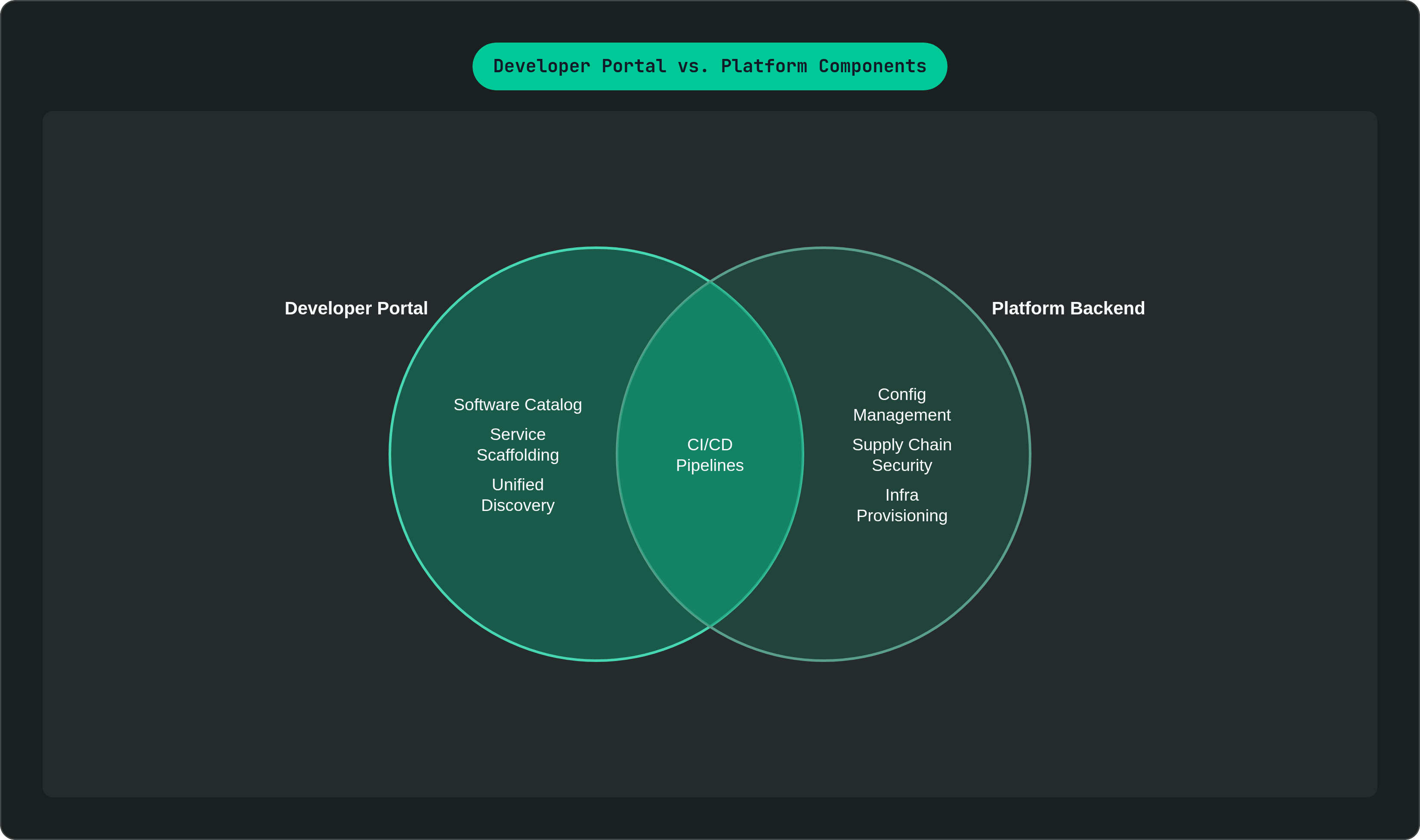
Every component described in this piece can exist in an organization without developers knowing how to navigate it. The developer portal is the interface that makes the architecture visible and usable: the unified surface through which all platform capabilities are discovered and accessed.
The portal's primary function is to reduce cognitive load. A developer who needs to provision a service, kick off a deployment, review an SBOM, check pipeline status, or understand what dependency version is running in production should be able to do all of those things from a single interface, rather than knowing which tool lives where and how to authenticate to each one. Backstage, the CNCF-incubated project originally developed at Spotify, has become the de facto foundation for this layer, primarily because its plugin architecture allows teams to surface existing tools rather than replace them. Teams that have tried to replace their existing tooling with portal-native alternatives have generally found the migration cost higher than the coherence gain. The lesson, which gets relearned regularly, is that integration beats replacement almost every time.
The software catalog is the portal's core data model. Every service, library, data pipeline, and infrastructure component the organization operates is registered with an owner, a lifecycle stage, and links to its documentation, runbooks, and dependencies. This catalog isn't a manually maintained wiki; it's fed by the same version-controlled metadata that governs the rest of the platform. When the catalog drifts from reality because ownership records aren't updated or new services aren't registered, the portal loses its value as a discovery mechanism. A stale catalog is nearly as bad as no catalog, because it creates false confidence, and false confidence in tooling is corrosive in ways that absence of tooling isn't.
Scaffolding, the ability to create a new service or component from a governed template in minutes, is where the portal delivers some of its most concrete value. A developer should be able to choose a service template, fill in a small number of parameters, and receive a repository with a configured CI/CD pipeline, observability instrumentation, and appropriate security defaults already in place. This is how the platform encodes organizational standards without requiring developers to read a style guide. The defaults are the standard, and the template produces them automatically.
The portal is where the platform's architectural coherence becomes apparent to the people who use it. The components beneath it, configuration management, reproducible environments, pipelines, supply chain security, provisioning, and observability, are what make the portal's promises real. Without them, the portal is a façade. With them, integrated and correctly coupled, it's the front door to a platform that genuinely works.