Backstage vs Custom IDP Portals for Mid-Size Engineering Orgs
Self-hosted Backstage demands three engineers for a year; managed platforms deliver value in weeks.
I've spent enough time in platform engineering standups to know how this argument usually gets settled: badly, and after the money's already spent. The choice between self-hosted Backstage and a commercial IDP isn't really about features. It's about where a platform team of three to six people spends the next eighteen months of their working lives. Get that wrong, and you find out about it the hard way, usually around month nine, when someone finally asks how many engineers are still touching the thing.
Internal developer platforms aren't a novelty anymore. Most mid-size orgs run something in this category now, and the market's grown up fast, but almost all the received wisdom about building one comes from companies with platform teams thirty engineers deep. That's not the resource picture at a mid-size shop. You're big enough that tool sprawl and slow onboarding cost real money, and small enough that standing up a Backstage team means yanking engineers off product work they'd otherwise be shipping. Port's State of Internal Developer Portals report puts the cost of tool sprawl and context-switching at something like a million dollars a year for a 50-engineer org. That number should be driving the decision, not a feature grid.
What Backstage actually is and what it requires to function
Spotify built Backstage for Spotify, at Spotify's scale, then donated it to the CNCF. People gloss over that origin story more than they should, because it explains almost everything that follows. Backstage was never a turnkey product. It's a framework you assemble, not a portal you install and forget, and missing that distinction is how projects go sideways in month two.
The core pieces, a software catalog, Software Templates (the Scaffolder), TechDocs, and a plugin ecosystem, all need configuration, not just installation. Making any of them reflect how your org actually works takes engineers fluent in React, TypeScript, and whatever your company standardized on years ago for auth, SAML or OpenID, take your pick. The plugin ecosystem runs deep and it's genuinely useful, but every plugin is a promise: somebody wires it up, and somebody keeps it alive when the next release lands. Backstage ships monthly, some of those releases break things, and the New Backend System migration that wrapped in 2024 ate months of engineering time at shops running it themselves.
Roadie's 2025 State of Backstage Report found satisfaction tracks closely with headcount: most of the "very happy" self-hosters had at least three engineers on it full-time, and the bigger deployments run crews well past that. Getting to the point where a new hire can push a commit and watch it deploy through the portal takes most of a year, typically. Skip the ongoing curation and the catalog rots into a graveyard of stale service entries nobody trusts. External adoption numbers routinely land nowhere near what Spotify sees internally. Makes sense. Spotify built this for Spotify.
The real cost of self-hosting Backstage at mid-size scale
Open source doesn't mean free. It means the cost moves into headcount, and headcount is the one thing a mid-size platform team never has enough of.
A functional deployment needs a floor of three to five dedicated engineers, sometimes five even at orgs still growing into themselves. That team owns infrastructure, upgrade cycles, the search index, and a running backlog of plugin work. Every hour there is an hour not spent on product engineering, because platform and product headcount come out of the same bucket at this size. At a hundred-engineer org, year one alone runs into a substantial six-figure to low seven-figure commitment counting salaries, before you touch infrastructure spend or the upgrade tax.
The dollar figure matters less than what it stands for. Three senior engineers on Backstage for a year are three senior engineers not shipping features, not fixing CI/CD flakiness, not solving the onboarding friction that's bleeding the org money today. And the tax doesn't stop after year one. Breaking changes land on schedule, and a mid-size team can only defer them so long before the security debt comes due all at once. This is the part the "Backstage is free" crowd leaves out. The license costs nothing. Staying on the hook to keep it running, and keep it current, costs quite a lot.
Commercial and managed IDPs: what the SaaS alternatives actually trade away
The commercial field has matured to the point where mid-size orgs have real, distinct options now. Port leans low-code and turnkey, built for fast cataloging and self-service actions, a solid fit if you want to show value in weeks rather than quarters. Cortex centers on service quality scorecards and operational maturity; Forrester's 2024 Total Economic Impact study pegs its pricing around $65 per user per month at scale. Humanitec sits closer to platform orchestration than portal, defining and running workloads instead of just displaying them. Roadie takes a different tack entirely: managed Backstage, the full open-source plugin ecosystem (211 plugins at last count) without asking you to staff the infrastructure, at roughly $22 per developer per month.
The time-to-value gap between any of these and self-hosted Backstage is not subtle. Setup drops from months to hours or days, and you feel that gap hardest the moment a new engineer tries to push a first commit.
The real cost of going commercial isn't the subscription line, though. It's the lock-in. Proprietary data models make migration miserable if a vendor gets acquired, pivots, or prices you out. You're also boxed into whatever the vendor builds or supports; the sprawling community plugin ecosystem that makes Backstage worth the trouble simply doesn't exist behind a closed platform. A few orgs that bet on the wrong SaaS vendor a couple years back are now staring at a full rip-and-replace, which is precisely the outcome this whole decision exercise is supposed to prevent.
Managed Backstage sits in a middle ground worth taking seriously. You keep the open-source ecosystem and its ongoing development, you hand the infrastructure and upgrade burden to someone else, and you trade away some control for a much lighter engineering tax. Headcount-intensive versus subscription-based: that's the real comparison, and below a certain scale, subscription wins on total cost of ownership before opportunity cost even enters the math.
What onboarding and developer adoption actually reveal about each path
Adoption is the number that tells you whether any of this was worth doing. A portal nobody opens is sunk cost dressed up as infrastructure.
The adoption gap in self-hosted Backstage is well documented at this point. Organizations outside Spotify see adoption rates a fraction of what Spotify gets internally, because the tool was shaped around Spotify's workflows, not yours. Onboarding is where this stops being an abstraction. Without a working IDP, a new engineer spends their first weeks hunting through scattered docs and unclear service ownership before shipping anything real. Manual onboarding generates a steady stream of support tickets per new hire in just the first two weeks; a functioning self-service IDP should push that number close to zero.
The best onboarding setups in 2026 share four traits. Self-service environment provisioning. Automated role-based access. A catalog that answers "where does this live and who owns it" without a Slack message to some poor soul on the platform team. A first-commit target measured in hours, not weeks. There's a retention angle here too, one that gets underweighted constantly: a meaningful share of developer turnover happens in the first 90 days, and replacing an engineer costs more than a year of any IDP subscription. Adoption failure isn't just a productivity problem. It's a retention risk with a dollar figure attached to it.
A Backstage rollout that takes most of a year to reach production, then lands at weak adoption, hasn't solved the onboarding problem. It's deferred it, while quietly eating the platform team's capacity the whole time. Commercial IDPs, with opinionated defaults and fast setup, have a structural edge here: less configuration means less that's half-broken when a new hire shows up on day one.
The environment layer that most IDP comparisons skip entirely
Nearly every comparison treats the portal as the whole system: catalog, scaffolding, self-service actions, done. But the portal is closer to the steering wheel than the engine.
The engine is what actually happens when a developer follows the golden path and provisions an environment. If that environment doesn't match what CI runs, or what production runs, the onboarding promise collapses at the exact moment it's supposed to matter. This isn't hypothetical. Malka et al.'s 2026 study of Docker builds found only a small fraction of rebuilt images matched the original installed package versions exactly, meaning bitwise reproducibility across builds was close to nonexistent in practice. A portal provisioning inconsistent environments has automated "works on my machine" and given it a nicer coat of paint, not solved it.
Nix-based tooling, Devbox and Flox among them, works one layer down, below the portal. Exact dependency specification means a developer's laptop, the CI runner, and production all resolve to the same versions, not close, the same. "Clone and go" onboarding stops being a pitch deck slide and starts actually happening, no arcane setup wiki, no dependency roulette. Locked, content-addressed dependencies also shrink supply chain exposure, which matters more each year now that provenance and SBOMs are things auditors and customers actually ask about. Flox, built on Nix, manages dependencies down to the package level, generating SBOM and provenance as part of the workflow instead of bolting it on after the fact.
The IDP decision and the environment tooling decision are separate calls, but they don't stay separate for long. Pair a well-chosen portal with reproducible environments and you actually deliver on the onboarding and CI reliability the portal promised. Skip the environment layer and the portal is decoration.
The organizational signals that point toward each path
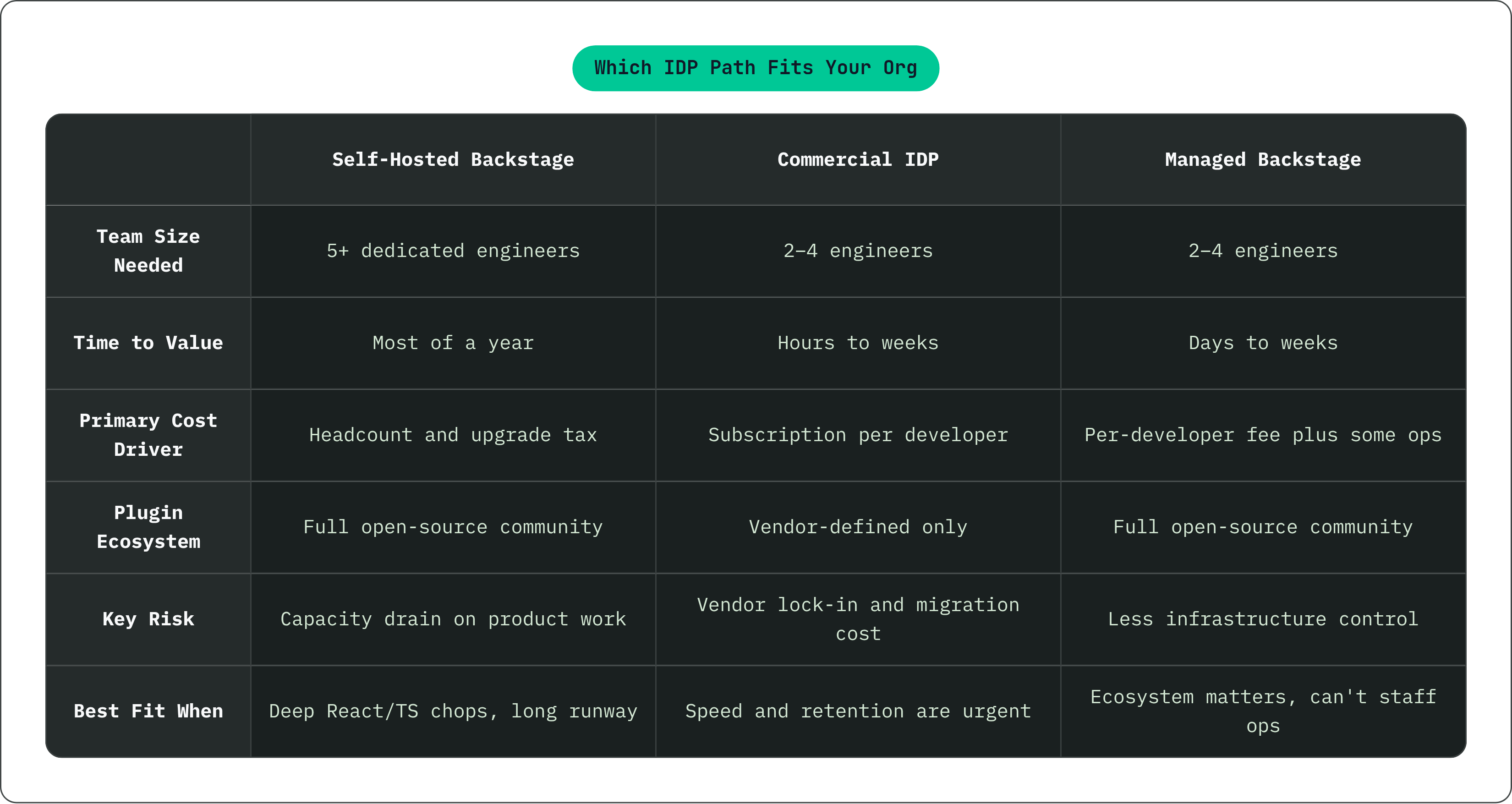
Strip the feature comparisons away and three things decide this: how much platform headcount you actually have, how mature your governance is, and how much of the portal's value you need now versus in two years.
Self-hosted Backstage makes sense when the platform team runs five or more engineers with runway to spare without starving product work, when there are integration needs specific enough to the business that no vendor covers them, when the team already has deep React and TypeScript chops, and when leadership will accept a slow first year in exchange for owning the platform outright by year three.
A commercial IDP, Port or Cortex or something in that lane, fits better when the platform team is two to four engineers and onboarding speed is the priority; when the org needs to show value within months, not a year, whether that's for internal credibility or because retention is already bleeding; and when the vendor's out-of-the-box integrations line up with what you actually need. The tradeoff is explicit: give up community plugin access, accept some migration risk, get speed and a lighter operational load in return.
Managed Backstage fits a narrower case. The open-source ecosystem's breadth genuinely matters to you, but the org can't credibly staff three dedicated engineers to keep it running, and paying per-developer for upgrade management and support beats taking on vendor lock-in.
Whichever path gets picked, the discipline matters more than the tool itself. DORA's 2024 research found orgs that treat their platform as a product, built for users, with feedback loops and iteration, saw measurably better developer satisfaction and delivery performance than orgs treating it as internal plumbing. The golden path needs to stay paved, not enforced. Developers need room to step off it when the situation calls for it, because a rigid platform kills the trust adoption depends on.
Making the call: a checklist mid-size orgs can actually use
This whole exercise exists to surface hidden costs before you commit, not after. Every path here has them. And the regret cases share one trait every time: the cost was knowable in advance, and nobody bothered to look closely enough.
So look closely. How many platform engineers can actually be dedicated to this without slowing product velocity, and for how long can that hold? What's the real time-to-value requirement; if leadership wants impact inside a year, self-hosted Backstage is a risky bet. Which integrations are truly non-negotiable, and does a vendor already cover them? Is the org ready to eat the migration cost if a vendor gets acquired or reprices hard? And has anyone actually addressed the environment layer, given that a portal sitting on top of drifting environments doesn't remove inconsistency, it automates it?
Reframe the question. Not "which portal is best," but "where does this team create the most leverage." For most mid-size orgs, the answer favors whichever path reaches real adoption fastest over whichever path looks best on a roadmap slide. A lot of IDP investments never produce a measurable productivity gain, and the thread connecting most of them is that nobody defined success before they started building. Define it first, adoption rate, time to first commit, support tickets per new hire, whatever fits, and measure it from week one, not after the platform team decides to declare victory.
The environment and supply chain layer deserves the same upfront scrutiny as the portal choice. An IDP that provisions reproducible, provenance-tracked environments, natively or through something like Flox, actually delivers on the onboarding and CI reliability it promises. One that skips it is making a promise it can't keep.
The Backstage-versus-custom decision is answerable. It's just only answerable once the org has been honest with itself about platform team capacity, the real timeline, and what success looks like twelve months out, not what looks good on a slide today.