Developer Self-Service Environments Without Cluster Access
Kubernetes now runs in production at 82% of organizations surveyed in the CNCF's 2025 Annual Cloud Native Survey, up from 66% two years earlier. Most developers at those same organizations still can't deploy anything without filing a ticket first. That gap, between how far Kubernetes has spread and how little of it developers can actually touch, is what this piece is about.
Nobody on a platform team is hoarding access out of spite. I've sat in retros where someone vents about "gatekeeping," and it's almost never true; the real issue is structural. There's no safe middle ground between "developer has zero access" and "developer can do anything a cluster admin can do." Namespace requests, RBAC changes, new environments all queue behind a platform engineer who's already juggling three Slack threads and an on-call rotation. That queue becomes the speed limit on how fast software ships, whether the org has five developers or five thousand.
So the real question is how you grant self-service without handing over the keys to the cluster itself.
What self-service without cluster access actually means in practice
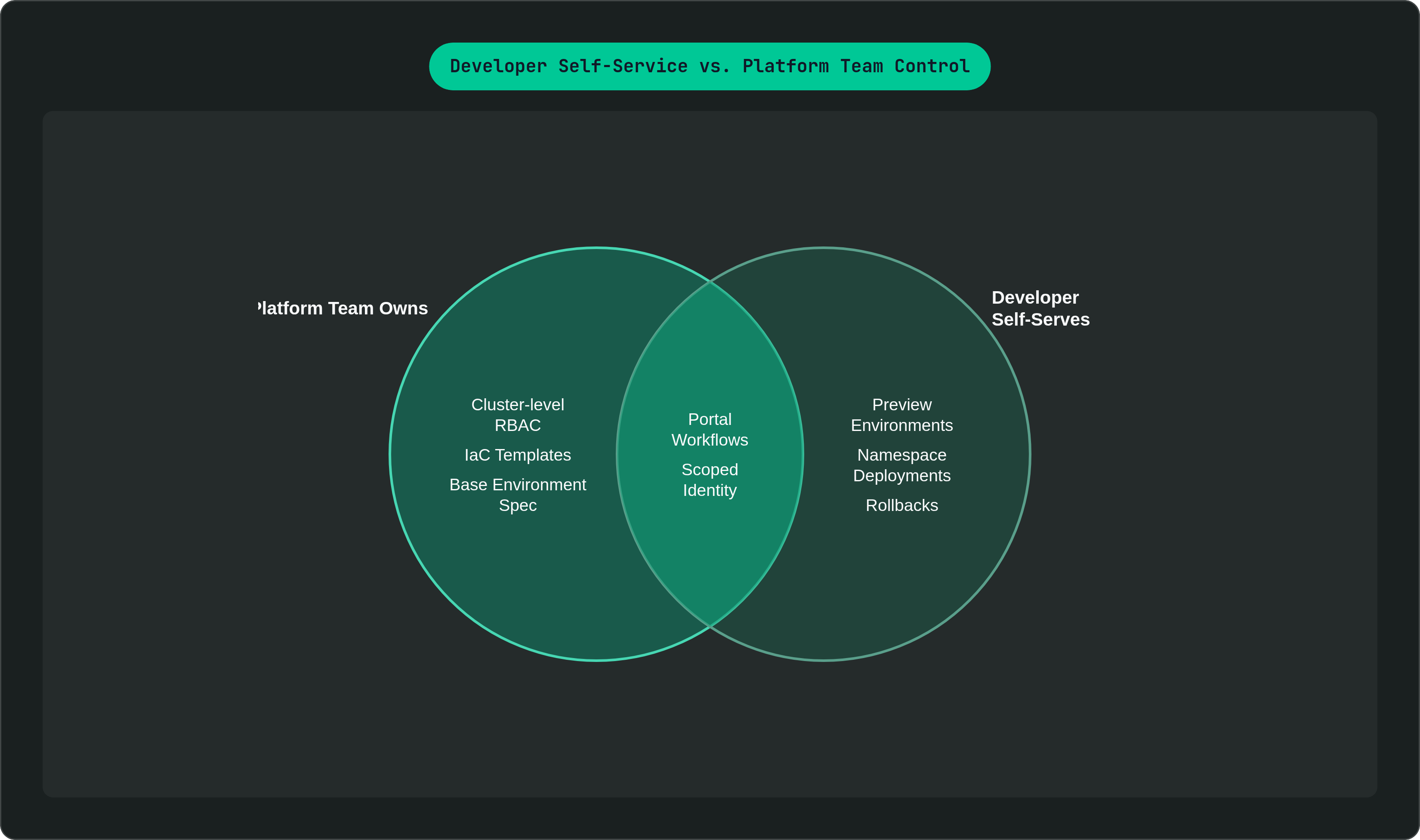
Platform and SRE teams still own how things get done. What changes under self-service is who kicks things off.
A developer provisioning infrastructure through a pre-approved, code-defined template counts as self-service. So does spinning up a preview environment from a CI/CD pipeline, or deploying into a namespace already scoped to their team without touching kubectl, or rolling back to the last known-good build without waiting on someone else to type the command.
What stays off the table: direct kubeconfig access, cross-namespace operations, cluster-level RBAC edits, infrastructure teardown outside an approved workflow. The access model usually runs through a scoped identity, a personal access token tied to a specific role, with the cluster itself invisible underneath it. The developer gets what they need to ship code. The platform team keeps the walls that make handing over the key safe in the first place.
How platform teams encode safe boundaries into tooling rather than enforcing them by hand
The boundaries can't live in a wiki page nobody reads, or a pinned Slack message that scrolls off after a week. They have to live in the tooling, and that usually means a few layers stacked on top of each other.
The base is infrastructure-as-code: Terraform modules, Helm charts, templates that are pre-approved and reproducible by design. RBAC and policy-as-code sit on top, baked into the templates rather than bolted on after the fact, so governance travels with the template instead of depending on someone remembering to apply it later. The developer-facing layer is a self-service portal, something like Backstage, Port, or Cycloid, hiding the complexity of kubectl while keeping operational visibility intact for whoever still needs to see what's running.
The portal is where a platform's intent turns into a developer's action. Click "new environment" and you're running a workflow the platform team already designed and vetted, rather than improvising against a live cluster and hoping for the best. Backstage has become something of a default reference point here; over 2,000 enterprises had tried it as of 2025, though most teams end up customizing the portal layer heavily rather than running it out of the box. The design principle underneath it is narrowing: the portal's surface shrinks to exactly what a developer is supposed to do, which makes misuse structurally harder to pull off rather than merely discouraged. Write the rules once, and developers operate inside them freely.
The platform engineering adoption curve and what it reveals about where most teams still struggle
Platform engineering has moved fast. A Google Cloud and ESG survey of 500 platform teams found 55% adoption as of 2025, with 90% of those teams planning to expand further. Gartner projects 80% of large software engineering organizations will have a dedicated platform engineering team by the end of 2026, up from 45% in 2022.
Adoption is outrunning maturity, though, and that's its own story worth sitting with. The fourth State of Platform Engineering Report, published January 2026 off 518 surveyed engineers, found more than half of companies already running multiple platforms segmented by team: separate setups for frontend, backend, data or AI work. "One platform to rule them all" has quietly died in practice, even if it's still alive in vendor pitch decks somewhere. Close to 30% of platform teams reported tracking no success metrics at all. No DORA metrics, no developer satisfaction data, no cost benchmarking. They built the thing and never checked whether it works.
That gap costs something real. The same Google Cloud and ESG survey found the most mature platform adopters sped up time-to-market at more than double the rate of less mature ones. The differentiator isn't which portal a team picked; it's whether the environments that portal hands out are actually identical every time, for every developer, in every context. That's where most self-service rollouts quietly fail: the portal works, the template runs clean, but the environment it produces this week isn't the one CI is running, or the one a teammate provisioned last Tuesday.
Why environment reproducibility is the load-bearing mechanism, not a nice-to-have
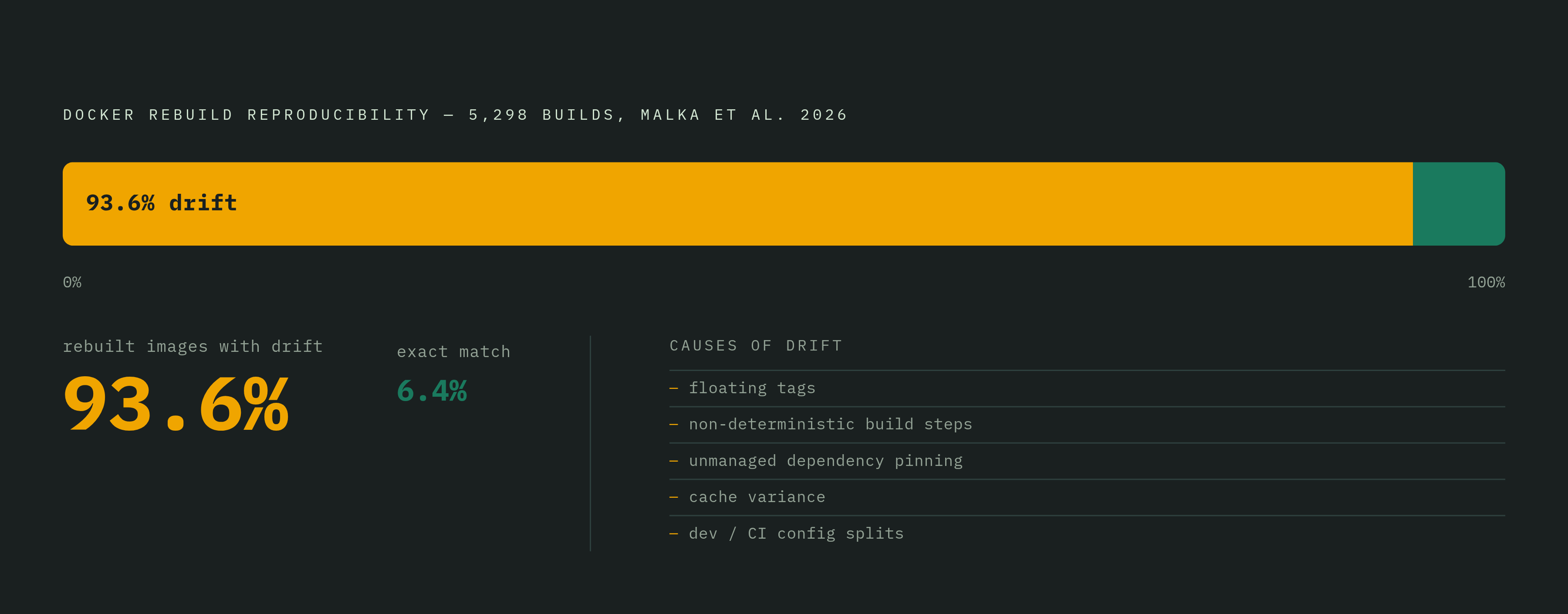
Here's how bad the drift actually gets. A January 2026 study by Malka et al. looked at 5,298 Docker builds and found that only 6.4% of rebuilt images matched the original set of installed package versions exactly. Rebuild the same Dockerfile and, the overwhelming majority of the time, you get something subtly, or not so subtly, different.
The causes are mundane. Anyone who's chased a "works on my machine" ticket will recognize them: build steps that aren't deterministic, timestamps baked into layers, cache contents that shift run to run, dependency pinning nobody enforced so a version drifts upward the moment an upstream package publishes a patch. Add a structural split on top, developer workstations on one configuration, CI on a completely separate one maintained by different people, and the two drift apart slowly, invisibly. The Reproducible Builds project has documented this for years: tool versions, OS assumptions, file paths, locale settings, even time zones shape a build's output, and almost none of it gets managed in a typical workflow.
For self-service, this is a serious liability rather than a minor annoyance. When a developer provisions an environment on demand, any drift in that environment means the exact consistency guarantee self-service depends on disappears at the one moment it needed to hold. If what a developer spins up doesn't match what CI runs, the platform hasn't delegated anything safely. Reproducibility is what lets a platform team trust that what got provisioned is what they actually designed. Take it away, and everything built on top of it stops meaning what it's supposed to mean.
How functional package management with Nix enforces reproducibility at the dependency level
Nix takes a different approach than most tooling in this space. A functional package manager treats every build as a pure function of its declared, transitively hashed inputs. Same inputs, same output, every time, with no exception carved out for "well, it depends on what's already on the machine."
Every package gets identified by a cryptographic hash computed from its inputs: source code, every dependency, build flags, even the compiler version. There's no ambient environment sitting around to quietly contaminate the result, because the build can't see anything outside its declared inputs. That isolation happens at the kernel level, not through convention or a linter warning someone might ignore. One underrated consequence: because the whole build graph is explicit and known ahead of time, targeting a different CPU architecture, building for ARM from an x86 laptop, say, becomes a normal operation instead of a fragile cross-compilation script duct-taped together per project.
Docker, by comparison, can encode non-determinism in several places at once: layer caching that behaves differently depending on what ran before it, floating tags like :latest pointing somewhere new every time someone rebuilds, network calls made at build time that fetch whatever happens to be live that day. Run the same Dockerfile twice and you can get two different images. An environment spec built on Nix works more like an actual contract: the same spec produces the same environment, on every developer's machine, in every CI run, indefinitely.
What platform teams define and what developers self-serve when Flox is the environment layer
Flox builds on Nix and carries that same reproducibility guarantee across the whole path, from a developer's first commit through to production: one declared environment spanning laptop, CI, and deployment, with no drift creeping in between stages.
The platform team's job, in this model, is to define the base environment once (tools, exact versions, dependencies, configuration) and publish it as the governed starting point everyone builds from. The developer's job is simpler. They activate the environment and Flox handles the rest, replacing the sixteen-step README that's three months out of date, the folklore passed down during onboarding, and the quiet divergence between what the platform team intended and what actually runs on someone's laptop. A new hire, or a CI runner spinning up for the first time, activates the exact same environment the platform team shipped.
Because Nix hashes every dependency as a content-addressed input, the full dependency graph is known the moment the environment is defined, not reconstructed later by scanning a finished artifact. SBOMs and provenance records fall out of that structure automatically, arriving as a byproduct of the build rather than a separate compliance step bolted onto the end of the pipeline. That rigor extends naturally to the AI coding agents showing up in CI pipelines now, too: an agent activating a governed Flox environment operates under the same guarantees a human developer does, rather than running loose in whatever ambient context happened to sit on the runner. Platform teams aren't locked into one rigid environment for every team, either. They can publish a base and let individual teams extend it for their own project's needs, without breaking the reproducibility guarantee or requiring a platform engineer to sign off on every tweak.
How reproducible environment boundaries address software supply chain risk in self-service workflows
Supply chain attacks more than doubled globally in 2025. Over 70% of organizations reported at least one incident tied to third-party software that year, and the global cost of these attacks reached an estimated $60 billion. Self-service, built on unlocked environments, makes this worse: a developer provisioning something that floats on a :latest tag is a dependency injection point that no amount of portal-level governance can see, let alone stop.
The environment foundation matters more than most teams treat it. Standard public base container images typically ship with 50 to 60 known CVEs baked in before anyone's written a line of application code; minimal, source-built images cut that down to single digits. That's a security decision, made or not made, at the moment someone picks a base image, usually without anyone thinking of it as a decision at all.
Locked, content-addressed dependencies shut down the most common attack paths almost by construction. Dependency confusion attacks don't work when a hashed input can only ever resolve to one specific artifact. Tag mutation attacks, where a floating tag gets silently redirected to a poisoned image, can't happen when there's no floating tag to begin with. Ambient contamination, where a package quietly pulls in some unspecified transitive dependency nobody asked for, gets blocked by kernel-level isolation. SBOMs settle into being a structural fact about the build rather than a checkbox exercise run before an audit; when every dependency is a declared, hashed input from the start, a machine-readable inventory of the build exists automatically, instead of getting generated under deadline pressure the week before a review.
This isn't optional anymore, either. U.S. Executive Order 14028 and the EU's Cyber Resilience Act have both pushed SBOMs and provenance data from nice practice to operational requirement. Teams that build this into the environment layer satisfy that requirement at the point where the environment gets defined, instead of scrambling to reconstruct it at audit time.
What the self-service model looks like end-to-end, and where it breaks down without the right foundation
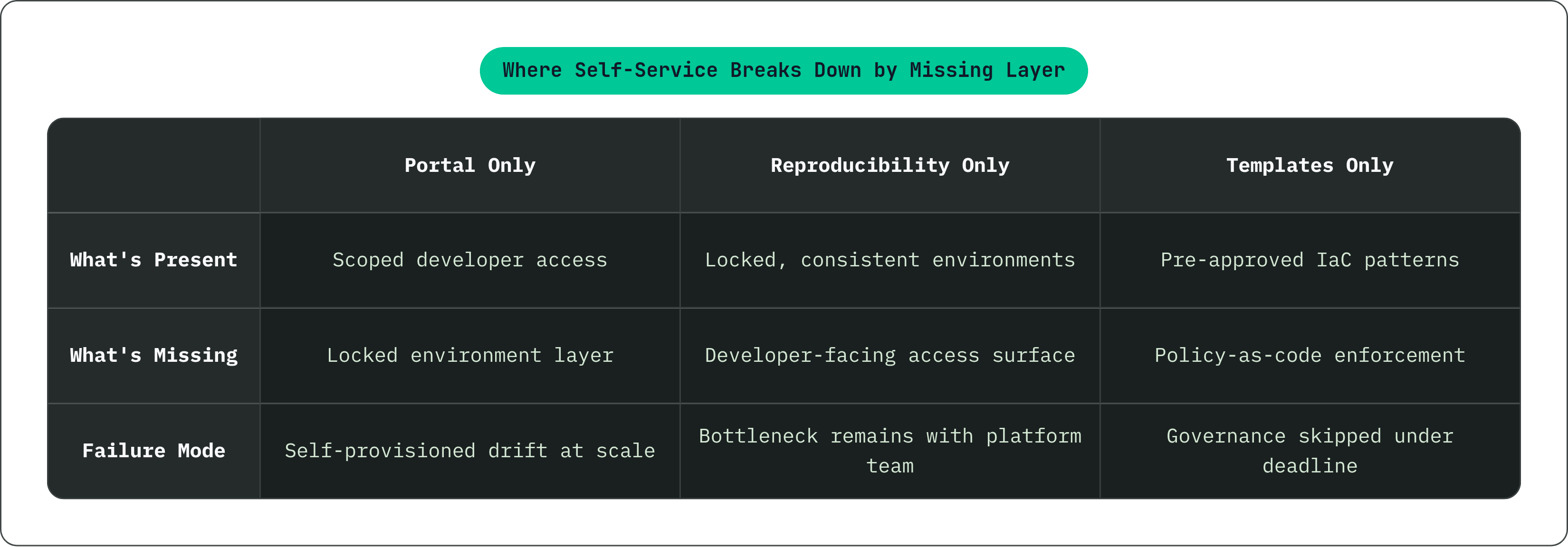
Put the whole thing together and the shape of a working system gets clear enough. The platform team defines the IaC templates, the RBAC policy, and a base environment spec with dependencies locked down. The portal exposes a scoped, identity-gated surface where developers provision exactly what the platform designed for them, nothing more. The environment layer guarantees that what gets provisioned matches what CI runs and what the platform team already validated: no drift, no ambient surprises. Provenance travels with the artifact the whole way through, so SBOMs and dependency graphs sit there, ready at any audit point, instead of getting reconstructed after the fact under time pressure.
Where does this break, then? A portal without a locked environment layer gives developers real delegation, but the consistency guarantee underneath it is fiction; they're self-provisioning drift and calling it self-service. Reproducibility without a portal solves the consistency problem but leaves the original bottleneck fully intact, since developers still need a platform engineer to hand them access. Templates without policy-as-code push governance back into documentation and human review, which means it gets skipped, forgotten, or quietly overridden the week before a deadline.
That chunk of platform teams tracking no success metrics at all has no way of knowing whether their self-service model works, or whether it's just accumulating invisible drift, one provisioned environment at a time. Reproducibility carries real weight here; it's the property that makes the portal, the RBAC, and the templates actually worth trusting. Take it away, and delegated control quietly turns into inconsistency, distributed at scale and moving fast.
DORA's 2025 research found organizations with mature platforms hit 3.5 times higher deployment frequency and 4 times shorter lead times than their peers. Most of that gap comes down to one question, asked and re-asked at every layer of the stack: does the environment hold, or doesn't it.