npm CI vs npm Install in Reproducible Build Pipelines
npm ci enforces exact dependency versions; npm install allows silent version drift.
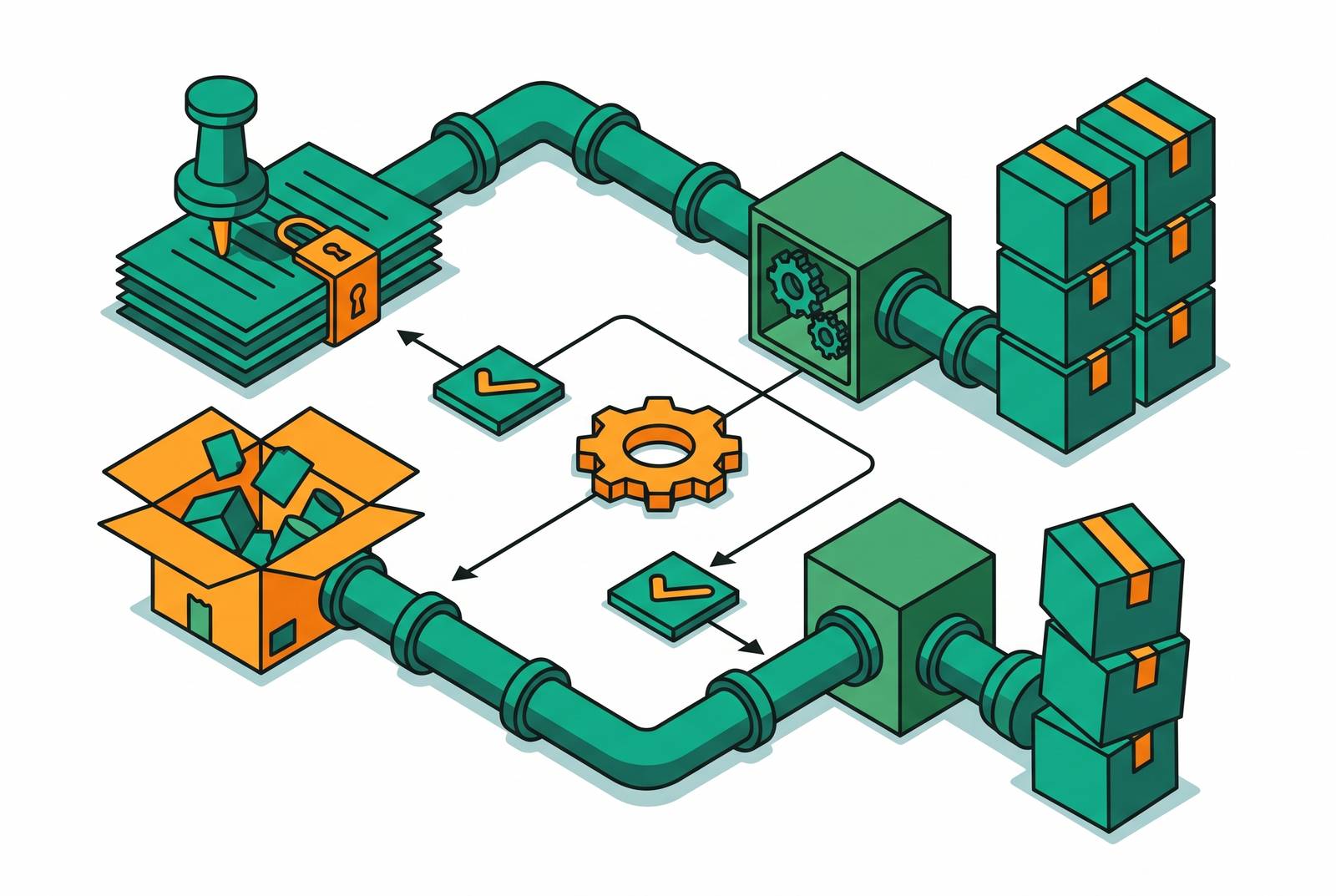
npm install and npm ci look like two ways of doing the same thing, but they encode two different philosophies about what a build is allowed to depend on. A developer who runs npm install on a Monday and a teammate who runs it on the following Friday can end up with different versions of a shared package in node_modules, even though neither of them touched package.json. That gap exists because the two commands have a fundamentally different relationship with package-lock.json: one treats it as a starting point, the other treats it as law.
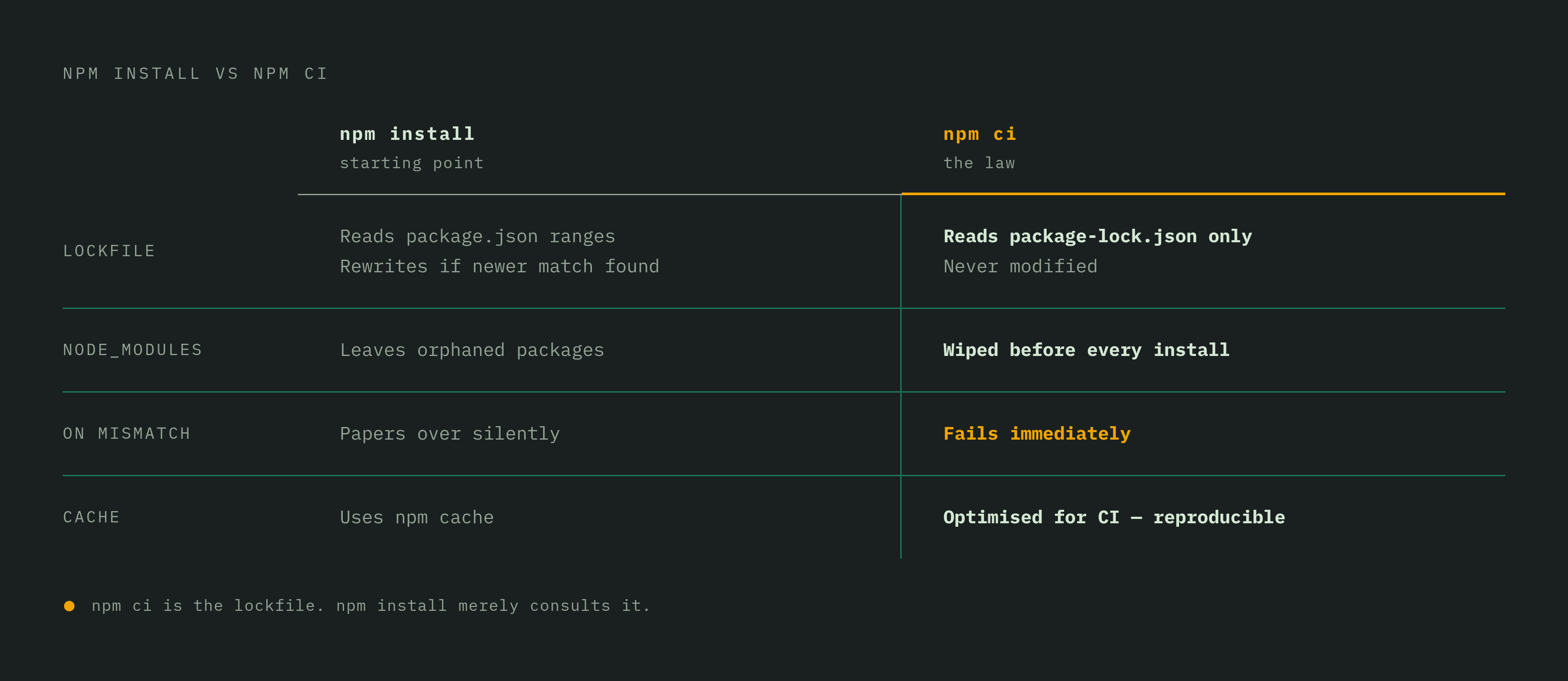
npm install reads the version ranges in package.json, resolves them against whatever is currently available in the registry, and rewrites the lockfile if a newer version satisfies the range. The lockfile follows the install. npm ci works the other way: it reads package-lock.json exclusively, installs the exact versions pinned there, never modifies the lockfile, and fails immediately if package.json and package-lock.json disagree. If you install a package and later remove it from package.json but never clean up node_modules, it stays there with npm install, orphaned and still loaded. But npm ci wipes node_modules on every install, so a dependency the lockfile doesn't declare can't survive. The choice between the two commands is a decision about whether your build is allowed to change behavior without anyone telling it to.
How environment drift compounds silently across a team
Used in a shared workflow, npm install doesn't fail loudly. It drifts quietly, so the drift adds up across people, machines, and time, and nobody can say which combination of versions actually produced the build now running in production. It is a structural property of a command that resolves versions fresh on every machine it touches.
One source of drift is obvious once named but easy to miss in practice: different npm versions on different machines can change the format of the lockfile even when package.json has gone untouched. A team running npm 8 on one laptop and npm 10 on another will see lockfile churn that has nothing to do with the dependencies themselves, and everything to do with which npm binary wrote the file. The fix is mechanical: pin the Node and npm versions a project expects with a.nvmrc file or an engines field in package.json, so the tool producing the lockfile is as fixed as the lockfile it produces.
A second, more dangerous drift pattern occurs when someone bumps a version range in package.json but forgets to commit the regenerated package-lock.json. If you run npm install against that mismatch, it will silently resolve a new dependency tree to paper over the gap, so the next person who pulls the branch gets code nobody tested. But if you run npm ci against the same mismatch, the build fails outright, because it treats any disagreement between package.json and package-lock.json as a hard error, not something to patch over. The explanation offered there is the core of the problem: npm install can modify the lockfile depending on local configuration or environment state, and npm ci removes that variable completely by refusing to touch the lockfile.
None of this works if you don't keep the lockfile itself under version control. Committing package-lock.json is not optional for any team that wants reproducible builds: the file records the exact resolved version of every package, including every nested dependency, along with integrity hashes for each one. If a project adds package-lock.json to.gitignore, a mistake you still see in the wild, it gives up the entire reproducibility guarantee the file exists to provide. Flox declares all build and runtime dependencies once in a manifest and enforces bit-for-bit reproducibility across every environment, closing off the version drift that npm install permits by design, the same way npm ci enforces a single, immutable source of truth in the lockfile.
Why npm ci Is Faster in CI Pipelines
npm ci isn't just the more correct choice in automated environments, it's also the faster one, and the speed comes directly from the same strictness that makes it reliable. Skipping dependency resolution entirely, rather than recalculating a tree that a human already resolved once, is what removes the overhead that slows npm install down.
In CI pipeline environments, npm ci consistently completes faster than npm install, and the gap widens further when node_modules is cached between runs. You can see this effect clearly in Docker layer caching. When package-lock.json hasn't changed since the last build, Docker skips the npm ci layer entirely on the next build, reusing the cached layer instead of touching the network or the filesystem again. npm install doesn't get the same benefit, because it may still re-resolve part of the dependency graph even when the lockfile is unchanged, which invalidates the cache and forces Docker to rebuild the layer anyway. The practical gap this produces in real Docker builds is large: a cached run can complete in roughly 2 seconds, while a cold run without that cache takes many times longer. Caching behavior, not the install step itself, ends up determining how long a pipeline actually takes to run.
This isn't a theoretical benefit. The Syncinary CI issue #83, opened September 14, 2026 and marked Done, documents a team making exactly this change: swapping npm install for npm ci in.github/workflows/ci.yml, as a single-line edit. The result was reproducible builds, faster pipeline runs, and lockfile drift caught early instead of in production, and speed is the argument that removes the last objection from teams worried that correctness comes at a cost.
The Lockfile as a Security Boundary
Up to this point, the two commands have differed mainly in reliability. It's also about what's allowed into the dependency tree in the first place, because unrestricted version resolution opens a door that a strict install closes. A package.json file specifies version ranges, not exact versions, and npm install will accept any release that satisfies the range it's given. So if a supply chain attacker publishes a malicious minor or patch version that technically satisfies the stated range, it can get picked up automatically on the next npm install, even though the lockfile on disk still looks completely fine. The divergence happens the moment install runs again, not before.
The scale of this risk is not abstract. npm carries the majority of all detected open-source malware, and the install command itself is where that malware detonates, whether it's triggered by a developer running npm install, opening a workspace, a CI job starting, or an AI agent beginning a session. The lockfile's defense against this starts with cryptography: npm records a SHA-512 integrity hash for every package archive it resolves, and npm ci verifies every one of those hashes before installing anything.
The same integrity records that protect an install also make the lockfile a natural starting point for a software bill of materials. But an SBOM is only useful if it's current: one generated once and left untouched can't catch a vulnerability disclosed after the fact, so it has to be regenerated on every CI build and stored next to the release artifacts it describes. The lockfile mismatch that silently compounds across npm install runs is a special case of a broader environment drift problem. Flox addresses that broader problem by pinning an entire dependency tree, not just packages from one language's ecosystem but every build and runtime dependency, with cryptographic hashes that guarantee identical environments from a laptop through CI and into production.
Malicious Packages and AI Agent Workflows
The same vulnerability that unrestricted version resolution opens for human developers is now open for AI coding agents too, and in many setups it is worse, because the human review step that normally catches a bad package never happens. If a developer accepts a dependency suggestion from a language model and then lets an agent run the install automatically, nobody is left to glance at a package name and hesitate. So a single typosquatted or poisoned package can reach node_modules and run its postinstall hooks before anyone has read a line of its source.
A documented attack class makes this concrete. Malicious npm packages have been found injecting Model Context Protocol servers into developer tools including Claude Code, Claude Desktop, Cursor, VS Code's Continue extension, and Windsurf, establishing persistence on a developer's machine. Some of these packages use a time bomb technique: they stay dormant for an extended period after installation before they activate. Tracking in a single month in 2026 found dozens of distinct campaigns and hundreds of indexed malicious packages. The install command remains an active and growing target, not a solved problem.
The mitigation for agent workflows is the same discipline that protects human developers: every dependency introduction has to pass through a locked, audited lockfile before it reaches a running environment. For a human developer, a pause before running npm install is a habit that can be taught. For an agent, there is no pause by default, so the enforcement has to sit at the infrastructure level instead of depending on a person remembering to look. Unrestricted version resolution in npm install is the opening that this entire threat class depends on. Flox mitigates that category of risk: it generates deterministic, hash-pinned SBOMs from declared environments, so you can detect and block or patch a malicious dependency at the hash level instead of grepping logs or rescanning images after an incident has already happened.
Making npm ci the Default for Every Engineer
Teams that get this right treat npm ci as infrastructure, not as a habit. The fastest way to get a new engineer productive on day one, standardize setup across every operating system the team uses, and run a single script that produces the same environment everywhere is to bake npm ci into a golden path CI workflow and pair it with a declared, version-controlled environment definition rather than leaving the install command to individual preference.
If you leave the choice between npm install and npm ci up to individual convention, some pipelines will drift eventually, because convention only holds until someone is in a hurry. The only reliable fix is to enforce npm ci at the platform layer as a default that isn't left open to debate. A golden path, the pre-configured and opinionated CI workflow a platform team hands every project, only earns its name if it's actually deterministic. A golden path that silently runs npm install somewhere in its pipeline has already broken the guarantee it was built to provide, so the install step has to be npm ci by default, with no quiet exceptions.
The cost of not doing this is measurable. N-iX's 2025 analysis of platform engineering trends found that a large majority of developers lose over six hours a week to tool fragmentation, which is exactly the waste a consistent, enforced CI command removes. Onboarding is where this pays off most directly: npm ci is the right command for a new team member's first setup precisely because it installs the exact, already-approved dependency set rather than whatever the registry happens to resolve that day. That makes it a primitive of the internal developer platform itself, not a setting buried in a configuration file somewhere in the pipeline. Research published under the label "Development Environment as Code" found that codifying environments as standardized, version-controlled artifacts cut onboarding time and improved consistency across a team.
This discipline isn't unique to npm. Every modern package manager that's serious about CI offers the same strict, lockfile-frozen mode: pnpm's equivalent is pnpm install --frozen-lockfile, built on exactly the same premise that an automated build should never be allowed to resolve a dependency tree on its own. Teams migrating between package managers should carry the same expectation with them, not treat it as an npm-specific quirk. The underlying principle holds regardless of which tool enforces it: a build that's trusted in CI, trusted in production, and handed to a new engineer on day one is a build that resolved its dependencies exactly once, wrote the result down, and never deviated from it again.