Multi-Architecture Toolchain Management for Platform Teams

The word "toolchain" is often used as shorthand for a language runtime and a package manager. That shorthand obscures what platform teams are actually responsible for: the entire stack underneath application code, including compilers, build tools, linters, formatters, secrets injectors, and their OS-level dependencies. Each layer varies by architecture in ways that aren't always visible until they fail. A pinned Node version resolves to a different binary on ARM versus x86. A native extension compiles differently, or refuses to compile at all. A prebuilt binary simply doesn't exist for the target architecture, and the installer silently falls back to something else.
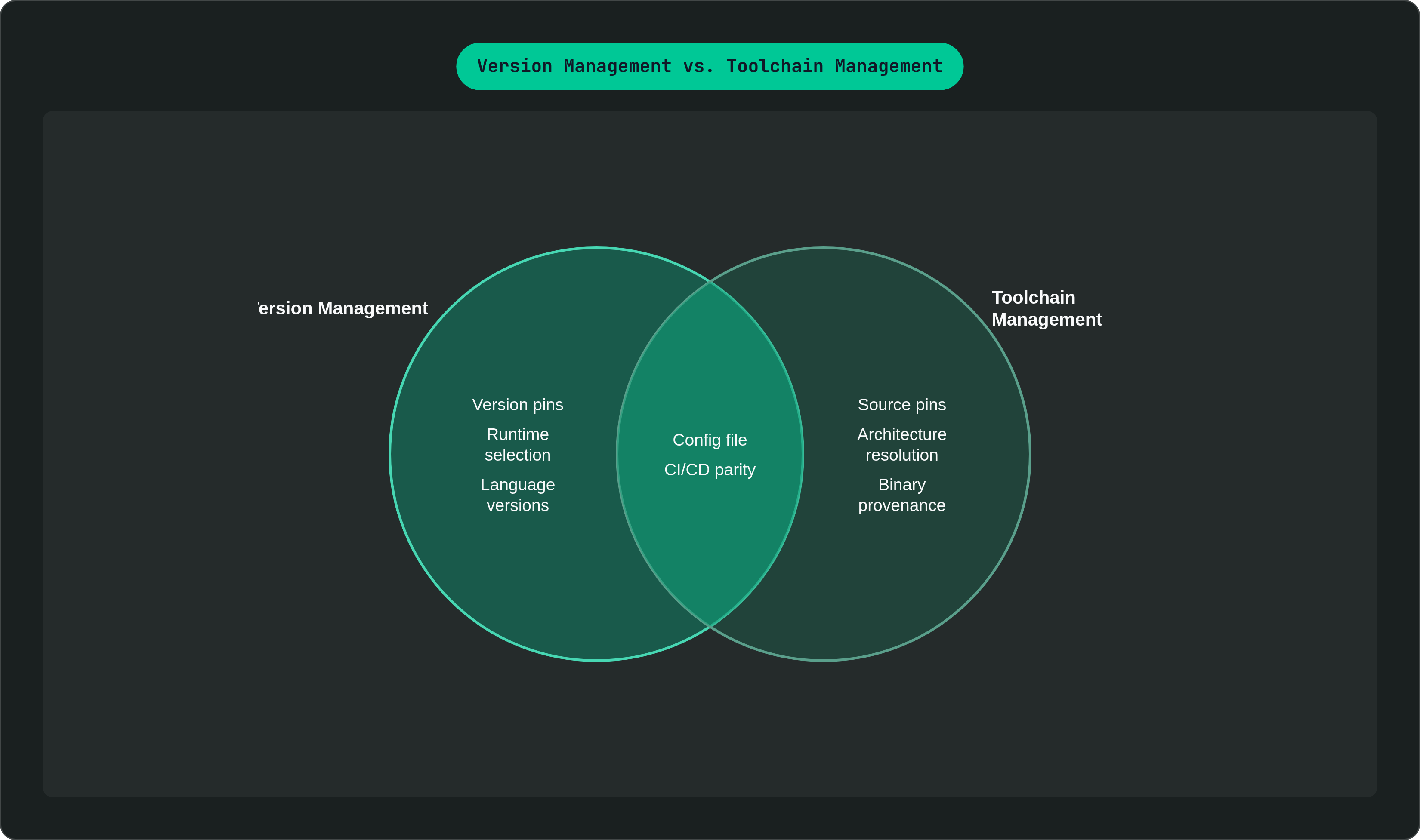
Getting specific about what a toolchain definition actually contains is worth the effort. Version pins establish what version of Go, Python, or Rust is expected. Source pins establish where the binary comes from — a registry, a content-addressed store, an official release tarball. Architecture resolution establishes how the definition handles the x86/ARM split, whether implicitly or explicitly. Most teams manage version pins reasonably well. Source pins are rarer. Explicit architecture resolution is rarer still, and that's where multi-arch drift enters. It doesn't arrive dramatically. It accumulates.
Platform teams generally land on one of three postures toward developer environments: own everything, leave it to individual teams, or standardize the definition format without mandating a single environment. The third posture is the one that actually scales, but only if the definition format is architecture-aware by default. If it isn't, teams are deferring the multi-arch problem to runtime, where it's harder to diagnose and considerably more expensive to fix. In my experience, every team that ends up there never made an explicit choice to be there. It just happened, incrementally, over many quarters.
How the Tooling Landscape Handles Architecture Variance Today
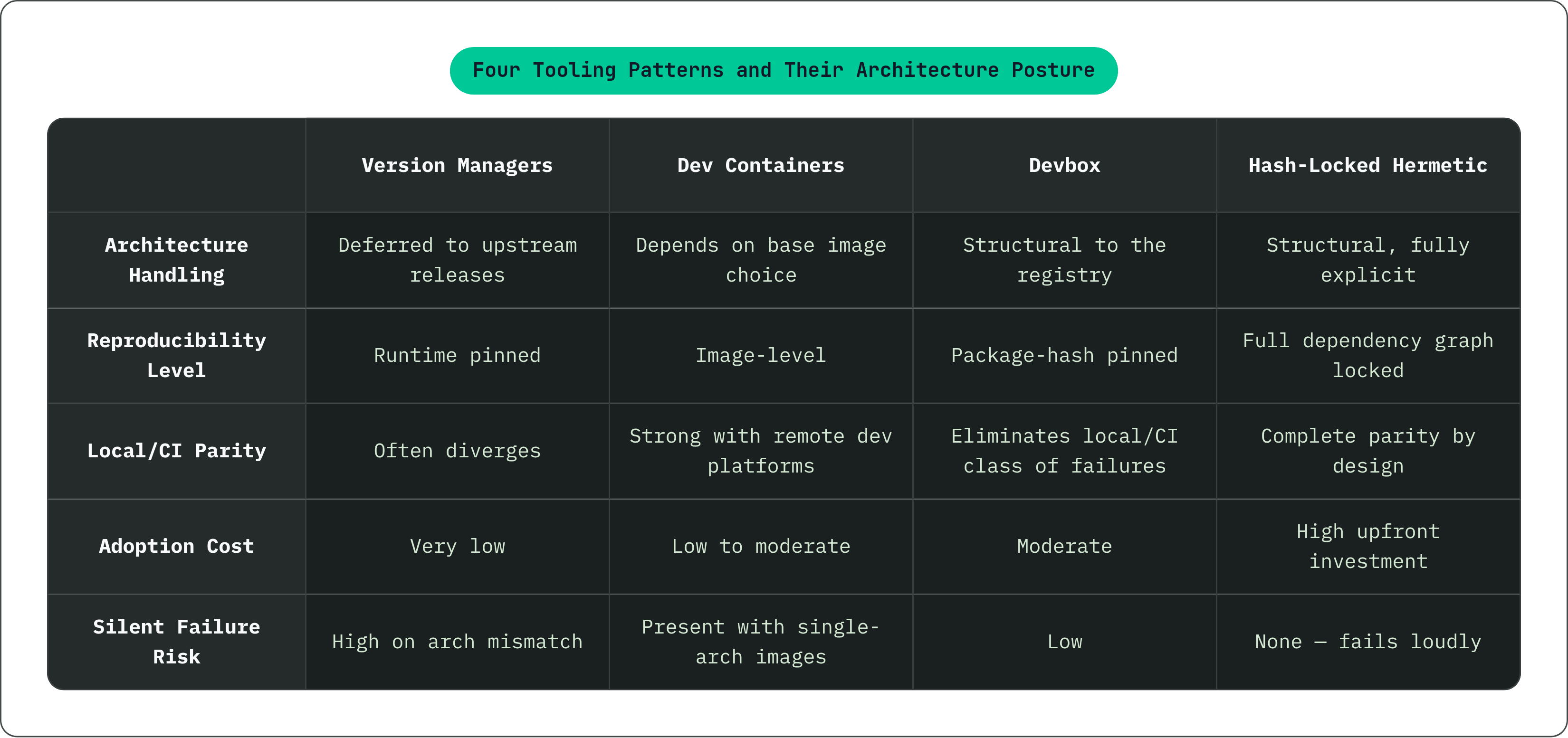
As of 2026, four patterns are in active use, each with a genuinely different relationship to architecture.
Version managers such as mise pin language runtimes via a committed configuration file. They're fast and low-friction to adopt. Architecture resolution depends on upstream release availability: the tool works well when OS-level dependencies are stable and arch differences are handled by the upstream toolchain. When they aren't, the version manager offers no structural remedy. You find out at the worst possible time.
Dev Containers move the environment into Docker, producing an ostensibly identical environment for every developer across VS Code, GitHub Codespaces, and similar remote development platforms. Architecture consistency depends on the base image. A multi-arch image solves the problem cleanly, but standard public images typically ship with dozens of known CVEs; minimal source-built images cut that count to single digits, a distinction that matters for teams with real security requirements rather than checkbox compliance.
Devbox pins packages from a content-addressed package registry via a declarative configuration file. Its package registry has broad multi-arch coverage, and using the same Devbox environment locally and in CI eliminates an entire class of failures where something passes locally and breaks in CI. The architecture handling is structural to the registry itself, not bolted on afterward.
Hash-locked hermetic environments represent the far end of the reproducibility spectrum: every dependency, including system packages, resolves identically across architectures. The architecture-awareness is structural. The adoption cost is also real, and teams shouldn't reach for that grade of reproducibility on day one. The practical progression is to pin language versions with a version manager first, add a package-pinned tool when drift begins surfacing, and move to hash-locked hermetic reproducibility only when it becomes a hard requirement rather than an aspirational preference.
One question applies across all of these tools: does the definition format encode architecture, or does it assume a single architecture and leave the rest implicit? That question has a definite answer for each tool, and it should inform the selection. None of them automatically audit whether the environment definition has architecture-specific gaps. That still requires intentional testing on each target architecture, which is the part most teams skip.
The CI/CD Surface Where Multi-Arch Toolchain Gaps Become Visible
CI runners are where multi-arch toolchain gaps produce hard failures rather than subtle behavioral differences. A binary built on a developer's ARM machine fails on an x86-64 runner. A dependency that installed silently under emulation on a developer machine refuses to run natively in CI. These failures are typically diagnosed as application bugs before anyone thinks to look at the toolchain. By the time the correct diagnosis surfaces, hours have passed and the team's confidence in the platform has taken a quiet, cumulative hit — the kind that doesn't show up in a single postmortem but degrades working relationships over months.
Several failure patterns recur with enough regularity to be worth naming. The toolchain is installed in CI via a different mechanism than locally — a system package manager versus a version manager versus a content-addressed store. The version string matches, but the binary provenance doesn't. The CI runner architecture differs from developer machines, with no explicit handling in the environment definition. Cached layers in CI preserve a previous architecture-specific binary, masking a toolchain update until the cache is invalidated. All of these share the same root cause: the environment definition isn't the single source of truth for both local and CI environments.
The fix is ensuring the environment definition is canonical for both local and CI, so the same definition runs everywhere. Read-only, git-driven environments close the most common drift vector. When infrastructure can't be modified at runtime, configuration can't drift between what passed testing and what runs in production.
DORA 2025 found that organizations with mature platforms achieved substantially higher deployment frequency and shorter lead times than peers without that maturity. Environment consistency across architectures is a prerequisite for the reliability that produces those numbers. A platform team should instrument not just whether the build passed, but whether the build used the expected toolchain definition. A passing build on a drifted environment is a false green. False greens are particularly corrosive because they erode the only thing a CI system is actually selling, which is trust in the signal.
What Multi-Arch Toolchain Inconsistency Costs During Developer Onboarding
Onboarding is the highest-stakes test of any toolchain definition. A new developer follows the README on their hardware, and every architecture-specific assumption that was never encoded surfaces immediately. The cost isn't abstract. Unstructured onboarding leaves new hires significantly underproductive in their first weeks. The math on a senior engineer's fully loaded salary during a two-week environment debugging spiral is uncomfortable, but platform teams should run it anyway, because that number is a concrete argument in a budget conversation.
One team I worked with reduced onboarding from two weeks to two hours after systematizing their environment definition. Not because they were particularly disorganized before, but because they'd accumulated years of implicit architecture assumptions that had never been written down. Across even a modest hiring pace, that kind of recovery accumulates fast.
The ARM/x86 split has made the problem considerably more visible. A team whose toolchain definition was written when everyone ran Intel-based machines now debugs architecture-specific failures on every new hire with Apple Silicon. The problem didn't change. The hardware mix did, and the definition wasn't built to accommodate it. Time to first meaningful change shipped is the most honest signal of platform usability. If that metric degrades when the team's hardware mix shifts, the toolchain definition is carrying implicit architecture assumptions that were never made explicit. The README didn't fail. The model of what a toolchain definition is for failed.
A longer README is documentation of a broken process. The fix is a definition format that encodes architecture so that a one-command setup produces the correct environment regardless of what hardware the developer is sitting in front of. By 2026, a substantial majority of large software engineering organizations had dedicated platform teams, a figure that has risen sharply since the early 2020s per Gartner. Those teams are being measured on onboarding speed. Multi-arch toolchain consistency is a direct input to the number they're being held accountable for, whether or not it appears on the dashboard.
Toolchain Provenance as a Supply Chain Security Requirement, Not Just a Reproducibility Preference
Multi-arch toolchain management and software supply chain security are the same problem viewed from two angles. Both require knowing exactly what binary came from what source, for what architecture, and whether it was tampered with in transit. In March 2025, the GhostAction compromise exfiltrated CI/CD secrets from a large number of repositories through a single compromised GitHub Action, per StepSecurity's disclosure. That isn't primarily a credential management failure. It's a toolchain provenance failure. The attack surface wasn't the application. It was the environment running the application.
The toolchain layer is a direct attack vector. A compromised compiler, a malicious package injected via dependency confusion, a typosquatted build tool — all of these enter through the same channel that multi-arch toolchain management must control. SBOMs tell you what's in your software. Sigstore, SLSA, and in-toto attestations tell you whether it was tampered with. After GhostAction, treating provenance verification for CI tooling as optional is a posture that's difficult to defend, practically or to an auditor.
Hash-locked environment definitions provide toolchain provenance as a structural property rather than an auditing exercise. The definition either resolves to the expected binary or it fails loudly, on every architecture, every time. There's no silent fallback. SLSA v1.2, released in November 2025, introduced the Build Track concept; for teams already on GitHub Actions or GitLab CI, implementing SLSA Level 2 provenance generation is a matter of days of engineering effort, with the meaningful investment falling in policy enforcement rather than in generation mechanics.
The practical question for platform teams is this: does your toolchain definition tell you not just what version of each tool you're using, but where each binary came from, and whether it's the same binary on every architecture you support? If the answer is no, you're doing version management, not toolchain management. Those aren't the same discipline. Conflating them is how organizations end up with audit trails that stop exactly one layer too high, which is precisely where the interesting failures tend to live.
What a Systematic Multi-Arch Toolchain Policy Actually Looks Like in Practice
A systematic policy operates across three layers, each of which must be architecture-aware from the start rather than retrofitted later. Retrofitting is always more expensive than it looks, and it's always later than you'd like.
The definition layer is a single environment definition file that explicitly encodes how each dependency resolves on each supported architecture. Not a single-arch definition with a note in the README. The file is the contract. If the architecture resolution isn't in the file, it isn't in the contract, and no amount of documentation compensates for that absence.
The verification layer runs the environment definition on every supported architecture on every merge, not only on the runner's native architecture. Failures are treated as environment failures, not application failures. That distinction matters more than it appears to. Treating an environment failure as an application failure sends teams hunting for the wrong root cause and, over time, teaches engineers to distrust the platform without being able to articulate exactly why.
The provenance layer pins sources alongside versions, so each binary can be traced back to its origin and verified. SBOMs and build attestations are generated from the same definition that produces the environment, not from a separate process run afterward. Provenance generated after the fact is evidence reconstruction, not assurance; auditors increasingly understand the difference.
The platform team's role in this model is to provide extensible base environments that teams can compose from, not to mandate a single environment or leave each team to reinvent architecture handling independently. The governance questions the policy must make explicit are which architectures are officially supported and what "supported" means in terms of CI coverage; what the escalation path is when a dependency lacks an arch-native binary and an emulated or cross-compiled binary is used instead; how toolchain updates are propagated, who owns the definition, how changes are reviewed, and how they're validated across architectures before rollout.
The anti-pattern to avoid is treating multi-arch support as a matrix of special cases managed per team. That's the path back to drift, and it scales inversely to team count. Every team managing its own architecture handling is a team that will eventually produce an incident whose root cause is indistinguishable from an application bug until someone thinks to check the toolchain. I've seen that particular postmortem written more than once. It's always awkward.
Time-to-productive-environment on each supported architecture is a platform health metric worth tracking explicitly. If it diverges across architectures, the definition has gaps. Measure it. The teams that treat architecture variance as a first-class concern in their toolchain policy are the same teams whose CI is trusted, whose onboarding is fast, and whose incident response doesn't begin with the question of what environment a failing job was actually running in. That last question, when it surfaces in a postmortem, is a reliable sign that the policy didn't exist or wasn't enforced.