Model Context Protocol Server Setup for Development Workflows
Environment drift in MCP servers creates silent security gaps that standard monitoring can't detect.

Anthropic released the Model Context Protocol as an open standard in November 2024. By December 2025 it had been donated to the Linux Foundation's Agentic AI Foundation, with joint governance from Anthropic, OpenAI, Google, Microsoft, AWS, Cloudflare, and Bloomberg. The protocol's core premise is elegant — a single, standardized interface that lets any AI application connect to any external tool, database, or API, replacing the proliferating web of custom adapters that previously required separate implementations per model and per tool.
Every MCP server exposes three primitives. Resources are data snapshots the model can use for context. Tools are typed, JSON Schema-defined functions the model can invoke, where the model emits a tool-call request, the client executes it through the MCP server, and the result is returned. Prompts are pre-defined task templates that standardize common operations and reduce token waste. Clean in specification. Their behavior in practice depends entirely on the environment in which the server runs.
The official MCP documentation recommends using uv --directory … run … to ensure a server runs in the correct environment when integrated with Claude Desktop. That recommendation exists because the simpler quickstart invocation, mcp dev <script.py>, launches a server using whatever Python environment and installed dependencies happen to be active at that moment. No pinning. No isolation. The documentation acknowledges the implicit dependency problem because the problem is real enough to demand acknowledgment in onboarding materials, which should tell you something about how early this issue appears in practice.
"Works on my machine" takes a specific and infuriating shape in MCP. Tool schemas behave differently across developer machines when SDK minor versions have silently diverged. A server that passes local testing fails in CI because the runner carries a different runtime. An AI agent receives inconsistent tool behavior depending on which environment it runs against. None of these failures are loud. They manifest as subtle behavioral drift, the kind that consumes hours to diagnose and rarely leaves an obvious stack trace. You start questioning the model before you question the environment. That inversion of suspicion is expensive.
Configuration drift in MCP is an explicit, documented threat, occurring across multiple layers simultaneously — server metadata, tool descriptions, permission scopes, and authentication tokens. Cascading failures that originate from drift at one layer aren't reliably detectable by traditional monitoring, because the server is running, the tools are callable, and the responses look structurally correct. The failure is semantic, not syntactic. That's a genuinely different class of problem than a crashed process or a failed health check, and most teams aren't equipped to catch it because they've never had to catch it before.
There is also a security dimension specific to this protocol. An MCP server that passes a security review can be silently modified after approval, a pattern sometimes called a rug pull attack. Without continuous verification against cryptographic baselines, an organization has no mechanism to detect post-approval changes. The environment isn't just a performance concern. It's a trust boundary.
The mcp.json configuration file, committed to the repository and kept identical across Windows, macOS, and Linux, is the minimum reproducibility floor. Most teams treat MCP setup as a one-time configuration task per developer. What it actually requires is the same environment discipline applied to any other runtime dependency: pinned, versioned, verifiable, and shared.
How Dependency Drift in MCP Servers Creates a Supply Chain Exposure
MCP environments depend heavily on third-party components — SDKs, connectors, protocol servers, vector database clients, plugins, and model-side tool integrations. These components run within trusted execution paths. A compromised dependency can alter agent behavior, introduce hidden backdoors, or modify protocol semantics without triggering any detection surface that a conventional monitoring stack would catch. The stack sees a healthy process. The agent sees a poisoned tool.
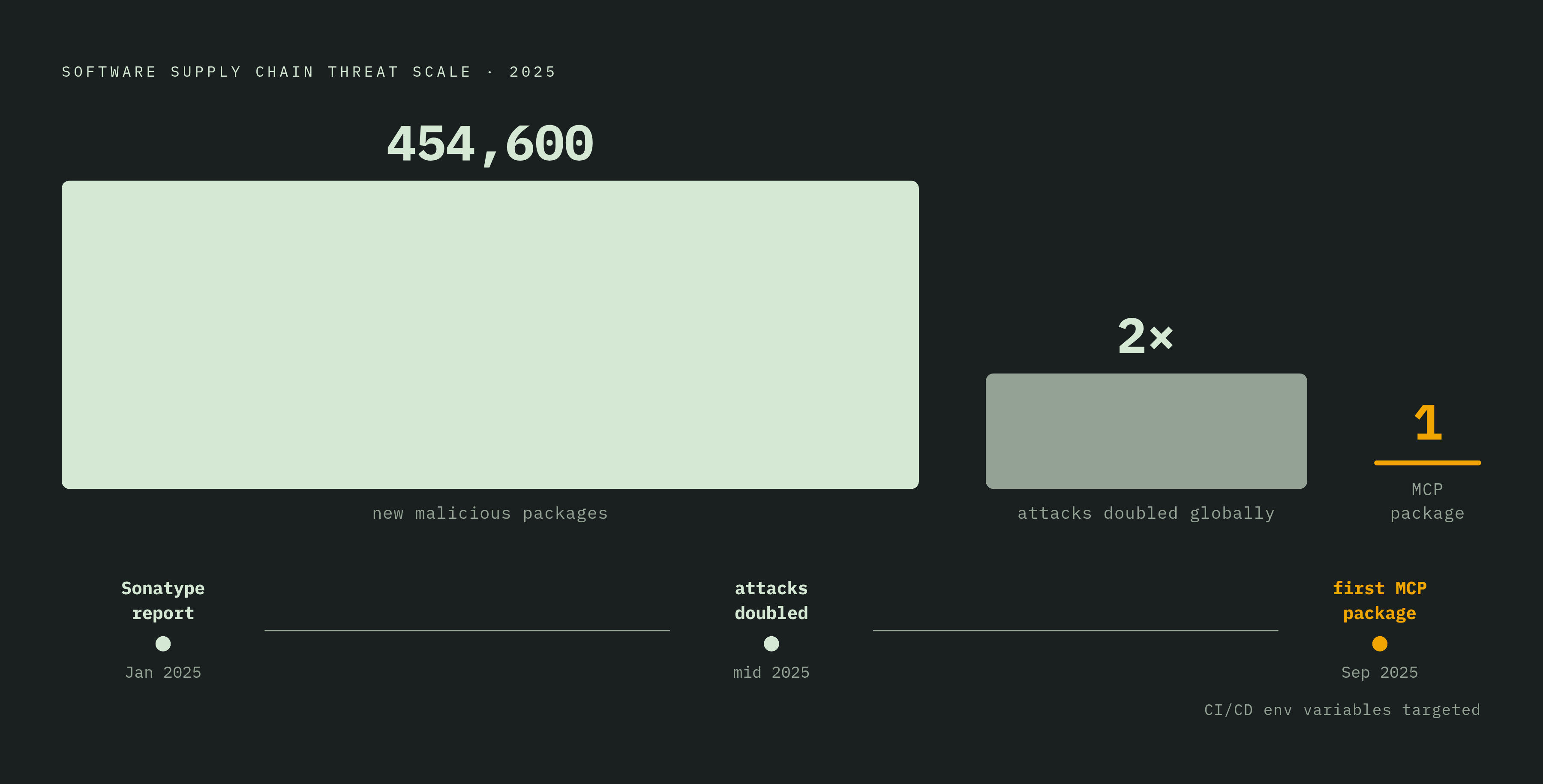
The first confirmed malicious MCP package appeared in September 2025. It posed as a connector for a popular service, presented clean-looking surface code, and activated a backdoor specifically when it detected environment variables common in CI/CD pipelines. The attack wasn't opportunistic. It was targeted at the execution context where MCP servers carry the most organizational trust.
That incident didn't occur in a vacuum. Sonatype identified over 454,600 new malicious packages in 2025 alone, and software supply chain attacks more than doubled globally that year. MCP isn't uniquely vulnerable; it's subject to the same threat landscape as every other software runtime, while operating in an execution context where the impact of any compromise is amplified because the tool layer connects directly to the agent's decision-making. The blast radius is larger than it looks.
Pinned, reproducible environments are the first line of defense. A locked dependency graph makes silent package substitution detectable — the build fails, or the hash mismatches. An unpinned environment silently accepts a malicious upgrade and gives the build system no signal that anything changed. The choice between pinned and unpinned is, at bottom, a decision about whether supply chain tampering is even detectable in your pipeline.
OWASP recommends generating both a Software Bill of Materials and a cryptographic bill of materials for each MCP server and plugin package. An SBOM provides the full dependency list, installed versions, and known vulnerabilities. When CVE-2025-6514 dropped, teams with current SBOMs immediately knew whether they were affected. Teams without them audited manually, which is slower, less complete, and only repeatable if someone remembers to do it again next time.
Most SBOMs generated today are produced at the end of a build, filed, and never consulted again. Better than nothing, but not sufficient. Build provenance — a cryptographically signed and independently verifiable record of how an artifact was produced — closes the gap between knowing what is in a dependency graph and knowing that the artifact was produced from that graph and nothing else. After the GhostAction attack in 2025, provenance verification moved from an optional practice to an expected one. SLSA and Sigstore should be applied to MCP server build pipelines the same way they are applied to traditional software artifacts.
Regulatory pressure is accelerating this shift. U.S. Executive Order 14028 and the EU Cyber Resilience Act both establish expectations around software provenance and supply chain transparency. SBOMs, SLSA, and Sigstore are moving from conference-circuit vocabulary to operational requirements, and MCP server pipelines aren't exempt from that trajectory.
What Reproducible MCP Environments Look Like in Practice
Containerization is the baseline. Packaging MCP servers as Docker containers encapsulates all dependencies and runtime configurations, removing environment-specific behavior from the equation across development, CI, and production. The container is the environment. This is not a novel insight for platform engineers, but it's frequently skipped for MCP servers because they feel small, like scripts rather than services. They are services, and they should be treated accordingly.
Lock files aren't optional hygiene. A pinned requirements.txt, a uv.lock, or a package-lock.json is the mechanism that makes an environment reproducible and supply chain drift detectable. Treating lock files as generated artifacts to be gitignored is a decision to accept unverifiable environments. The lock file belongs in version control, full stop.
The mcp.json committed to the repository is a trust artifact, not a convenience file. Every developer and every CI run resolves the same server configuration. Changes to server metadata, tool descriptions, or permission scopes become visible in version history. Diffs surface configuration drift exactly the way code diffs surface logic changes. If it's not in the repository, it doesn't exist in any auditable sense.
Schema discipline matters beyond startup. The MCP Inspector checks for missing or mismatched parameters at development time, which is useful but insufficient for regression coverage. Unit and integration tests for tool schemas ensure that a schema change breaking an agent's tool call is caught before it reaches CI or production. A tool that silently accepts fewer parameters than it used to, or returns a field whose type has changed, will produce genuinely difficult-to-diagnose failures for any agent relying on that contract. Without a test that explicitly encodes the expected schema, there's no automated signal that anything broke.
Keep the active MCP set small. Three to six well-chosen servers outperforms fifteen, because every additional server adds tool-call latency and increases the probability of tool-name collisions inside the agent's context window. Every server in the set is a dependency graph to maintain, a configuration to keep current, and an attack surface to monitor. The correct number of MCP servers is the minimum that covers the required tooling. Accumulation isn't a strategy.
The stateless MCP specification, released in late July 2026, makes tool calls self-contained, with each request carrying all required state. This removes the stateful session coupling that previously blocked horizontal scaling behind load balancers, proxies, Kubernetes, and serverless platforms. When servers scale horizontally across pods, environment parity across every pod is what ensures consistent agent behavior. Pod-to-pod drift produces nondeterminism that is extremely difficult to reproduce and nearly impossible to attribute cleanly. I've seen teams spend days chasing that kind of bug, certain they had a model problem, before realizing two pods were running different SDK patch versions.
For teams running MCP in active agent pipelines, the emerging Agentic AIBOM concept (arXiv:2603.10057, 2026) extends traditional SBOMs into active provenance artifacts that capture runtime behavior and environment drift, not just static dependency inventories. The direction it points toward — treating environment state as a continuously verified artifact rather than a one-time snapshot — is where the field is headed.
How Environment Consistency Determines Onboarding Speed for MCP-Using Teams
The industry median time-to-first-commit is two to three weeks. High-performing teams target one to three days. When time-to-first-commit exceeds two weeks, the bottleneck is almost always environment setup or access provisioning, not the complexity of the codebase itself.
MCP teams have their own version of this problem. A new developer joins a team with six MCP servers, each set up differently, some documented in a README, some documented only in someone's memory. They spend days reconstructing environments that should be a single command. The knowledge required to replicate those environments — which Python version, which SDK version, which exact configuration was used — is tribal. It lives in the heads of the engineers who built the servers, not in the repository. That's not a documentation failure. It's an environment discipline failure, and documentation can't fix it.
A reproducible MCP environment changes the onboarding equation directly. The mcp.json and the locked dependency graph are already in the repository. Clone and run, not read-and-reconstruct. A new contributor can verify that their local environment matches CI before writing a single line of code, but that verification is only possible if there's a canonical environment to verify against. Without one, you're asking a new hire to reverse-engineer a system that the people who built it can no longer fully describe.
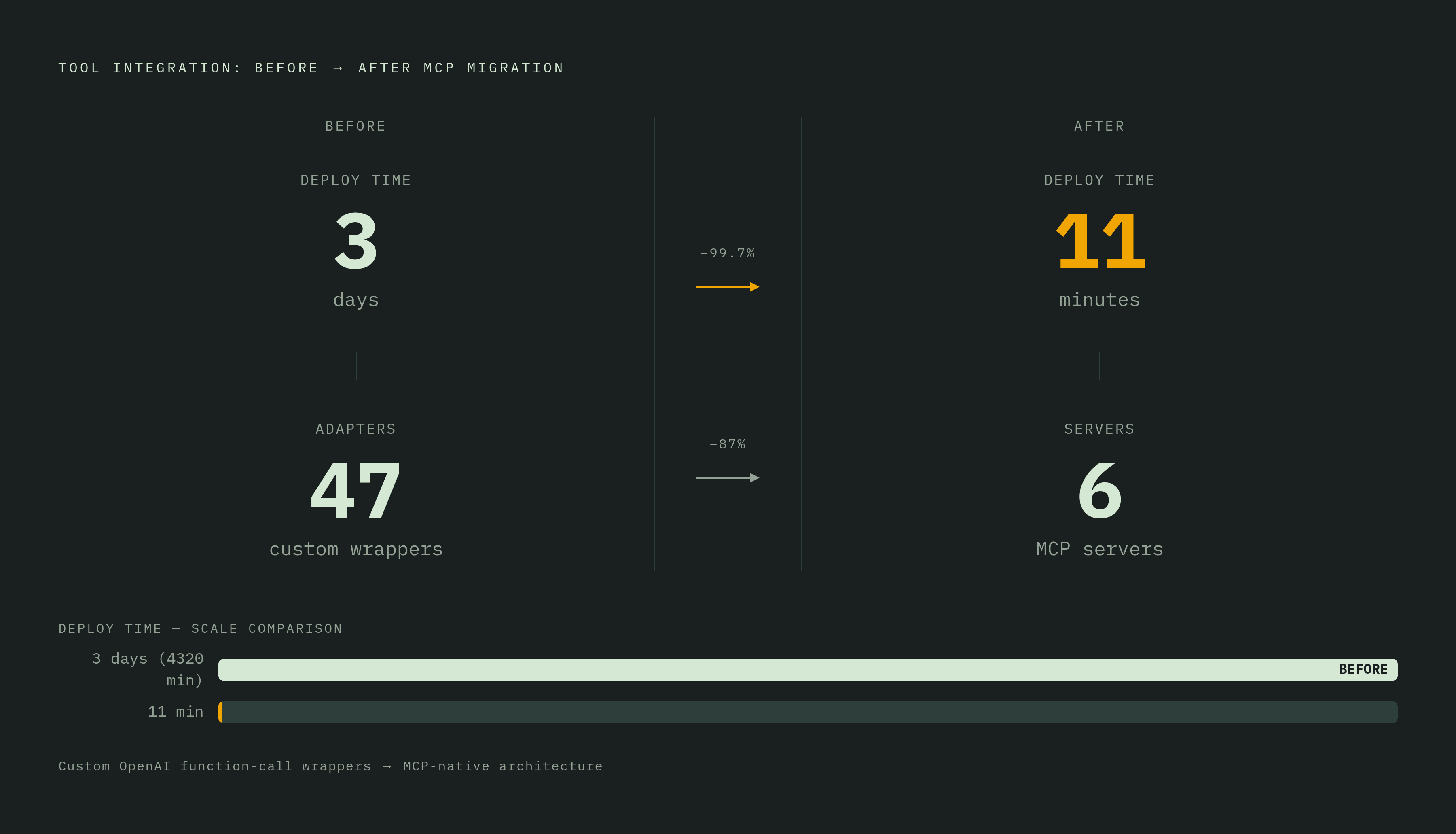
One practitioner account from 2026 quantifies the improvement. Migrating from custom OpenAI function-call wrappers to a fully MCP-native architecture dropped deployment time for new tool integrations from three days to eleven minutes, while shrinking the integration surface from 47 custom adapters to 6 MCP servers. The speed came from having a known, stable, shareable environment, not just from adopting the protocol itself. That distinction matters.
The retention dimension of this problem receives less attention than it deserves. New hires reach only 25% productivity in their first 30 days without structured onboarding, according to SHRM data from 2025, and Jobvite data from the same year puts developer turnover within 90 days at 22%. Developers who spend their first weeks fighting environment setup don't conclude that the environment is poorly managed. They conclude that the organization is poorly managed. That inference is earned, and reversing it is harder than preventing it.
Community tooling is filling some of this gap. Context7 MCP, a community-built server, fetches current documentation through a documentation-as-context pipeline rather than relying on training data, directly reducing the time new engineers spend hunting for up-to-date API references. It's most useful when the environment around it is already stable enough to use consistently.
Best-in-class onboarding in 2026 shares one structural trait relevant here: self-service environment provisioning through an internal developer platform. An engineer navigates a catalog, selects the environment they need, and gets a running setup without waiting for a senior colleague to walk them through it. MCP server environments are a natural candidate for that catalog. The alternative is scheduling a meeting, and meetings don't scale.
How Platform Engineers Should Own MCP Environments Across the Organization
More than half of surveyed companies already operate more than one internal developer platform. Gartner forecasts that roughly 80% of large engineering organizations will have established platform teams by the end of 2026. Platform engineering exists to absorb accidental complexity so that product teams can focus on intentional complexity. MCP environment management is accidental complexity, and it belongs to the platform team.
The platform team's role here isn't to lock down tool access. It's to eliminate the situation where each product team manages its own dependency graph and server configuration independently, producing a fragmented landscape where environment drift is invisible until it causes a production incident. Platform-managed MCP environments mean approved, audited server configurations published through an internal catalog. Developers pull from a known-good baseline. SBOM generation and provenance signing run as part of the CI pipeline, not as something someone runs when an audit is scheduled. Environment parity is guaranteed across developer machines, CI runners, and agent runtimes because the same locked environment runs everywhere.
AI agents are first-class environment consumers, and this point gets underweighted. An MCP-connected agent running in CI or production needs the same pinned, reproducible environment as a human developer. If the agent's tool environment drifts, its behavior drifts with it, silently, in ways that won't surface until the agent makes a consequential decision based on a tool response that would have been correct last week. There's no stack trace for that. There's just a decision that shouldn't have been made.
MCP for infrastructure monitoring illustrates the stakes concretely. An MCP-connected agent can continuously monitor for drift between declared infrastructure state and actual deployed state, surface discrepancies in the developer's existing tooling, and propose remediation. That agent's usefulness depends entirely on its own environment being reproducible and current. An infrastructure monitoring agent running against a drifted tool environment is producing confident-sounding noise, and nobody knows that until something breaks in production.
As of the Zuplo State of MCP survey in December 2025, 72% of MCP users expected their usage to increase in the next 12 months, and 70% were already running between two and seven servers simultaneously. Gartner predicts that 75% of API gateway vendors will include MCP support by the end of 2026. MCP environments will proliferate regardless of what platform teams decide. The question is whether that proliferation happens with environment discipline behind it or without it.
The ecosystem already demonstrates what's possible at scale — over 97 million SDK downloads, more than 13,000 MCP servers on GitHub, an official SDK surpassing 25 million weekly downloads as of mid-2026, and community servers already covering GitHub, Slack, PostgreSQL, Stripe, Figma, Docker, Kubernetes, and more than 200 other tools. Twenty-eight percent of Fortune 500 companies had deployed MCP servers for production AI workflows by early 2026. Platform teams that don't systematize MCP environment management now will inherit the compounded drift of every team's ad-hoc setup, baked into agent behavior, not just into configuration files.
The work itself isn't interesting. Lockfiles, container specs, signed provenance records, catalog entries in an internal platform — none of it surfaces in a sprint review or earns recognition in a performance cycle. But anyone who has worked through a production incident traced back to undocumented environment assumptions understands exactly what that work is worth. You do the maintenance now, or you do the forensics later. I've done both. The maintenance is less painful.