Measuring Developer Onboarding Time-to-Productivity

Measuring developer onboarding time-to-productivity sounds simple until you try to define "productive." Shipping code? Passing review without a rewrite? Owning a feature end to end? Most engineering leaders answer with a shrug and a manager's gut sense, and that shrug is why a slow ramp goes unnoticed until someone quits or a deadline slips. GitLab's research puts it at roughly 44% of organizations reporting that onboarding a new developer takes more than two months. Few of those organizations had a dashboard that would have told them so before the two-month mark passed.
The financial stakes of a slow ramp
Start with the salary math. A senior engineer hired at competitive pay who sits at half-productivity for six or eight weeks represents real, unrecovered spend, and it compounds fast once you're hiring in cohorts instead of one at a time. Most finance teams never see this number because nobody codes it as a line item.
Then there's the cost that doesn't show up on any compensation spreadsheet at all. Senior engineers and platform staff get pulled into manual onboarding, answering the same Slack questions and walking new hires through the same broken setup steps, hours that would otherwise go toward the platform work they were actually hired to do. Early attrition makes the math worse. A meaningful share of developers leave within their first ninety days, and replacing one can run close to a full year's salary once you count recruiting, lost institutional knowledge, and the re-onboarding of whoever comes next.
I don't think this is theoretical, and the market size backs that up: the onboarding software space has grown into a multibillion-dollar segment, which suggests organizations have sat with this cost long enough to conclude it warrants dedicated tooling. Keep that dollar figure in mind, because it's what makes the case for measurement precision worth making at all.
Leading vs. lagging indicators and why the distinction matters
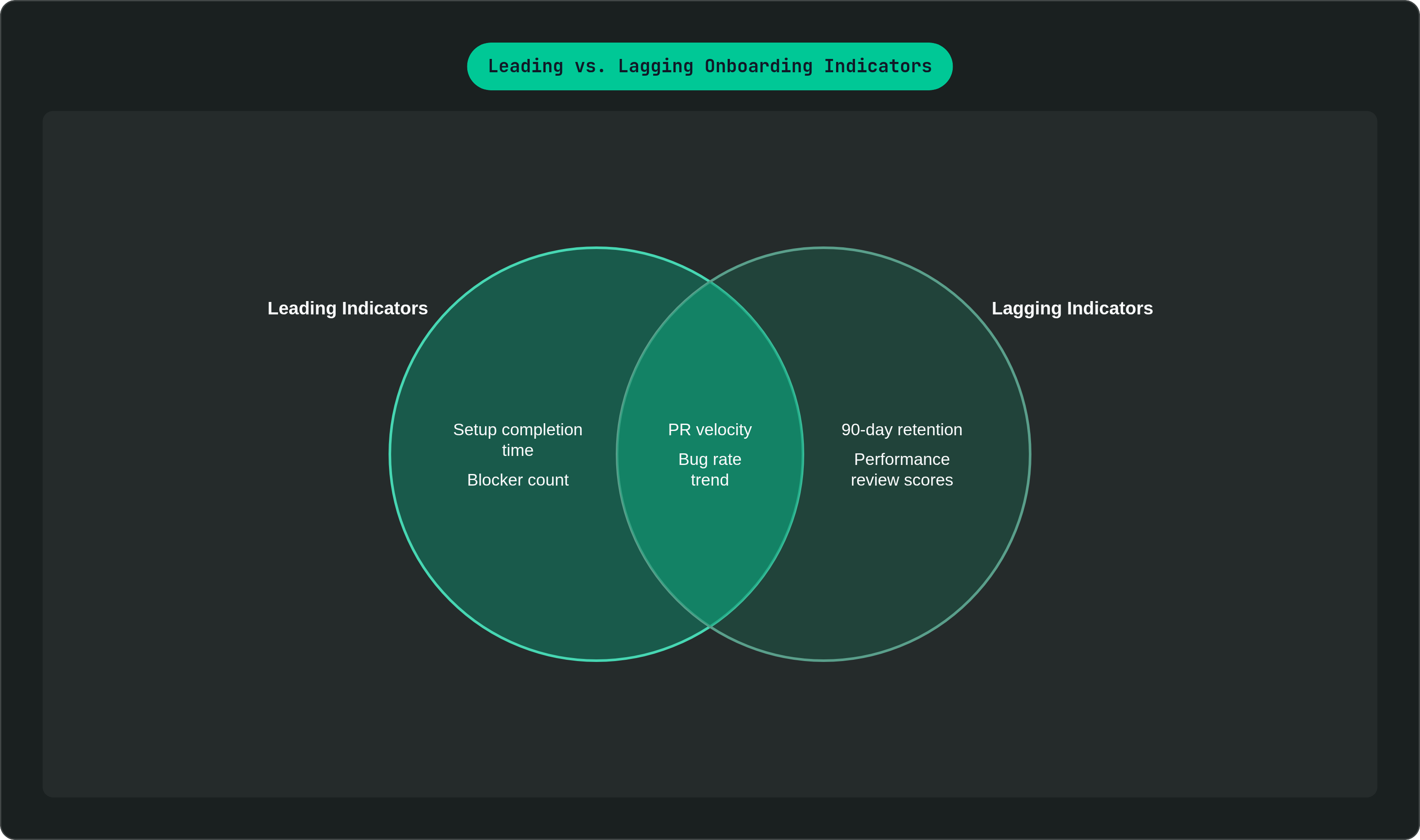
Most teams, if they measure onboarding at all, measure the wrong things. Ninety-day retention, performance review scores, manager satisfaction ratings: these are lagging indicators. They tell you the outcome, and by the time you have them, the outcome already happened. You cannot intervene on a retention number after the person has left.
Leading indicators are where the actual leverage sits. Time-to-first-commit (TTFC) is the earliest observable signal that a developer has cleared environmental and access blockers and touched real code. Time-to-first-PR-review tells you something different: whether they've actually been pulled into the team's workflow. Setup completion time, the gap between a developer's first day and a working, verified local environment, is one of the cleanest signals available and one of the least tracked anywhere I've seen. Blocker count and resolution time across the first two weeks work as a rough proxy for hidden friction in tooling and documentation, friction that otherwise never gets logged anywhere.
A lagging indicator arrives after the fact, like a post-mortem. A leading indicator works more like a smoke detector, letting you act within days instead of finding out in a quarterly review. Stack Overflow's 2024 Developer Survey found structured onboarding correlates with meaningfully faster time-to-productivity than ad hoc approaches, and that correlation traces back to teams catching leading signals early enough to fix problems before they calcify into culture.
How the 30-60-90 day framework structures measurement across the ramp
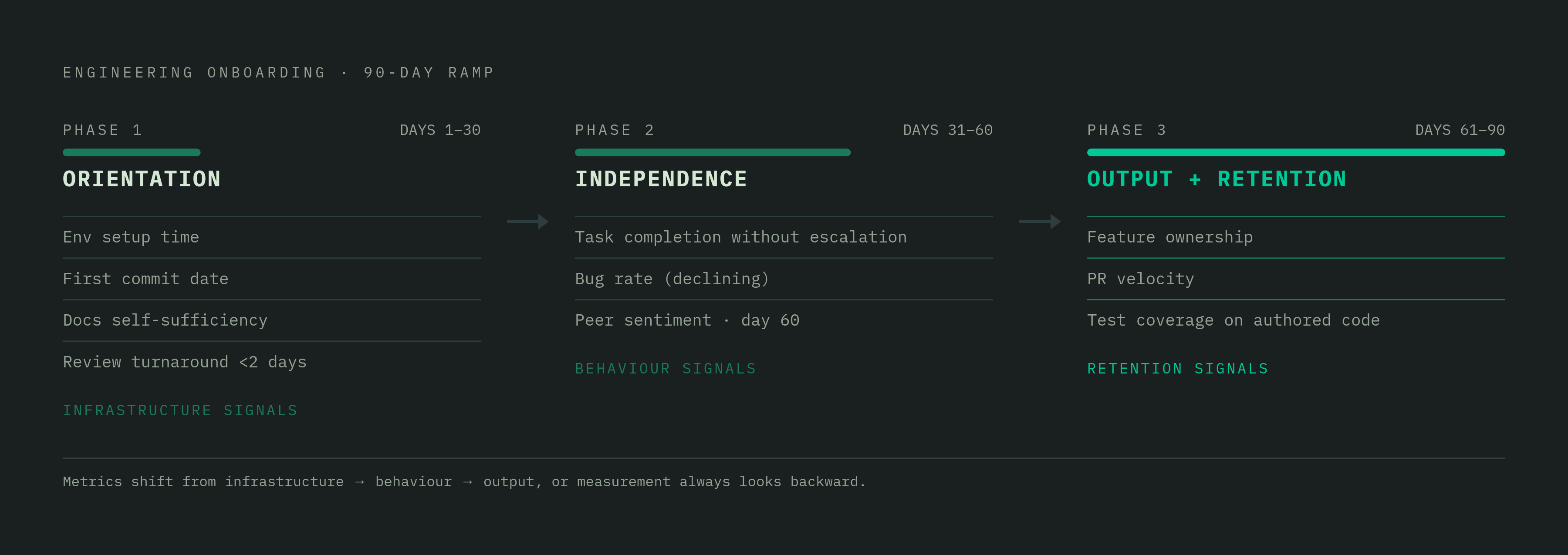
The 30-60-90 day structure isn't new. What's underused is treating it as a measurement scaffold rather than a checklist someone fills out once and files away.
Days 1 through 30 are about orientation and access. The metrics that matter here are environment setup time, first commit date, and documentation self-sufficiency: whether the developer had to ask for help to get unblocked or found their own way through. Code review turnaround under two days by the end of month one is a good quality proxy, since it tells you the developer is in the loop and not sitting in a queue somewhere. Manager check-ins at day 30 should be structured, with specific questions about tooling friction, role clarity, and codebase confidence, rather than a vague "how's it going."
Days 31 through 60 shift toward independence and integration. Watch task completion without escalation, and participation in team rituals: standups, retros, code review as a reviewer and not just the person being reviewed. Bug rate on submitted code is a rough but useful proxy for codebase familiarity, and it should be declining across this window. Peer sentiment surveys at day 60 function as a check on social integration rather than a performance judgment, and social integration turns out to predict retention better than most output metrics do.
Days 61 through 90 are about output, and about whether the person is likely to stay. Feature ownership, PR velocity, test coverage on authored code: these tell you whether the developer has become a real contributor rather than a supervised one. SHRM data shows organizations with structured onboarding programs see meaningfully better three-year retention than those running things ad hoc. By day 90 the question has shifted from "are they ramping?" to "will they stay and grow?" and the metrics need to shift with it. The value isn't in the specific day counts. It's in how the framework forces measurement before the outcome is obvious to anyone.
Why environment setup time is the most overlooked variable in the ramp
Of everything covered so far, environment setup time is the metric almost nobody names, despite being the single largest source of friction in a new developer's first week. Ask five engineering managers what their onboarding dashboard tracks and count how many mention it. One, maybe, if you're lucky.
The gap between teams is wide enough to be alarming. Well-instrumented teams get a developer to a working environment in a couple of hours. Teams running on a README and a list of manual steps can take several days, and that gap almost never shows up on a dashboard, because it happens before the developer has access to most team systems. There's no PR to timestamp, no ticket to close, no deploy event to log. It's invisible by default, which is exactly why it survives budget cycle after budget cycle.
But invisible doesn't mean free. A developer stuck on setup for three days hits their first commit no earlier than day four, and from the outside that looks like a slow ramp or a knowledge gap. The real cause is a tooling failure dressed up as a productivity problem. Worse, the senior engineers pulled in to help with setup pay an opportunity cost that scales with headcount; the tenth new hire this quarter costs the platform team just as many hours as the first one did. Environment setup time belongs right next to TTFC as a named, tracked metric, because together they tell you whether a slow first commit is a learning curve or an infrastructure failure. Right now, most teams can't tell the difference. They're guessing, and calling the guess a gut check.
How environment drift inflates setup time and corrupts other metrics
Drift is the reason setup time balloons in the first place. It happens when the environment on a new developer's laptop diverges from what CI uses, from what the team lead's machine has quietly accumulated over eighteen months, and from what production actually expects. The new hire ends up debugging infrastructure before writing a single line of feature code.
The causes are mundane, and familiar to anyone who has onboarded a team past five or six people. README-driven setup rots the moment someone bumps a dependency without updating the doc. Long-lived developer containers with cached packages look fine right up until they don't, quietly diverging from anything reproducible. Separate teams maintain separate environment definitions on separate schedules, so developer workspaces and CI pipelines look identical on paper and diverge in practice. The same setup instructions can resolve to different versions of Python, Node, or OpenSSL depending on whether you're on a laptop, in CI, or on a build agent, with no visible error until something breaks in a way nobody can reproduce.
This is where drift stops being an onboarding problem and starts corrupting metrics you'd otherwise trust. A high bug rate in the first sixty days chalked up to "still learning the codebase" might actually be environment inconsistency, bugs that don't reproduce on anyone else's machine. Slow PR velocity read as a skill gap might just be a debugging tax, paid because the developer's environment doesn't match CI's. Test coverage numbers mean nothing if tests pass locally and fail in the pipeline for reasons that have nothing to do with the code itself. Stripe's research on developer debugging time found that most of it goes toward reproducing the environment a bug appeared in, not toward fixing the bug itself. New hires just feel that organizational problem more acutely, since they haven't built up years of workarounds yet. Worth a sentence on its own: inconsistent environments mean inconsistent patch states, so drift is a vulnerability surface as much as it's a productivity tax.
What reproducible environments make measurable that drift makes invisible
Fix the drift, and setup time stops being a random variable that depends on which senior engineer happened to be free that morning. It becomes something you can actually track.
A reproducible environment that spins up with a single command gives you a clean timestamp. The moment the developer runs that command marks the start of productive time, replacing what would otherwise be a multi-day scavenger hunt through outdated docs. TTFC becomes a real signal of onboarding speed instead of a confounded proxy for infrastructure luck. Bug rates and test failures in the first sixty days can finally get attributed to code quality and learning curve, because environment mismatch has been ruled out as a variable. CI/CD reliability metrics start meaning something too: if the developer's environment and the pipeline's environment are defined identically, a failing test represents a real problem, not a discrepancy between two machines that were never actually the same to begin with.
This is the specific mechanism behind deterministic package management, the approach Nix-based tools like Flox take. Every dependency gets pinned to an immutable version, so the environment a new developer receives on day one matches what CI runs and what the team lead's machine has accumulated over years, without manual reconciliation and without a growing list of "works on my machine" exceptions. Platform teams define a base environment once, version it like any other artifact, and hand it to every new hire in one command. Whether setup time actually drops, and stays stable enough to track, depends on how consistently that base environment gets maintained — but the mechanism at least removes drift as an excuse for noise nobody can explain.
Pre-boarding deserves a mention here too. Send the environment definition before day one, and the developer arrives already able to build and run the codebase. The TTFC clock starts on day one instead of day four, which is most of a work week recovered before the new hire has even met the whole team.
Quantitative targets worth tracking and qualitative signals that complete the picture
None of what follows is a rigid mandate. These are ranges to calibrate against your own team and role mix, not numbers to enforce blindly across a company with wildly different codebases.
On setup: hours, not days. If it takes longer than a workday to get a new developer to a working environment, that's a platform problem worth fixing before the next req opens. TTFC within the first two days is realistic for teams running reproducible environments; within the first week is a reasonable floor for everyone else. Code review turnaround under two days by the end of month one measures both individual throughput and how well the developer has integrated into team workflow. Bug rate trajectory matters more as a trend than an absolute number, and it should be declining across months one through three. PR velocity should climb week over week across the first ninety days; an early plateau is worth investigating rather than shrugging off as a busy sprint.
Numbers only tell part of the story. Does the new developer ask questions in public channels, or only in private DMs? Public questions are a decent signal of psychological safety and real integration. Are the questions still about tooling and access two months in, or have they shifted toward codebase and business logic? That shift marks a genuine inflection point, arguably a more honest one than anything on a dashboard. Manager and peer sentiment at 30 and 60 days matters too, less as a performance verdict than as an early read on retention risk that the numbers alone won't catch.
The quantitative and qualitative signals need to be read together, or neither means much. A developer with excellent TTFC and strong PR velocity but weak peer integration scores is a retention risk hiding behind good numbers. A developer with slower early output but sharp domain questions and real peer engagement is probably ramping just fine. Treating any single metric as definitive is the mistake to avoid: TTFC alone rewards a trivial first commit pushed just to hit the number, PR velocity alone rewards volume over judgment, and setup time alone will miss the developer who got a fast environment but is still lost in the codebase six weeks later.
How to baseline, benchmark, and improve onboarding measurement over time
Before optimizing anything, get a baseline. Instrument what you have, run it across the next two or three hiring cohorts, and get real numbers on setup time, TTFC, and 30-day bug rate before changing a single process. Teams that skip this step end up fixing problems they never actually measured, which is a special kind of wasted effort.
Instrumentation doesn't need to be elaborate to start. A simple check-in and check-out around environment setup, logged in the onboarding script or ticketing system, is enough to get a real number. TTFC can be pulled automatically from version control; the data's already there, it's just rarely surfaced anywhere a manager would think to look. Structured manager check-ins at 30 and 60 days, with the same questions asked consistently across every hire, matter more than any fancy survey tool, because consistency is what makes cohort comparison possible later on.
For benchmarking, the 30-60-90 targets give you a reference frame, but comparing this quarter's cohort against last quarter's beats chasing an industry average that varies wildly by role, seniority, and how gnarly your codebase happens to be. The improvement loop follows directly from where the data points. High setup time means an infrastructure fix: reproducible environment tooling, pre-boarding access, a bootstrap that runs in one command instead of twelve. High TTFC despite fast setup usually means a documentation and task-clarity problem; the developer has a working environment but no clear sense of what to build first. High bug rates at 60 days deserve a look at environment consistency between developer machines and CI before anyone concludes it's a skill issue.
The deeper value of building this measurement system is that it doubles as a feedback loop between hiring and platform engineering. If every new cohort trips over the same setup bottleneck, that's a platform investment decision that's been sitting there in the data the whole time, waiting for someone to act on it.