Rollback Triggering Criteria and Automation in Production Deployments
Define rollback triggers in advance to catch failures automation alone cannot spot.
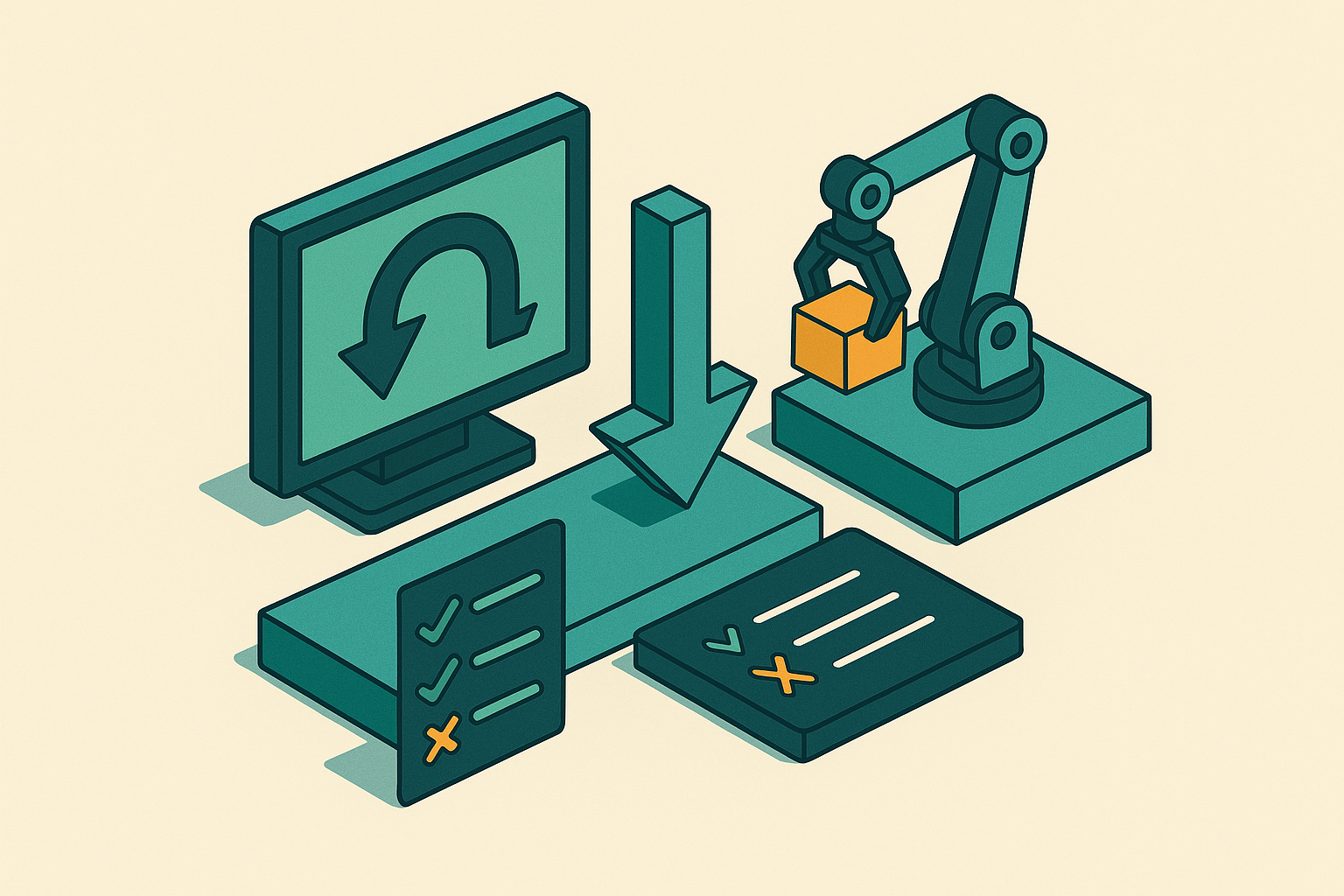
An outage that drags on for forty minutes past the point it should have been resolved is rarely a story about a broken revert command. It is a story about nobody having defined, in advance, the condition that should have triggered that command. The rollback mechanism itself, whether that's kubectl rollout undo or a deployment platform's built-in revert, tends to work exactly as advertised once invoked. What fails is the decision logic sitting in front of it: the signal that should have fired, the threshold that should have been crossed, the automation that should have acted before a human noticed the dashboard looked wrong. Teams that treat rollback as a tooling problem spend their effort hardening a mechanism that was never the weak point, while the actual gap, choosing the right signals and setting defensible thresholds, goes unaddressed. The chain that matters runs from signal to threshold to automated action, and every section that follows traces a different link in that chain.
Manual rollback still exists for a reason that has nothing to do with tooling maturity: automation can only act on what it measures, and there's a class of failure that produces no measurable anomaly. A runbook has to settle, before an incident starts, who can authorize a rollback, which kinds of impact justify one, and when rolling forward with a fix beats reverting. Those questions are cheap to answer in a calm meeting and expensive to answer while a deployment is actively causing damage.
The three signal layers practitioners use
Rollback signals split into three layers, each one catching a different category of failure, and a team relying on just one of them is leaving a gap the others were built to close. The first layer is infrastructure health, the second is application performance, and the third is business-level outcome. Mature rollback design treats all three as complementary.
Infrastructure health checks form the first layer, and in a Kubernetes environment, this comes down to three probe types that monitor container state. Startup probes exist to protect applications that take a long time to initialize, giving them room to boot without being mistaken for a liveness failure. When new pods deployed as part of a release consistently fail readiness checks, that pattern is the clearest trigger point for an automated rollback at the infrastructure layer: the new version cannot serve traffic, full stop on the diagnosis.
Application performance metrics make up the second layer, and here the canonical signals are error rate and latency percentiles. These metrics are usually collected through something like Prometheus, and the operational value comes from wiring alert rules directly into action: an alert that fires on an error rate spike or a latency regression can route through an Alertmanager webhook to a rollback controller, which receives the payload and executes the revert command itself. That pipeline runs from metric to action with no human step in between, which is precisely what makes this layer fast and precisely what makes its blind spots dangerous.
Business-level indicators form the third layer, and they catch what the first two cannot. Orders completing, signups succeeding, transactions clearing normally: when these continue trending the way they did before a release, that is a signal no health check or latency graph can substitute for. When a person steps in to initiate a rollback after noticing a problem no automated trigger caught, that isn't a failure of how the automation was built. It reflects the structural limit of triggering rollback purely on metrics, a limit no amount of additional tooling removes.
Setting thresholds that trigger rollbacks without triggering false alarms
A threshold has to be explained in terms of baseline behavior and acceptable deviation from it, otherwise it's a guess, and guesses in this context fail in one of two directions: either a real degradation slips through because the number was set too loose, or a healthy release gets reverted because the number was set too tight.
Threshold design has to start from a measured baseline, not from intuition or a round number borrowed from somewhere else. The previous stable version's observed behavior in production serves as the reference point, taking priority over any industry rule of thumb. From that baseline, a team can define rules in the same structural shape across every metric: an error rate that climbs more than some small fraction above baseline triggers an automatic rollback; a P95 latency increase beyond a defined number of milliseconds above baseline does the same; a pod restart count climbing past a defined multiple of its baseline halts the rollout and alerts the on-call engineer. The specific numbers will differ by system and by how much risk a given release carries, but the structure, measure the baseline, define the acceptable deviation, assign the response, holds regardless of the numbers chosen.
Thresholds also have to separate a genuine release failure from the ordinary noise every production system generates. That unnecessary rollback does more damage than the blip it was reacting to, because it erodes confidence in the automation itself and creates pressure to loosen the thresholds until they stop catching anything. The fix is windowing: evaluating a threshold over a rolling time window rather than reacting to a single instantaneous reading. A window filters out a transient spike while still catching a degradation that persists. Different signal types call for different window lengths. Canary releases paired with rollback gates, evaluating a small slice of traffic against these windowed thresholds before a full rollout, have become a standard part of how practitioner guidance frames safe deployment going into 2026, because they let a team catch a bad threshold breach before it reaches every user.
Stateful services need a threshold category of their own, because not every component of a deployment reverts with equal ease. Schema compatibility and data migration constraints have to be checked before a deployment goes out, not discovered during an attempted rollback, and any release that isn't safely reversible needs that constraint modeled explicitly in the rollback plan. A full rollback can touch application code, configuration, infrastructure, and data, and those four don't all revert on the same timeline or with the same risk. A stateful service carries no such guarantee, and treating it as if it did is how a rollback intended to fix one incident creates a second one.
Even a well-calibrated threshold, built from a real baseline and evaluated over a sensible window, only measures what can be measured. It says nothing about whether the application is doing the right thing commercially, only whether it's behaving the way it did before. That gap is what makes manual override a permanent part of the design, not a fallback for immature automation.
Rollback flapping and the circuit-breaker logic that prevents it
Getting the signals right and the thresholds calibrated doesn't end the work, because automation introduces a failure mode of its own: flapping. A system rolls back a broken release, the deployment pipeline redeploys the same or a similarly broken version, the same signals breach the same thresholds again, and the cycle repeats. Each iteration looks like the automation doing its job. The net effect is a service that oscillates between two broken states faster than any human could track, which is worse than the single failure the rollback was built to catch.
Flapping happens when the condition that triggered the rollback is still present in whatever gets deployed next. Without a cooldown period between a rollback and the next deployment attempt, trigger logic has no way to recognize that it's repeating itself rather than responding to a new, independent failure. A circuit breaker, a defined window during which a repeat deployment is blocked or flagged for review rather than allowed to run straight into the same automated rollback, closes that loop.
The length of that cooldown window is itself a threshold decision, carrying the same tension as every other one in this system. If the window is too short, flapping resumes the moment it closes. If the window is too long, a legitimate fix that would have resolved the incident gets blocked from reaching production for no good reason. The right length is bounded by how long it actually takes the team to diagnose and fix the root cause behind a given class of failure. The number comes from the team's real incident response capacity.
Whatever the cooldown length, manual override has to remain available at every point in this loop. Automation that can't be overridden by a human decision, in either direction, forcing a rollback it hasn't triggered or preventing one it's about to trigger, is a liability. The next section works out where that human judgment belongs across a full range of rollback decisions, not only at the edges of a flapping loop.
Tiered automation: matching the level of human oversight to the risk of the action
Every decision covered so far, which signals to trust, how to calibrate their thresholds, how to stop automation from flapping, comes together in a single architectural question: how much authority does the automation actually get, and over which actions? A flat model, where everything is automated or nothing is, doesn't survive contact with a real production system. A tiered model, where automation authority scales with how reversible and how risky a given action is, lets a team act within seconds on the cases that call for speed while keeping a human in the loop on the cases that call for judgment.
Tier 0 covers read-only diagnostics: pulling pod status, recent events, logs around the failure window, relevant metrics, recent deploy and commit history. None of this changes system state, so none of it needs approval, and it should run immediately the moment any alert fires. The value of this tier is that it costs nothing to automate in full and produces the diagnostic context that makes every decision in the tiers above it faster, since a human or an automated system reasoning about what went wrong starts from a ranked set of hypotheses.
Tier 1 covers low-risk, reversible actions: restarting a single pod, scaling a deployment up. Reversibility is what defines this tier: if the action itself turns out to be wrong, undoing it costs almost nothing.
A higher tier covers high-risk or irreversible actions: anything that touches stored data, triggers a financial transaction, or cannot be cleanly undone once executed. Actions at this level require explicit human authorization before they run, because this is where the limits of metric-based triggering described earlier become concrete. A semantic correctness failure, a price calculated wrong, an approval step silently skipped, occurs at this tier, and no amount of automated monitoring can verify that kind of failure on its own.
The tiered structure also sets the standard for logging and audit. Every automated action, at every tier, should leave an immutable record that can be attached to a post-incident review, and the higher the tier, the richer that record needs to be. This ties rollback automation directly into supply chain and audit requirements that extend well past the incident itself: a deployment that was automatically rolled back should leave behind exact evidence of which version was live at which moment and what triggered the reversion. The number of tiers a given team settles on matters less than the underlying principle, that automation authority has to scale with how reversible and how risky an action actually is.
AI agent deployments require additional signal types that traditional rollback systems do not monitor
Everything built out across the three signal layers, the threshold logic, and the tiered automation model still applies to AI agent deployments, but the vocabulary of signals has to expand, because agents fail in ways an HTTP error rate was never built to catch. An AI agent can complete a task from end to end, report no error, and still have made a commercially wrong decision along the way. Degradation in an agent is often statistical and gradual rather than sudden and binary, which means it can hide from exactly the signals that catch conventional service failures.
An AI agent deployment carries four versioning layers that need to be pinned independently: code, prompt templates, model version, and tool or API contracts. Each one introduces its own failure mode, and each can trigger a rollback on its own, separate from the others. Even with prompt versioning in place, a safe rollback has to revert every versioned layer together, prompt, model, and tool contracts as a set, because reverting just one of them while leaving the others on their current version can produce a combination that was never tested together.
Rollback trigger logic for an agent deployment needs signals that a conventional service doesn't generate. For agents where output quality can be measured directly, a semantic correctness or hallucination score crossing a defined threshold over a longer rolling window belongs in the trigger logic as well. Infrastructure signals are evaluated over shorter windows because quality drift tends to show up gradually.
Stateful agent conversations add a constraint with no clean equivalent in a conventional service rollback. A user partway through a conversation at the exact moment a rollback executes may be holding context that the previous version of the agent has no way to interpret correctly. Rolling back mid-conversation risks corrupting that interaction rather than simply reverting it to a known-good state, which is the one assumption that holds cleanly for a stateless frontend and breaks down entirely here.