Platform Engineering vs DevOps Scope and Team Structure Differences
Platform engineering solves the scale problems DevOps eventually creates.

Engineering leaders keep running into the same false choice in job postings and org-chart debates: is this team DevOps or is it platform engineering, and did someone just rename the infrastructure group to sound current? DevOps and platform engineering are sequential responses to growth, not rival schools of thought. DevOps exists to solve the silo between the people who write software and the people who run it. A maturing DevOps practice eventually creates a scale problem on its own, once autonomy and automation start generating more operational surface area than individual teams can absorb, and platform engineering exists to solve that. Spacelift's comparison of the two states it directly: DevOps is a cultural movement built around autonomy, automation, and collaboration, while platform engineering is one of the primary ways organizations realize those same DevOps objectives by building automated internal platforms. Treating them as competitors pushes leaders toward one of two costly mistakes, dismissing platform engineering as a rebrand of infrastructure work already being done, or tearing down a working DevOps culture prematurely in a rush to stand up an internal developer platform before the organization actually needs one.
What DevOps covers
DevOps is a culture and a set of practices built around collapsing the separation between the engineers who write code and the engineers who keep it running. Its core mechanics, continuous integration and continuous delivery pipelines, infrastructure as code, automated testing, and continuous monitoring, exist to shorten the distance between a commit and a running system in production. The operating philosophy is usually summarized as "you build it, you run it": developers own their deployments end to end, write their own pipelines, configure their own Kubernetes manifests, and get paged when their own alerts fire. That breadth works well at small scale. A team running two or three services can reasonably own the full stack, from container definition to production monitoring, without the overhead of that ownership becoming unmanageable. The remit ends where breadth turns into burden: when the full toolset required to ship a single new service, a Dockerfile, a Kubernetes deployment spec, a Helm chart, a CI/CD pipeline, Prometheus scraping configuration, Grafana dashboards, and alerting rules, starts consuming days of engineering time that should be going toward product work instead.
The three failure modes that pure DevOps produces at scale
Past a certain headcount, DevOps without any additional structure produces three compounding failure modes, and all three are structural rather than a reflection of any individual team's discipline. The first is cognitive load explosion: as the organization grows, shipping a single new service demands infrastructure expertise, Kubernetes, Helm, Prometheus, secret management, that most product engineers were never meant to carry, and every hour spent acquiring that expertise is an hour not spent on product. The second is inconsistency across teams: when each team builds its own infrastructure independently, the small decisions diverge, what looked like healthy autonomy at ten engineers looks like a maintenance nightmare at a hundred, and security policy becomes nearly impossible to enforce centrally because there is no central point to enforce it from. The third is the platform team that becomes a bottleneck instead of a lever: the common organizational reflex, standing up a central infrastructure group that other teams file tickets against, is not platform engineering at all. It combines the worst features of both models: it strips away developer independence but doesn't supply real self-service in return. The practical signal that an organization has hit this ceiling is observable well before the engineering culture breaks down: developers spending a large share of their week on operations tasks instead of product features, and new hires needing weeks just to learn one team's bespoke setup before they can ship anything.
What platform engineering is and what it is not
Platform engineering is the discipline of building and maintaining an internal developer platform: a product, internal to the company, that gives development teams self-service access to infrastructure, deployment pipelines, observability, and operational tooling, so they no longer need to master the complexity underneath. The defining word in that description is product. A platform team treats other engineers as its customers, it tracks success through developer experience and adoption rather than ticket throughput, and it runs the platform against a roadmap with real feedback loops, the same discipline a product team applies to anything customer-facing. Spacelift's description of the structural output captures what this looks like in practice: internal developer platforms provide self-service mechanisms, custom CLIs, web interfaces, and golden paths, that let developers provision infrastructure, configure environments, and deploy software without opening a ticket or waiting on another team's queue. Golden paths matter here because they are pre-approved, standardized workflows for the most common engineering tasks, so they handle the majority of real-world use cases while encoding organizational knowledge into components other teams can simply reuse. What platform engineering is not matters just as much: it is not an infrastructure team wearing a new title, and not the ticket-queue bottleneck described above with better branding. The test is self-service: if developers still have to ask the platform team for access before they can do their work, the platform is not functioning as one yet, whatever it is called.
How the two scopes diverge across six concrete dimensions
The scope of these two disciplines pulls apart sharply once it is examined dimension by dimension, and the comparison matters because treating "DevOps engineer" and "platform engineer" as interchangeable job titles is one of the more expensive hiring mistakes an organization can make.
On core focus, DevOps covers culture, practice, and automation across the full delivery lifecycle, while platform engineering narrows in on building and maintaining the self-service tools and golden paths that make that lifecycle usable at scale. Spacelift's role breakdown describes DevOps responsibilities as spanning requirements planning through incident response, while platform engineers work closest to the infrastructure layer and build the tools that turn those operations into something self-service.
On team interaction, DevOps engineers work hands-on inside product teams, collaborating directly on deployments and troubleshooting as those issues arise. Platform engineers build systems that product teams consume on their own, and the platform engineer is deliberately absent from most individual deployment conversations, because their presence has been replaced by the platform they built.
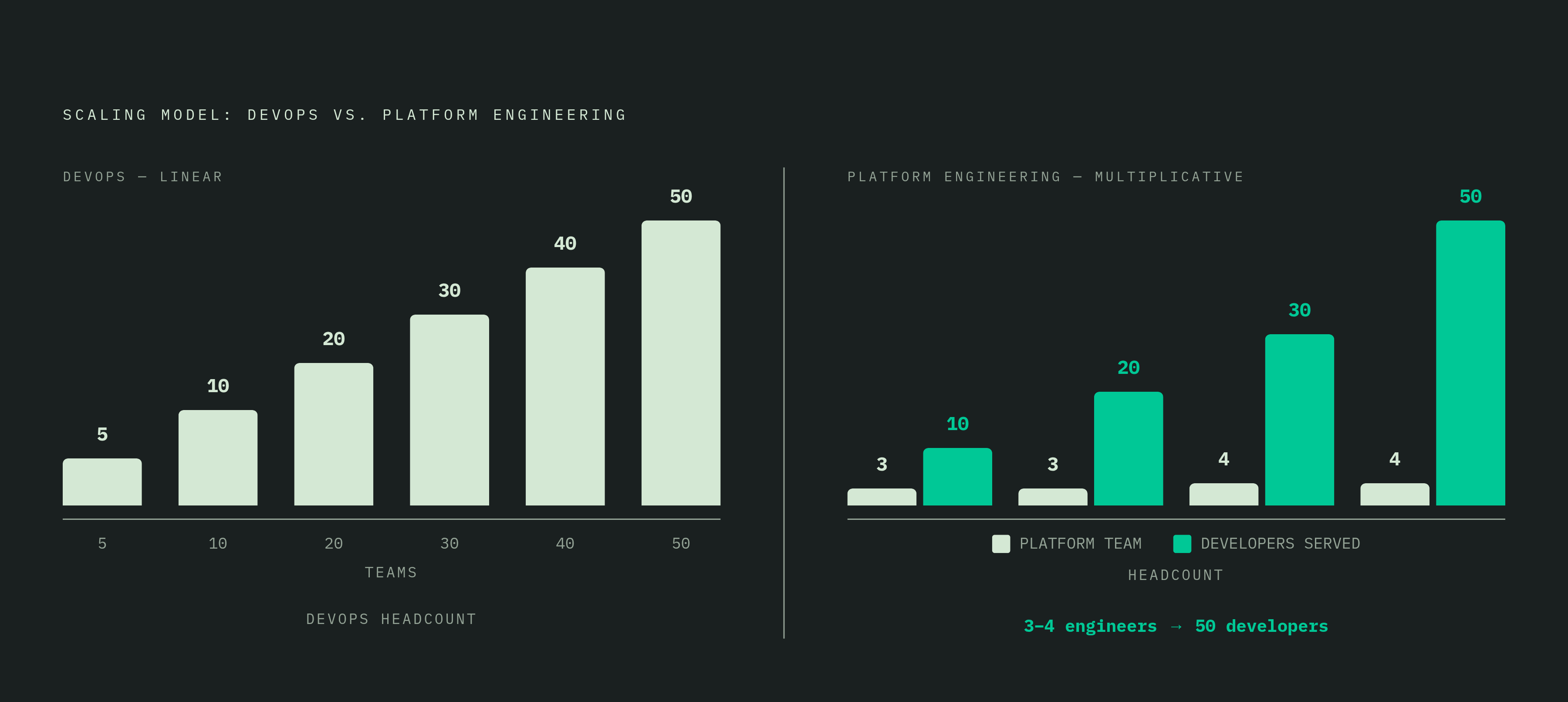
On scaling model, DevOps scales linearly: more teams require proportionally more DevOps support, a relationship that holds because the work and the headcount grow together. Platform engineering scales multiplicatively instead, since the platform is built once and reused simultaneously across every team that adopts it. This is the core economic argument for investing in a platform team at scale: the leverage a mature internal developer platform produces has no equivalent in a pure DevOps model, where operational knowledge stays concentrated in whichever senior engineers happen to hold it.
On output, DevOps teams produce pipelines, runbooks, scripts, and monitoring dashboards tied to their own services. Platform teams produce the internal developer platform itself, self-service portals, golden path templates, developer CLIs, and shared infrastructure modules meant for everyone else to use.
On success metrics, DevOps teams are measured against deployment frequency, lead time, mean time to recovery, and change failure rate, the standard delivery metrics. Platform teams are measured on developer satisfaction, onboarding time, and platform adoption rate instead, a different scorecard entirely because the customer being served is internal.
How team structure differs
The structural difference between these two models is organizational position, not just headcount. A DevOps engineer lives inside a product team and serves that team's delivery goals directly. A platform engineer belongs to a dedicated team, and its customers are every other engineering team in the organization. A DevOps engineer's day runs through managing CI/CD pipelines, writing infrastructure as code in Terraform or Ansible, monitoring production systems, responding to incidents, and working directly with developers to clear deployment blockers, work where the knowledge lives in the individual and in the relationships that person has built across the org. A platform engineer's day runs through building self-service tooling, designing and maintaining golden path templates, managing shared infrastructure modules, gathering feedback from the developers using the platform, and iterating on it the way a product manager would iterate on a release, work where the knowledge lives in the system itself.
Standing up a functional platform team takes real investment: at least two to three senior engineers working on it full time, growing to three or four for an organization of roughly fifty developers, ideally supported by product management. Anything smaller lacks the capacity to build, maintain, and iterate on a platform while still fielding the daily needs of the developers depending on it. The leverage ratio that makes platform investment pay off, a small platform team supporting a much larger developer population, only materializes once the internal developer platform has matured into something genuinely self-service. In the early stages of building one, the ratio of platform engineers to the developers they support is much closer to one-to-one, and leaders should expect that before they expect multiplicative returns. Most organizations operating at real scale run both structures in parallel rather than choosing one: DevOps engineers stay embedded in product teams handling team-specific automation and incident response, while a separate platform team builds and maintains the shared infrastructure that those embedded engineers and their developers draw on every day.
When a platform team becomes necessary
The right model for a given organization is determined by its stage of growth, not by which approach happens to be fashionable in the industry at a given moment, and the signals marking the transition are visible well before the three failure modes described earlier become acute. DevOps alone is enough for an organization that is still small, running a handful of product teams, where each team can maintain genuine end-to-end ownership of its services without the cognitive load becoming unmanageable, and where any diversity in tooling across teams is still visible enough for leadership to notice and correct directly. Several concrete signals indicate that a platform team is becoming necessary. Developer onboarding consistently stretches across multiple weeks because every team has built its own undocumented setup, which is a strong indicator on its own. Developers report spending a substantial share of their time on operations tasks rather than building the features they were hired to build. Security or compliance reviews find policies that are implemented inconsistently, or not implemented at all, across different teams. Cloud spending grows faster than the user base does, because teams are provisioning resources independently with no central function optimizing for cost. A de facto central infrastructure team has already formed on its own, and its growing ticket backlog is the bottleneck failure mode described earlier, now showing up in practice. None of this implies that every organization is destined to build a platform team eventually. It means these signals make the decision legible when the time comes, rather than leaving leadership to guess based on headcount alone or on what a competitor down the street happens to be doing.
How environment consistency becomes a platform-level responsibility
Environment drift, the slow divergence between what runs on a developer's laptop, what runs in CI, and what runs in production, sets up the most common class of reliability failure in organizations that have not yet made environment management a platform-level concern. In a pure DevOps model, each team manages its own version managers for languages and runtimes, tools like nvm, pyenv, and rbenv among others, and because these tools don't communicate with one another across teams, they drift independently over time. The failure appears in two familiar and costly forms: tests that pass locally but fail in CI, and production breakages that nobody can reproduce on a development machine. The breadth of DevOps work, spanning Dockerfiles, Kubernetes manifests, Helm charts, CI/CD pipelines, and observability configuration, is manageable for a small team, but as the organization grows, mastering every one of those layers becomes an unsustainable ask for any single developer. Tools like Flox that handle environment and dependency management declaratively can take one layer of that burden off the table entirely, by letting developers declare a reproducible build and runtime stack in a single manifest and leaving the rest of the infrastructure concerns to be handled separately.
Making environment consistency a golden-path property, something the platform defines and guarantees rather than something each team is individually responsible for getting right, eliminates this entire category of failure. The platform specifies what the environment is, pins it precisely, and every team consumes that same specification. This is one of the concrete points where Flox operates: teams define an environment once in a human-readable manifest.toml file, pin every dependency to a hash derived from its inputs, and get an environment that runs identically across developer laptops, CI runners, and production, across Linux and macOS, on both x86-64 and ARM, without rebuilding or redistributing large artifacts. FloxHub extends that same guarantee to the team level: environments can be versioned and shared by name, so a new developer can pull a complete, pinned stack with a single command instead of working through a multi-step README full of caveats and exceptions. That single capability speaks directly to one of the clearest signals discussed above, the multi-week onboarding process that tells leadership a platform team is overdue.
How software supply chain security becomes a platform property
Inconsistency across teams doesn't just cost engineering time, it compounds into a security problem the moment each team is left to build its own infrastructure independently, because there is no single point from which policy can be enforced. A security requirement that one team implements faithfully and another team implements loosely, or not at all, is not really a policy in any enforceable sense; it's a suggestion that happens to be written down somewhere. A platform engineering layer that provides golden paths for environment setup gives an organization a place to encode its standards once, in the form of versioned, reproducible environment manifests, and have every team inherit them automatically rather than reimplementing them from scratch with their own interpretation of what "secure enough" means.
Here, software provenance, knowing what dependency versions are running, where they came from, and whether they match what was tested, shifts from a question each team answers for itself to a property the platform guarantees for all of them. An internal developer platform built on declarative manifests gives every team self-service access to a standardized, reproducible stack, so no developer needs to understand the packaging, hashing, and distribution mechanics underneath it. A single configuration file defines the dependencies, can be versioned, promoted through environments, and rolled back atomically if something goes wrong, and because the specification is pinned rather than assembled ad hoc, the organization gets an audit trail for what ran and where it came from as a natural byproduct of how the platform works, not as an additional compliance exercise bolted on afterward.