CI/CD Pipeline Design for AI Agent Task Execution
Reproducible agent environments require the same version discipline as production code.
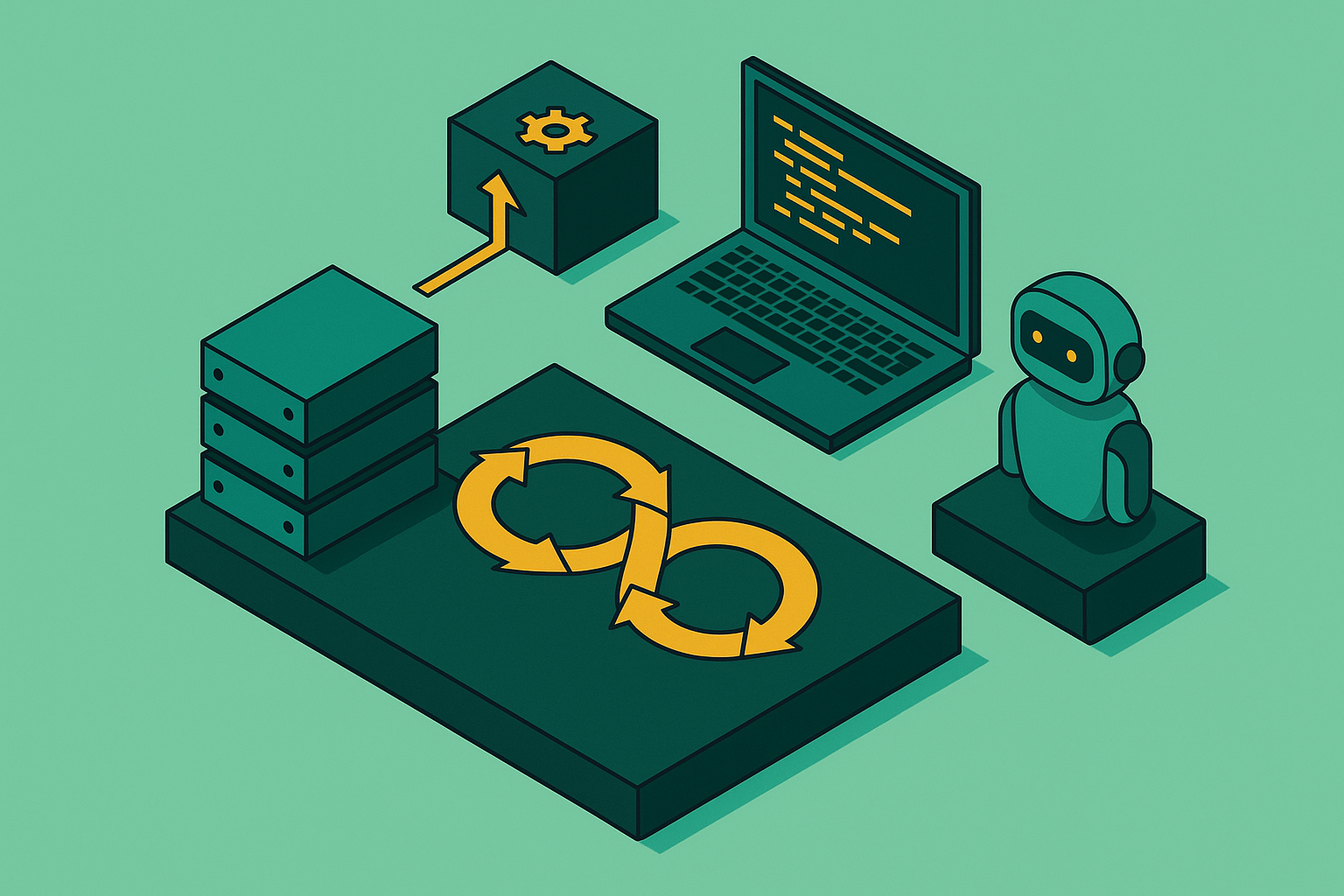
CI/CD pipelines built for AI agents have a reliability problem, and it lives beneath the model, in the runtime, the tool schemas, the credentials, the exact versions of everything the agent touches when it makes a decision. Most teams manage this environment the way they'd manage a junior developer's laptop: informally, with drift tolerated because someone will eventually notice something looks off. An agent running headless in a pipeline has no one nearby to notice, and treating its runtime with anything less than the reproducibility discipline applied to production code is exactly how teams end up with an agent that behaves differently in staging than it did an hour earlier in dev.
Platforms are already building for a world where this matters. GitHub's early preview of Agentic Workflows, announced in February 2025, folds agent runners directly into the CI execution model rather than bolting them on as a side tool. Once agents are infrastructure, their runtime has to be versioned, pinned, and audited the same way a build server or deployment target would be. A developer who hits a broken environment reads the error, pokes around, improvises a fix. An agent in a headless run just fails silently, or worse, produces a wrong answer that looks perfectly plausible, with nobody in the loop to catch it.
How environment drift becomes agent behavior drift
Two failure patterns from ordinary CI/CD get worse the moment an agent is the one acting on the environment.
The first is toolchain drift: compilers, SDKs, and language runtimes shift between builds, sometimes at nothing more than a patch version, and that shift can change what a tool call returns or how a subprocess behaves. The second is environment rot, where system libraries, environment variables, and shell configs pile up quietly until nobody can reconstruct the exact runtime a build once ran on. Neither pattern is new. What's new is what happens once an agent's reasoning sits downstream of them, because an agent's decisions are conditioned entirely on what its tools report back.
If a tool's behavior changes because the environment under it changed, the agent's output changes too, with no edit to the model, no edit to the agent's code, nothing in version control that explains the shift. That's what makes it hard to debug: there's nothing obviously broken to point at.
MCP-server schema drift is the sharpest version of this problem. If a tool's schema changes between one pipeline stage and the next without a version gate catching it, the agent gets handed a different set of capabilities than the ones it was tested against, and it has no way of knowing that happened. Partial tool failures and silent schema drift are recognized failure modes in agentic pipelines. Because agents rarely throw a clean error when this happens, the failure looks like a plausible answer instead of a crash, and debugging it requires knowing whether the environment moved at all, which is impossible unless the environment was traceable from the start.
What reproducibility actually requires when agents are in the pipeline
Reproducibility means the environment rebuilds from a version-controlled definition with no manual steps and no hidden assumptions about the host machine. Traceability means every change to that environment has a record and an owner, so when agent behavior shifts, someone can tell whether the cause was the environment, the model, or the agent's own logic. Most teams reach for one of these and skip the other; both are required, or the debugging problem above never actually gets solved.
For agent pipelines, "environment" covers more ground than most teams budget for at the outset. It's the language runtime and system libraries the agent process runs on. It's MCP server versions and the tool schemas they expose. It's model weight or API version pins, where the model is self-hosted or the version is selectable. It's the agent's own configuration: rules files, permission sets, max-turn limits. And it's the state of non-human identity credentials, including when they last rotated.
All of that needs the version discipline normally reserved for application code, no exceptions carved out because the artifact in question is "just config." The bar is a pipeline that fails loudly the moment any one piece drifts, rather than one that limps forward on a degraded environment and hopes nobody notices.
Tooling options for pinning and distributing reproducible agent environments
The tooling here has gotten good enough that a single command spins up an identical environment on a developer's laptop, a CI runner, and a containerized deployment. Flox, for instance, manages this through a single manifest that pins dependencies identically across all three. The choice between tools comes down to team constraints, not capability gaps, though one option deserves more weight than it usually gets.
Nix, and Nix flakes specifically, offer the deepest reproducibility available: offering deep, deterministic pinning across the dependency stack, working across multiple operating systems without requiring Docker. The tradeoff is real and well documented; the Nix language is genuinely hard to learn and unforgiving to teams without someone already fluent in it. For teams that actually need the strongest provenance guarantees, that cost is worth paying, and treating Nix as too arcane to bother with is how teams end up settling for weaker guarantees they'll regret later.
Devbox wraps Nix under a friendlier JSON config. Environments come up as isolated shells, walled off from global system packages, and the same devbox.json file drives both CI and a developer's machine, so there's no divergence between the two. It costs less to onboard than raw Nix, though some of the extreme edge-case guarantees get traded away for that convenience.
Devcontainers integrate well with common IDEs and cloud-hosted dev environments. The catch is the Docker layer underneath: image freshness and base image drift become their own maintenance job, and provenance questions inherit whatever the container layer introduces.
There's also a category of manifesto-driven environments built on Nix that rebuild deterministically from a single manifest, whether that manifest is cloned to a laptop, pulled into a CI runner, or containerized for deployment. The appeal for agentic pipelines specifically: the same manifest a human developer activates locally becomes the exact artifact a CI agent runner consumes, closing the gap between "works on my machine" and "works in the pipeline." Because the environment is fully declared, provenance data is a natural byproduct of the definition rather than a report bolted on after the fact.
Containerized build environments work well layered on top of any of the above. Locking a toolchain into a versioned image and pushing it to a container registry adds a distribution and immutability layer. Pinning immutable image tags in agent configuration is the pattern to follow for MCP server deployment in multi-tenant or blue/green setups.
Whatever gets chosen, the environment definition has to be something a CI runner can consume without a human translating it. That means declarative manifests over imperative setup scripts that only make sense to the person who wrote them.
Treating MCP servers as versioned CI/CD artifacts
MCP has become the standard way to give agents reliable access to outside tools and data, and adoption sped up quickly after the protocol was moved to a foundation governance model in late 2025. Inside a CI/CD pipeline, an MCP server is a versioned dependency of the agent's behavior, full stop, and it needs to be managed like one, with the same change control as any other dependency in the system.
Three practices follow directly from that framing. First, validate the schema in CI: serialize the tools/list response as a fixture and fail the build the moment it drifts. Any change to what tools an agent can see is a breaking change and deserves the same explicit sign-off a breaking API change would get. Second, containerize MCP servers with immutable image tags pinned into the agent's configuration; the daemon model that's fine for a solo developer's laptop falls apart the moment more than one tenant or one deployment environment is involved. Third, expose server version and tool hashes through health check endpoints that APM tooling can read, so an observability system can tie a change in agent behavior back to a specific server version change instead of a shrug and a guess.
On the auth side, more recent MCP spec revisions have aligned server auth with standard OAuth patterns, so servers consume tokens from an existing identity provider instead of minting their own. That's the right call: it lines MCP up with auth patterns enterprises already run and kills the custom token infrastructure teams used to build by hand. In a pipeline, MCP server credentials should travel through the same secrets management path as every other pipeline credential, following the standard process rather than a special exception carved out for AI components.
Request fan-out is where things get genuinely tricky. An agent calling several MCP servers in parallel can succeed partway in a way that looks like a clean success to the pipeline while actually shipping a degraded output. That's an observability gap specific to MCP, and most teams' monitoring setups don't catch it yet.
Non-human identity and credential discipline for agents running in pipelines
Authenticating a headless agent through a developer's personal account is a shortcut that shows up constantly, and it's the wrong call every time. Token lifecycle ends up tied to whether that person still works at the company. Audit trails mix human actions with machine actions in ways that make forensics nearly impossible after the fact. Revoking the credential affects the person as much as it affects the pipeline, so nobody wants to revoke it even when they should, and the credential just sits there, overprivileged and unmonitored.
The fix is dedicated service accounts: one non-human identity per pipeline or automation task, rather than a shared login borrowed from whoever set things up first. That gives every action specific attribution, tied to a pipeline rather than a person, which means a compromised pipeline credential can be revoked on its own without locking a developer out of anything.
Rotation needs to be a deliberate step, not something left to expire on its own: create the new token, update the automation to use it, then revoke the old one. Tokens don't age out by themselves. Skipping that sequence just means old credentials sit around indefinitely, valid and unwatched.
This matters more for agents than for ordinary automation because agents take a wider range of actions: tool calls, code commits, deployment triggers, all of which need to trace back to something specific. There's a supply chain angle here too, and it's easy to miss. An agent holding broad credentials while operating inside a compromised environment is itself a supply chain attack vector, which means the identity layer and the environment integrity layer have to be designed together from the start, rather than bolted on separately after an incident forces the question.
Supply chain provenance for agent pipelines, including AI components
The supply chain threat surface has widened. Third-party involvement in breaches has grown sharply in recent years, and the stretch from 2025 into 2026 brought a run of high-profile compromises hitting CI/CD actions, package registries, and security tooling itself, touching widely used open-source dependencies across the software delivery chain. Software supply chain failures — covering third-party components, repositories, development tools, and build artifacts — represent the entire surface an agent pipeline touches on a normal day.
Most SBOMs generated today are compliance paperwork, produced at the tail end of a build and filed away without anyone acting on them, which makes them close to worthless as a security control. The practical gap is acting on what's in the SBOM once it's generated, not generating it in the first place. Transitive dependency coverage can be inconsistent, so SBOMs work best when paired with other analysis approaches that surface actionable findings.
For agent pipelines, the SBOM has to stretch further than a traditional software bill of materials, and treating it as though model artifacts and agent configuration sit outside its scope is a gap waiting to be exploited. It needs to cover model weights or API version pins where the model is self-hosted or selectable, MCP server images and their dependency graphs, and agent configuration artifacts like rules files and permission manifests that shape what the agent is even allowed to do.
Strong provenance attestations, paired with cryptographic signatures on base images, are the bar to hit for any artifact an agent consumes or produces. Sticking to open standards keeps this evidence portable across customers and regulators without locking a team into one vendor's format: CycloneDX or SPDX for the SBOM itself, in-toto for build attestations, SLSA for provenance levels, OSV for vulnerability data, VEX for exploitability context. This data belongs stored alongside the artifact in the artifact repository, so provenance travels with the artifact through every stage of the pipeline instead of getting lost between them.
Pipeline architecture that prevents agents from running away or acting without authority
A sound architecture keeps four concerns separate that are easy to let blur together. Orchestration handles sequencing, retries, and escalation decisions. Execution handles the actual model calls and tool actions. Data access handles context and memory, with explicit boundaries on what the agent can see. Policy enforcement checks every high-risk decision before it's allowed to run. Collapsing any of these into the others is how a single misbehaving component ends up with the authority of all four.
Headless CI adds its own constraints on top of that. Max-turn limits cap how many iterations an agent can run through; without a ceiling, an agent stuck looping burns resources indefinitely and never produces anything useful. Rules files load team-specific coding standards and keep agent behavior bounded during implementation work. Permission types built around human input, like an "ask-user" option, have no place in a headless configuration; they just block the pipeline forever, waiting for someone who was never going to show up.
Policy enforcement carries weight well beyond compliance checkbox status, and treating it as a paperwork exercise misses the point entirely. Agents can be prompted or manipulated into taking actions well outside their intended scope, and a policy gate is the defense that doesn't depend on the agent's own judgment holding up under pressure. Every high-risk action, whether that's a code commit, a deployment trigger, or a credential access request, needs an explicit authorization check in the policy layer, logged against the non-human identity tied to that pipeline run.
Done right, this architecture makes it possible to answer four questions for any given run: what the agent did, in what environment, against what policy, in which pipeline execution. A pipeline that can't answer all four is a black box that happens to produce output, and the two should never be confused for each other.
Drift detection as a continuous pipeline gate, not a periodic audit
Environment drift doesn't get solved once at setup and stay solved. It comes back continuously, as dependencies update on their own schedule, CI runner images get refreshed upstream, and MCP server schemas evolve out from under whatever version a team last tested against.
By the time a quarterly audit catches drift, the agent has already acted on a compromised runtime and shipped whatever came out of it. Drift detection has to run as a gate on every single pipeline execution: hash the environment, diff it against the last known-good version, and fail the build the moment something doesn't match, before the agent gets a chance to act on a runtime nobody signed off on. A gate built into the pipeline catches drift before the agent takes a single action on top of it, which is the only point in the sequence where catching it actually matters.