Managing Toolchain Upgrades Across Platform Engineering Teams
Toolchain upgrades risk organizational drift—here's how to stage them safely.
Toolchain upgrades are the highest-risk moment in platform engineering, full stop, and most organizations still run them with less discipline than they'd apply to a routine dependency bump. A version skew in a compiler, runtime, or build tool doesn't announce itself. It changes behavior quietly, and by the time anyone notices, half a dozen teams are already building on foundations that no longer match. I've watched this go wrong enough times to have opinions about it. This piece is a framework for running toolchain upgrades that keep environments reproducible and teams unblocked, from pinning through rollback.
Start with a distinction that gets collapsed too often. A dependency update touches one project: you bump a library, run the tests for that project, ship. A toolchain upgrade touches every project sitting on the platform, because the compiler, runtime, and build tool versions live underneath application code as an assumption nobody restates every day. Shift that assumption and the blast radius stops being one repository's problem. It becomes everyone's problem, usually before anyone's had a chance to say so out loud.
Drift shows up differently during an upgrade than during normal operation. Staggered rollouts leave some teams on the old version and some on the new; that's the "works on my machine" problem, except now it's an organizational one instead of a personal one. Floating version references make it worse. A team pinned to a major-version tag rather than an exact release pulls a different build on a different day, and nobody decided that should happen, it just did. CI pipelines and developer laptops tend to diverge first, and production follows later, by which point nobody can say with any confidence what actually changed.
Platform teams own this risk whether they signed up for it or not. They set the baseline the rest of the org depends on, so when that baseline moves, they become the coordination layer holding the whole thing together, whether they meant to or not. Skip the coordination and teams route around the platform instead, standing up shadow toolchains just to keep shipping. Those shadow toolchains don't go away once the upgrade lands. Instead, they sit there, waiting to make the next upgrade worse.
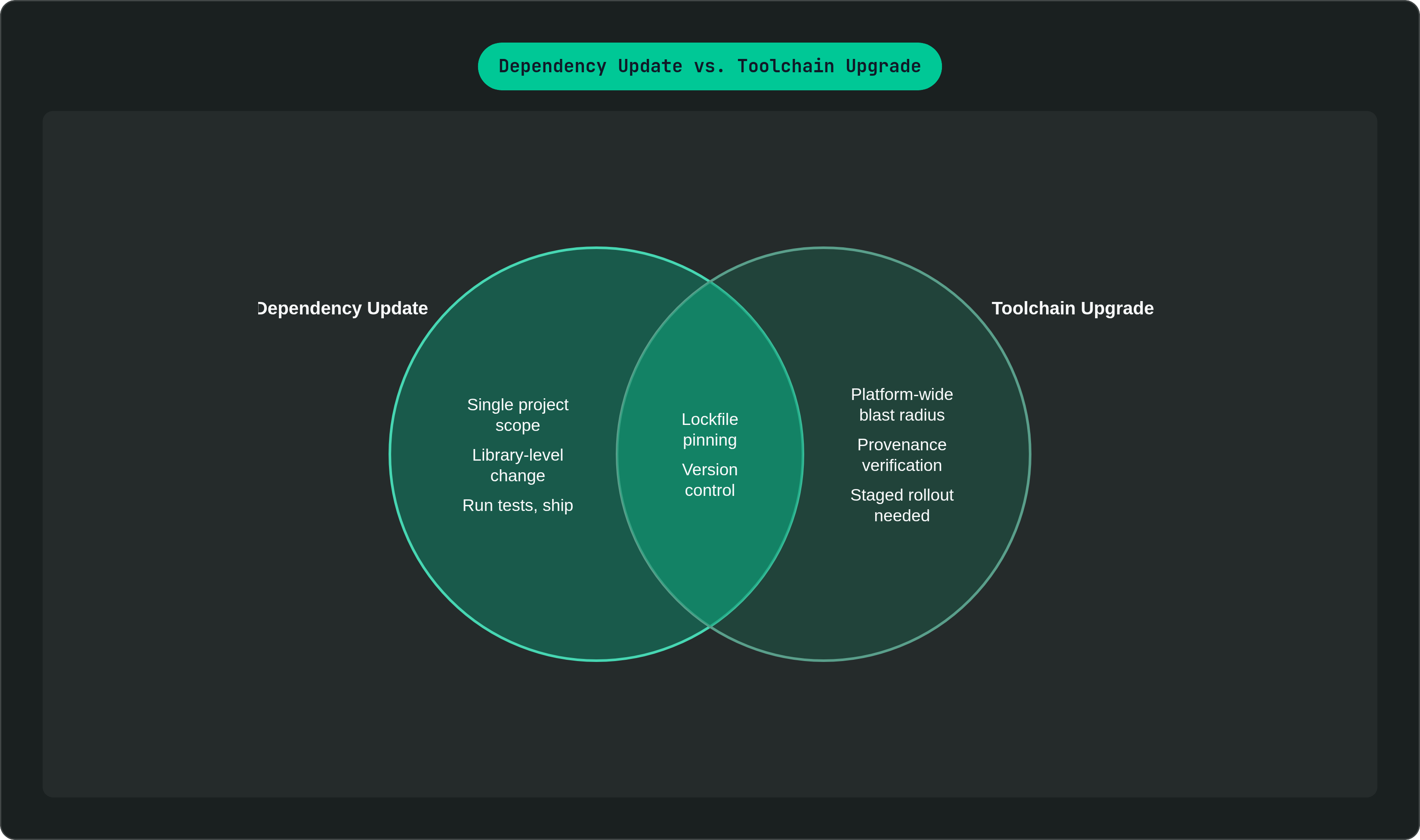
What a toolchain upgrade actually touches across the platform
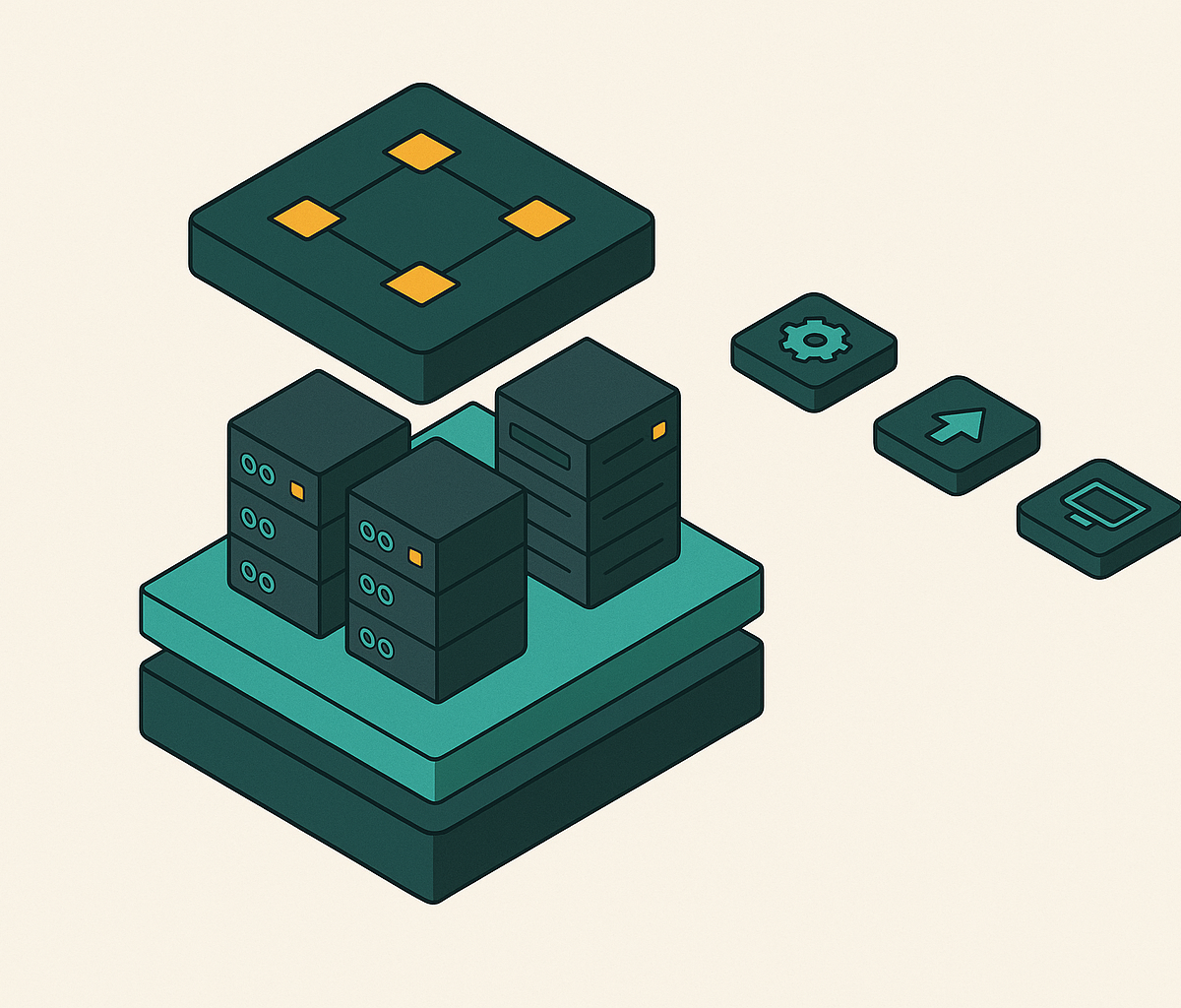
An upgrade propagates through five layers, and most of the pain in a bad rollout comes from treating them as one. Developer workstations and local shells sit at the bottom. Above that: CI/CD pipeline runners and build agents, then container base images used in test and staging, then production runtime environments, and finally the documentation, onboarding scripts, and README files that are supposed to tell people how any of this works.
Each layer loses consistency its own way. On local machines, developers running different operating systems or chip architectures can resolve the same version spec to different binaries with zero errors thrown anywhere. In CI, if the pipeline installs its own tools instead of reading from what developers use locally, parity between the two is luck, not a guarantee. Container images turn this into something almost routine: a team running node:20 instead of a digest-pinned image pulls a silently updated build on the next run, and nothing in the pipeline flags it. I'd call this the single most common configuration lapse in container-based environments, and it's not close.
The organizational surface is wider than engineering. Application teams hit build failures or behavioral regressions they can't explain, because nobody told them a toolchain change had landed under their feet. Security and compliance teams lose the ability to trace what was actually used to build what, which matters far more than it sounds like right up until an audit asks the question and nobody has an answer. And the disruption lands on top of an existing wound: in a survey of roughly 1,200 software engineers, 67% said their first production-ready contribution took more than four weeks, with environment confusion cited as a primary driver. An unmanaged upgrade reintroduces that exact confusion for everyone, mid-cycle, all at once.
There's a supply chain angle here too, and it gets less attention than it should. A toolchain is itself third-party software, with its own dependency tree and its own build process somewhere upstream, out of view. Upgrading it means trusting a new artifact, and without provenance verification a team has no real way to confirm that artifact wasn't altered somewhere between the vendor and the install script. More on that later.
Pinning and lockfiles as the foundation of a safe upgrade path
"Latest" is a promise to drift, deferred until whenever the next install happens to run. An upgrade done without pinning just resets that clock. Exact pinning turns the upgrade into something deliberate and reviewable, instead of something that happens quietly the next time someone runs an install command and doesn't think twice about it.
A lockfile records the exact resolved version, ideally the content hash too, of every tool in the environment. Any developer or CI job reading from that same lockfile gets identical tool versions, down to the bit. An upgrade becomes a lockfile diff a reviewer can actually sit with in a pull request before it ships to anyone. Rollback comes free with this setup: revert the lockfile and the prior environment comes back whole, not approximately, not close enough.
Different tools sit at different points on the pinning spectrum, and the differences matter once you're actually running one. Mise pins language and CLI tool versions at the project level; it's the lowest barrier to entry and covers the drift vectors most teams hit first. Devbox, built on Nix, resolves packages to a lockfile against a package repository covering a huge range of versions across languages, databases, and CLI tools, which buys stronger guarantees while keeping local and CI in lockstep. Dev Containers support pinning in the spec, but teams skip digest pinning often enough that I'd flag it on its own as the most common failure mode in container setups. Flox extends Nix-based pinning across architectures and operating systems, which starts to matter the moment a team spans Linux and macOS, or x86 and ARM, and needs the lockfile to mean the same thing everywhere.
For an upgrade specifically, pinning makes the whole process almost dull: bump the pin on a branch, not on main. The diff is auditable, reviewers see exactly what's changing before it touches anyone downstream, and because the old pin still lives in version control, two versions of the toolchain can coexist while the rollout plays out.
A staged rollout model that keeps teams productive during the transition
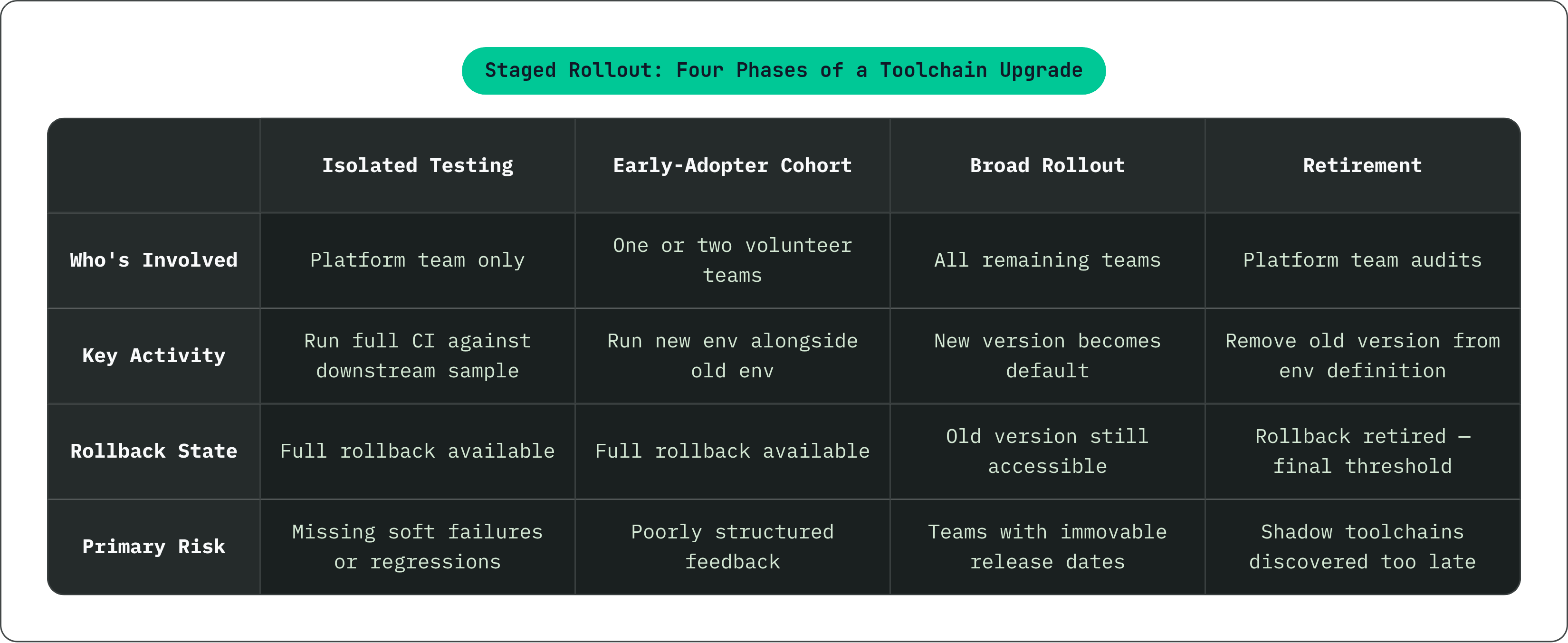
A hard cutover, everyone moves the same day, is the riskiest option on the table, and it's still the default at more organizations than I'd like. Move the whole platform at once and a failure has no isolation; you can't tell whether it's the toolchain, a downstream dependency, or something else entirely tangled up in between. Teams with release deadlines that happen to land near the cutover either become blockers or get exceptions, and those exceptions have a habit of turning into permanent forks nobody actually planned for.
Isolated testing comes first. The platform team cuts a branch of the environment definition with the new toolchain pinned, then runs the full CI suite against a representative sample of downstream projects, not just the platform's own code. Every failure gets written down as it surfaces: behavioral changes, deprecation warnings, performance regressions, anything at all.
Then an early-adopter cohort, one or two teams willing to run the new environment alongside the old one. This only works cleanly with exact pinning, since the two environments need to be independently stable rather than fighting over the same floating reference. Feedback here should be structured, not vibes: build time changes, test failures, the ordinary friction developers notice but almost never file a ticket about.
Broad rollout follows, paired with a sunset date for the old version. The new version becomes default; the old one sticks around but gets explicitly marked for retirement on a fixed date. That date creates urgency without forcing everyone to move at the same second, and migration guides with automated scripts lower the cost for whoever's still catching up.
Retirement is last: pull the old version from the environment definition, and audit for teams that quietly pinned around the platform to keep using it directly. If you find those teams at this stage, that's a signal the rollout created more friction than it should have. Worth a retrospective, not a scolding.
Internal developer platforms make all four stages cheaper. When environment definitions are exposed as self-service artifacts, teams opt into the new version on their own schedule instead of waiting for a push, and automated provisioning takes most of the coordination cost out of running two versions side by side.
Testing the upgrade against the real workload before anyone else sees it
The platform team's own test suite proves the toolchain works for the platform team's code. It proves almost nothing about anyone else's. A real test pass needs a representative sample of downstream project types, compiled languages, interpreted runtimes, build-heavy monorepos, anything with native dependencies, because that's usually where the sharp edges live.
Failures come in a few distinct flavors, and they're not equally easy to catch. Hard failures, compilation errors, missing symbols, broken build scripts, are the easy case; CI screams immediately. Soft failures are harder to catch: a warning gets promoted to an error, a deprecation starts getting enforced, an output format changes shape, and downstream scripts that parsed the old output quietly break without a single red X in sight. Performance regressions are harder still, since longer build times or higher memory use often don't fail CI at all, they just make developers miserable at scale, week after week, until someone finally complains loud enough. Ecosystem compatibility issues need the full dependency graph tested, not the toolchain in isolation, because a new compiler version can conflict with a dependency that hasn't caught up yet and won't for months.
None of this testing means much if CI and local development aren't running the same environment. When CI installs tools separately from the lockfile developers use on their laptops, a green CI run tells you nothing about what happens locally. Running the equivalent of devbox shell in CI, from the identical lockfile developers use, closes that gap for good. Test environment and developer environment become the same thing by definition, not by convention, not by good intentions.
The write-up from this phase isn't optional paperwork, even though it gets treated that way half the time. A summary of what was tested, what broke, what got fixed, and what behavioral changes remain is the migration guide downstream teams actually use. Teams that get this document can decide for themselves when to move, which takes real support load off the platform team's plate.
Communicating upgrades so teams can plan rather than react
Getting the engineering right doesn't count for much if nobody downstream knows it happened. Application teams run their own release calendars, and an upgrade landing at the wrong moment forces a choice between freezing their roadmap or rushing a migration they weren't ready for. This isn't hypothetical: in that same survey of roughly 1,200 engineers, 42% said their onboarding documentation was significantly out of date. Upgrade communication tends to fail the same way, announced once, then left to rot.
A real upgrade announcement covers what's changing and why, whether that's a security fix, a performance improvement, or a required ecosystem update. It spells out what teams need to actually do, in steps, not a changelog link and a shrug. It says what breaks if a team does nothing, and by when. And it says where to go when something doesn't match the plan, because something always doesn't.
Lead time matters as much as content, maybe more. Announce the new version and the old version's retirement date together, so teams can plan a migration window instead of getting a last-minute notice that turns into a scramble. A minor CLI bump doesn't need much runway. A runtime major version does, and lead time should scale with how disruptive the change actually turns out to be.
The best channel is often the one that already exists. If the environment definition lives in a repo, the pull request bumping the version is the announcement: visible, commentable, linked straight to CI results. Teams watching the platform repo see the change coming before it merges, which beats an email that lands after the fact and dies in an inbox.
There's a broader number worth tracking here. Organizations that measure developer cognitive load formally look at how many separate tools a developer has to touch just to ship a deployment. Upgrade communication that sends people across three different systems to piece together what changed adds to that load for no good reason at all. One place, authoritative: that's the goal, and it's simpler to say than to build.
Rollback as a first-class part of the upgrade plan, not an afterthought
Rollback usually isn't there when people go looking for it, and that's almost always a planning failure, not a technical one. Teams that upgraded by mutating a shared environment in place have no clean prior state to return to; they overwrote it, on purpose, without meaning to lose it. Teams running on floating version references can't even define "what we had before" precisely, because it was never pinned down to begin with.
Exact pinning fixes this by design, not by heroics. If the upgrade is a lockfile diff sitting in version control, rollback is just a revert of that diff: no manual reinstall, no tribal knowledge locked in one engineer's head who happens to be on vacation the week it matters. The reverted lockfile puts every tool back to its exact prior version, on every machine that pulls it. Upgrade and rollback become the same operation, run in opposite directions, and that symmetry is what makes rollback something a team can actually count on instead of a step in a runbook nobody's ever tested for real.
The rollback window needs to be designed into the staged rollout from day one, not bolted on when something breaks. During the early-adopter and broad rollout stages, the old version stays available, so rollback is a switch back to a known-good environment definition, not an emergency scramble at 2 a.m. Retirement is where rollback gets expensive: don't retire the old version before you're confident failures would have already surfaced in production, since retiring too early leaves you with no safety net at exactly the moment you still needed one.
Decide the rollback triggers before the upgrade ships, not while it's already failing and everyone's arguing in a Slack thread. What CI failure rate is too high. What class of production behavior change is unacceptable. What level of team complaints tips the decision. Set this in advance and you remove the social pressure to "give it a few more days" once the evidence has already made the call for you.
Cross-architecture teams add a wrinkle here. A team spanning Linux and macOS, or x86 and ARM, needs rollback to behave identically everywhere; a plan that only works on one architecture leaves a gap that surfaces at the worst possible time, usually during an incident, never during a quiet Tuesday. Environment tools that resolve reproducibly across architectures from a single lockfile are what make that rollback tractable instead of aspirational.
Supply chain verification during a toolchain upgrade
An upgrade is, underneath everything else, an act of trust in an artifact you didn't build yourself. That artifact came from somewhere, passed through some number of hands and registries, and landed on your machine claiming to be exactly what it says it is. Verification is the practice of checking that claim instead of taking it on faith, which is exactly what most teams do without quite realizing it.
Provenance attestation is the mechanism that matters most. A build system that publishes a signed record of how an artifact was built, from what source, using what inputs, lets a platform team confirm the toolchain binary they're about to roll out matches what the vendor actually intended to ship, rather than something altered in transit or swapped at a compromised mirror somewhere along the way. Skip that check and an upgrade rests on faith dressed up as an engineering decision, which is a worse trade than it sounds.
This matters more, not less, during an upgrade specifically, because upgrades are exactly when a team is most likely to pull a new artifact for the first time and least likely to have any build history to compare it against. A tool that's been running unchanged for a year has an implicit track record built up behind it. A brand-new version has none of that, and that's precisely the moment verification pays for itself.
Signature verification and hash pinning belong in the same lockfile discipline covered earlier, not bolted on as some separate ritual. If the lockfile records a content hash alongside the version, that hash becomes a checkpoint every time the environment gets provisioned, whether that's a laptop, a CI runner, or a container build. Skip that check and pinning only guarantees consistency, not integrity, which means you'll reproduce the exact same compromised artifact everywhere with perfect precision.
None of this replaces judgment, and I don't think it should. A platform team still has to decide how much verification overhead is proportional to the toolchain in question; a compiler used by every project on the platform warrants more scrutiny than a niche linting tool one team happens to like. That decision should get made on purpose, as part of the upgrade plan, not discovered as a gap after something's already gone wrong and someone's asking why nobody checked.