Software Deployment Tools for Immutable Release Pipelines
Rebuild-free deployments let teams prove what actually ran in production.
An auditor asks a simple question after an incident: which commit produced the artifact running in production, and who approved its promotion. In a surprising number of engineering organizations, no one can answer with certainty. The failure is not a missing deployment tool. Most teams already run sophisticated CI/CD automation. The failure is that the tools they run rebuild, reconfigure, or otherwise touch the artifact between environments, so the thing running in production is never quite the thing that was tested in staging.
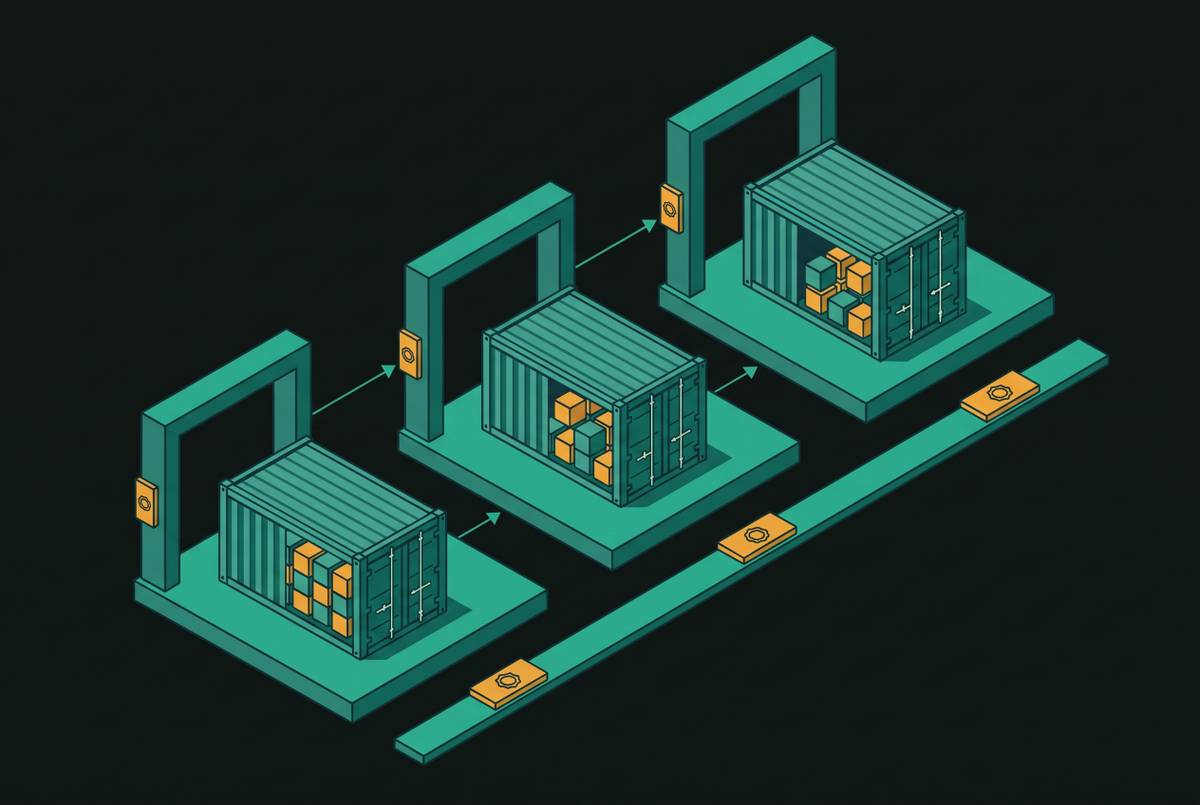
The pipeline model that actually delivers on the promise of immutability is straightforward to state: build once, store that artifact, and promote the identical binary through development, staging, and production without touching it again. What most teams run instead is a pipeline that rebuilds at every stage boundary, from the same source code, but with different timestamps, different resolved dependency versions pulled fresh from a registry, and different package cache states. The source hasn't changed. The artifact has.
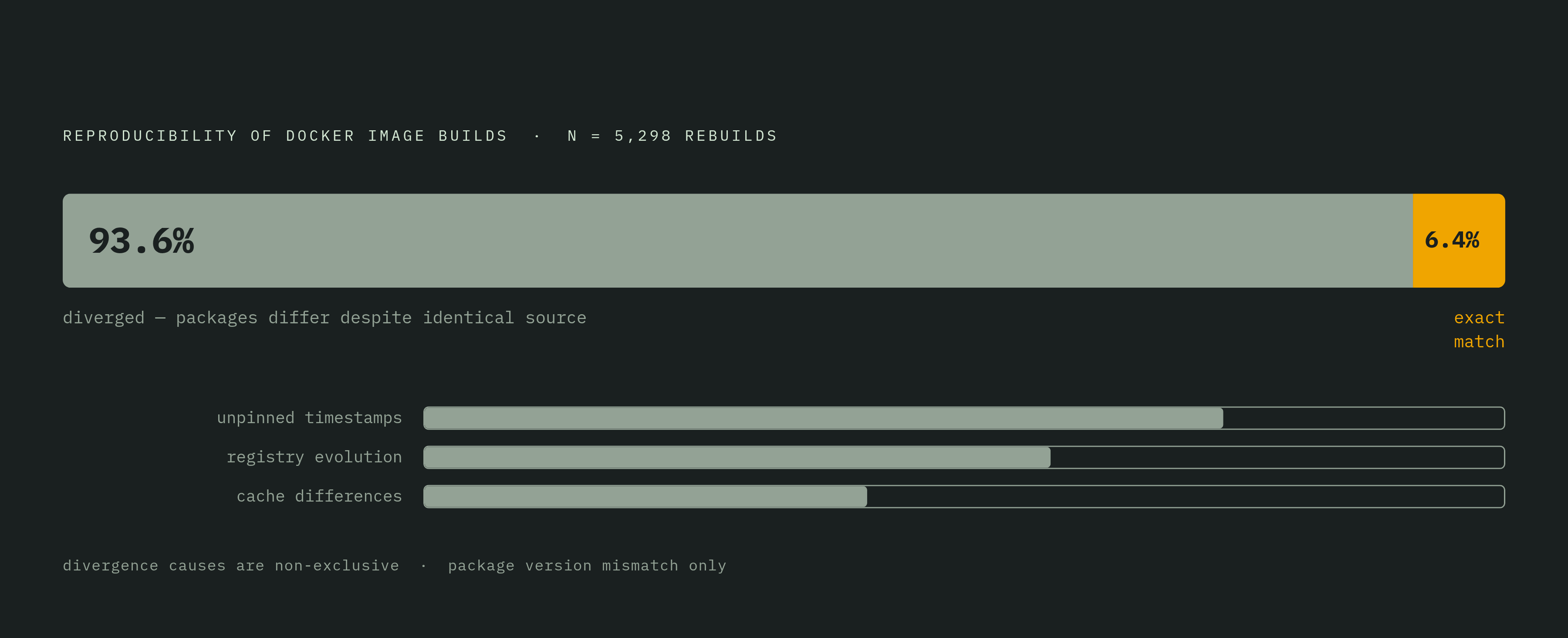
A study of 5,298 Docker builds found that only 6.4% of rebuilt images matched the original set of installed package versions exactly, even when the underlying source was identical. Nondeterministic build steps (unpinned timestamps, cache contents that differ run to run, and upstream repository evolution) account for most of the divergence. That statistic describes the ordinary condition of most CI/CD pipelines running today, not an edge case.
During a security incident or a compliance audit, a team needs to state with certainty which commit produced a given release, which dependency versions shipped inside it, and whether the artifact was modified after it was built. If the pipeline rebuilds at every stage, none of those questions has a clean answer. Environment drift isn't a developer convenience issue that shows up as wasted debugging hours. It erodes the two things a release pipeline exists to protect: confidence that what was tested is what shipped, and an audit record that holds up under scrutiny.
The rest of this piece evaluates deployment tools against that specific failure mode. Not which tool has the most integrations or the friendliest interface, but which ones actually enforce build-once, promote-everywhere discipline, and which ones leave that discipline to the team to bolt on afterward.
What build-once, promote-everywhere requires from a tool
Testing whether a deployment tool supports immutable pipelines means checking five specific properties, not counting how many integrations it lists on its marketing page.
The first is artifact identity. Every build output needs a unique, traceable identity, combining a semantic version with a source commit reference, so that something like "app-2.8.1-f4c8e7d" can be traced back to an exact Git SHA rather than sitting in a registry as an opaque, unattributable filename. The practical version of this is simple to implement: pair a human-readable semantic version with a Git commit identifier, so the artifact name itself carries both the release intent and the source traceability an auditor would need.
The second is promotion without rebuild. Moving an artifact from staging to production has to mean moving the stored binary, not triggering a new build from the same source tag. If the tool's default behavior is to rebuild at each stage, the binary in production is never provably the binary that passed staging tests, no matter how good the tests were.
The third is cryptographic provenance. The artifact needs to be signed or hashed at the moment of creation, so any mutation between stages, intentional or accidental, is detectable rather than silent.
The fourth is an immutable audit trail. Approval decisions, gate clearances, and promotion events need to exist as tamper-proof records tied to a digital identity and a timestamp, not reconstructed after the fact from a Slack thread someone remembers half of.
The fifth is rollback mechanics that actually roll back: re-deploying a previously promoted artifact rather than rebuilding from an old tag, which preserves the exact binary that was originally verified rather than approximating it.
Evaluating a deployment tool for immutable pipelines means testing five specific properties, not counting integrations. That asymmetry, more than any single feature comparison, is what separates a tool that happens to support immutable pipelines from one that was built around that discipline from the start.
Deployment platforms for artifact promotion and audit trails
Octopus Deploy is purpose-built continuous delivery software, designed around the idea of defining a deployment process once and executing it consistently across every environment, which is close to the architectural ideal for promote-everywhere discipline. It offers built-in multi-tenancy for customer-specific instances, role-based access control, deployment runbooks with full history, and built-in approval gates, and its audit trail for deployments themselves is strong. Octopus Deploy lacks native SBOM generation, so teams typically bolt on an external scanner, which reopens the phantom-dependency blind spot that a build-time SBOM would have closed. Octopus offers a free tier for small teams and paid tiers for larger ones, with both self-hosted and cloud deployment options.
GitLab CI/CD takes a different architectural approach: a single DevSecOps application with end-to-end traceability, where merge request approvals and built-in compliance pipelines produce a strong provenance record from source to artifact. Git functions as the single source of truth for environment state, and the merge request approval chain itself becomes an auditable promotion record. GitLab offers a free tier with usage limits, along with Premium, Ultimate, and Dedicated paid tiers, and supports both self-managed and SaaS deployment. Its gap sits on the CD side: continuous integration is handled well, but continuous deployment across heterogeneous environments with multi-tenancy takes more configuration work, and air-gapped deployments require a self-managed setup rather than working out of the box.
Harness Pipeline made a set of changes in its Q1 2026 update that speak directly to the artifact-identity and drift-prevention criteria. Pipelines stored in Git can now be triggered and executed from Git tags rather than only branches, which gives a pipeline version an immutable reference to a specific pipeline state: tag a release v2.1.0, and that exact pipeline version runs, with no ambiguity about which configuration executed. Also added in Q1 2026 was a Dry-Run Validation API that validates YAML syntax, schema conformance, template expansion, and OPA policy compliance before a commit lands, catching drift before it enters the pipeline. Harness also introduced AI-assisted OPA policy authoring, letting teams describe a governance requirement in natural language and generate the corresponding Rego policy, which lowers the barrier to codifying compliance gates without requiring deep OPA expertise on the team. Those policies now live under a full GitX workflow, including branch switching and bidirectional sync, putting the governance layer under the same version control discipline as the pipelines it governs. Step-specific failure notifications route security-scan failures to the security team and deployment failures to on-call, cutting alert noise without losing signal. Harness prices with a free self-serve tier and two paid, contact-sales plans (an Essentials bundle and a modular Enterprise plan); the AI policy authoring is powerful but introduces a new trust boundary, since generated policy should be reviewed before production rollout.
Codefresh is optimized for Kubernetes and GitOps workflows, using Git repositories as the single source of truth for both environment configuration and deployment state. That native GitOps model means the desired state is always declared and auditable, which is a strong fit for teams running Kubernetes-centric promotion pipelines specifically.
Argo CD, listed among the 14 leading deployment tools for 2026, applies the same GitOps principle to Kubernetes continuous delivery. Because the model is declarative and Git-backed, every desired environment state is versioned, and drift from that desired state is visible in the Git history automatically rather than waiting for someone to notice. Its rollback story is a particular strength: re-syncing to a prior Git commit redeploys the exact, previously-verified state, which is close to the rollback discipline the evaluation framework calls for.
Spinnaker, also listed among 2026's leading tools, offers multi-cloud continuous delivery with pipeline-as-code and defined promotion stages, suited to large organizations coordinating promotion across multiple cloud targets, with approval gates enforceable between environments.
ONES.com scores strongest on audit trail integrity and approval workflow granularity among compliance-driven tools, tying requirements, task stories, and release versions into a single item tree with full history, so a single export gives an auditor a who-what-when record down to the field level. Its custom workflows require mandatory multi-role sign-offs, so no promotion proceeds without the correct gated approvals, and its audit reports show every gate clearance with a timestamp and digital identity attached. It offers deployment across Cloud, On-Premise, Private Cloud, and Air-Gapped environments with feature parity across all of them, which matters for GDPR, HIPAA, and defense-sector compliance mandates. It's free for small teams. Its gap is architectural: ONES is primarily a project management and release orchestration platform, and deep artifact-level immutability, including hashing and SBOM generation, requires integrating a dedicated artifact store or supply chain tool alongside it.
Digital.ai Release targets enterprises orchestrating complex releases across dozens of applications, with drag-and-drop release orchestration and automatic evidence collection, priced on a quote basis with both on-premise and cloud options. It's well suited to multi-application release trains where approval chains span several teams and systems at once.
None of the platforms above fully solve environment drift that starts before the pipeline ever runs, a problem that sits one layer beneath deployment tooling. When the build environment itself differs between a developer's laptop, the CI runner, and production, no downstream promotion workflow, however disciplined, can guarantee that the artifact it promotes has a stable identity. This is where declarative environment managers, including Nix-based tooling and Devbox, function as a complementary layer beneath the CI/CD tools already discussed, rather than a replacement for any of them. Nix-based approaches pin dependencies down to the system-library level on Linux, including glibc, and work across Linux and macOS on both x86-64 and ARM without requiring container isolation, describing the entire build environment in a single declarative file that becomes the actual source of truth. Devbox, built by Jetify, is an open-source CLI that uses the Nix package catalog to create isolated, reproducible development environments, letting developers define dependencies in a plain JSON file without needing to learn the Nix language itself; in one internal team test, the overwhelming majority of engineers got a working environment without needing to ask anyone for help. The supply chain payoff follows directly from the reproducibility: when the environment is declaratively pinned, SBOM generation can capture the full dependency graph, transitive dependencies included, closing the gap where ordinary SBOM generators miss a meaningful share of what's actually in a complex build.
SBOM generation as a build output, not a scan
An SBOM produced by scanning a finished artifact after it's built will miss a material part of the dependency graph. An SBOM produced at build time, from a pinned environment, captures that graph completely. That difference is architectural, and it determines whether the resulting document is something a security team can act on or something that exists mainly to satisfy a checkbox.
Basic SBOM generators, run as a post-hoc scan against a compiled artifact, routinely miss transitive dependencies and what the field calls phantom or shadow dependencies, and they tend to stumble entirely on binary-only components that carry no readable manifest. A scan can only report what it can see in the finished object. A build-time SBOM, by contrast, is generated from the same declarative inputs that produced the artifact, so it has no blind spots to miss.
The stakes for getting this right have risen considerably. SBOMs have moved from an optional best practice to, in many contexts, a regulatory and customer-trust requirement; the EU Cyber Resilience Act and emerging AI-specific transparency obligations have put supply chain security on the agenda of executives and boards who previously treated it as an engineering concern. The question organizations now face is no longer whether they have an SBOM on file somewhere, but whether they have the governance to act on it, since an inventory they cannot operationalize does not reduce risk.
The Shai-Hulud worm, identified in August 2026, makes the stakes concrete. It infected more than 400 npm packages across multiple versions, harvesting credentials from both developer machines and CI environments, a single poisoned dependency reaching thousands of downstream projects that had pulled it in without ever inspecting it directly. Teams with incomplete SBOMs, the ones built from post-hoc scans rather than build-time generation, could not rapidly determine which of their own builds had pulled in the compromised package. That is the operational cost of treating an SBOM as a compliance artifact instead of a live map of what's actually running.
Base image choice compounds the problem before any scanning even happens. Standard public container images ship with a large number of known CVEs, in the range of 50-60, while minimal source-built images ship with a fraction of that, making every subsequent scanning and patching layer cheaper, and starting from a smaller, cleaner base reduces the surface the SBOM has to account for in the first place.
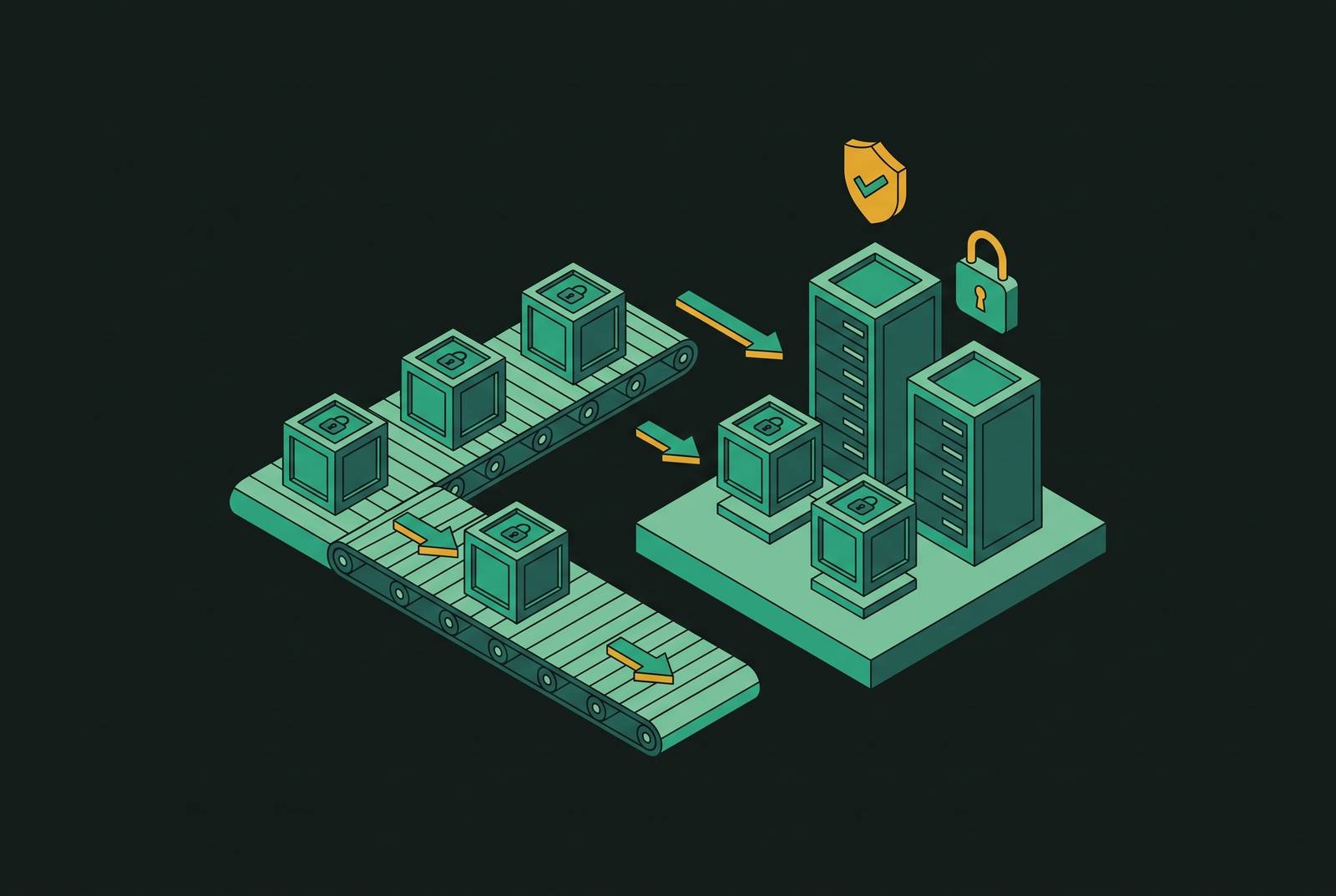
The architectural fix follows the same logic as the build-once principle that governs the rest of the pipeline. When the build environment itself is declaratively pinned, every package sits at a known version with an input-derived hash, so the SBOM becomes a direct output of that environment definition rather than a reverse-engineered guess produced by scanning a finished binary. Compliance becomes a natural byproduct of how the artifact was built, rather than a separate task, once the environment itself is pinned.
A further complication is already visible on the horizon. As AI-native systems become foundational to more applications, the models, datasets, and embeddings inside them shape application behavior just as much as source code does, and a traditional SBOM has no mechanism to capture that surface at all. That gap is pushing the emergence of the AI Bill of Materials, or AI-BOM, a parallel inventory cataloging training datasets, model versions, and evaluation artifacts with the same rigor a software SBOM applies to packages.
Rollback mechanics reveal whether a pipeline is truly immutable
Rollback is where a pipeline's claim to immutability gets tested against reality rather than against a diagram. Every property discussed so far, artifact identity, promotion without rebuild, cryptographic signing, audit trails, can look correct on paper right up until an incident forces a rollback and the pipeline has to prove it.
A team tags a Git commit that corresponds to the last known-good release, triggers a new build from that tag, and calls the result a rollback, but it isn't one. The rebuilt artifact can differ from what was actually running in production before the incident, because dependency resolution may pull different package versions than it did at the original build time, and the build cache may no longer hold the same state it held then. The team believes it has restored the previous state. What it has actually done is deploy a new, untested artifact that merely shares a source commit with the one that used to be running.
A rollback that triggers a rebuild carries every drift risk of a fresh deployment, just executed under pressure and mistaken for a safe, known-good return to stability. True rollback means re-promoting the artifact that was already built, signed, and verified the first time, the exact binary that passed every gate it passed then, moved back into production without being touched again.
This is why the tools that handle rollback well in the comparison above (Argo CD's re-sync to a prior Git commit, Octopus Deploy's deployment runbooks with full history, a properly pinned artifact store sitting behind any CI/CD layer) share a common trait: they treat the artifact, not the source tag, as the unit of truth. A pipeline that can only roll back by rebuilding has never actually been immutable. It has been consistent, most of the time, until the moment consistency mattered most.
Sources
- Best Compliance-Driven Release Tools for 2026
- Q1 2026 Product Update: Harness Pipeline
- 14 Best Software Deployment Tools for 2026
- From Source Code to Trusted Release: Building Immutable Artifacts with Versioning, Packaging, and SBOMs in CI | by SwayamOps | Jun, 2026 | Medium
- Build Once, Promote Everywhere: Stop Rebuilding Artifacts per Environment
- Audit-First Rollback Semantics for Safety-Critical Deployment Pipelines