Why the Environment Manifest Should Gate Kubernetes Deploys
Gating deploys on manifest validation catches configuration errors before production breaks.
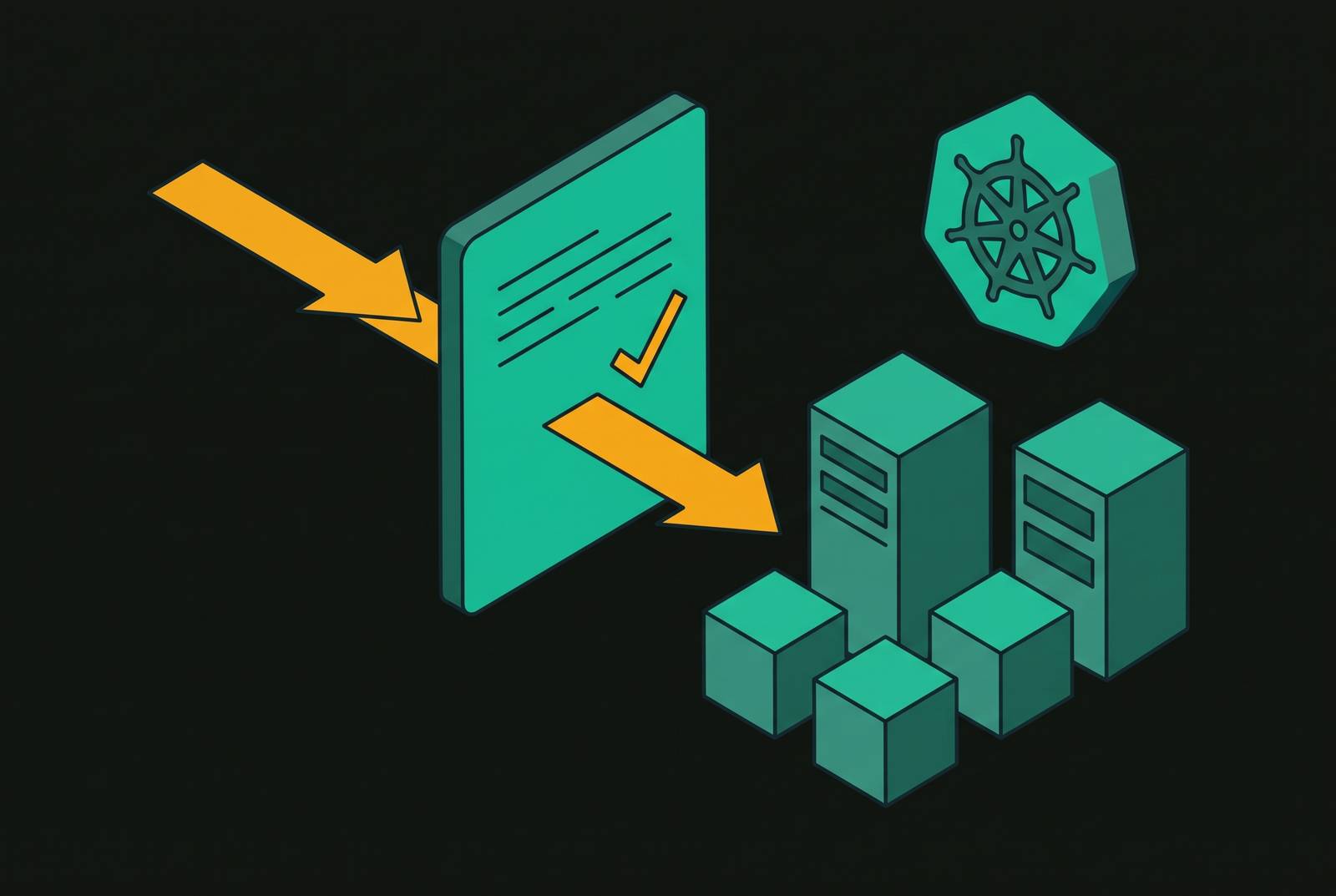
A Kubernetes manifest is not paperwork attached to a deploy. It is the deploy, the declared, authoritative statement of what should exist in a cluster, and everything downstream, the image, the rollout, the running pods, exists to make that statement true. Treat it as a gate and the pipeline gets safer. Treat it as an afterthought and every environment past staging becomes an unpaid tester of your configuration.
Why a Kubernetes manifest is already doing the job of a deploy contract
Strip away the tooling and a manifest is a YAML or JSON file describing the desired state of a pod, a deployment, a service, a configuration store, a credentials store, or an Ingress rule. That sentence sounds bureaucratic until you notice what it actually implies. That reconciliation loop runs constantly. It does not care what the container image is doing internally; it cares that the manifest's declared intent is being met.
This is the detail people underweight: the image tells the cluster what code to run, but the manifest tells it how, where, at what scale, with what configuration, and under what constraints. That second list is longer and more consequential than the first. Replica counts, update strategy, label selectors, resource requests and limits, health checks, namespace placement, revision history: none of that lives in the image, all of it lives in the manifest's sibling document, the deployment spec itself.
There's also a version contract buried in there that people forget is a contract at all. The Rackspace Spot 2026 deployment guide states that apiVersion: apps/v1 is the current, stable API version for Deployments, and older fields such as extensions/v1beta1 were removed from Kubernetes outright, across versions 1.16 and 1.22 depending on the resource in question. Apply an old manifest to a current cluster and it does not degrade gracefully. Applying an old manifest to a current cluster does not degrade gracefully; it errors. The image never had to know any of this; the manifest was carrying that compatibility burden the whole time.
Kubernetes' own documentation is blunt about the operational discipline this demands: never apply manifest files straight from a laptop, keep them in version control, treat that repository as the rollback and disaster-recovery mechanism's neighbor. That guidance only makes sense once you accept the premise that the manifest is the source of truth, not a rendering of one. Once you accept that, an uncomfortable question follows immediately: if the manifest is carrying this much decision-making weight, who is checking it before it reaches a cluster?
How pipelines got inverted: treating the manifest as output rather than gate
Most CI/CD pipelines answer that question badly, and not through negligence so much as inherited habit. Code gets written, an image gets built, the image gets scanned for vulnerabilities, it gets pushed to a registry, and then, at the very end, the manifest gets applied to a cluster. Look at that sequence closely. The manifest appears last in the sequence, as a delivery mechanism rather than something that was ever tested on its own terms.
Meanwhile the image goes through real scrutiny. It gets linted, tested, scanned for known CVEs, sometimes signed. The manifest carries version contracts that the image does not, since apiVersion: apps/v1 is the stable, current API version for Deployments while older fields like extensions/v1beta1 were removed from Kubernetes (across versions 1.16 and 1.22, depending on the resource type) and will error on any current cluster. The Kubernetes project's own configuration guidance, published on its blog in November 2025, states that a missing quote, a wrong API version, or a misplaced indent in YAML can wreck an entire deploy. Those are manifest failures. They have nothing to do with what is inside the container.
The consequence compounds quietly. Staging, pre-production, production: each becomes, in effect, a test environment for whether the manifest was written correctly, because nothing upstream ever checked.
None of this happened because teams were careless. Early Kubernetes tooling was built around image build and push as the hard part of the problem, and manifest application was kubectl apply, a single command that felt too trivial to need its own gate. That assumption made sense when manifests were simple. Manifests are not simple anymore. The tooling around them mostly hasn't caught up.
The September 2026 ElcanoTek incident: what silent manifest failure looks like in production
The abstract version of this problem became concrete on September 20, 2026. A validator called fleet validate-config, running on a production box, exited with a failure code over a manifest problem. The defect it caught had already shipped. It had already deployed. Nobody had noticed, because nothing had checked the manifest before it got that far.
The incident is worth studying not for the failure itself, but for where the failure was caught. The validator only ran when the fleet service started on the box (systemctl start fleet), not anywhere in CI. Production, in other words, was the first and only place the manifest was ever checked. That is close to having no gate at all, just a very expensive tripwire.
The fix, authored the same day by bradflaugher, called fleet's own reusable validate-bundle.yml workflow inside CI, running the identical validate-config check the box would otherwise run right before starting the service, this time pointed at the repository's manifest before merge. The pull request description put the underlying diagnosis into one sentence that deserves to be quoted rather than paraphrased: "A bundle's manifest is the one artifact this repo exists to ship, and nothing was checking it".
The fix draws a distinction between two checks that sound almost interchangeable and are not. One option was to gate on mcp_servers, which inspects only the servers still enabled after environment-variable gating has already filtered the list down. On a CI runner that holds no production secrets, most connectors get filtered out before that check even runs. Gating on mcp_servers in that environment is close to gating on nothing, because there is almost nothing left to check by the time it runs.
The gate covers manifest and mcp_catalog, not mcp_servers, which inspects only servers left enabled after environment-variable gating (on a CI runner with no production secrets, most connectors filter out before that check runs, making it close to gating on nothing); mcp_catalog validates declared structure without requiring the command to actually be installed. A concrete test of the difference: take a bundle, delete the script file behind a credential-gated server, and mcp_servers passes clean while mcp_catalog catches it. That is the entire argument for structural validation over runtime-availability validation, made in a single reproducible case.
One more design choice in the same PR resists an obvious instinct. credentials deliberately does not gate the merge. The CI runner has no production secrets, so failing that check every single time would turn the gate permanently red for reasons that have nothing to do with the manifest's correctness. It still runs, though, and its output still lands in the job summary, so a connector that structurally can never be enabled stays visible to a human reviewer without blocking anyone's work. The pull request merged into main that same day, five checks passing.
What the manifest gate must validate beyond the limits of naive checks
A manifest gate that only checks syntax is not really a gate, since the checks that catch real failures require structural and semantic validation, scoped to what the CI environment can actually evaluate. Real manifest validation needs layers, and each layer catches a distinct failure mode that the others miss entirely.
This is the cheapest layer to run and the one most teams already have, if they have anything.
The second layer is structural correctness, and it's where a lot of real incidents actually live. Do the label selectors in spec.selector.matchLabels line up with the labels in spec.template.metadata.labels? Are resource requests and limits actually present? Are health checks defined and pointed at something real? Is a namespace specified at all? None of these are exotic checks. A syntax-only linter waves all of them straight through.
The third layer is policy compliance: the constraints an admission controller like Gatekeeper would enforce, run in CI instead of waiting for the cluster boundary. Most teams today only apply these policies at admission time, which means a manifest that violates organizational policy gets discovered at the exact moment it's being applied to a live cluster, not before.
The fourth layer is the one ElcanoTek's incident actually demonstrates: environment-resolved dependencies, where a check like mcp_servers inspects only what survives runtime filtering, and a check like mcp_catalog inspects everything that was declared, independent of whether the CI environment could ever run it. This layer is the one naive implementations get backwards, because gating on the post-filter view feels more "realistic" and is actually closer to gating on nothing.
There's a fifth category that belongs in the pipeline without belonging in the gate: things like credential checks, box-owned environment variables, database connectivity, sandbox availability. These are correct to run, and their failures should be visible in a job summary for a reviewer to see, but making them a hard merge block would leave the gate permanently red for manifests that are, in every way that matters, correct.
Two more wrinkles deserve attention rather than being glossed over. Helm abstracts a manifest into a versioned package, a chart, which is genuinely useful for deployment consistency, but it also means the chart itself is the wrong validation target. The rendered output of helm template is what a cluster will actually see, so that's what the gate has to check. Kustomize overlays raise the identical issue in a different shape: validate each environment's rendered output, not the shared base it was built from. Tools like Gatekeeper, Conftest, and kubeconform (the schema validator that superseded the now-deprecated kubeval) exist precisely to sit at this layer, checking rendered manifests against schema and policy rather than checking source templates that were never going to be applied as-is.
Where in the pipeline the manifest gate belongs
Moving validation earlier in the pipeline is necessary, and it is not sufficient on its own, because CI cannot simulate everything a live cluster will do. The CI gate belongs on every pull request, validating the rendered manifest before anything merges. That's the primary shift-left move, and it's exactly what the ElcanoTek fix implements.
But a manifest can bypass CI entirely, an operator patching something by hand during an incident, a manifest generated by a tool nobody wired into the standard pipeline, an emergency fix applied under pressure at two in the morning. GitOps tools such as Argo CD or Flux help by reconciling live cluster state against manifests stored in Git automatically, which removes the manual kubectl apply step from the normal path. That's complementary to the CI gate, not a replacement for it. Admission control at the cluster layer, Gatekeeper or Kyverno enforcing policy at the moment a manifest is actually applied, is the backstop that catches everything that skipped CI in the first place.
In a healthcare SaaS incident from 2025, a manual Helm chart update overwrote critical production configuration and caused a major outage. That is precisely the class of change a CI-only gate cannot touch, because it never went through CI. Cluster-side admission control, had it been enforcing the same structural and policy checks CI would have run, was the layer positioned to catch it instead.
Rollback deserves its own line here. GitOps tooling can trigger something like kubectl rollout undo automatically when a post-deploy health check fails, which is the recovery path for the case where a manifest passed every static check CI could run and still broke something once it met real traffic. Put the whole thing together and the pipeline looks linear: a pull request opens, CI runs the manifest gate covering schema, policy, and structural checks, the merge is blocked until that passes, a GitOps tool applies the result to the cluster, the admission controller enforces policy at that moment too, and a post-deploy health check stands ready to trigger rollback if reality diverges from what was promised. The Kubernetes blog's November 2025 recommendation to keep manifests in version control is not just good hygiene in this picture, for it's the precondition for the whole enforcement chain to exist at all.
How AI agents and MCP-native tooling raise the stakes for manifest gating
None of this gets less urgent as AI agents start authoring manifests directly; it gets more urgent, because the manifest becomes the only place a human can still check the agent's work. One developer's account of migrating to a fully MCP-native architecture describes deployment time for new tool integrations dropping sharply. That speed brings a corollary: less friction standing between an agent's decision and a manifest reaching a live cluster.
AI agents can genuinely help across coding, testing, deployment, and troubleshooting, but how much they help depends entirely on the platform around them providing standardized workflows and real safeguards, not on the agent's own judgment. The ElcanoTek pull request is itself a data point here rather than a hypothetical: it was co-authored by Claude Opus 5 and Claude Fable 5.1. An AI agent wrote the gate that checks the manifest, which is a different and more interesting fact than an AI agent merely writing the manifest itself.
The mcp_catalog distinction described earlier turns out to double as a safeguard purpose-built for exactly this scenario. It validates every declared server's structure regardless of whether the CI environment could ever enable it, which means the check doesn't depend on runtime secrets an agent was never going to have access to in the first place. Absent a gate like that, an agent triggering a deploy through an MCP Kubernetes server leaves no human-readable record of what was actually validated before that deploy happened. The manifest is the one artifact positioned to carry that record, provided something is actually checking it.
There's a broader structural point here. Reproducible, declarative environments, where the manifest itself is the unit that gets promoted from one stage to the next, rather than an imperative sequence of shell commands, give an agent something stable to check its work against. Imperative pipelines don't offer that. An agent (or a human, for that matter) can't meaningfully validate a sequence of commands the way it can validate a declared end state. MCP has emerged as a common interface for models to connect with external tools, and community-built MCP servers now exist for GitHub, Slack, PostgreSQL, Docker, Kubernetes, and over two hundred other tools, per S1.
Supply chain provenance and the manifest as the natural integration point for SBOM enforcement
Supply chain security stopped being purely an engineering concern once regulation caught up to it. The EU Cyber Resilience Act now imposes SBOM requirements on a wide range of companies, with full compliance required by December 2027. That deadline is close enough that the question of where SBOM enforcement actually lives in a pipeline stops being academic.
Most SBOMs generated today are compliance artifacts in the least useful sense: produced once, at the end of a build, filed somewhere, and never looked at again. That's a hard ceiling on what an SBOM can do for security, because a document nobody consults might as well not exist once a new vulnerability occurs.
Sigstore and Cosign, the SLSA framework, and Kubernetes admission controllers together form something close to a working triad against supply chain attacks, and the manifest gate is precisely where CI-side verification meets admission-side enforcement. Attach input-derived hashes to a manifest and CVE response gets a lot faster, too: when a new vulnerability is published, teams can trace which deployed manifests reference the affected image digests directly, without grepping through logs or rescanning every image in a registry. The 2026 version of this requirement is having a single source of truth governing open-source libraries, AI model weights, and MCP server integrity (the manifest, as the declared dependency graph for a deployment, is that source of truth if it is treated as one). A manifest, as the declared dependency graph for an entire deployment, is that source of truth, on the condition that someone actually treats it that way.
The furthest end of this argument points toward declarative environment management, the kind built on tools like Nix, where packages are pinned to input-derived hashes and the manifest carries the complete dependency graph rather than a partial snapshot. Under that model, SBOM generation is a derivation, a deterministic output of the manifest itself, rather than a point-in-time guess about what got built. That's the difference between an SBOM that sits in a compliance folder and one a team can actually query the day a new CVE drops. The manifest was always capable of carrying that weight. A given pipeline has decided whether to let it, and that is the only open question left. The manifest gate creates the natural check point: before a manifest is applied, it verifies that the image digests it references have attestations, that the SBOM for each image is present and covers declared dependencies, and that no known CVEs block deployment.
Sources
- Gate this bundle's manifest in CI by bradflaugher · Pull Request #7 · ElcanoTek/example-kubernetes-config
- Kubernetes Configuration Good Practices | Kubernetes
- Kubernetes Deployment: A complete guide to YAML, strategies, rollouts, and scaling (2026)
- The 2026 Guide to Software Supply Chain Security | Cloudsmith
- Kubectl apply does not remove manually added env vars, causing permanent drift between manifest and live Deployment · Issue #136586 · kubernetes/kubernetes
- Shift Kubernetes Validation Left: Catching Manifest and Helm Errors with kubeconform in CI | by SwayamOps | Jun, 2026 | Medium
- The YAML janitor problem: why Kubernetes dev environments always drift and how to fix it
- The MCP Server Ecosystem in 2026: Integration Layer for AI Agents - DEV Community