NIST Guidance on Software Supply Chain Security
Understand which NIST document governs your role and why misalignment costs compliance audits.

The NIST software supply chain framework isn't a single document. It's a layered architecture of publications, each addressing a different audience and a different slice of the problem. Conflating them produces a predictable failure mode where the wrong document gets assigned to the wrong team, and the gaps surface at the audit.
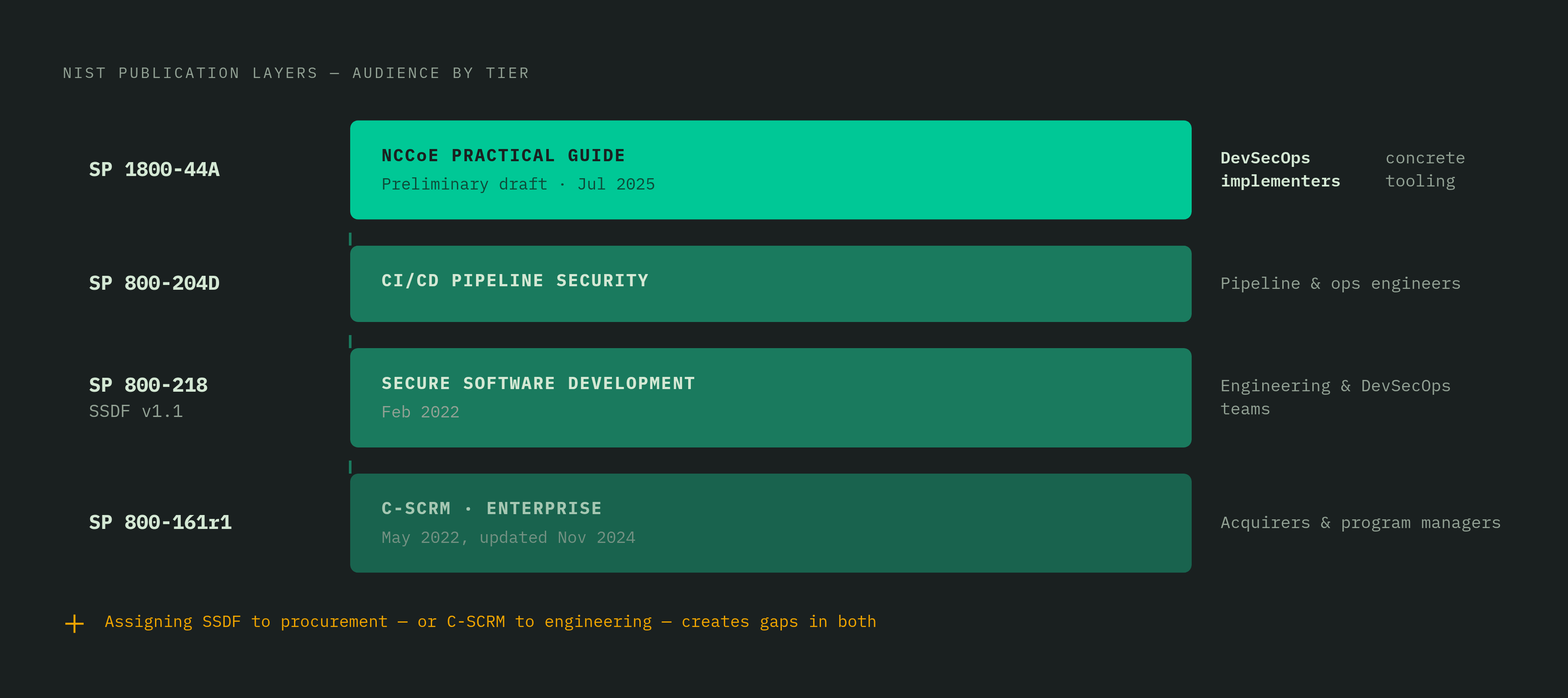
SP 800-161r1, published in May 2022 and updated in November 2024, is the foundational Cyber Supply Chain Risk Management standard. It governs how organizations identify, assess, and respond to supply chain risk at the enterprise and program level. Its primary audience is acquirers, buyers, and program managers — the people deciding which vendors to trust and which contractual controls to require. Appendix F, updated in January 2025, addresses software-specific controls within the broader C-SCRM framework. It deserves to be read as a standalone reference for software procurement decisions, not buried in a compliance checklist where it gets skimmed once a year.
SP 800-218, the Secure Software Development Framework at version 1.1, published in February 2022, governs how software is built. Its audience is engineering teams and DevSecOps practitioners. Where SP 800-161r1 asks which software to acquire and from whom, SP 800-218 asks how to produce software that deserves to be acquired. Assigning SSDF compliance to procurement, or C-SCRM to engineering, produces gaps in both, because neither team ends up reading the document that governs the other's domain.
A draft revision, SP 800-218r1, was published in December 2025 under EO 14306, which extended the supply chain security mandate and directed NIST to establish the Software Supply Chain and DevSecOps Security Practices Consortium with fourteen industry partners. That draft adds materially improved practices for AI-assisted development and was in public comment as of this writing. Organizations building compliance programs against the current 1.1 text should be tracking it. Its final form will raise the baseline.
SP 800-204D addresses software supply chain security in CI/CD pipelines. SP 800-218A is an SSDF Community Profile for Generative AI and Dual-Use Foundation Models. SP 1800-44A, a preliminary draft published in July 2025, is the NCCoE's practical DevSecOps implementation guide developed with the fourteen-company consortium; it bridges from framework language to concrete tooling and workflow patterns in a way the earlier documents don't attempt.
These publications define a compliance surface that has extended well beyond federal agencies. The EU Cyber Resilience Act and NIS2 are both structured around principles that align closely with NIST's framework, and that convergence happened without any formal legal extension of U.S. federal requirements. A framework written for federal procurement is now shaping how commercial software is built in Brussels.
How the SSDF Organizes Secure Development into Four Practice Groups
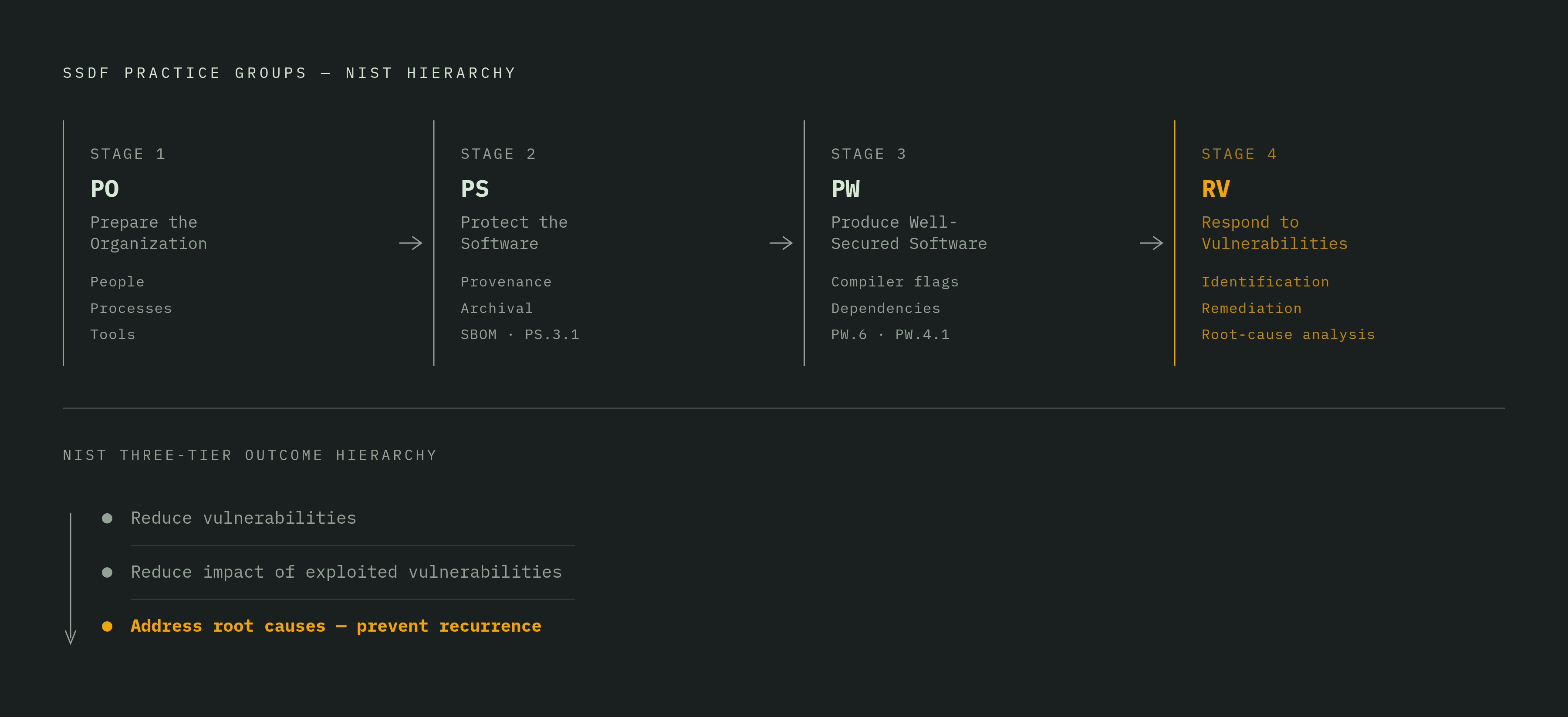
The SSDF's foundational premise is one that most engineering organizations would rather not sit with: most software development lifecycle models don't address security in adequate detail. Secure practices don't emerge from well-intentioned teams working from good instincts. They have to be deliberately integrated at every stage. The framework provides that structure through four practice groups.
Prepare the Organization (PO) covers people, processes, and technology readiness before a line of code is written. This includes defining security requirements, assigning accountability, training staff, and securing the development environment itself. Organizations that treat developer workstations as unmanaged endpoints are non-compliant at the PO level before any other control is evaluated. The audit question isn't only what the build produces; it's what state the machine was in when it produced it, and that question lands harder than most teams expect the first time they face it.
Protect the Software (PS) governs the protection of software and its build artifacts throughout the lifecycle. Provenance requirements live here, including the archival obligations that make SBOMs meaningful and reproducible builds necessary rather than optional.
Produce Well-Secured Software (PW) covers the engineering practices directly: hardened builds, dependency management, compiler configurations, and reproducible-build posture. This is where a team's actual development decisions get measured against a documented standard, which is a different exercise than measuring them against internal convention. Those two standards diverge more often than teams anticipate.
Respond to Vulnerabilities (RV) addresses the identification, analysis, and remediation of vulnerabilities in released software. NIST frames the four groups as a hierarchy of outcomes — reduce the number of vulnerabilities in released software, reduce the impact of exploited vulnerabilities, address root causes to prevent recurrence. That ordering separates organizations that patch and move on from those that investigate and improve. In my experience reviewing programs in this space, the former category is larger than the latter by a significant margin, and every organization in the former category I've reviewed would sincerely describe itself as the latter.
The SSDF deliberately doesn't prescribe a single SDLC model. Organizations map their existing processes to these practice groups, and that flexibility is genuine. It's also the primary source of implementation failure. The mapping exercise requires honest self-assessment, and the results skew toward optimism when the same team that built the pipeline is the team evaluating whether the pipeline meets the standard.
What NIST Specifically Requires Around Build Integrity, Provenance, and Reproducibility
Two practice identifiers appear in almost every supply chain compliance conversation: PS.3.1 and PW.6. The language NIST uses in both is doing specific technical work, and the precision matters more than the framing usually suggests.
PS.3.1 is the provenance anchor. NIST requires securely archiving the necessary files and supporting data — including provenance records, build artifacts, configuration, and SBOM — for each software release, so that the producer can reproduce, analyze, and respond to security events. The implication is concrete: a build that cannot be reproduced from archived inputs is non-compliant by design, not merely operationally inconvenient. Provenance isn't a post-hoc documentation task. The information must have been captured during the build. A record assembled after the fact cannot satisfy this requirement, and auditors who understand the standard will ask exactly when the record was generated.
PW.6 is the build hardening requirement, covering compiler flags, container base images, reproducible-build posture where applicable, and the dependency-resolution policy used at build time. The qualifier "where applicable" gives organizations flexibility, but that flexibility carries a real cost: the burden of justification falls on the organization when reproducible builds weren't achieved, not on the auditor who notices the gap.
PW.4.1 governs third-party dependencies and applies to the entire dependency graph, not just direct imports. Transitive dependencies, the libraries that a library depends on, are within scope. Teams generally know what packages they import. They frequently can't account for what those packages import, which is precisely where the exposure concentrates.
SP 800-204D and SP 1800-44A both identify developer environments as a primary attack vector, including BYOD scenarios, distributed workforces, and mixed SaaS and self-hosted source control. The developer machine is inside the compliance perimeter. That point still surprises teams whose mental model of the security boundary stops at the CI runner.
These build and provenance requirements are also what make SBOMs substantively meaningful rather than merely bureaucratically required. An SBOM generated after the fact cannot reliably reflect the actual dependency state at build time. NIST acknowledges this limitation explicitly, and retroactively generated SBOMs frequently diverge from actual build-time state in ways that matter directly for vulnerability mapping.
What NIST and CISA Now Require from SBOMs, and Where the Standard Is Still Evolving
EO 14028 defined the SBOM as "a formal record containing the details and supply chain relationships of various components used in building software." NIST offered the food-ingredient-label analogy, and it holds up reasonably well. An SBOM doesn't prevent a vulnerability any more than a nutritional label prevents a bad diet. It provides the visibility that makes informed decisions possible. What it cannot do, despite how some procurement conversations treat it, is substitute for actual security controls.
The accepted formats per NTIA guidance are SPDX, CycloneDX, and SWID. These aren't interchangeable across all tooling contexts. An organization that generates CycloneDX SBOMs and delivers them to an acquirer whose toolchain only processes SPDX has produced a document that cannot fulfill its function. Format selection is an operational decision that has to happen before the first SBOM is generated.
The 2026 CISA Minimum Elements update, which replaces the 2021 NTIA document, raises the bar in several concrete areas. Pedigree is now required for all backported and forked software. License and re-licensing information is now explicitly required; CISA notes directly that improper use of licensed components can trigger enforcement actions affecting a producer's ability to deliver on security commitments. Hash fields have been added to enable integrity verification rather than mere identification. An SBOM that satisfied 2021 requirements doesn't necessarily satisfy 2026 requirements, and the delta isn't cosmetic.
When properly implemented, SBOMs enable direct mapping of vulnerabilities to affected components, license and intellectual property compliance, pedigree tracing including forks and backports, and risk-informed acquisition decisions. NIST is explicit about the limitation: federal acquirers that can't ingest, analyze, and act on SBOM data won't improve their C-SCRM posture. The document alone isn't the control. This is where most SBOM programs stall. The document gets produced. The infrastructure to consume it doesn't.
The EU Cyber Resilience Act legally requires SBOMs for digital products. NIS2 mandates supply chain security measures. PCI DSS 4.0's software inventory requirement took effect March 31, 2025. Federal compliance is the floor now, not the ceiling.
How CI/CD Pipelines Become Either the Enforcement Point or the Weakest Link
SP 800-204D's framing is precise: protecting software through CI/CD means ensuring it isn't compromised at any stage of the pipeline, whether build, test, package, or deploy, and that supporting artifacts and attestations exist to prove it. NIST's definition of supply chain assurance here covers not just the outputs of specific activities but the integrity of the activities themselves. A pipeline that produces correct outputs through inconsistent means doesn't satisfy the requirement.
SP 1800-44A integrates Zero Trust principles throughout the DevSecOps pipeline, not just at the network perimeter. The guide calls for continuous monitoring, vulnerability scanning, integrity verification of artifacts, and code commit signature verification. That last requirement warrants direct attention: every commit must be attributable and verifiable, not just at release. Artifact integrity verification means build outputs must be provably unmodified between pipeline stages.
The economics of supply chain attacks explain why CI/CD hardening matters beyond federal compliance. Targeting a widely used vendor, service, or open-source component yields downstream impact across a large range of victims. SolarWinds is the canonical example. A single compromised dependency in a shared CI environment can propagate through every downstream build that consumes it. The attack surface isn't bounded by your own code.
SP 1800-44A captures the compositional nature of modern software risk directly: applications are combinations of code from many sources, some under direct team control and others, including open-source libraries and AI coding assistants, whose security testing status is uncertain. First-party code is a small fraction of what ships in most production systems, which is why pipeline controls must cover the entire dependency graph.
A CI/CD pipeline that doesn't enforce environment parity, dependency pinning, and artifact signing isn't just operationally fragile. Under SSDF PW.6 and PS.3.1, it's a documented compliance gap.
AI-Assisted Development Under NIST's Framework and What SP 800-218A Adds
NIST finalized SP 800-218A as an SSDF Community Profile specifically for Generative AI and Dual-Use Foundation Models. It augments SP 800-218 with practices, tasks, and considerations specific to AI model development throughout the SDLC. The December 2025 SSDF v1.2 draft adds further practices for AI-assisted development. NIST is treating AI not as a separate compliance domain but as an extension of existing secure development obligations, and for organizations that have been running AI tooling as an informally governed parallel workflow, that framing has significant practical consequences.
The core compliance question AI introduces is accountability. If an AI coding assistant produces a code suggestion, or an AI agent commits code autonomously, which SSDF controls apply, and who is responsible for verifying them? PW.4.1's third-party component requirement applies to AI-generated code: the provenance of that code isn't self-evident, and the obligation to maintain well-secured components doesn't exclude components a model generated. PS.3.1's archival requirement means that inputs to a build, including AI-generated artifacts, must be reproducible and attributable. A build whose provenance chain includes an AI agent operating in an undocumented environment has a structural gap in that chain.
SP 1800-44A is direct on this: while AI improves efficiency and security testing capabilities, the guide requires human oversight and verifiable processes to ensure the accuracy and trustworthiness of AI-generated content. This isn't a prohibition on AI tooling. It's a verification requirement that maps to existing SSDF controls that should already be in place, which means organizations that have those controls aren't starting from zero.
The environment parity problem applies to AI agents exactly as it applies to human developers. An AI coding agent operating in an inconsistent or undocumented environment introduces the same drift risks as a developer on an unmanaged workstation. The SSDF's PO requirements, which govern environment security before code is written, apply to agent environments. Deploying AI coding agents without extending environment management, dependency tracking, and provenance controls to cover their outputs isn't a technical oversight. It's a compliance gap with a name.
What Environment Reproducibility Looks Like as a Compliance Practice, Not Just a Developer Convenience
The SSDF's PO practice group establishes an unambiguous premise: before any code is written, the development environment must be secured, defined, and controlled. Environment management is a security control, not a developer convenience, and the compliance implications follow from that directly.
What "reproducible" means in NIST's terms is specific. A build is reproducible when the archived inputs — encompassing source, dependencies, configuration, and toolchain — produce the same output on demand. Anything less leaves a gap in the provenance chain that can't be closed after the fact. The "works on my machine" problem, long treated as a developer annoyance, is evidence under the SSDF that PW.6 and PS.3.1 controls aren't in place. Environment inconsistency between developer workstations, CI runners, and production is a compliance deficiency, not a workflow inconvenience.
Dependency pinning follows directly from PW.4.1. Knowing exactly which version of every dependency, including transitive dependencies, was used at each build is a requirement. Floating version references are incompatible with it. A build that resolves dependencies at runtime against an unpinned range can't satisfy PS.3.1's archival obligation because the inputs aren't deterministic. The problem isn't that pinning is difficult; it's that every team I've audited that skipped it treated it as optional until an auditor asked.
Defining the development environment as code, committed to the repository and version-controlled, ensures that the environment applied on a developer's workstation, in CI, and in staging is the same environment. This eliminates the class of provenance gap that arises from undocumented local configuration and makes the environment auditable.
Nix-based environment management, as implemented by tools such as Flox, supports PS.3.1 and PW.6 directly. Nix produces cryptographically reproducible environments with complete dependency graphs and provenance. Every package, including the smallest transitive dependency, is pinned and attributable. The output of a Nix build is determined entirely by its inputs; there's no ambient state that can produce a different result on a different machine. That property is exactly what PS.3.1 requires, and achieving it through conventional package management is genuinely difficult, which is part of why so many organizations discover the provenance requirement is harder to satisfy than they initially estimated.
Build-time SBOM generation, as opposed to post-hoc generation, is the only approach NIST acknowledges as capable of accurately reflecting the actual dependencies used at build time. The tooling to support this must be in place before the build executes.
Onboarding is a compliance surface that organizations consistently underestimate. If a new developer or contributor requires a multi-step, manual environment setup to begin contributing, the organization can't guarantee environment parity across contributors. Each manual step is a point at which local state diverges from the documented standard, and under the SSDF, that divergence is a control failure. Environment onboarding, from first clone to first compliant build, should be deterministic, automated, and verifiable.
The compliance test isn't whether the environment documentation is thorough. It's whether two developers, starting from the same repository state, produce identical build outputs on independent machines. Run that test. The result will clarify where the program actually stands.