Environment Parity Between Staging and Production in Kubernetes
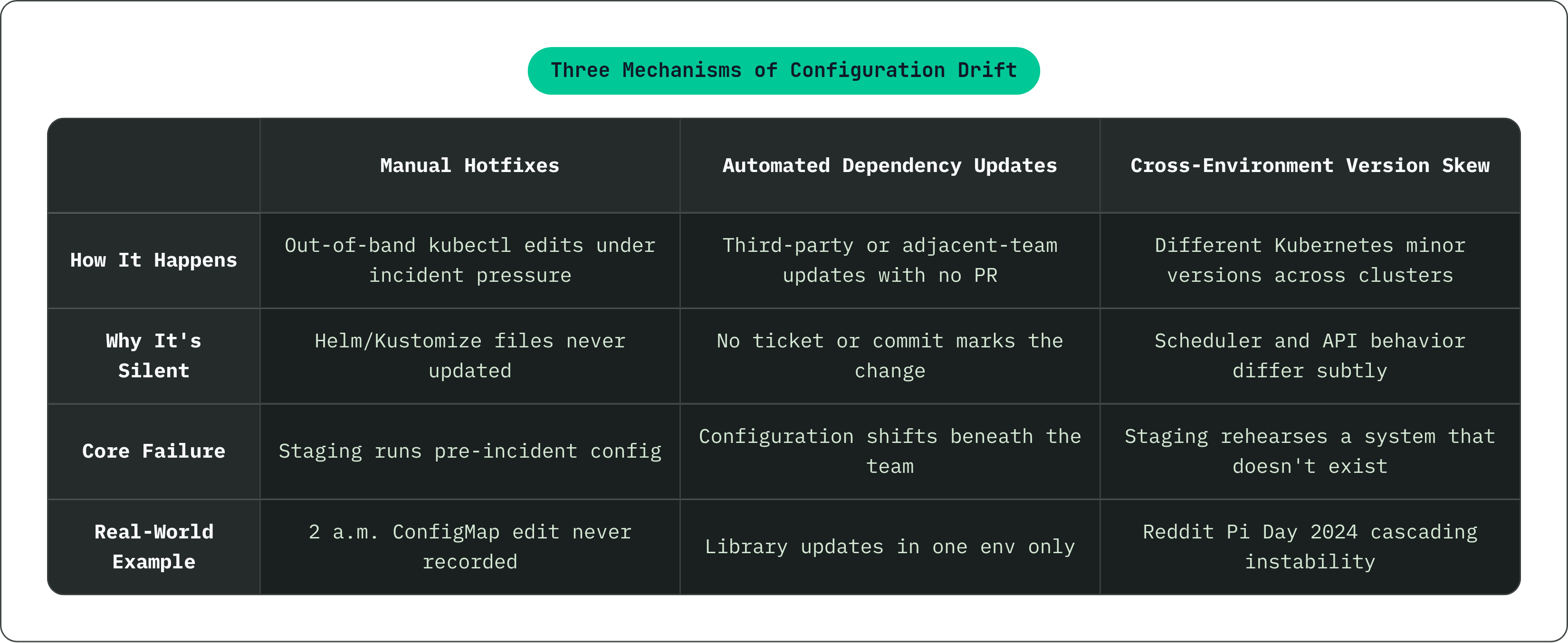
Configuration drift is the divergence of an environment's actual running state from its recorded desired state. In Kubernetes, that divergence arrives through three distinct mechanisms, each with its own failure signature and each capable of invalidating every test run against the drifted environment.
The first mechanism is the manual hotfix executed under incident pressure. An engineer logs directly into a production node or edits a ConfigMap through kubectl to restore service at 2 a.m. The change works, service is restored, and the Helm values file or Kustomize overlay never gets updated to reflect what actually happened. Staging continues running the pre-incident configuration while production runs something subtly different, and that gap stays invisible until the next deployment surfaces it.
The second mechanism requires no human action. Third-party dependencies with automated update schedules, open-source libraries, and services owned by adjacent teams update in one environment independently of another. No pull request was merged, no ticket was opened; the configuration simply shifted beneath the team's feet.
The third mechanism is cross-environment version skew, and it is the most consequential because it undermines the premise of testing itself. When a staging cluster runs Kubernetes 1.29 and production runs 1.30, admission webhook behavior, API deprecation enforcement, and scheduler defaults can differ in ways that surface only under production load. Reddit's Pi Day outage in 2024 is the instructive case: subtle inconsistencies in Kubernetes version handling cascaded into widespread instability requiring full rollbacks across clusters. Version skew between environments turns staging into a rehearsal for a system that does not exist in production.
Each mechanism alone is manageable. Together, they compound in ways that are genuinely difficult to untangle after the fact. A cluster carrying version skew, a manually patched node, and an auto-updated dependency is effectively an untested configuration, regardless of how many test suites passed against it.
Why Namespace-Based Isolation Fails as a Parity Boundary
Organizations trying to balance cloud infrastructure costs against operational rigor frequently resolve that tension the same way: pack staging and production into the same cluster, separated only by Kubernetes namespaces. The economics appear sound. The structural problem is severe.
A Kubernetes cluster shares a single control plane across all namespaces: one etcd instance, one API server, and by default the same physical nodes. A staging team running an aggressive load test against their namespace can exhaust shared API server request limits and degrade production simultaneously. A faulty NetworkPolicy applied in staging can affect traffic routing across the entire cluster. ResourceQuotas constrain CPU and memory per namespace, but that enforcement is itself a configuration that drifts, and it does nothing to prevent a staging workload from consuming all available CPU on a shared host node before the quota controller intervenes.
The security implications compound the availability risk considerably. Shared clusters mean shared blast radius for RBAC misconfigurations. A credential scoped to staging that inadvertently carries ClusterRole permissions rather than Role permissions can interact with production control-plane resources. The separation feels real in the Kubernetes UI; at the authorization layer, it is not real.
Physical cluster separation is the only functional isolation boundary. Separate clusters allow CI/CD pipeline credentials and developer access to be bound exclusively to non-production environments through cloud provider IAM roles, so a developer cannot deploy to production from a staging pipeline regardless of intent. Without this, any parity claim rests on false assumptions about what the namespace boundary actually enforces.
GitOps as the Foundational Control Against Configuration Drift
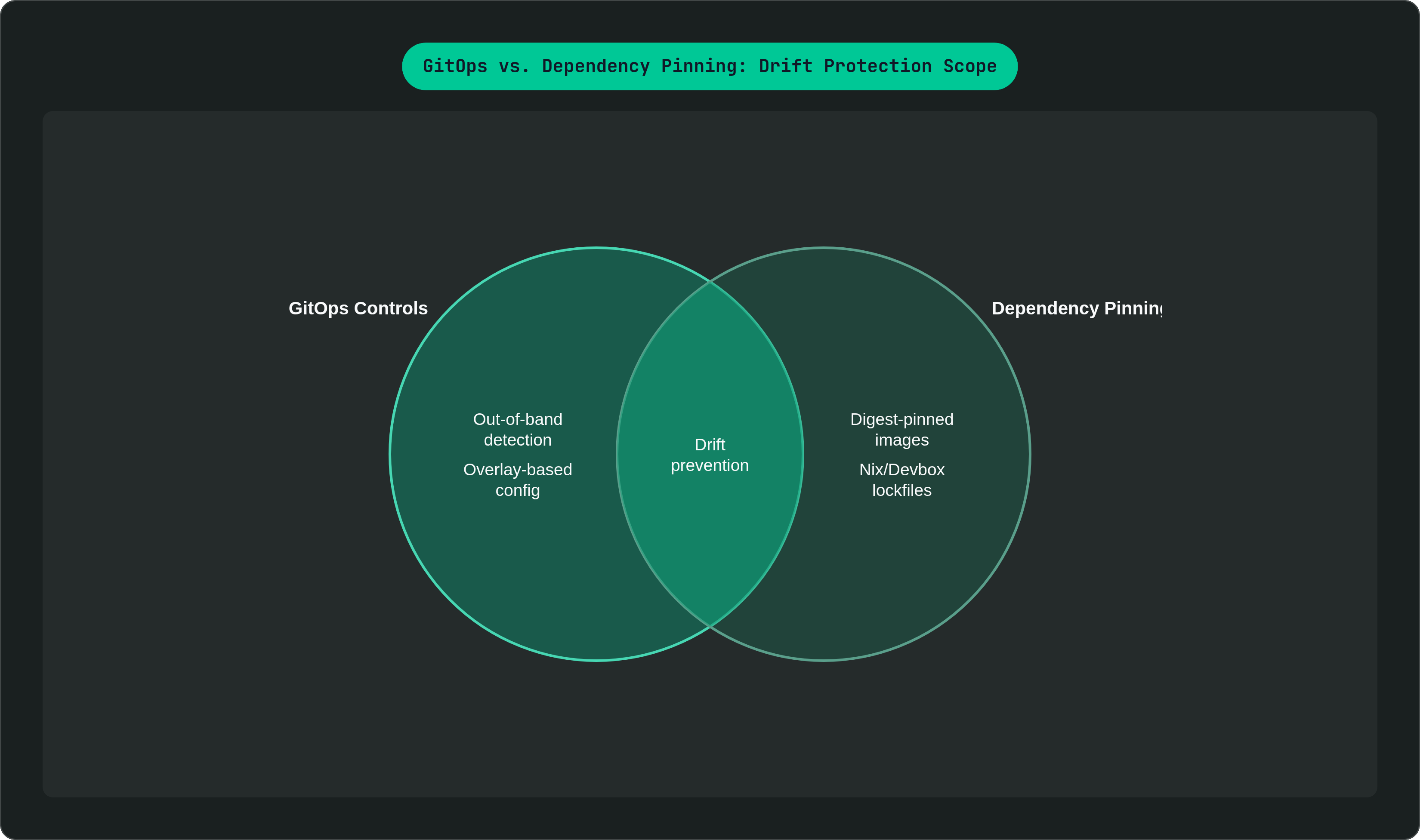
GitOps establishes one organizing principle: every change to every environment passes through a version-controlled repository, and no configuration exists in any environment that is not represented in Git. This addresses the manual-hotfix failure mode directly, because a change made outside the repository either gets reconciled back to the desired state automatically or gets detected as an explicit drift event. Silent persistence becomes structurally impossible.
Kustomize and Helm are the standard tooling layer for implementing this in practice, and both see wide adoption at organizations operating Kubernetes at scale. The discipline that matters more than the choice between them is this: never duplicate manifests. A single base configuration with per-environment overlays or values files ensures staging and production diverge only where they are explicitly intended to diverge. Unintentional divergence becomes visible as a diff in a pull request rather than a mystery that emerges during an incident postmortem.
Argo CD and Flux enforce the Git-as-source-of-truth contract continuously, not just at deploy time. Any out-of-band change, whether from a manual kubectl edit or an automated external process, triggers either a reconciliation back to the desired state or an alert. The team always knows the state of the environment relative to what Git says it should be.
GitOps governs the desired state represented in manifests. If the tools used to build, render, and apply those manifests vary between environments, or if dependencies external to the manifests drift independently, GitOps provides no protection against that class of failure. Dependency and toolchain pinning carry that weight, and they carry it in a domain GitOps was never designed to reach.
Pinning Dependencies and Toolchains to Make Staging Results Valid
The gap GitOps leaves is the tool layer: the kubectl binary, the Helm version, language runtimes, linters, and build tools that engineers use on their laptops, in CI, and in deployment pipelines. These tools govern how manifests are rendered and applied, and they vary silently between a developer's machine and the CI environment running the staging pipeline more often than most teams want to acknowledge.
Floating image tags are the canonical failure mode here. A CI pipeline that resolves node:20 rather than a digest-pinned image reference can pull a different base image on successive runs without any deliberate action. The test environment has changed, the results are not reproducible, and no one has a clear record of what was actually tested. I have worked through post-incident reviews where this was the root cause, and it is a genuinely demoralizing discovery, because it means you cannot trust any of the test results that preceded the incident. Every assurance the team gave stakeholders during the release cycle was built on a shifting foundation nobody knew was shifting.
The same problem applies to Kubernetes tooling itself. Running kubectl apply against a 1.30 cluster from a 1.28 kubectl binary can silently omit fields introduced between those versions, producing behaviors impossible to reproduce consistently across environments.
Several tooling approaches address this by locking the entire tool dependency graph. Nix identifies every package by a cryptographic hash of its inputs, so identical inputs always produce identical outputs. Devbox provides a simpler interface over Nix, resolving package versions to a lockfile so any developer or CI job running from the same repository gets bit-for-bit identical tool versions. Dev Containers define the development environment via a devcontainer.json manifest and are reliable when the referenced images are digest-pinned, but they reproduce the floating-tag problem when they are not. Flox builds on Nix to manage software and its dependencies across the full software lifecycle, with SBOM generation and provenance included by design, operating consistently across macOS, Linux, and Windows from development through CI/CD.
The integration rule is non-negotiable: the same environment tooling used locally must govern the CI job. A lockfile that controls a developer's shell must control the pipeline. When it does not, the class of failures where a test passes locally but fails in CI due to a mismatched tool version persists indefinitely, and staging results carry no predictive validity for what will happen in production.
Ephemeral and Preview Environments as a Structural Alternative to a Shared Staging Queue
A single shared staging environment serializes testing and accumulates configuration from multiple in-flight changes that were never intended to coexist. The team waiting for the staging slot inherits whatever state the previous team left behind. Over time, the environment becomes a persistent artifact of every team's decisions, which is precisely the condition that produces invisible drift at the worst possible moment.
Ephemeral clusters address this structurally. Using vcluster, kind, or k3s, teams spin up short-lived, production-like environments for a specific purpose and destroy them on completion. Preview environments extend this to the pull-request level: each PR receives its own namespace, its own ingress URL, and an isolated database state, then gets destroyed on merge, PR close, or an inactivity threshold.
The parity argument for ephemeral environments is stronger than it first appears. An environment spun up fresh from the same GitOps source repository, with the same digest-pinned toolchain and against the same Kubernetes minor version as production, is a more accurate proxy for production behavior than a persistent staging environment that has accumulated six months of manual changes, auto-updates, and unrecorded hotfixes. The ephemeral environment carries no accumulated history, by construction.
A production-grade per-PR lifecycle looks like this: the CI/CD pipeline triggers cluster or vcluster creation on PR open; Argo CD or Flux deploys workloads from the branch path; external secrets are pulled from Vault or AWS Secrets Manager rather than hardcoded per-environment values; temporary kubeconfigs are scoped to the environment via OIDC or ephemeral certificates; teardown is automatic on merge. Cost discipline follows as a secondary benefit, since ephemeral environments exist only while actively needed, eliminating the expense of keeping a staging cluster running at production scale around the clock.
Ephemeral environments require the GitOps and dependency pinning infrastructure described in prior sections to function correctly. Without those controls, spinning up a fresh cluster reproduces a fresh instance of the drift problem rather than eliminating it.
Where SBOMs and Supply Chain Controls Fit Into a Parity Framework
Environment parity extends beyond Kubernetes version alignment and manifest values. It includes what software components are actually running inside the containers, where those components originated, and whether the build process that produced them was tampered with. These questions have moved from compliance territory into operational territory, and the distance between those two categories has collapsed sharply in recent years.
The GhostAction incident in early 2025 illustrates the failure mode for Kubernetes-adjacent pipelines. Attackers gained repository access and modified workflow code after the fact; every repository referencing the action by tag rather than commit SHA automatically pulled the compromised version on its next run. This was a parity failure caused by a floating reference, structurally identical to the floating image tag problem but at the CI layer. The organizations unaffected had pinned their Action references to a specific commit SHA, making the dependency immutable regardless of what happened upstream.
SBOMs function as operational tooling when generated and maintained correctly. The Log4Shell response illustrated this distinction concretely: organizations that generated queryable SBOMs in both SPDX and CycloneDX formats and integrated them into a searchable store answered "do we use Log4j, and in which container images?" within minutes. Organizations without that infrastructure spent days manually tracing dependencies through codebases and image layers. A compliance-snapshot SBOM, generated once for an audit and never indexed, provides none of that operational value.
The SolarWinds compromise surfaces a limitation that SBOMs alone cannot address. In that incident, the listed components were genuine; the malicious code was injected into the build process itself, so an SBOM reflecting the final artifact's contents would have shown nothing anomalous. Provenance verification through frameworks like SLSA (Supply-chain Levels for Software Artifacts) and tooling like Sigstore's Cosign addresses the build-process attack surface by signing artifacts at build time with attestations tied to the specific build environment and source commit. Kubernetes-native enforcement using OPA Gatekeeper with artifact attestation admission policies rejects workloads at deploy time if they lack verified provenance, making supply chain verification a structural gate rather than a periodic audit.
AI models entering production pipelines introduce a surface that current scanner tooling handles poorly. A model used in an inference pipeline carries the same supply chain risk profile as any other artifact: it has provenance, it can be tampered with, and it warrants a signed attestation. The tooling to enforce this at the model artifact level is not yet mature, but the governing principle is identical to what applies to compiled binaries. Flox's approach of embedding SBOM generation and provenance into the development environment from the start of the lifecycle means the artifact arriving at staging already carries an auditable record of its build inputs, regardless of whether that artifact is a binary, a container image, or a model file.
How Platform Engineering Operationalizes Parity Across Teams
Per-team discipline does not scale. When each team maintains its own environment definitions, its own image pinning conventions, and its own SBOM pipeline, the organization produces as many parity standards as it has teams, and the variance between those standards compounds with every new team that joins. This is not a people problem; it is an architecture problem.
Platform engineering reframes the problem by making parity a property of the platform rather than a practice each team must independently sustain. Platform teams build and maintain base environments, GitOps templates, and CI/CD scaffolding that product teams extend. Cluster version alignment, pinned toolchains, SBOM generation, and supply chain verification live in the platform layer and are inherited rather than reimplemented from scratch by every team that needs them.
Internal Developer Platforms serve as the delivery mechanism. A well-constructed IDP gives developers a self-service interface to provision environments that already conform to the platform standard: correct cluster version, pinned toolchain, admission policies enforced, SBOM pipeline integrated. Developers extend within guardrails rather than constructing environments from first principles. Formerly, an operations team had to be involved in every environment provisioning request, and that dependency created a bottleneck at exactly the wrong moment in a release cycle; a mature IDP eliminates that serialization entirely.
Onboarding time is a useful signal for the actual state of environment reproducibility. If a new developer reaches a production-identical local environment in a single command, the environment definition is genuinely reproducible. If onboarding requires a multi-step README with footnotes about OS-specific caveats and manual dependency installations, drift is baked into the baseline. Time-to-first-commit serves as a lagging indicator of parity quality: when environment setup is automated and deterministic, the onboarding bottleneck disappears; when it is not, new contributors expose every assumption that was left implicit in the setup instructions.
Flox occupies a specific role in this model as the tool platform teams use to define base environments that any developer activates with a single command. Its consistency across macOS, Linux, and Windows eliminates the class of OS-specific drift that otherwise surfaces when a team spans multiple operating systems, and its lockfile and provenance model carries forward into CI without additional configuration.
A Concrete Checklist for Auditing Staging-Production Parity Today
An honest "no" answer to any of the following questions identifies a structural gap, not a process gap.
Cluster architecture:
- Are staging and production on physically separate clusters with separate control planes?
- Are Kubernetes minor versions identical across staging and production, including patch releases?
- Are cluster addons, specifically the CNI plugin, ingress controller, and storage class provisioner, running the same versions across both environments?
- Are production cluster credentials structurally inaccessible from staging pipelines via IAM or equivalent access controls?
Configuration management:
- Does a single Git repository serve as the authoritative source of truth for all environment configurations?
- Are per-environment differences expressed as explicit overlays or values files rather than duplicated manifest directories?
- Does a continuous reconciliation tool such as Argo CD or Flux detect and alert on any out-of-band configuration change?
Dependency and toolchain pinning:
- Are all container image references pinned to digest rather than floating tags?
- Are developer tooling versions, specifically kubectl, Helm, and language runtimes, locked in a reproducible environment definition that governs both local development and CI?
- Does the CI environment use the same lockfile that governs developer machines?
- Are GitHub Action references and external CI dependencies pinned to commit SHAs rather than mutable tags?
Ephemeral environments:
- Does each pull request receive an isolated environment provisioned from the same GitOps source as production?
- Are ephemeral environments destroyed automatically on merge or inactivity, and is that teardown verified rather than assumed?
Supply chain controls:
- Are SBOMs generated in CI for every build and stored in a queryable format, not archived for compliance and left unindexed thereafter?
- Are container images signed with Cosign or equivalent tooling, and are admission policies enforcing signature verification at deploy time?
Platform layer:
- Do developers provision environments through a self-service interface that enforces platform standards, rather than constructing environments manually?
- Can a new engineer reach a production-identical local environment in a single command?
The teams that have closed these gaps did not do it all at once. Cluster separation and GitOps came first; the rest followed systematically. The sequencing matters less than starting with an accurate picture of where the gaps actually are.