GUI and CLI Wrappers That Deliver Nix Reproducibility to Stack-Focused Engineers
Wrappers let teams use Nix's reproducibility without learning the language.
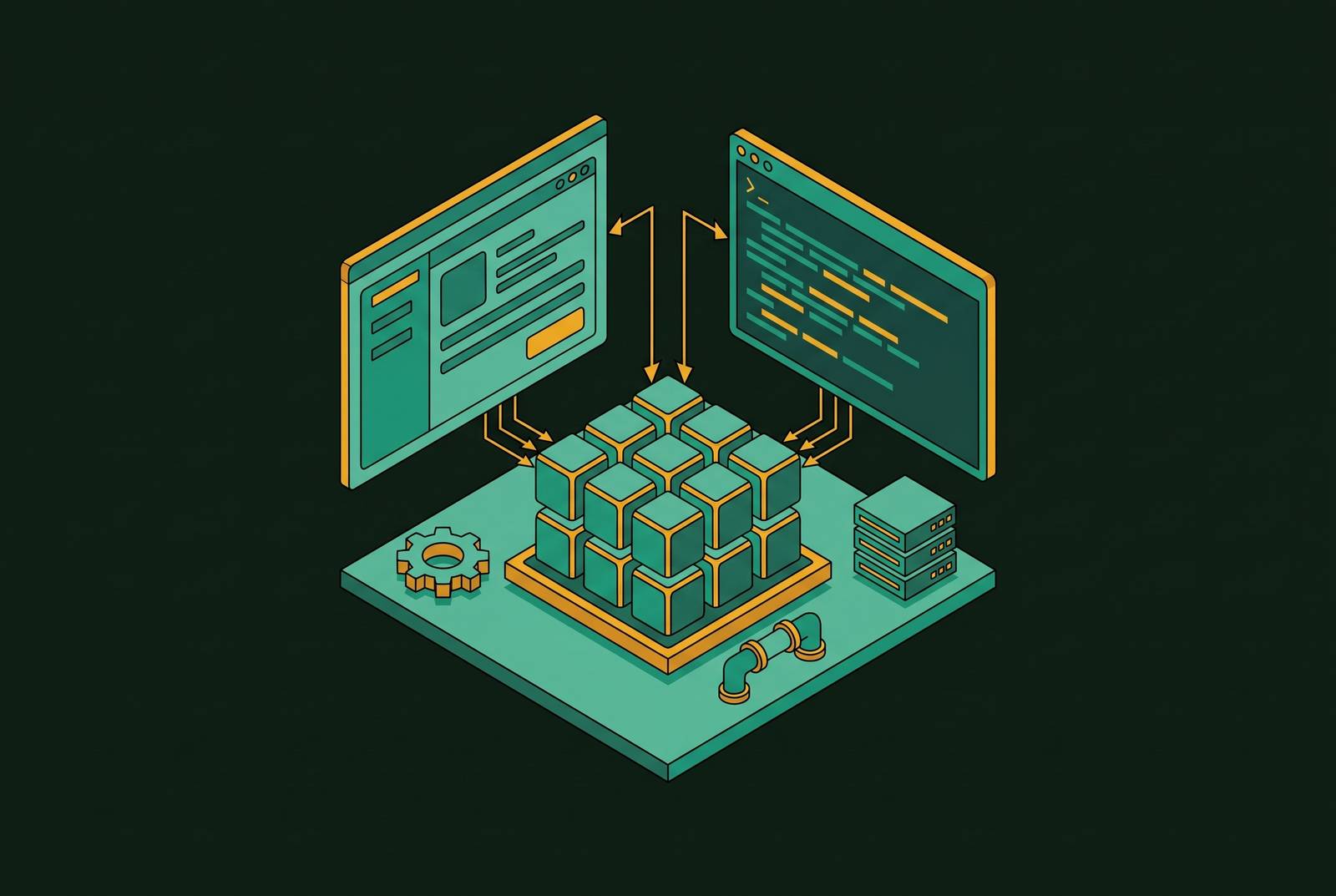
Nix-powered developer environments without writing Nix are possible when a wrapper or a platform-owned configuration handles the underlying definitions. Devbox offers a JSON authoring surface, while devenv lets platform teams expose a shared environment without asking every developer to edit Nix. How much of the stack must be reproducible determines the choice of tool.
Why Nix's guarantees don't reach most engineers without a wrapper
Environment drift starts below the application code. Terraform versions diverge between laptops, Python dependencies conflict, or kubectl no longer matches the cluster. Pinning a language runtime addresses only part of that problem because compilers and system libraries also influence what builds and runs. Nix treats packages as functions of their declared inputs, pinning dependencies down to the C library.
Three concepts support that model. Derivations describe the build instructions, sandboxing restricts arbitrary network and filesystem access during builds, and closures describe complete dependency graphs. A build-time closure includes the packages needed to build, while a runtime closure includes those needed to run. Flakes extend the definition to environments, with flake.lock recording exact input commit hashes.
The obstacle is the authoring experience. Nix has its own unforgiving language, its documentation has long been hard to use, and waiting for evaluation and rebuilds can interrupt day-to-day development. Multi-language monorepos, platform teams, and security-conscious organizations have strong reasons to want its guarantees. Yet adopting the formalism can demand more attention than stack-focused engineers can give it, creating the gap that wrappers address.
What the wrapper layer is actually doing
A wrapper changes the interface to the guarantee. It generates or invokes Nix configuration so that engineers work through a familiar manifest or CLI command rather than construct every Nix expression themselves. Behind that interface, locked inputs and complete dependency closures still define what is in the environment. Hiding the authoring machinery does not, by itself, weaken reproducibility.
The distinction is between convenience and coverage. One tool may pin language runtimes, while another also covers system libraries, services, and process definitions. Their adoption curves also differ, particularly when a failure exposes an underlying Nix concept that the normal workflow conceals. Workflow fit adds another dimension, including whether the main task is opening a local shell, matching CI, coordinating services, or provisioning an agent. A useful comparison therefore asks what remains pinned, what gets abstracted, and who owns the configuration when the abstraction runs out.
What are the options when Nix's learning curve is too steep?
Raw Nix Flakes provide the deepest direct control. They can pin system libraries and compilers together with the rest of the environment, making them suitable for complex monorepos or teams with a Nix champion who owns the definitions. A command such as nix develop .#backend opens the declared toolchain without each user having to know how it works. The person who writes the configuration has the most to learn. That distinction makes raw flakes a viable platform foundation even when they are not a suitable team-wide authoring interface.
Devbox places a JSON manifest at that boundary. A platform team can own a devbox.json base while developers work with project-specific additions, avoiding Nix expressions in the normal authoring path. This makes it relevant when the requirement is specifically to obtain Nix-backed environments without writing Nix code. The comparison with devenv is therefore not simply about syntax. It is also about whether the team wants a simpler manifest or a broader declarative environment owned by someone comfortable with Nix.
devenv uses devenv.nix to define languages, services, processes, tasks, and secrets together. It abstracts much of the environment machinery, but its configuration remains Nix. Its value is the breadth of the workflow it brings under one definition, rather than the complete removal of Nix from configuration. Package search uses the exact Nixpkgs version pinned by the project, so the packages it finds match the environment being built. It works on Linux, macOS, and WSL.
That breadth extends to running the environment. devenv 2.0 includes a Rust process manager with dependency ordering, restart policies, and readiness probes. It replaces process-compose as the default, although the latter remains available through process.manager.implementation = "process-compose". For a stack with several cooperating services, these facilities bring process coordination into the same declaration as the toolchain.
mise is easier to get started with. It pins versions of tools such as Node, Python, and Go, but does not pin system libraries or provide shell isolation. It is appropriate for small projects or simple single-language stacks where full closure reproducibility is unnecessary. As dependencies and CI requirements grow, Devbox or devenv address a broader environment definition. Raw flakes become more attractive when direct control over the dependency graph and supply chain evidence justifies the additional configuration work.
What devenv 2.0 changed about the day-to-day experience of using a Nix wrapper
Evaluation delays make configuration changes feel expensive. In the older workflow, invoking nix develop could mean waiting through evaluation, while a small edit could trigger broad rebuild work. Directory activation through direnv could also tie up the prompt when switching branches. These interruptions compound because entering and adjusting environments are routine actions.
devenv 2.0, released in March 2026, replaces multiple Nix CLI invocations with a C FFI backend built on nix-bindings-rust. It calls the Nix evaluator and store directly through the C API. A single evaluation serves devenv shell, devenv test, devenv build, and the other commands.
Its incremental cache narrows the work further. Each evaluated attribute is cached with the files and environment variables it touched, so a change causes only dependent attributes to be re-evaluated. When content hashes show that nothing changed, devenv returns the cached result without invoking Nix. This is more precise than treating every configuration edit as a reason to repeat the entire evaluation. The cache follows the dependencies of the configuration itself.
Native shell reloading separates that work from the terminal session. After a file is saved, devenv rebuilds in the background while the shell stays interactive and a status line reports progress. A failed rebuild appears there without disrupting the session. direnv remains supported for directory-based activation, but is no longer required. The terminal UI also shows structured evaluation progress, derivations awaiting build or download, task dependencies, and expandable error details.
For experiments and CI matrix jobs, command-line overrides can create an ad-hoc shell without committing a devenv.nix, including enabling Python and selecting version 3.12.
How wrappers extend Nix's guarantees into CI and supply chain audit
A committed lock file links local development to CI. On the same platform, a locked Nix configuration gives both the same package inputs and store paths. This removes version skew as a cause of tests passing locally but failing in CI. It does not imply that different operating systems become identical.
The same graph also supports supply chain evidence. Nix's store model makes it possible to trace a system image to a specific set of sources, dependencies, and build tools. Retaining the full source closure makes an offline rebuild feasible and verifiable. CI parity and auditability thus rest on the same graph, though an audit needs artifacts beyond a working shell.
sbomnix, from tiiuae/Ghaf Framework, supplies that practical reporting layer. It generates SBOMs from a Nix flake reference or store path, with outputs including sbom.cdx.json for CycloneDX and sbom.spdx.json for SPDX. Related tools examine different parts of the graph. nixgraph queries and visualizes dependencies, vulnxscan supports SBOM-driven CVE scanning, and nix_outdated prioritizes outdated dependencies by how many packages depend on them. The provenance tool generates SLSA v1.0-compliant provenance attestation files for a Nix flake or derivation.
Package classification remains an open limitation. CycloneDX requires a type property, while SPDX's analogous primaryPurpose field is optional. Nix package names and outputs alone do not reliably distinguish categories such as applications, frameworks, libraries, or firmware. Without additional metadata, generated SBOMs can misidentify components.
Availability introduces a separate operational constraint. Public Nix binary caches are an external point of failure for production CI/CD, so strict uptime or air-gap requirements call for local high-throughput caching layers. With that infrastructure in place, a wrapper-managed environment, committed lock file, and CI reporting step make provenance part of development. Security evidence is produced from the environment definition before an audit begins.
Running AI coding agents inside Nix-managed environments
AI coding agents get their environment from the one that launches them. Differences in installed toolchains, available binaries, and sandbox configuration can make the same prompt behave differently across developer machines and CI. Repeated agent runs amplify the cost of that inconsistency because each run begins with the inherited setup. A pinned development shell removes tool-version drift from that process. It does not establish that every difference in an agent's output comes from its environment.
A flake-defined shell gives the agent the declared versions of tools such as rustc, node, and python3 on each supported platform. Role-specific shells narrow that toolset further. nix develop .#backend can expose Rust, PostgreSQL, and the project's dependency versions, while nix develop .#frontend provides Node and Playwright. This makes the intended working context explicit. A scoped toolchain should not, however, be confused with a complete security boundary for an agent.
The agent executable can also enter the dependency model. The Codex CLI official repository includes a flake.nix that builds its Rust-native binary. nix run github:openai/codex#codex-rs runs it on a machine with Nix and flakes enabled without a global installation tied to changing Node.js versions. For broader toolchain management, numtide/llm-agents.nix packages approximately thirty terminal-based AI tools, including Codex CLI, Claude Code, Goose CLI, and GitHub Copilot CLI. It is updated each day, giving platform teams a shared source of packages for those tools.
Configuration generation needs authoritative information as well. A wrong Nix attribute path can cascade into a broken build, so live MCP queries can replace reliance on model memory with current configuration data. The pinned shell sets which tools can run, while the query gives the information needed to write the configuration.
How platform engineers can deliver Nix reproducibility to teams that will never touch a flake
Organization-wide adoption depends on ownership more than individual enthusiasm. A platform team can maintain the base devenv.nix or devbox.json, version it, share it by name, and let developers extend it for their projects. Developers need to understand only the project-facing additions.
devenv 2.0 makes that composition practical across repositories. Backend, frontend, and shared-library projects can reference another devenv project's outputs through inputs.<name>.devenv.config. A canonical base can therefore stay in one place while each repository composes its own environment from it. The same devenv.nix can also emit OCI containers with the declared packages and versions. This connects local environment ownership to deployment artifacts without a separate Dockerfile.
SBOMs and provenance artifacts give security and GRC teams evidence derived from the environment definition. Input-derived hashes attached to deployments support CVE discovery and hash-level blocking without reconstructing dependencies from logs. In this model, the manifest becomes the unit of promotion, with atomic edits and rollbacks replacing a separate build-scan-tag-push cycle.
The practical acceptance test is one-command onboarding. If a contributor cannot move from git clone to a running development environment in a single command, the definition has not yet been delivered as a usable platform capability. Wrappers make that handoff achievable, but the platform team must own it. The engineer receives the reproducible environment.