Day One Onboarding Without a Setup Doc Using Single-Command Environment Activation
Verifiable environment setup replaces stale docs with executable code that stays current.
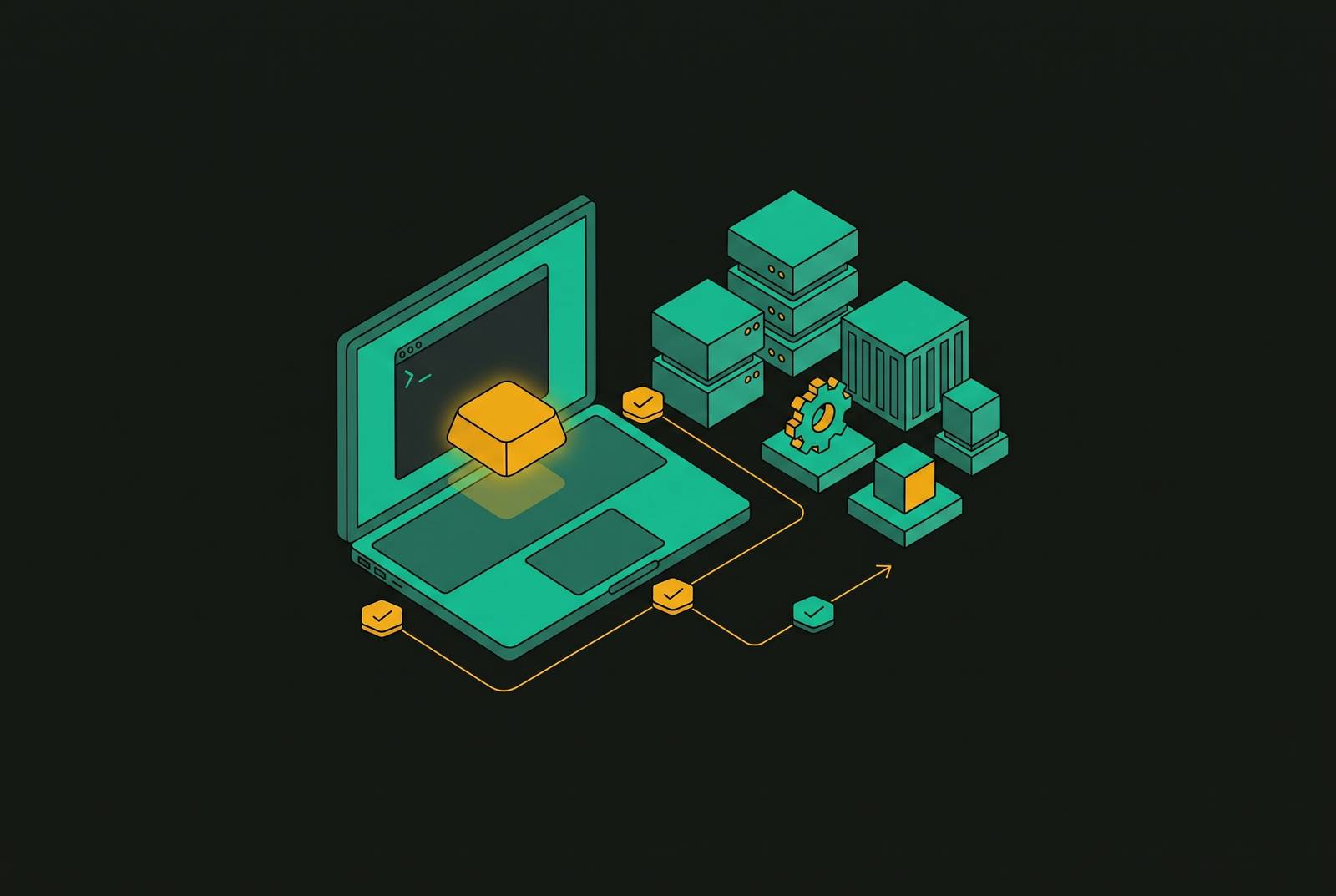
After cloning the repository, a developer activates that definition to obtain the declared toolchain, dependencies, services, and environment variables. The command becomes trustworthy when teams review, test, and update the environment as application code, removing the separate instructions that otherwise drift away from what works.
Why the setup README is structurally guaranteed to go stale
A developer reaches day one, follows the setup instructions, and finds that the application still will not run. The requested runtime differs from the one the project now needs, or a service dependency never made it into the document. Nothing in the instructions explains the discrepancy. The failure starts because the written setup procedure and the environment the application needs are two descriptions of the same system that are kept up to date separately. Updating one does not update the other.
Unpinned transitive dependencies change beneath the declared packages, operating systems supply different system libraries, and established developer machines accumulate local changes. Application package managers work above the OS layer, so they can miss C library mismatches, compiler differences, and shell conflicts. Some failures appear immediately, while others produce software that misbehaves only in production.
Even a README updated on merge day has no automatic connection to the next runtime change or added service. Careful editing cannot repair that missing connection. A developer can thus follow every written step correctly and still end up with a different environment from the one their teammates use. The structural defect is not a lack of diligence, but the use of prose to reproduce a changing set of executable requirements.
What actually happens when a new developer follows a stale README
When setup fails, the new developer has to tell an application defect from an environment defect before they know enough to spot either. A missing system dependency can look like a broken build, while an undocumented service can make otherwise correct configuration appear wrong. Investigation stalls before useful application work begins.
That task rarely stays with the new developer. It becomes a Slack interruption to a senior engineer who knows the workaround but never recorded it. The senior engineer then talks them through the missing state, taking time away from building. Repeating this process across hires turns isolated assistance into an ongoing support burden.
Cycloid's 2026 onboarding guide places average time-to-productivity at 2–4 weeks and describes automated self-service onboarding that compresses it to under a day. Those figures include more than the time lost to stale documentation. The attributable cost here is the time spent reconstructing requirements that the repository should already express. The same guide describes manual onboarding support at scale as a full-time equivalent diverted from delivering platform capabilities. A working setup mechanism removes that particular source of delay rather than claiming to solve every part of onboarding.
How declarative environment definitions eliminate the gap between doc and reality
A declarative manifest replaces the reconstruction exercise with explicit inputs. It defines the language runtimes, system libraries, tools, and services the application requires, while a lockfile fixes the dependency selections. Because the environment definition lives with the application in version control, a change to either can be reviewed as part of the same codebase.
Content-addressing supplies the link between a declared dependency and its concrete identity. A package resolves to an immutable path derived from its content, rather than a mutable installation that happens to have a familiar name. Different inputs remain distinguishable. This lets the environment manager resolve pinned packages without relying on the order in which a developer installed tools on the host.
Across an ARM MacBook, an x86-64 Linux workstation, and a CI runner, the goal is the same declared dependency state with native binaries for each target. Reproducibility means that the target's resolved inputs identify what must be reproduced, with binaries for different architectures allowed to differ in bytes. Version control then shows what changed through a diff, approval, and merge. Reverting the manifest and its locked inputs restores the declared environment without manually undoing a succession of tool installations.
How does one-command environment activation replace manual setup?
A conventional README asks the developer to install a language version manager, select a runtime, and install a package manager. It then walks them through the system dependencies for their platform, environment variables, dependent services, and database seeding. Each step creates another point of divergence. Its success can depend on what ran before it, what the operating system supplies, or which undocumented prerequisite an established teammate already has.
After git clone, the alternative is the repository's single activation command. How the command is written depends on the environment manager. The command resolves the declared toolchain and system dependencies, sets the environment variables, and makes the required services available. When database seeding belongs to setup, that operation must also be encoded.
The onboarding guide sets a concrete self-service target that includes an environment provisioned from a catalog, automatically installed dependencies, production-matching configuration, and passing local builds and tests. Activation makes those requirements executable. The same definition also gives CI the local environment's declared tool versions, so undeclared version differences between them no longer cause failures. AI coding agents can activate it before running commands for the same reason. Their tools then operate against known inputs rather than whichever packages happen to be present on the runner.
What teams must do to make the single command trustworthy on day one
To make activation reliable, teams must treat the manifest as a first-class artifact of the codebase. Disciplined teams test it on a clean machine rather than relying on an established workstation that already contains half the prerequisites. Existing installations can conceal missing declarations. A quarterly clean-machine check exposes those omissions before a new hire encounters them, testing whether the command actually stands on its own.
Environment changes also belong in pull request review. Adding a tool, upgrading a runtime, or connecting a service changes what every developer needs, so the change must go into the shared definition, including any change communicated in a Slack instruction. The review provides both visibility and an audit trail. Teams keep lockfile pins up to date by choosing when to update them and reviewing what changes. Reproducibility preserves a selected state, but it does not make an old dependency snapshot current.
Security and access complete the practical requirements. The environment definition and its implied software bill of materials, or SBOM, must be machine-readable so security teams can connect a generation's input-derived hash to affected components. Access must be ready before activation begins. The onboarding guide treats credentials, repository permissions, and SSO as a distinct pre-boarding stage with its own owner and checklist. A command can automate environment construction, but it cannot substitute for permission to obtain the repository and its required inputs.
How platform teams scale this across many services and many developers
Across an organization, teams share a named, versioned environment that is published through a central control plane. Platform teams maintain curated base environments containing approved toolchains, security baselines, and service integrations. Application teams add what their services need to those bases. Splitting the work this way gives developers self-service access without making the platform team support every configuration put together on a laptop.
A developer joining another team pulls that team's environment when they need it, replacing the practice of copying an .env file from a wiki or filing a setup ticket. The platform team is removing the README as the mechanism for transferring an environment from one developer to another.
If a base update breaks several services, generation-based rollback lets the platform team restore the base so the services that extend it get the fix too. Individual teams need not manually unwind installations. The internal developer platform becomes the place to get working environments, dependency graphs, and SBOMs, going beyond a portal with links to instructions. The onboarding guide sets zero setup tickets from the new developer as the self-service target, so whether activation works tells more than how clear the documentation is.
The supply chain security dividend that comes with reproducible environments
The same declaration that supplies a new developer's tools also records what those tools are. A manually assembled machine leaves security teams to reconstruct that information, while a content-addressed lockfile acts as a de facto SBOM for the development environment. Provenance follows from the declared inputs. The security record is therefore a byproduct of building the environment correctly.
The U.S. Executive Order on improving the nation's cybersecurity tells NIST to issue guidance that recommends that software vendors supplying the federal government provide an SBOM. OMB Memorandum M-26-05 means that, as of 2026, the government-wide mandate has ended, a distinction that prevents overstating the compliance requirement. CycloneDX, maintained by OWASP with broad CI/CD support, and SPDX, from the Linux Foundation and standardized as ISO/IEC 5962:2021, provide machine-readable formats for compliance workflows. Generating those formats during normal environment operation removes another separately maintained document.
Operational use gives that inventory its value. When a vulnerability is disclosed, security teams can identify environment generations whose input hashes include the affected component and target remediation or blocking at that level. They do not need to begin by asking each engineer which version is installed. Organizations that produce SBOMs only for compliance risk weakening confidence in records that no operational process uses. Connecting the SBOM to activation and vulnerability response makes it a live artifact of the environment the developer actually received.
What day one looks like when the single-command pattern is fully in place
With access provisioned before arrival, the new developer clones the repository and runs the activation command. The declared runtimes, toolchain, services, and environment variables become available on their own hardware. Verification replaces the search for missing prerequisites. The developer runs the local build and tests against the environment the team maintains, rather than first reconstructing an experienced teammate's machine.
The first pull request can then contain a scoped bug fix or a small feature. The onboarding guide targets a first commit on day 1-2, shortening the timeline from 2-3 weeks. That target depends on the whole onboarding path, including access, but environment activation removes the manual setup sequence from it. The platform team's inbox has no setup ticket to resolve, and a senior engineer has no undocumented workaround to explain. Security has the environment's SBOM from activation, eliminating the wait for a scan deferred to the next sprint.
AI coding agents provisioned for the developer activate the same declared environment, so their commands and the human developer's terminal use the same known dependency state. The setup README, if retained, needs only the instruction to clone the repository and run activation. The manifest handles the rest of the sequence. Instead of reaching day three unable to run the application because the README is out of date, the developer ships a real commit before the end of day one.