Reproducible Environments on Apple Silicon and x86 Teams
Teams lose sprints to architecture mismatches between ARM Macs, x86 CI, and production.
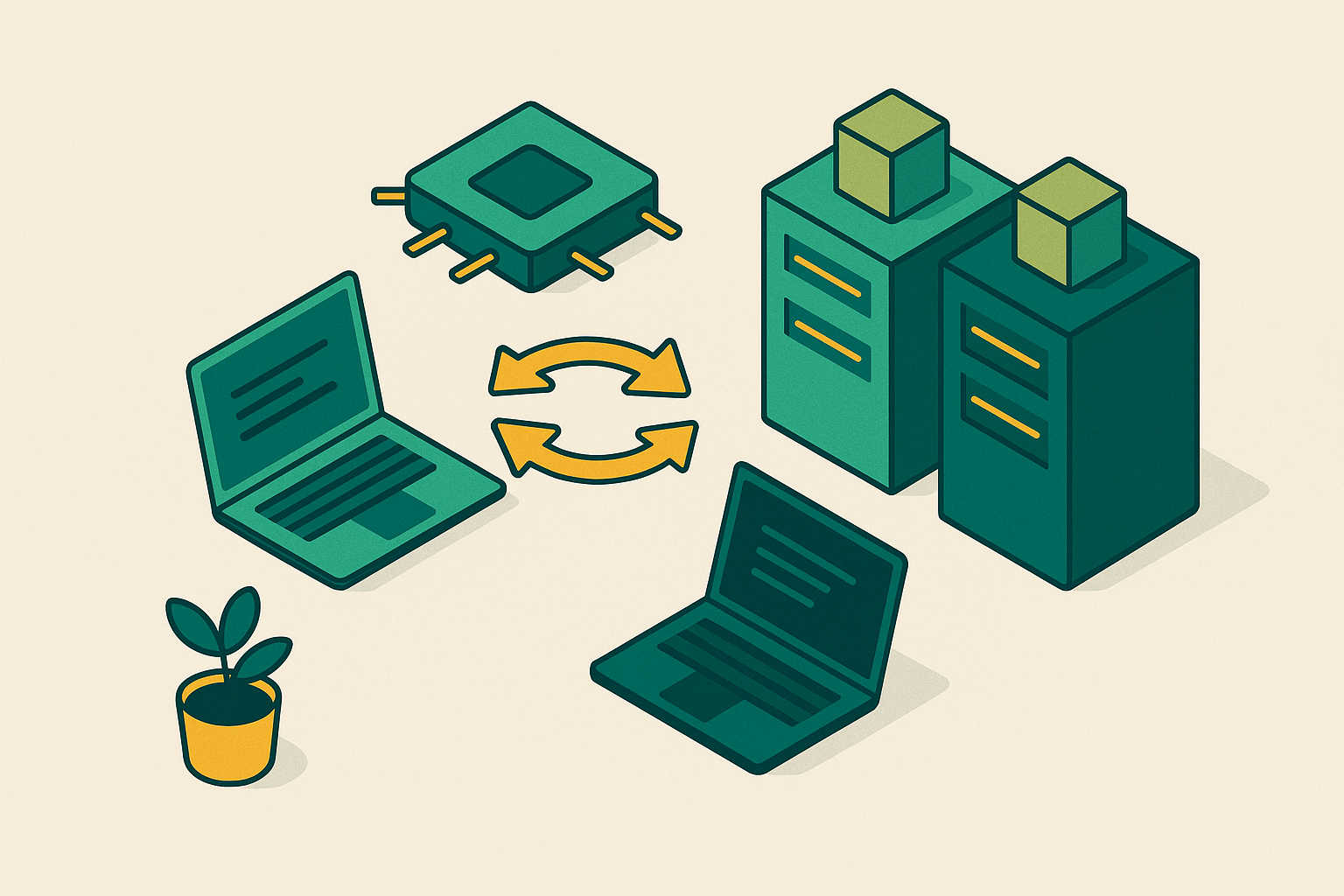
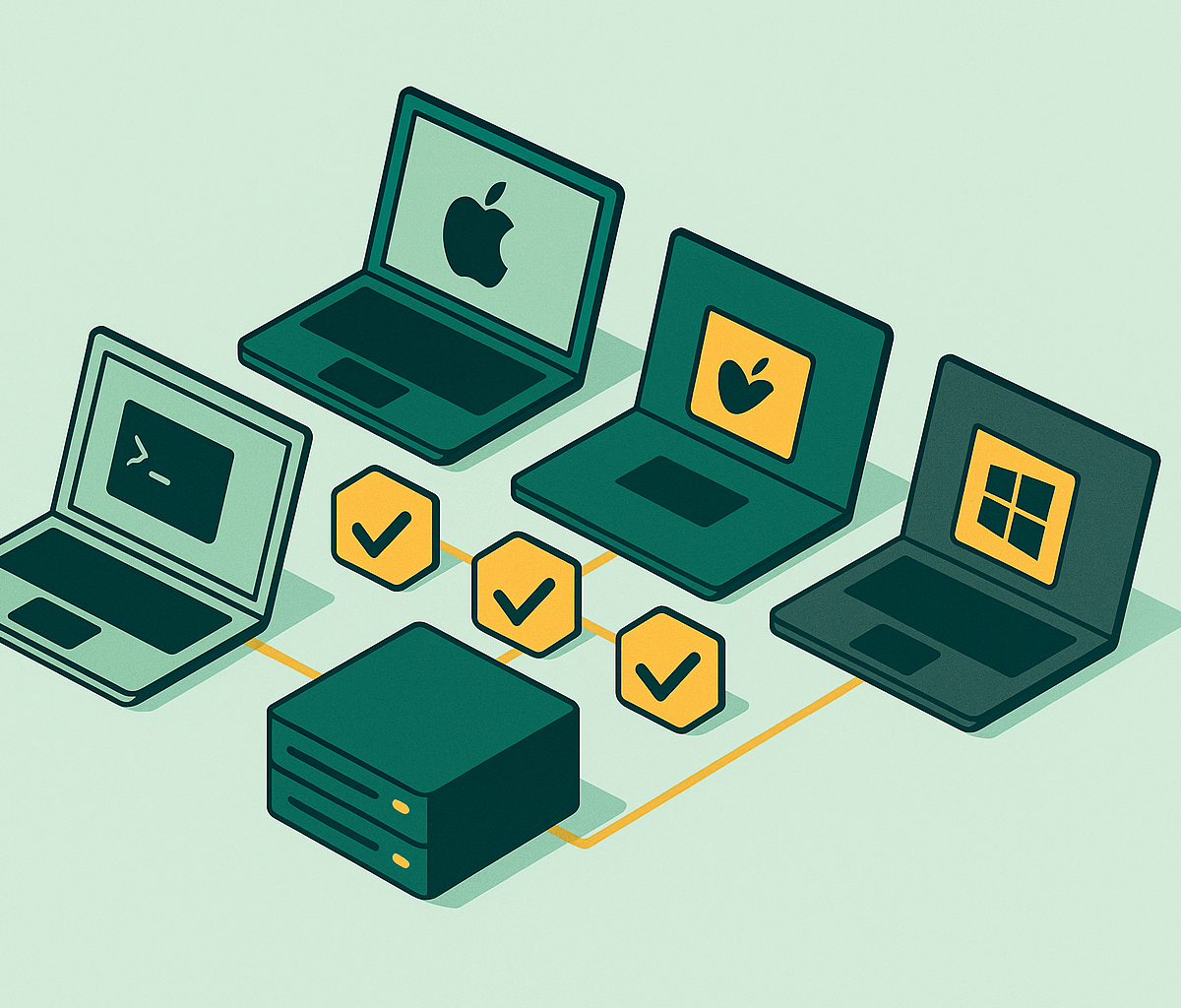
Apple's shift to its own silicon started in November 2020, and five years on, most engineering organizations run a mix of M-series laptops and x86 machines somewhere in their stack. Cloud economics keep x86 instances in production even as ARM becomes the default on developer desks. So developers write code on ARM64 Macs, CI runners mostly build and test on x86_64 Linux, and production increasingly spans both AMD64 and ARM64 instances. Each pairing looks fine by itself. Trouble starts the moment you need to trust all three at once, and Teams can lose entire sprints to exactly that.
Where the three-way drift actually originates
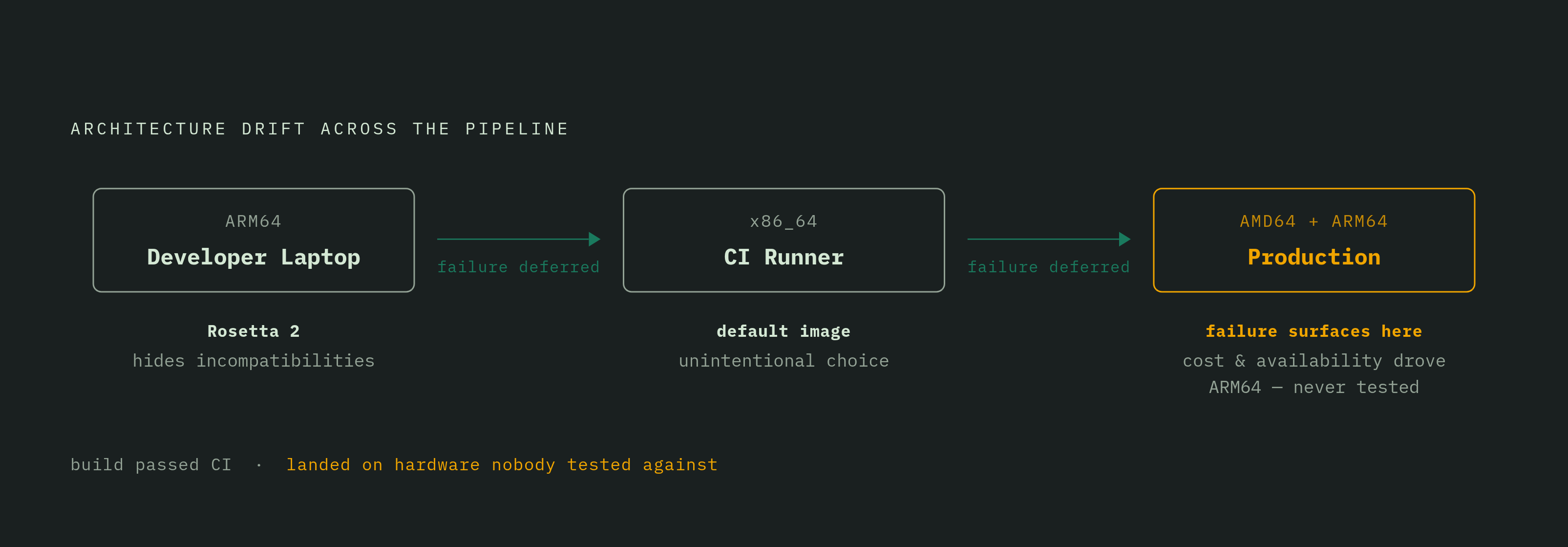
Start with the laptop. Apple Silicon runs ARM64 natively, and Rosetta 2 translates x86 binaries on the fly, well enough that most developers never think about it twice. That's the problem. Rosetta hides incompatibilities instead of surfacing them, and they resurface later, somewhere less convenient than a laptop.
CI is the second source. Most hosted CI runners default to x86_64 Linux. So the code someone just wrote on an M-series Mac gets tested for the first time on a completely different instruction set, often without anyone deciding that on purpose. It's just the default that shipped with the provider.
Production is the third leg, and the least stable of the three, because it moves for reasons that have nothing to do with development velocity. Cost and availability push infrastructure teams toward ARM64 in some regions and AMD64 in others. A build that passed CI cleanly can land on hardware nobody ever tested it against.
None of these three is dramatic on its own. The compounding version is what does the damage. Each hop adds an assumption nobody wrote down, and the failure never surfaces where the assumption got made. It shows up in staging, or in production, or as a performance regression nobody can quite explain three weeks later.
Codesigning on Apple Silicon is a clear example of how subtle this gets. As documented for Apple Silicon builds, a binary's UUID derives from its content, and that content differs by architecture. Fat binaries targeting both Intel and Apple Silicon show codesigning behavior that depends on which architecture the machine doing the build happens to be running. Two developers on the same team, running the identical build command on different laptops, walk away with artifacts that behave differently under signature verification. Neither one did anything wrong.
The symptoms pile up in familiar ways after that. x86 container images run under QEMU emulation on ARM hosts and are noticeably slower, because emulation approximates equivalence rather than delivering it. Certain database containers, MySQL and MongoDB among them, have a documented history of bugs that show up specifically on ARM and nowhere else. Any library with native extensions is a recurring failure point too, since those extensions got compiled for one architecture and nobody checked whether they'd behave the same on the other.
Why emulation and "just use x86" are workarounds, not solutions
Rosetta 2 and QEMU let you run the "wrong" architecture's binaries, which is genuinely convenient for quick local testing. Running something is not the same as building or testing it reliably, and that gap is where the risk sits. Emulation gives you a false positive: the test suite passes locally under Rosetta, then the same code fails on native x86 CI, because the emulation layer smoothed over an incompatibility that was real the whole time.
The performance cost matters more than teams account for. Build-heavy workloads run substantially faster on native ARM than on the same hardware pretending to be x86 through QEMU. Forcing ARM developers back onto emulated x86 for the sake of consistency throws away the exact advantage that justified buying the hardware in the first place. Strange trade to make on purpose, and yet Teams make it anyway, out of sheer fatigue with debugging drift.
"Just pin CI to x86" is the other common answer. It quiets the CI-versus-developer mismatch for a while, but does nothing about the CI-versus-production mismatch, especially as production keeps drifting toward ARM64 for cost reasons. All that move accomplishes is shifting the point of failure one step to the right, from CI into production, where it costs more to diagnose and shows up in front of customers when it breaks.
Both workarounds share a blind spot. Architecture gets treated as something the runtime figures out at the last second, rather than something the team declares up front. As long as different parts of the stack each resolve that question independently, drift is close to guaranteed.
Treating architecture as a declared dependency in the development environment
Architecture belongs in the environment definition, the same way a language version or a package version does: written down, checked into version control, resolved the same way every time no matter which machine is doing the resolving.
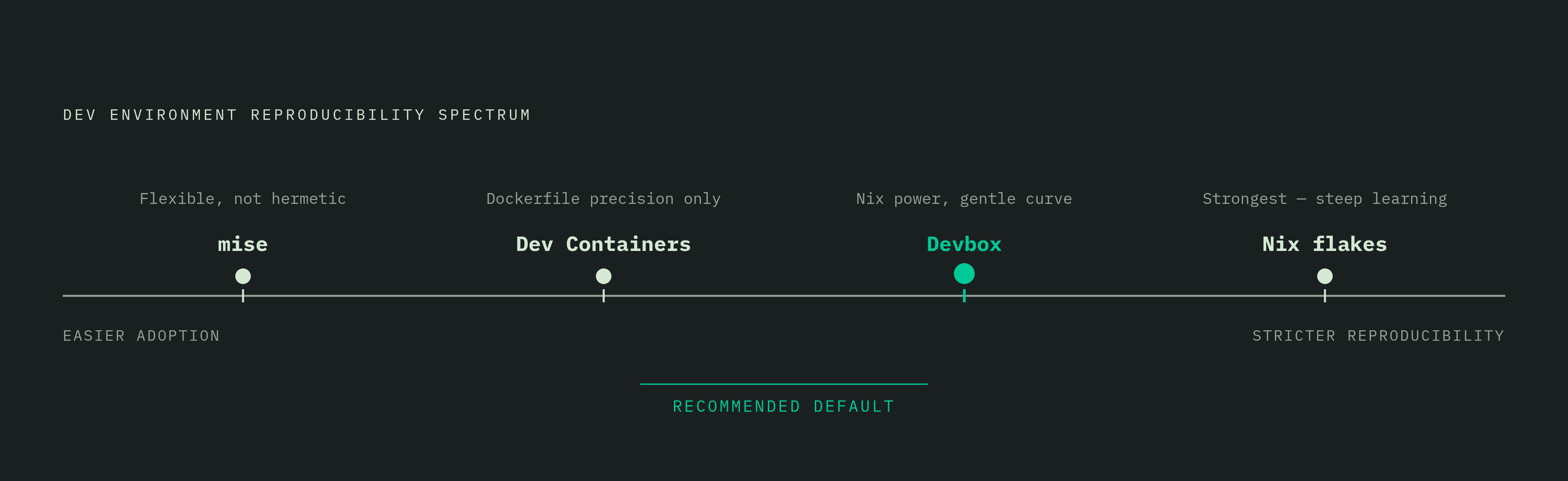
Four tools cover most of this space today, and they trade reproducibility against ease of adoption differently. Flox, a single-manifest environment manager built on Nix, is one approach to keeping that same environment consistent across laptops, CI, and production. Each tool represents a different point on the reproducibility-versus-adoption tradeoff.
Nix flakes sit at the strict end. Nix's purely functional evaluation model isolates every dependency and stores it separately, unaffected by whatever else happens to be installed on the system. It's the strongest reproducibility guarantee available here, and the tradeoff is a learning curve steep enough that it's the main reason teams avoid it, even when they'd benefit from it.
Devbox, built by Jetify, wraps Nix behind a JSON config file and a command-line interface that reads like a normal package manager, drawing on a collection of over 100,000 packages, according to devtoolreviews.com. It also generates a devcontainer.json automatically, so VS Code picks it up without extra configuration. For most teams Devbox is the sensible default, since it gets you most of Nix's reproducibility without asking developers to learn Nix's language first.
Dev Containers, the specification Microsoft maintains, define the environment inside a Docker container via a.devcontainer/devcontainer.json file. VS Code and JetBrains both detect the container and drop the developer into it automatically. There's a catch: the reproducibility guarantee is only as good as the Dockerfile behind it, and Dockerfiles are typically far less precise than a Nix closure.
mise, the tool that picked up where asdf left off, is fast and simple, pinning language and CLI tool versions in a single config file. Genuinely useful, though not hermetic the way Nix is, and a new minor version of some dependency can leak into the resolved environment without anyone noticing.
A useful heuristic for choosing among these tools: the closer dev, CI, and production need to be to byte-for-byte identical, the further toward Nix a team should move. mise is fine for pinning tool versions, but it won't get you full environment parity on its own. Whatever the choice, the test stays the same. Clone the repository, run one setup command, and get the identical resolved environment whether that command runs on an M3 Mac or a Linux x86 box.
Building multi-architecture images that CI and production can both trust
For production images, multi-platform builds through Docker's Buildx, backed by QEMU, remain the standard approach. One build command produces images for linux/amd64 and linux/arm64 at the same time, and that single command is what closes the gap between CI and production.
Worth understanding precisely: a multi-arch image isn't one image. It's a manifest list, a pointer to separate platform-specific images underneath, and Docker pulls whichever one matches the architecture of the machine running it, automatically, so nobody has to remember which variant goes where.
Enforce this in the pipeline, not in the developer's judgment. A CI workflow, on GitHub Actions or an equivalent, should run a buildx step that builds and pushes both platform variants on every merge to main. That takes the architecture decision out of any individual's hands and encodes it as a pipeline rule instead.
Apple's Containerization framework, announced at WWDC 2025, deserves a mention here. It's an open source Swift framework with an accompanying CLI, built specifically for Apple Silicon, and it runs each container in its own virtual machine rather than sharing a kernel across containers. That per-VM isolation changes the security math meaningfully, particularly for AI-generated code or images pulled from sources nobody's vetted closely. It also produces proper OCI multi-platform manifests, so CI pulls the correct architecture without special-casing anything.
Base image choice is a lever teams underuse. According to minimus.io, standard public images commonly ship with somewhere around 50 to 60 known CVEs baked in before anyone's code gets added; minimal, source-built images can bring that count down to single digits. Architecture parity closes one gap, but it does nothing for a base image that was already carrying dozens of known vulnerabilities. Both problems need solving, and neither substitutes for the other.
Make "which architecture is this running on" a fact the pipeline states out loud, not an assumption baked into whoever happened to build the image last.
Supply chain provenance when the same code ships to two architectures
Once a build produces two separate artifacts, linux/amd64 and linux/arm64, both need their own provenance record. A single software bill of materials attached at the manifest-list level isn't enough, because the two platform images can resolve dependencies differently even from identical source code.
SPDX and CycloneDX are the two dominant SBOM formats in use today, and generation tools including Syft, CycloneDX's own tooling, Fossa, and Finite State all produce multi-format output that captures dependency data in reasonable detail.
The threat here isn't hypothetical. In March 2025, attackers modified historical Git tags on a widely used GitHub Action, one relied on by more than 23,000 repositories, and used the compromise to exfiltrate CI/CD secrets into public Actions logs, according to StepSecurity's disclosure of the incident. That's precisely the category of compromise that SBOM generation paired with build provenance is designed to catch.
The SLSA framework gives the industry a shared vocabulary for talking about how trustworthy a build actually is. Level 0 means no provenance at all, tolerable only when development and testing happen on the same local machine and nothing else is at stake. Level 1 means the build platform automatically generates a record of how the artifact got produced. Level 4, the top, means fully hermetic and reproducible builds, where a separate party can recreate the exact artifact from the same source. For a mixed-architecture team, Level 4 is the right target for production release artifacts, and getting there depends entirely on the environment reproducibility work described above.
Most SBOMs generated today are compliance artifacts: produced once at the end of a build, filed away, rarely revisited unless an auditor asks. Treating that snapshot as a living, queryable record instead is what makes it useful when a new vulnerability surfaces.
Regulation is already pushing this direction. Executive Order 14028 requires federal software vendors to supply SBOMs, and NIST SP 800-218, the Secure Software Development Framework, lays out secure development practices across the software lifecycle. Companies selling into government are already obligated to do this work, and the expectation is spreading into other regulated industries.
The operational payoff shows up clearest under pressure. During an incident on the scale of Log4j, a team with SBOMs in place identifies exposure within minutes. A team without them is stuck manually inspecting builds and containers one at a time, hoping to find the vulnerable dependency before someone else does.
What reproducible environments do for developer onboarding on mixed-arch teams
Mixed-architecture teams pay an onboarding tax that's easy to underestimate. A setup README written by an x86 developer can fail silently on an M-series Mac, and the reverse happens just as often. The new hire spends days fighting environment setup instead of doing the work they were actually hired for.
That cost is measurable even before you get to specific numbers. Research has found new hires reach only 25% productivity in their first 30 days without structured onboarding. For a senior engineer at a competitive salary, a few weeks of ramp friction adds up to real direct cost, and most of it is avoidable.
A declared, version-controlled environment definition collapses that onboarding problem to a single command, regardless of what hardware the new hire showed up with. The environment itself knows what architecture it's running on and resolves accordingly. The new hire doesn't need to know the difference between ARM64 and x86_64 to get started, and frankly, most of them shouldn't have to.
This gets more urgent as AI coding agents start writing and testing code alongside humans. An agent needs the same environment rigor a human developer needs, arguably more, because there's no person glancing at a warning message and pausing to investigate it. An agent running on a different architecture than CI produces code that passes every check it can see locally and fails once it hits the pipeline, with nobody in that loop to catch the drift before it happens.
Platform engineers gain more from shipping a versioned base environment that developers activate on day one than from a sixteen-step README with architecture-specific caveats buried halfway through. The tooling to hit that one-command standard already exists.
Closing the three-way gap systematically rather than piecemeal
The three-way drift problem has no single point of intervention. Fix the developer environment and leave CI and production as they were, and the mismatch just moves somewhere else. The same holds for fixing any one node on its own. I've tried the piecemeal approach more than once, hoping to avoid the bigger lift; it never held for more than a quarter.
Start with the development environment itself. Adopt a Nix-based tool, either Nix flakes directly or Devbox as the friendlier entry point, and declare architecture and dependencies explicitly, committed to version control where everyone can see them. Extend the same discipline into CI by configuring buildx to build and push both linux/amd64 and linux/arm64 on every pipeline run, so architecture never becomes an implicit assumption baked into whichever runner happened to be available that day. Harden the base images at the same time; moving from standard public images carrying 50 to 60 known CVEs down to minimal, source-built images with single-digit counts is a concrete improvement, and it doesn't require touching a line of application code. Then add provenance: generate per-platform SBOMs with a tool like Syft or CycloneDX at build time rather than a single document at the manifest level, targeting SLSA Level 1 as a baseline and Level 4 for anything shipping to production.
Enforcement is the last piece, and it's the one teams skip most. Provenance that exists but never gets checked is just paperwork sitting in a bucket somewhere. The pipeline should reject artifacts that lack it or fail signature verification, automatically, without a human needing to remember to look.
Writing it down in version control lets the toolchain enforce it instead of trusting developer discipline to hold at every merge. Teams that close all three nodes, developer machine, CI, production, stop spending their time debugging architecture-specific failures after the fact. They ship the artifact their developers actually tested. That's the whole point.