SCA Tool Evaluation Criteria for DevSecOps Teams
Focus SCA evaluation on remediation speed, not detection count alone.

Open-source code sits inside 96% of commercial codebases, and 84% of those codebases carry at least one known vulnerability already sitting in a dependency somewhere. That fact alone should settle any argument about the value of software composition analysis. What it doesn't settle, and what most procurement conversations skip past, is whether the tool a team buys actually closes the gap between finding a flaw and fixing it.
The industry median time to remediate a known vulnerability is 252 days, and the number keeps climbing. Buying another scanner does not move that number. Fixing what the scanner already found does. Teams that treat SCA evaluation as a checkbox exercise, comparing vendors on how many CVEs they catch at the CI gate, are optimizing for the part of the problem that was never the bottleneck.
Meanwhile the threat picture keeps getting worse on two fronts at once. Supply chain attacks rose 156% year over year, with more than 704,102 malicious packages identified since 2019, meaning attackers have shifted from waiting for developers to introduce vulnerable code to actively planting malicious code in the packages developers already trust. And the volume of new vulnerabilities to track is outpacing anyone's ability to triage them by hand: CVE submissions to a major vulnerability database rose 32% in 2024, which has left a backlog so large that severity guidance alone can't tell a team what to fix first. An SCA tool evaluated purely on detection count is answering a question nobody needs answered anymore. Everyone can find vulnerabilities now. The scarce capability is deciding which ones matter and getting them fixed before day 252.
SCA's scope relative to SAST, DAST, and container scanning
Software composition analysis inventories every open-source and third-party component in an application, from source manifests and lock files down to container image layers and compiled binaries, and checks each one against known vulnerabilities, license obligations, and signs of supply chain tampering. That's the job description. It's worth pinning down precisely, because SCA gets confused with adjacent tooling more often than it should.
SAST looks at custom source code and catches security flaws in proprietary logic before the build ever happens. DAST tests a running application and finds what's actually exploitable during execution. Secrets scanning combs through source code and version control history for exposed credentials and tokens. Container scanning inspects images and runtime artifacts for vulnerabilities baked into base images and packaged software. SCA is the only one of the four looking specifically at the open-source and third-party components riding along inside the application, rather than the code an organization wrote itself.
That distinction carries weight because of how much of a modern application isn't original code at all. Somewhere between 70% and 90% of the code running in a typical application today is open-source or third-party, and in many projects the majority of the actual vulnerabilities trace back to transitive packages, the dependencies of dependencies, pulled in automatically without any developer ever typing an import statement for them on purpose.
A tool worth shortlisting has to cover three distinct scanning methods, and a vendor should demonstrate each one rather than take a slide deck's word for it. Manifest scanning reads dependency files like package.json, requirements.txt, and pom.xml along with their lock files. Container image scanning goes layer by layer through both the application's dependencies and the base image itself. Binary scanning identifies components baked into compiled artifacts and packaged AI models; these never appear in a manifest because there is no manifest to read in the first place. A tool that only does the first of these is only doing part of the job.
Tool integration across the SDLC, from IDE through CI to post-deployment monitoring
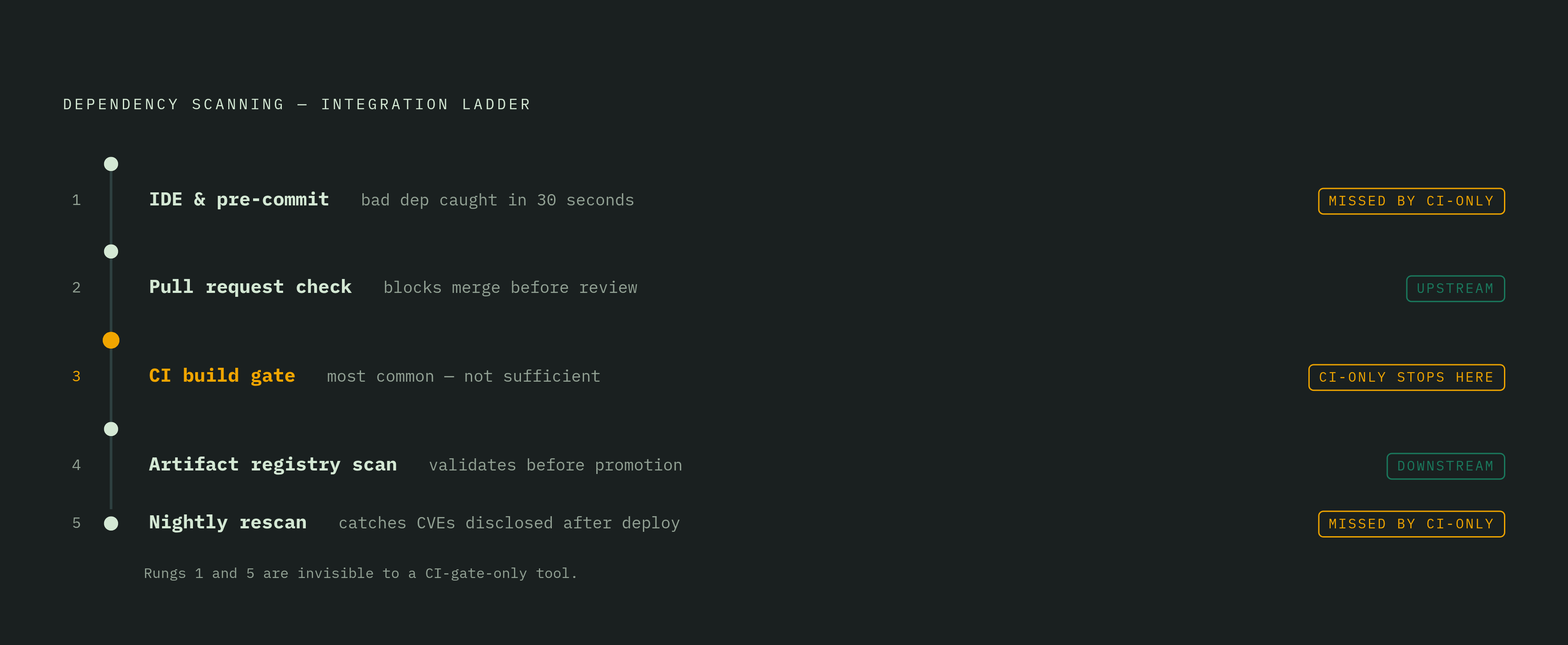
Think of integration as a ladder, not a single rung. At the bottom sits the IDE and pre-commit hook, where a developer sees risk before it ever enters version control. Above that is the pull request stage, where an automated check can flag or block a change before it lands on the default branch. Then comes the CI build gate, where scanning runs as part of every build rather than as a separate, occasional audit. Above that sits the artifact registry, where images and packages get scanned before they're promoted anywhere near production. At the top is post-deployment monitoring, where versions already running in production get rescanned, ideally nightly, to catch vulnerabilities disclosed after the fact.
A tool that only fires at the CI gate misses both ends of that ladder. It misses the earliest point, where catching a bad dependency costs a developer thirty seconds in their editor, and it misses the latest point, where a CVE disclosed six months after deployment needs someone to notice it's sitting in a production image right now. A container scanner that only runs once a night has an entire working day during which a vulnerable image can ship, get promoted, and reach customers before the next scan even fires.
SBOMs belong in this same continuous frame. They need to be generated and maintained inside the CI/CD pipeline itself, on every build, not produced once during an annual audit and then filed away. And already-deployed versions need ongoing rescanning to catch CVEs that get disclosed after the software has already shipped, since a vulnerability doesn't have to exist at build time to become a real problem later.
SAST evaluations offer a signal-to-noise test that applies here: a scanner that dumps a hundred low-confidence tickets into a sprint backlog burns through developer trust within a month or two, and after that nobody reads the tickets at all. The same failure mode occurs in SCA. Evaluators comparing tools should be measuring false positive rate and alert fatigue with the same rigor they apply to detection breadth, because a tool nobody trusts is a tool nobody acts on, regardless of how many vulnerabilities it technically found.
Dependency provenance, SBOM generation, and the practical requirements of visibility
An SBOM, or software bill of materials, is a machine-readable list of every component, library, and dependency inside an application, including version numbers, where each one came from, and what license governs it. Any tool under evaluation should produce one in either the CycloneDX or SPDX format on every single build, and that SBOM should be signed and attached directly to the build artifact rather than living in a separate document somewhere.
Visibility is not security. An SBOM that sits in a compliance folder, disconnected from anything that actually enforces a policy, is an audit artifact. It proves a component exists. It does nothing to stop that component from shipping.
There's also a difference between a continuous SBOM and a point-in-time one: a point-in-time SBOM goes stale the moment the next build ships, while a continuous one doesn't. OX Security's Pipeline Bill of Materials concept tracks dependencies, configurations, and build pipelines continuously, so the inventory stays accurate across every build and release rather than describing a snapshot from three releases ago. Anyone evaluating a tool should ask directly whether its SBOM output stays live between releases or goes stale the moment the build finishes.
Provenance checks round this out, and three specific capabilities are worth requiring rather than treating as nice-to-haves: artifact signing and verification through Sigstore or Cosign, build attestations that prove what an artifact is and where it actually came from, and deployment-time enforcement that applies provenance rules at the moment of deployment, not after the fact.
Malicious package detection and AI-generated dependency risk, the supply chain threats most SCA tools weren't built for
CVE matching answers one question: is this known-vulnerable code present. It says nothing about whether a package was deliberately planted, whether a maintainer's account got compromised and started pushing malware, or whether a typosquatted package with a name one letter off from a popular library just got added to a lock file. Detecting those requires a different discipline entirely, one built around watching package metadata and version history for sudden, unexplained changes rather than matching strings against a vulnerability database.
The Shai-Hulud 2.0 campaign against the npm registry affected more than 25,000 GitHub repositories, and it's a useful illustration of exactly this distinction: nothing about a poisoned package necessarily maps to an existing CVE the day it gets planted. Socket has built its differentiation specifically around this category of detection, distinct from vendors competing on license compliance or on developer experience. That's a meaningfully different evaluation question than "how many CVEs does it catch."
AI-generated code adds a new and specific version of this risk. A 2025 USENIX study tested sixteen code-generating models and found they referenced hallucinated, nonexistent package names in 19.6% of cases on average, with commercial models at around 5% and open-source models running closer to 21.7%. A hallucinated package name is a blueprint for a dependency confusion attack, where someone registers that exact nonexistent name on a public registry, loads it with malicious code, and waits for an AI coding assistant somewhere to suggest it again. It's a blueprint for a dependency confusion attack, where someone registers that exact nonexistent name on a public registry, loads it with malicious code, and waits for an AI coding assistant somewhere to suggest it again. Any team leaning on AI-generated code without a tool that checks generated dependency names against hallucinated packages is leaving a door open that didn't exist a few years ago.
Reachability analysis and risk prioritization, how tools separate actionable findings from noise
Most of what a standard SCA scan flags is never actually executed by the application. That's the uncomfortable core of prioritization, and it's the reason detection breadth alone is such a poor evaluation criterion. Without reachability analysis, a development team ends up wading through a list of vulnerable transitive dependencies the application imports but never calls, spending fix cycles on code paths nobody's software ever touches.
Scale makes this worse. The GitHub Action actions/setup-node is used in roughly 78% of organizations, so a single popular dependency creates an enormous attack surface on paper, most of which is unreachable in practice. A severity score with no reachability context will rank it as urgent everywhere it appears, regardless of whether the vulnerable function ever runs.
Endor Labs has built its differentiation specifically around solving reachability, using call-graph analysis to confirm that a vulnerable function is actually invoked rather than merely present. Ask any vendor during evaluation whether the tool traces execution paths or stops at "this package exists in the dependency tree.""
A genuinely useful prioritization model answers four questions before ranking anything as urgent. Is the vulnerable component reachable from the application's actual execution paths? Is the vulnerable version even deployed to a production environment, as opposed to sitting in a staging branch nobody ships? What's the exploitability given the specific runtime context, beyond the CVSS base score sitting in a database? And does the tool correlate its findings with runtime data and cloud asset context, or is it working from static code alone, blind to how the thing actually runs in production?
Remediation workflow integration, the capability gap between finding a vulnerability and closing it
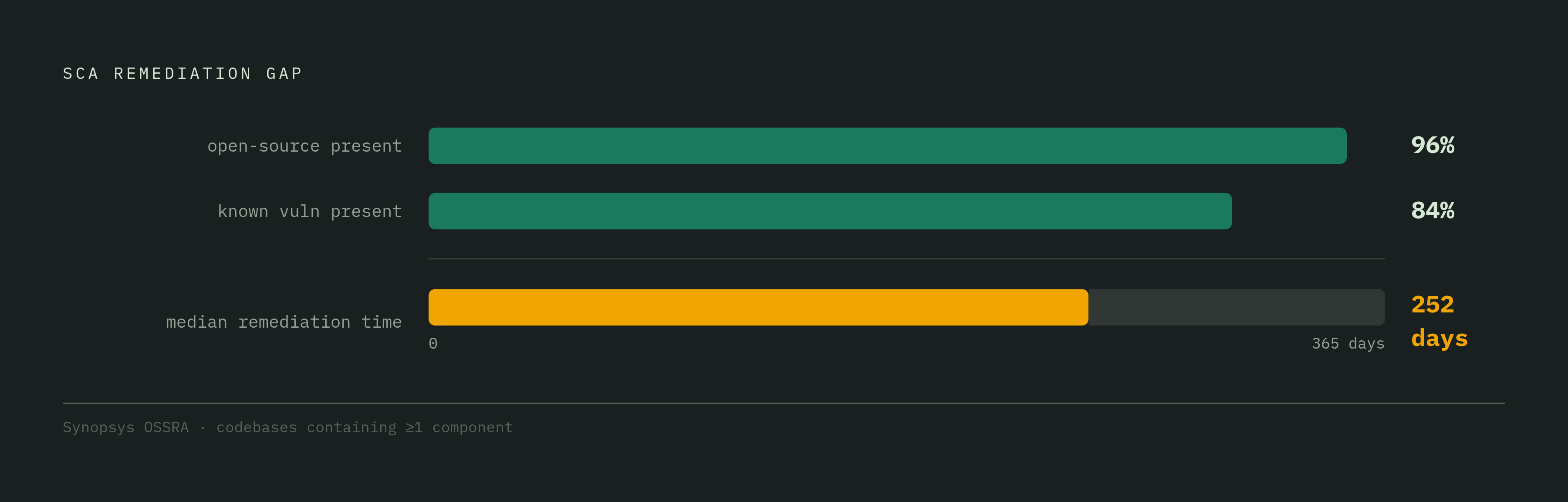
Running three SCA tools instead of one gets a team exactly zero cross-tool remediation, because more scanners pointed at the same dependency tree just produces more overlapping alerts, not more fixes. The median 252-day remediation time isn't stuck there because detection is weak. It's stuck there because workflow is weak, and that's the part evaluation criteria consistently underweight.
A handful of concrete features separate tools that close this gap from tools that only widen it. Automated pull request generation for dependency upgrades matters most, and Dependabot and Renovate are widely recognized reference implementations for this capability, with Snyk and Mend also generating fix PRs automatically rather than leaving the upgrade as a line item on a dashboard. Fix suggestions need to show up inside the pull request and the IDE itself, with a plain explanation of what changed and why, rather than sitting in a separate security tool a developer has to remember to open. Policy-enforced CI gates need customizable thresholds so a team can block genuinely risky code from reaching production without also blocking every minor version bump. Rollback capability means that when an automated upgrade introduces a regression, the environment can return to its prior pinned state without someone manually hunting down the last known-good version at 11 p.m.
Pixee occupies a distinct category worth understanding separately from the SCA scanners themselves. It operates as a cross-tool remediation layer on top of existing scanner output, automating the fix application step regardless of which scanner surfaced the finding. Teams whose primary SCA tool generates alerts well but automates fixes poorly should weigh whether a layer like this belongs in the stack as a complement, rather than assuming the scanner vendor needs to solve remediation alone.
None of this gets easier by waiting. Old dependencies pile up on top of each other, each new library added on top of libraries nobody's upgraded in years, and every month that passes makes the eventual upgrade path more tangled and more expensive. Applications built on a foundation of unmaintained libraries don't fail all at once. They just get progressively harder to fix, until the fix costs more than the rebuild would have.