FedRAMP and CMMC 2026 Compliance Changes for DevSecOps Teams
Compliance now runs on continuous signals, not annual paperwork snapshots.
FedRAMP and CMMC both changed their operating logic in 2026, not just their paperwork. The authoritative measure of a cloud provider's security posture moved from periodic documentation snapshots to continuous, machine-readable evidence streams, and that shift touches every team that builds, ships, or operates federal cloud systems. FedRAMP finalized its Consolidated Rules for 2026 (CR26) on June 25, 2026. On the CMMC side, Phase 1, covering Level 1 and Level 2 self-assessments in applicable solicitations, began November 10, 2025, and Phase 2, which would have brought mandatory C3PAO certification requirements for Level 2 contracts starting November 10, 2026, was suspended on July 13, 2026. That suspension should not be read as the bar coming down: the technical posture requirements behind CMMC Level 2 have not relaxed, and contractors still need to meet them even without a hard certification deadline forcing the issue.
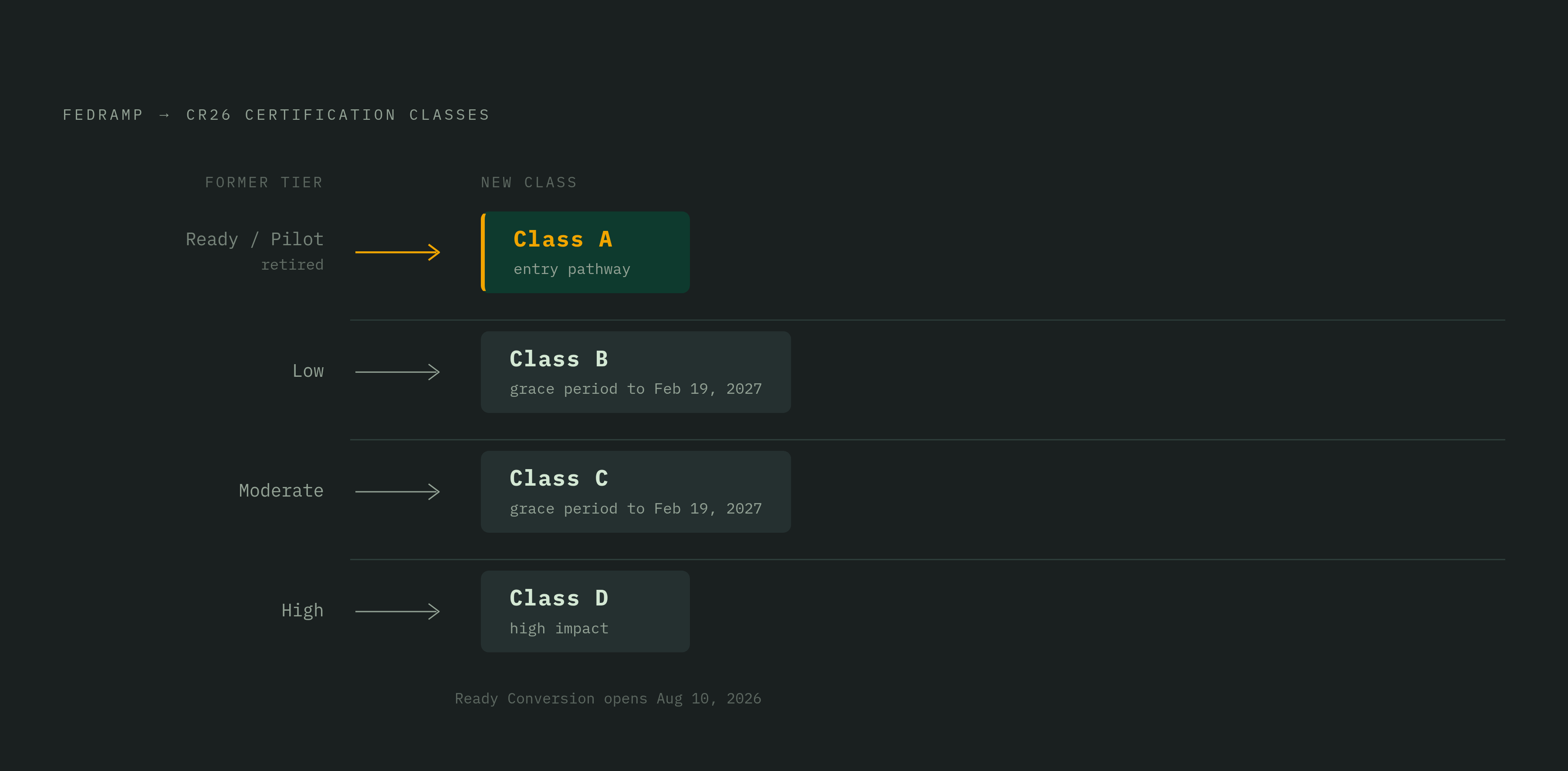
The terminology shift at FedRAMP names what changed underneath: the program now operates by different rules than before. "FedRAMP Authorization" is now "FedRAMP Certification." Low, Moderate, and High impact levels become Certification Classes B through D, with a new Class A replacing the old FedRAMP Ready and Pilot tier. These aren't cosmetic renamings done for branding purposes. They reflect a program that now treats its own rules as code: the FedRAMP Consolidated Rules live in a machine-readable repository on GitHub, and that version is the authoritative program text, ahead of the human-readable reference document. A compliance program that version-controls its own rulebook is telling providers something about how it expects them to operate going forward. Providers who read CR26 as an update to a PDF will miss what the program itself has become.
The Shift from Authorization to Certification
The move from authorization to certification changes how a provider gets listed on the FedRAMP Marketplace, and it changes how agencies decide whom to trust. A provider that treats CR26 as a paperwork update risks losing business even where its underlying controls remain sound, because the people making procurement decisions are learning a new vocabulary and a new set of signals at the same time providers are adjusting their own packages.
FedRAMP Ready is being retired. A Ready Conversion pathway opens on August 10, 2026, for providers that held FedRAMP Ready status before July 28, 2026, with a grace period that runs until February 19, 2027, available to Class B or Class C applicants under specific conditions. If you're sitting on Ready status, you need to map yourself into this new structure deliberately; the transition won't happen on its own. Certification Classes carry information about the amount and fidelity of evidence in a certification package. If a provider moves to a lower class to save money, it may unintentionally signal reduced assurance to procurement officials who had previously understood that provider at a higher posture, even when nothing about its actual controls changed. That's a commercial risk as much as a technical one, and it sits squarely with whoever owns the certification decision inside the organization.
Faster certification timelines do not guarantee faster agency acceptance. Relying parties, the agencies and procurement officials who depend on FedRAMP's judgments to make their own purchasing decisions, have to learn the new class system before they can rely on it with confidence. Until that education catches up, providers face a near-term revenue risk that has nothing to do with the strength of their security program and everything to do with how well the market understands the new labels. The fact that FedRAMP maintains its rules as a versioned GitHub repository reinforces where this is headed: a compliance program built like software, tracked, updated, and consumed programmatically rather than read once a year. If your processes still max out at reading a PDF once a year, you'll end up structurally behind competitors who watch compliance status continuously.
Key Security Indicators and Machine-Readable Evidence
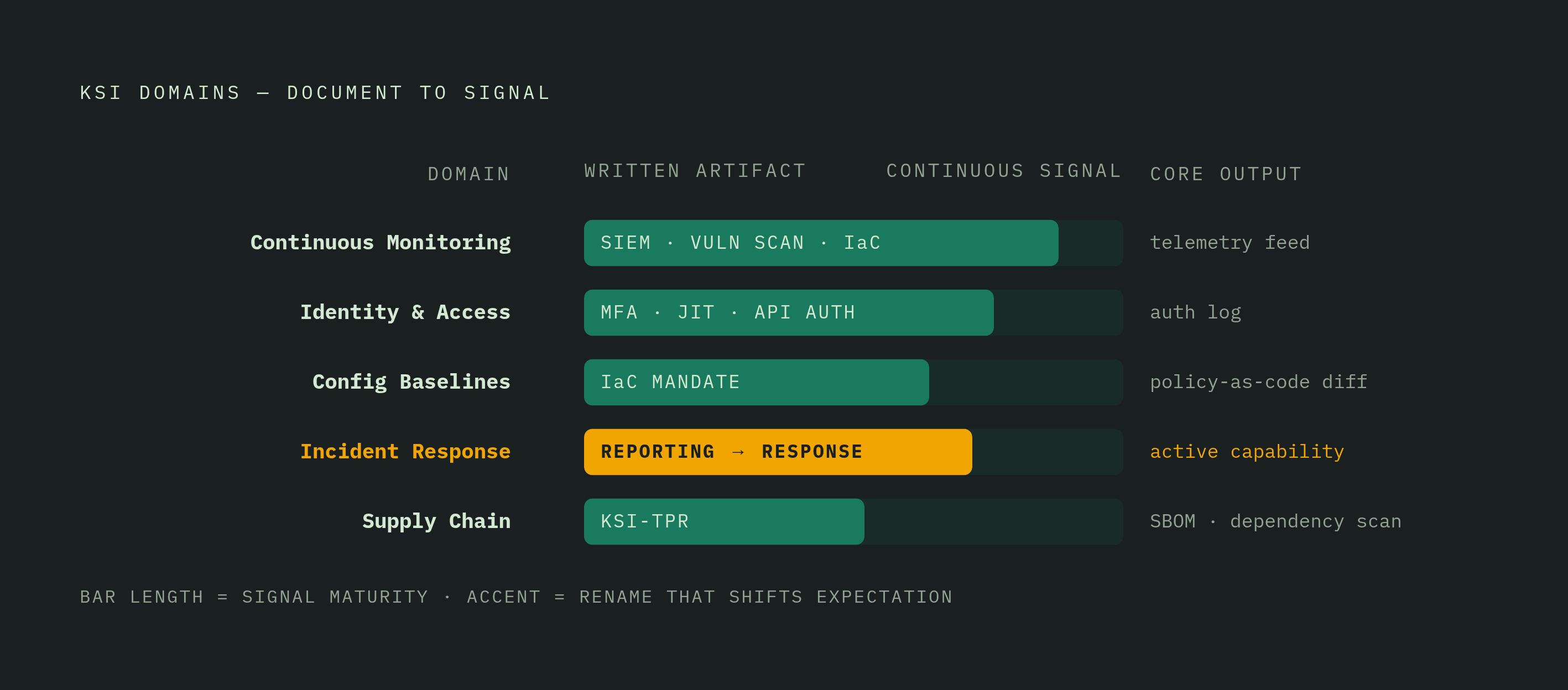
Key Security Indicators, or KSIs, are what make continuous authorization possible. Under FedRAMP's continuous-authorization model, KSIs replace the old prescriptive narrative compliance artifacts, the long written explanations of how a control gets satisfied; instead you get signals that can often be derived automatically from technical configuration and resolved to a simple true or false. Some KSIs still rely on documented or human-attested validation, so not every signal collapses into a boolean. But the shift in center of gravity is unmistakable: the compliance check becomes an engineering output, produced by the systems themselves, rather than a document written about the systems after the fact.
KSIs span five domains. You need SIEM coverage, authenticated vulnerability scanning, and infrastructure-as-code and configuration scanning running as a matter of course to meet Continuous Monitoring and Vulnerability Management. Identity and Access Controls calls for phishing-resistant multi-factor authentication, secure API authentication, and least-privilege, just-in-time access rather than standing permissions. Configuration Management and Secure Baselines points providers toward a recommended secure configuration standard, but one published RFC goes further and rewrites a KSI as a direct infrastructure-as-code mandate rather than a recommendation. Incident Detection and Response has been relabeled by a published RFC: KSI-INR changes from "Incident Reporting" to "Incident Response," and that rename carries weight, because it shifts the expectation from documenting an annual incident response plan to demonstrating continuous, active response capability. Supply Chain and Dependency Integrity, governed by KSI-TPR, covers third-party information resource management, and proof here is especially hard to construct after the fact if a provider hasn't built it in from the start.
Each of these domains produces a signal that has to stay continuously true, a check the system itself re-verifies rather than a checkbox marked once and forgotten until the next audit cycle. That distinction is the whole point of the model, and it's why the underlying NIST SP 800-53 Rev5 controls haven't gone anywhere: KSIs change how those controls get assessed, not which controls apply. If a team assumes the new path erases control obligations, that assumption will cost them. OSCAL, the Open Security Controls Assessment Language, is the primary machine-readable format for Rev5 authorization packages, and a published RFC now sets a hard deadline: Rev5 holders have to deliver their packages in that machine-readable form. FedRAMP's own Phase 1 recap found that a fully open pilot with minimal guardrails led providers to widely varying approaches, and those providers had to pull engineering teams in heavily to make the model work. Compliance teams can't produce KSI-compliant evidence streams on their own if they work in isolation. The evidence has to come from the systems that compliance teams were previously just writing about.
Continuous ConMon Under CR26 and Periodic Scan-and-Document Workflows
Continuous compliance under CR26 is a different operating model from the old continuous monitoring cycle, one that assigns named ownership to every detected vulnerability, demands near-real-time actionable data rather than monthly snapshots, and requires risk acceptance decisions to carry expiration dates rather than sitting open indefinitely. Teams running quarterly spreadsheet reviews are structurally non-compliant under this model, regardless of how diligent those reviews are, because the cadence itself no longer matches what the framework expects.
The escalation mechanics make the stakes concrete. Under the legacy Rev5 model, a missed monthly package, an overdue high-severity finding, or an unapproved change triggers a defined path: a Detailed Finding Report, then a Corrective Action Plan, then suspension, and ultimately revocation. CR26's risk-based vulnerability management model complicates the old approach further by weighing exploitability, reachability, known active exploitation, potential agency impact, criticality, detectability, prevalence, and privilege together. A flat severity score that simply drives teams to chase patch counts no longer meets the bar, because it ignores most of the factors the new model actually weighs.
Drift compounds the exposure. Under CR26, significant changes to a CSP's environment require advance notification to the agency, and uncontrolled drift, where production quietly diverges from its approved baseline, can trigger notification obligations nobody planned for and open a gap in the authorized baseline that an assessor will eventually find. Five areas define the continuous compliance program, and each needs a named owner: reporting, vulnerability detection, remediation, significant change management, and reassessment. To run all five at the scale CR26 expects, you need a DevSecOps owner working alongside governance, risk, and compliance staff, with engineering as a core partner rather than an occasional helper to a GRC team operating by itself. The failure mode that CR26 exposes is organizational as much as technical: security, compliance, engineering, and operations teams that still work in separate lanes will see that separation appear as a compliance deficiency in audits, because the evidence the framework wants can only be produced when those functions operate as one pipeline.
Software Supply Chain Integrity as a Binary Gate, Not a Best Practice
Supply chain integrity has become a binary go/no-go condition for federal procurement under KSI-TPR and the current SBOM policy landscape, a mandatory part of the initial package rather than a deliverable added later. The January 2026 policy shift adds a wrinkle: teams now have to track per-agency SBOM requirements rather than work against a single government-wide mandate. Federal policy as of January 2026 no longer requires agencies to obtain software security attestations from vendors as a blanket rule. Agencies can choose to require SBOMs based on their own risk assessments. For a vendor selling across multiple agencies, that creates fragmentation that has to be actively managed rather than solved once and filed away.
The technical bar that remains constant across this fragmented policy landscape is build-time provenance. An SBOM has to be produced as part of every build, signed, and attached to the artifact it describes. SBOMs reconstructed later from production scans miss build-time context that matters, including transitive dependency resolution and the compiler flags in effect at build time. Federal guidance itself notes that retroactively generated SBOMs may not reproduce the same dependency list that existed at build time, and it flags that gap as an operational constraint federal acquirers should weigh when evaluating a vendor's package. KSI-TPR governs third-party information resource management specifically, and automated proof under that indicator is hard to retrofit onto a system that wasn't built to produce it. Vendors carrying complex dependency stacks have reason to start mapping those stacks now, well before any certification pipeline opens, because mapping dependencies after the fact is slower and less reliable than capturing them as a build runs.
The fix that satisfies this requirement follows directly from how it's written: SBOM generation has to be native to the build pipeline rather than a scan run after deployment. A declarative environment manifest that pins every dependency at definition time, and carries a hash derived from its own inputs, produces a build-time SBOM as a structural byproduct of the build itself, generated automatically rather than assembled afterward to satisfy an auditor.
Environment Drift as a Compliance Failure Under the New Continuous-Evidence Model
Under CR26's continuous-evidence model, any uncontrolled divergence between what was approved and what is actually running, at any layer from a developer's laptop through CI into production, opens a gap in the evidence record that can't be closed retroactively. That's a sharper standard than most teams have operated under, because it means the evidence trail has to hold together continuously rather than just at the moment an assessor happens to look.
Drift appears in an audit in at least three forms that matter. Configuration drift happens when a running system deviates from its declared baseline, and that can trigger the advance-notification obligations described earlier. Dependency drift happens when a package version differs between a developer's environment and the CI environment that builds the production artifact, which invalidates the build-time provenance a vendor needs for its SBOM. Architectural drift happens when, say, a development machine running on one processor architecture builds artifacts that differ subtly from what production runs on another, and you often don't see the mismatch until a late-stage CI failure hits at the moment of deployment.
Two architectural patterns close these gaps structurally rather than procedurally. Immutable infrastructure eliminates post-deployment configuration drift by design: components are never modified in place after deployment, they're replaced with new versions, and each replacement becomes a traceable, auditable event instead of an undocumented change buried in a running system. GitOps enforces environment parity by making Git the single source of truth for both infrastructure and application configuration; changes committed to Git trigger the pipelines that reconcile desired state against deployed state, so deviations get caught continuously instead of turning up during an assessment months later. A declarative environment manifest, where every package, version, and configuration parameter is pinned in a human-readable file committed to version control, makes the approved baseline auditable at every stage of the software development lifecycle. If you attach a hash derived from that manifest's own inputs to each environment version, assessors and agency Authorizing Officials get a direct, verifiable link between what was approved and what is actually deployed, one that supports rapid CVE discovery and hash-level blocking without anyone having to grep logs or rescan container images by hand.
A CI/CD Pipeline for Continuous Compliance Evidence
A pipeline built for the FedRAMP continuous-evidence model treats its compliance artifacts, SBOMs, provenance attestations, scan reports, image digests, and signatures, as first-class outputs of every single build, generated continuously rather than assembled in the week before an audit. That reframing is the practical center of everything the sections above describe: KSIs, drift control, and supply chain provenance all converge on a pipeline that produces proof as a byproduct of normal operation.
Ephemeral build runners work as a security control and a compliance control at the same time. Every build runs in a clean, short-lived environment with no state left over from the previous run, which removes an entire category of drift where a contaminated runner quietly produces artifacts that don't match what a clean environment would have built. Paired with a declarative environment manifest and an input-derived hash attached to every build, this kind of pipeline gives a provider the pieces CR26 and KSI-TPR are asking for: a signed, build-time SBOM; a verifiable link between an approved baseline and what's actually deployed; and vulnerability and configuration signals that stay current because they're regenerated with every build rather than refreshed on a quarterly schedule. That's the structural difference between a team that can answer an assessor's question in real time and one still waiting for its next scheduled scan to come back.
Sources
- FedRAMP's Consolidated Rules for 2026: What It Means for Cloud Providers
- What's Changing - FedRAMP Consolidated Rules for 2026
- 2026 06 25 Propelling Change Fedramp Launches Consolidated Rules For 2026
- Initial Outcome from RFC-0020 FedRAMP Authorization Designations
- CIO - Cybersecurity Maturity Model Certification
- Key Security Indicators - FedRAMP Consolidated Rules for 2026