CI Pipeline Configuration for AI Agent Testing Workflows
Environment reproducibility must precede agent evaluation, or every test becomes noise.
An agent that passes its test suite on Tuesday and fails the identical suite on Wednesday has not necessarily gotten dumber. Most of the time, the model didn't change at all. What changed is the environment underneath it, and that distinction is the whole subject of this piece: configuring CI for AI agents means solving a reproducibility problem first, then building agent-specific testing on top of it. Skip the first step and every eval, guardrail, and dashboard built afterward is measuring noise.
What makes AI agent testing categorically different from classical CI testing
Classical CI answers yes-or-no questions. Does the build compile? Do the unit tests pass? Does the integration contract hold? These are deterministic signals against stable expectations, and when something fails, the fix is usually mechanical: revert a dependency bump, fix a broken assertion, patch a null check.
Agent CI has to answer a fuzzier question: did the agent do the right thing? Did it pick the correct tool, finish the task it was given, reason through a multi-step problem without going sideways halfway through? None of that is binary. It shows up as a score on a spectrum, and that score can move between runs even when nothing about the code changed. The metrics reflect this shift. Where classical CI tracks build time, pass rate, and code coverage, agent CI needs to track accuracy, context adherence, instruction adherence, tool selection quality, action completion rate, and reasoning coherence. A healthy agent pipeline doesn't just show green or red, it shows a trend line holding steady or climbing over time.
The artifacts change too. A system prompt isn't documentation sitting off to the side, it's a first-class piece of the system, arguably shaping behavior more than the model weights themselves do. That means it needs the same review discipline as application code: every prompt change goes through a pull request, and that PR triggers automated tests checking prompt injection resistance, output format adherence, and safety violations. One practitioner running this kind of setup reports 50 test scenarios per prompt version as a baseline, not an exception.
There's also a layer separation that classical CI never had to enforce. Agentic tools belong upstream, in drafting and planning: figuring out what to do, writing a first pass, proposing a plan. Deterministic frameworks like Playwright or Selenium own execution, actually clicking buttons and asserting on DOM state. Mix the two inside a single live run and the pipeline breaks in ways that are hard to debug, because you can no longer tell whether a failure came from the agent's judgment or from a flaky non-deterministic step masquerading as a deterministic one.
GitHub's Copilot Coding Agent, launched in May 2025, shows what this looks like when it's working. GitHub Actions kicks off the agent, triggered by an issue or a PR comment (schedule-based triggers exist too, through a separate automations feature). The agent reads the codebase, writes code, runs the test suite, and opens a PR. A human reviews it and merges if the tests pass. Three things had to converge to make that practical: models capable of handling multi-file changes and writing tests that actually pass reached sufficient reliability; CI platforms added native agent support with sandboxed, scoped-permission environments; and MCP servers gave agents a way to touch real infrastructure instead of just editing files in isolation.
This isn't a niche use case teams can defer. Gartner forecasts that by 2028, 33% of enterprise software applications will carry some form of agentic AI, up from under 1% in 2024. Teams setting up agent CI now aren't building for an edge case, they're building for what's about to be the default.
Reproducible environments as the non-negotiable foundation
Here's the part most teams underrate. A study by Siddiq et al. in November 2025 found that 21% of LLM-for-software-engineering artifacts were unreproducible, and the cause wasn't exotic: missing machine-readable dependency lists, missing container specs. That figure covers teams who were actively trying to be reproducible and still fell short. In hosted CI environments specifically, the most common source of drift isn't even a code change, it's a manual console tweak that never made it back into infrastructure-as-code.
Reproducible, in practice, means three things. Every dependency, runtime, toolchain, and library has to be pinned and declared rather than resolved at build time from a registry that can change under you. The environment has to be reconstructable from one source of truth, not a Dockerfile plus a README caveat plus whatever the last engineer remembers doing by hand. Flox, for instance, captures that single source of truth in a manifest.toml that pins the same dependencies across laptops, CI, and production. And isolation has to be enforced so state left behind by a previous run can't quietly contaminate the current one.
Functional package managers like Nix and Guix are built around exactly this problem. Every environment is synthesized as a pure function of explicitly declared, transitively hashed inputs, and isolation gets enforced at the kernel level, so there's no ambient leakage between builds. Devbox makes the Nix interface usable day to day: a devbox.json file that feels roughly like an npm or yarn config, but under the hood it's Nix providing the hermetic, reproducible environment guarantees that raw Nix is built around. Tooling that automates environment activation per directory can further cut out manual shell steps and remove one more place for drift to sneak in.
Containers do complementary work. Writing the build configuration into a Dockerfile makes the environment version-controlled, auditable, and reconstructable with a single command, and it fixes dependency versions, compiler toolchains, and library configurations so a laptop and a CI runner stop disagreeing with each other. But containers alone don't close the gap if the image build itself isn't deterministic. In a study of 5,298 Docker builds, only 6.4% of rebuilt images matched the original installed package versions exactly. That means pinning still has to happen inside the Dockerfile itself, containers are not a substitute for that discipline, they're a delivery mechanism for it.
"Works on my machine" isn't a developer failing to be careful. It's an infrastructure gap, and it's one that reproducible tooling closes systematically rather than through more vigilance. This matters especially for cross-architecture work: an agent that passes on a developer's ARM Mac and fails on an x86 CI runner has an environment problem, not a reasoning problem, and treating it as the latter wastes time chasing a bug that doesn't exist in the agent's logic at all.
The stakes are sharper for ML workloads specifically. Environment changes alone, same code, different container or hardware, have produced test-accuracy drift greater than 6% for binary classifiers and greater than 8% for LSTM models. That's drift with zero changes to the model or the code. Any team debugging agent flakiness by staring at prompts before ruling out the environment is very likely debugging the wrong layer.
Structuring the CI pipeline around agent-specific testing layers
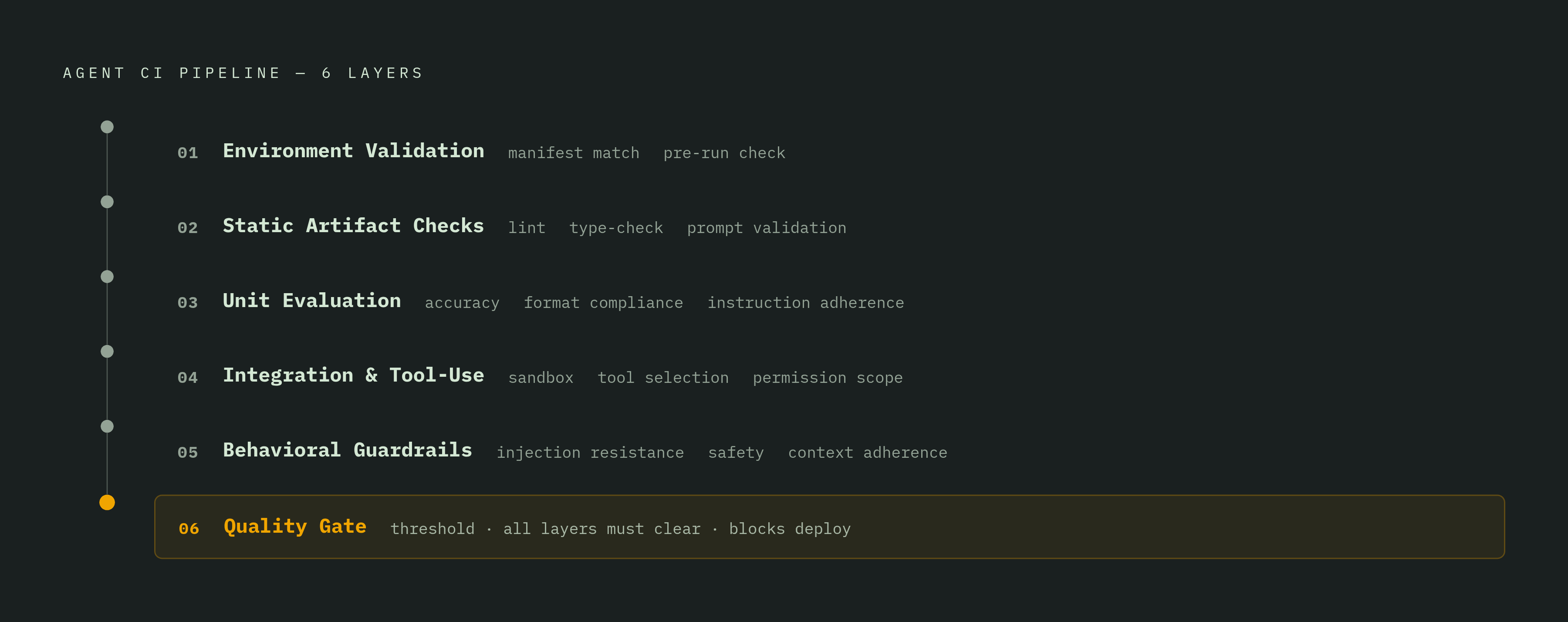
Once the environment is solid, the pipeline itself needs structure, and that structure is sequential rather than flat. Layer one confirms the environment matches what the manifest declares, before any agent code runs at all; a mismatch here invalidates everything downstream. Layer two handles static artifact checks: lint, type-check, and validate prompt files and configuration schemas the same way you'd validate application code, because that's what they are now.
Layer three is unit-level agent evaluation, running the agent against a fixed set of inputs with known expected outputs and measuring accuracy, instruction adherence, and format compliance. Layer four moves into integration and tool-use validation inside a sandbox, with real or realistic tool calls, checking tool selection quality, action completion, and whether the agent stayed inside its granted permissions. Layer five is behavioral guardrails: prompt injection resistance, safety violations, context adherence, run as regression tests on the agent's behavior rather than functional tests on application logic. Layer six is the quality gate, where a threshold-based check, or a Quality Decision Agent, evaluates whether the accumulated scores clear the bar before anything gets approved for deployment.
The layer-separation principle from earlier applies structurally here too. Agentic tools handle analysis, planning, and drafting upstream of the pipeline; deterministic frameworks own execution inside it. Execution Orchestration Agents can coordinate test runs across environments, allocate resources, and manage parallel workflows, but that coordination role sits at layer four and above, not inside the deterministic execution step itself.
Every deployment cycle should add new golden-flow cases into layer three. It's a small habit, but it steadily shrinks the surface area where a regression can slip through unnoticed. Automated quality benchmarking on every build then supports regression testing, model comparison, and A/B testing of production configurations, with results gating or approving deployment against thresholds set in advance rather than judged case by case.
Trust builds in stages, and the pipeline should reflect that rather than pretending otherwise. Teams new to agentic CI should start at what's sometimes called the Draft level: the agent opens PRs, and a human approves every single merge. Specific workflow types graduate toward auto-merge only as confidence in their scores accumulates. Concrete examples make the scope tangible. Bug triage: the agent reads an issue, finds the relevant code, writes a fix and a test, opens a PR, and a human reviews the judgment call while the routine debugging grunt work gets handled without anyone touching a keyboard. Dependency updates: the agent runs the package manager, bumps minor and patch versions, runs the test suite, and opens a PR with a changelog, replacing the brittle, context-blind Dependabot-style PR with something that actually batches changes sensibly. Documentation: when a PR modifying an API endpoint merges, the agent reads the diff, updates the docs, and opens a follow-up PR, tying the doc change causally to the code change that caused it.
Supply chain security and provenance requirements specific to agent pipelines
Agent pipelines consume packages at every layer, runtime dependencies, tool integrations, MCP servers, and the threat landscape around that consumption has gotten worse, not better. Sonatype identified over 454,600 new malicious packages in 2025 alone, pushing the cumulative count past 1.2 million.
Several 2025 and 2026 incidents land directly on the agent CI attack surface. The GhostAction GitHub Actions compromise in March 2025 exfiltrated CI/CD secrets by injecting malicious workflows through compromised GitHub user accounts, and agent workflows triggered on issues or PR comments sit exposed to that exact same path. The Shai-Hulud npm worm, also September 2025, self-replicated across more than 200 packages and over 500 package versions autonomously, which makes any agent that updates dependencies as a routine CI task a direct target rather than a bystander. Separately, over 800 malicious npm packages tied to the Lazarus Group targeted developer credentials, meaning credential theft through the package-install step is a live risk in any agent-driven dependency update workflow. Into 2026, compromises touching Trivy, LiteLLM, and Axios hit security tooling, an LLM gateway library relevant directly to agent pipelines, and a widely used HTTP dependency, respectively.
The scope of what "securing the supply chain" even means has expanded accordingly. It now covers source code and dependencies, build pipelines, binary artifacts, AI model weights and their provenance under what's being called MLSecOps, and the MCP servers that govern what data an agent can actually reach.
SBOMs are the operational answer teams are converging on. Gartner had projected that 60% of organizations building or buying critical infrastructure software would mandate SBOMs by 2025, and adoption has broadly tracked that pace. The practical payoff shows up when a critical vulnerability drops: organizations with SBOMs in place can identify affected applications far faster than those without them, who must do the same forensic work by hand. In an agent pipeline touching production data through MCP integrations, that gap in response time is the difference between a contained incident and an open one. SBOM entries get more useful when enriched with repository URLs, commit SHAs, and build provenance attestations through frameworks like in-toto and SLSA, giving a real trace from binary back to source. VEX documents layered on top, with AI assisting in judging likely exploitability given the actual environment and code reachability, cut down on the noise of vulnerabilities that technically exist but can't actually be triggered.
For teams already running GitHub Actions or GitLab CI, the path in isn't as long as it sounds. SLSA Level 2 provenance generation paired with Sigstore signing is achievable with a relatively small amount of engineering work. The SLSA GitHub Generator gets a project most of the way to Level 3 build provenance on GitHub Actions, though hitting every SLSA Level 3 requirement takes additional work beyond just running the generator. Policy enforcement, configuring admission controllers to require provenance verification before anything deploys, adds additional work on top of that.
Open standards matter here beyond technical correctness: CycloneDX and SPDX for the SBOM format itself, in-toto and SLSA for provenance, VEX for exploitability, all chosen specifically to avoid vendor lock-in and to give customers and regulators evidence they can actually check independently. And the timeline for adopting all this isn't really optional anymore. U.S. Executive Order 14028, the EU Cyber Resilience Act, and CMMC 2.0 are turning SBOM and provenance requirements from a nice-to-have into a contractual one. Teams building agent CI today should bake provenance into the workflow from day one, because retrofitting it later, once the pipeline is already load-bearing, is a much harder job.
Observability and behavioral guardrails that make agent failures actionable
Build logs, pass/fail results, coverage reports: none of that tells you whether the agent behaved correctly. A perfect pass rate on deterministic tests can sit right next to an agent that picked the wrong tool three times and got lucky on the outcome. Classical observability is necessary here, it's just nowhere near sufficient.
Agent-specific observability starts with tracing every run in structured form, not free text: inputs, tool calls made, tool calls declined, outputs, and the reasoning steps connecting them. Those metrics, accuracy, context adherence, instruction adherence, tool selection quality, action completion rate, reasoning coherence, need to be tracked as time series across builds, not as one-off snapshots. Alerting has to catch score degradation across builds too. A slow decline in instruction adherence is a real regression signal even if no individual run ever crosses a hard failure threshold, and a pipeline that only watches for outright failures will miss it entirely.
Behavioral guardrails function as automated regression tests sitting alongside the functional ones. Prompt injection resistance checks confirm the agent doesn't execute instructions smuggled in through user-controlled input. Output format adherence checks confirm the agent still produces its declared schema, and format drift can be an early visible symptom that something changed upstream, in the model or the environment. Safety violation checks confirm the agent isn't generating content or actions that break declared policy. Permission boundary enforcement checks confirm, per run rather than just by configuration, that the agent isn't reaching for secrets, pushing to protected branches, or calling tools outside its granted scope.
Observability needs differ by trust level too. At the Draft stage, where a human reviews every PR, observability exists mainly as a signal for that reviewer: which eval scores backed the agent's output, and which ones flagged something worth a second look before anyone hits merge.