Multi-Agent Workflow Orchestration in Local Development
Fix your environment first, or multi-agent orchestration will fail.
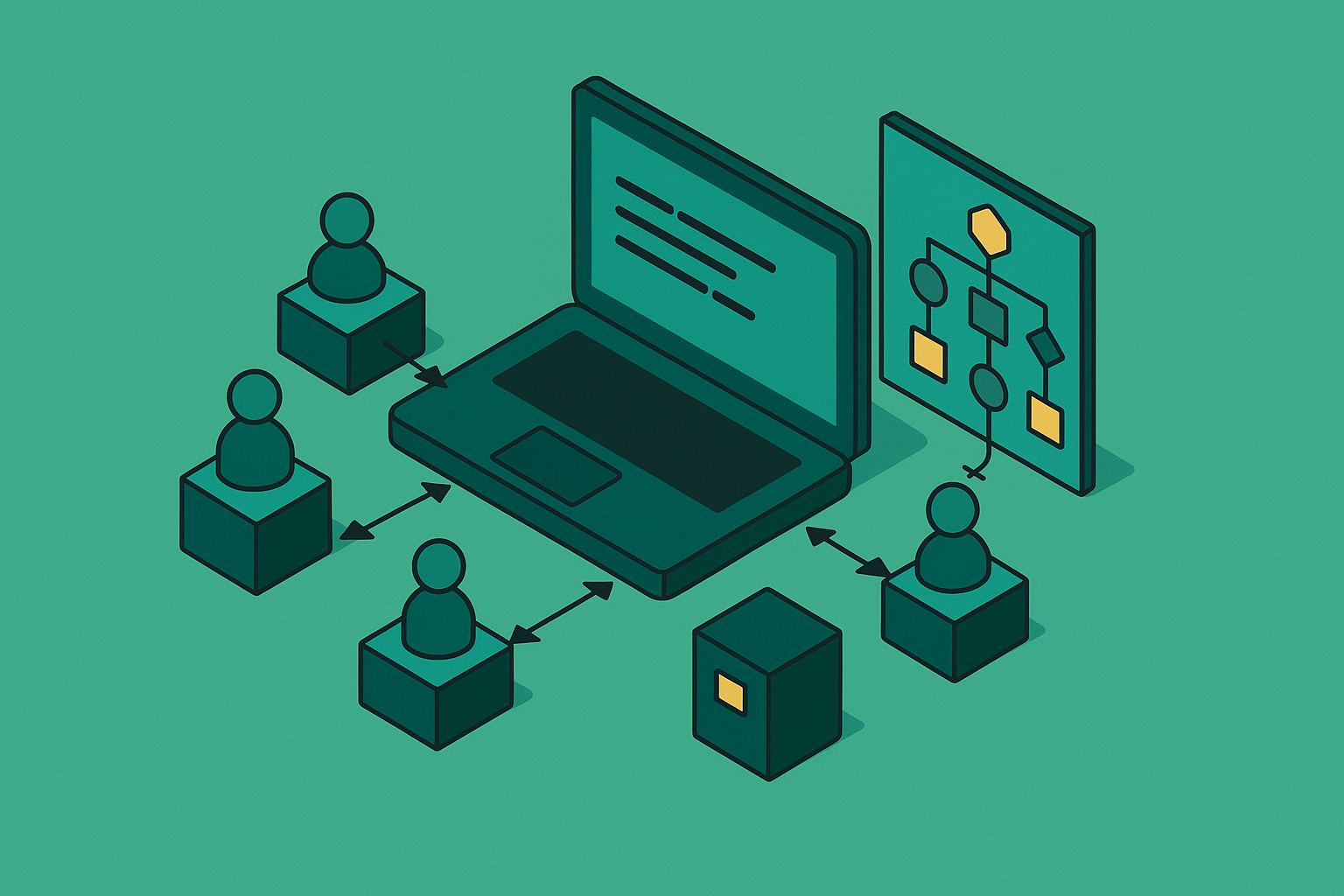
Multi-agent workflows have become the default way developers stitch AI tools together locally, and that shift is exposing a hard truth: the errors that break these systems rarely come from bad model reasoning. They come from environments that were inconsistent from the start. Most teams try to solve coordination before they've solved the environment underneath it, and that's backward. It's the single biggest reason these setups fail in practice, not a minor process quibble, and the industry keeps treating it like a footnote instead of the root cause.
How uncoordinated environments turn agent errors into systemic failures
Error propagation and state drift get talked about like agent logic problems. They aren't, mostly. They're environment problems wearing agent logic as a disguise.
Think about what "environment" actually covers in a multi-agent pipeline. It's the package versions each agent subprocess resolves at runtime. It's the compilers, runtimes, and native libraries that may or may not match across developer machines. It's whether an MCP server or CLI tool the orchestrator assumes exists is actually reachable from a sub-agent's shell. It's file paths, environment variables, and secrets, anything an agent pulls from ambient context instead of receiving as a direct input.
Drift creeps in through completely ordinary paths. One developer updates a package on their laptop. A teammate hasn't pulled that change yet. A CI runner is still working off a container image pinned from last month. The "same" agent, running the "same" task, now behaves three different ways depending on which machine picked it up. Research on LLM-for-software-engineering artifacts (Siddiq et al.) found that missing machine-readable dependency lists, container specs, or explicit system details led to unreproducibility in roughly 21% of cases, and that's before chaining agents together. Chain four or five agents together and the exposure compounds.
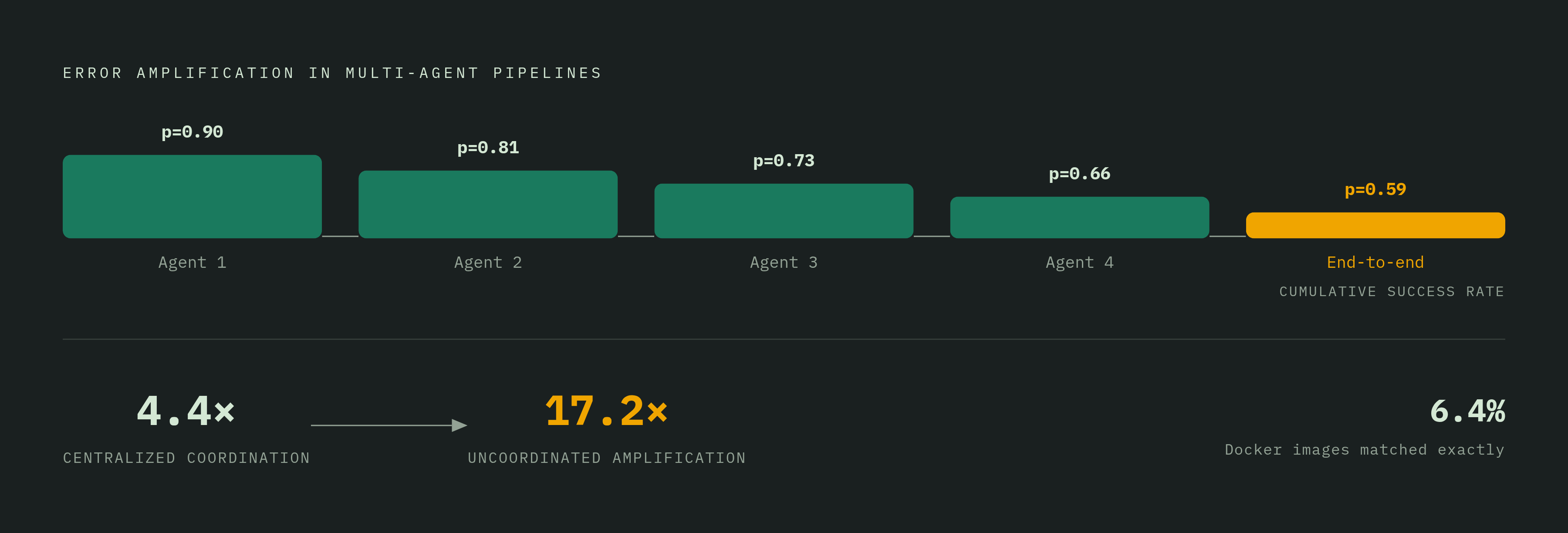
It gets worse at the container level, which is supposed to be the fix for exactly this problem. A reproducibility study (Malka et al.) found that only 6.4% of rebuilt Docker images matched the original set of installed package versions exactly. The tool most teams lean on for consistency is, under standard practice, mostly not reproducible at all. Containers get treated as a solved problem when the data says otherwise, and that gap is worth sitting with before blaming anything downstream.
Run the math on a four-agent pipeline where each agent has even a small chance of behaving differently than expected because of environment mismatch. Reliability doesn't degrade by addition, it degrades by multiplication. Reliability doesn't degrade by addition across a multi-step pipeline, it compounds, and a chain of individually plausible failure rates can produce a much weaker end-to-end result than any single step suggests.
State drift shows up alongside this, related but distinct. Agents writing to shared files, databases, or registries can quietly corrupt each other's working state if their underlying tool versions parse or format that shared output differently. No amount of clever orchestration design fixes this if the ground underneath the agents keeps shifting.
What reproducible environments actually guarantee, and what they leave to orchestration
A properly reproducible environment gives a workflow four things it can't get any other way. Every agent subprocess resolves the identical dependency graph no matter which machine runs it. Tool availability gets declared and hashed up front, not assumed from whatever happens to sit on the host's PATH. Environment variables and secrets arrive as explicit, traceable inputs rather than inherited ambient state. And the environment a developer tested against locally is the exact one CI uses and the exact one a collaborator gets, with no "works on my machine" excuse left standing.
Functional package management, the Nix-based end of the spectrum, is the strict version of this idea: every build is a pure function of explicitly declared, transitively hashed inputs, and isolation gets enforced at the kernel level so nothing ambient leaks in. That's a mechanism, not a best practice someone wrote in a wiki. Tools like Devbox put that mechanism into a form a working team can actually use day to day, offering per-project isolated environments, the same shell locally and in CI, and the same behavior whether someone's on a local machine or a CI runner. That isolation means switching between projects stops leaking configuration from one into another.
None of this touches orchestration, though, and the boundary needs to be stated clearly. A reproducible environment says nothing about which agent gets which task, that's topology. It says nothing about how agents hand state to one another, that's protocol design. It has no opinion on what happens when an agent returns malformed output, that's error recovery. And it does nothing for a workflow that gets interrupted halfway through and needs to resume rather than restart from zero, that's checkpointing.
Reproducible environments are the foundation. Orchestration is the structure built on top. Building the structure first, then trying to backfill environment consistency, is the single most common way local multi-agent setups fail, and it's entirely self-inflicted.
The orchestration patterns developers are actually using in 2026
Four coordination models dominate current practice, and each one breaks in its own particular way once pushed past what it's actually suited for.
Directed graph or state machine setups, LangGraph being the clearest example, treat agents and functions as nodes with conditional edges routing based on current state. The cyclic capability matters here: it lets a workflow loop, retry, and reason step by step in ways a strictly linear pipeline can't. LangGraph reached general availability on October 22, 2025, with checkpointing at every step and Postgres-backed persistence supporting resumption across sessions. Setup overhead runs highest here, but it's the right fit for regulated or auditable work where every state change needs a paper trail.
Role-based crews, the CrewAI model, assign agents named roles, goals, backstories, and specific tool sets, then run them one after another or hierarchically. The mental model maps cleanly onto how a human team is organized, which lowers the setup cost considerably, though the control flow is less predictable than a state graph.
Hierarchical tree structures, exemplified by Google's ADK, have a root orchestrator delegate to sub-agents, each of which can coordinate agents beneath it, with every agent answering to exactly one parent. ADK supports the Agent2Agent protocol for cross-framework communication over HTTP and JSON-RPC, which makes it strong for structured delegation, if less flexible when task graphs need to shift shape on the fly.
On-demand specialization, the approach behind AOrchestra, skips fixed roles entirely. The orchestrator models any agent as a four-part tuple, instruction, context, tools, and model, and builds a tailored sub-agent at runtime rather than picking from a static roster. That sidesteps the coverage gaps that predefined agent sets create when a task doesn't match any of the roles someone thought to define in advance. AOrchestra reported a 16.28% relative improvement over the strongest baseline across GAIA, SWE-Bench, and Terminal-Bench.
MetaGPT and OWL make the underlying tension visible from two different angles. MetaGPT locks in structured software-development roles with predefined communication protocols. OWL's WORKFORCE framework separates domain-agnostic planning from domain-specific execution. Both show that orchestration topology encodes assumptions about how a task is shaped, and those assumptions break the moment a real task doesn't match the mold.
The pattern that actually separates a working system from a demo, across all four models, is durable state. A five-step workflow that loses its context at step four needs to resume from step four. Restarting from scratch and re-paying the cost of four already-completed steps is a significant inefficiency. It's the difference between a system a team trusts and one it has to babysit.
There's a real architectural tension underneath all four patterns, and it deserves to be named directly: centralization wins here, at a cost. One research paper (arXiv, Dec 2025) put uncoordinated agent error amplification at 17.2x versus 4.4x under centralized coordination, so the case for a central orchestrator is not close. But centralizing control creates a single point that itself has to be reliable, and the orchestrator's own environment consistency now matters just as much as any individual agent's, arguably more, since every downstream agent inherits its mistakes.
MCP as the connective tissue between agents and the tools they need
The Model Context Protocol, introduced by Anthropic in late 2024, is an open standard built on JSON-RPC 2.0. An MCP server exposes a set of capabilities, tools, resources, prompts, and any MCP-compatible client can use them without custom, per-application integration work. Write the server once, and every client that speaks the protocol gets to use it.
The comparison people reach for is the Language Server Protocol, the standard that let one language server work across every code editor instead of each editor needing its own bespoke integration. MCP does roughly the same job for the plumbing between agents and the outside systems they need to touch. MCP solves standardization, not capability. It doesn't make an agent smarter. It makes the wiring between agents and tools stop being bespoke, and that distinction is the whole point of the protocol.
Adoption has moved fast. By December 2025, Anthropic reported more than 97 million monthly SDK downloads across all supported languages and over 10,000 active MCP servers running in production. The protocol was donated to the Agentic AI Foundation under the Linux Foundation, backed by Anthropic, Block, OpenAI, AWS, Google, Microsoft, Bloomberg, and Cloudflare, a governance move that meaningfully lowers vendor lock-in risk for teams betting their tooling on it.
The practical payoff shows up in integration time, and the gap is not subtle. One reported case found that migrating from custom OpenAI function-call wrappers to a fully MCP-native setup cut deployment time for a new tool integration from three days down to eleven minutes. Integration work built on older web-service standards had been running three to five days of senior developer time per integration, before ongoing maintenance was even factored in. That gap alone should settle which approach a new project reaches for, and there isn't much of an argument left for the old way.
MCP also works, almost as a side effect, as an environment-consistency mechanism. When every agent in a local workflow reaches an external system through the same MCP server, tool behavior stops being a function of which agent happens to have which SDK version installed on its particular machine. The interface is standardized at the server, not scattered across every client's local setup.
That doesn't mean the problem is solved, though. Tool descriptions are the main semantic interface guiding a foundation model's behavior inside an MCP-enabled workflow, and poorly written MCP tool descriptions are a compounding source of agent error in their own right. A reproducible environment stabilizes the runtime underneath a tool call. It says nothing about whether the tool's description actually tells the model what the tool does, and that authorship work still falls on a person, not the protocol.
There's a security dimension too, and it deserves more weight than it usually gets. Governing which MCP servers an agent can reach, and what data those servers expose, is a supply chain security problem, not a convenience feature. Auth-propagation failures have been a consistently reported integration blocker in enterprise MCP adoption. Teams adopting MCP need to apply the same provenance thinking to the server layer that security teams already apply to software packages: know what a server does, know who maintains it, and don't assume a name in a config file is trustworthy by default.
Local developer tooling that puts orchestration within reach today
Orchestration frameworks handle the coordination logic. What's been missing, until recently, is tooling that makes the entire local loop, environment plus coordination plus visibility plus deployment, work without a team building all the scaffolding by hand.
Orcha, currently in open beta, is a desktop orchestration tool that coordinates Claude, Gemini, and Codex running in parallel. It offers visual workflows, automatic handoffs between agents, saved templates, and a PM agent that can set up an entire agent team from a plain-English description. It's aimed squarely at the five-open-terminals problem, the exact symptom developers run into when they're managing multiple agent sessions by hand with no shared view of what's finished and what's still waiting. It's free during the open beta.
Microsoft's AI Toolkit for VS Code, updated at Ignite 2025, offers a complete local setup for building, debugging, and deploying multi-agent workflows. A developer can work locally inside VS Code, switch over to the Foundry portal for visual orchestration, and deploy to Foundry in a single click. It includes a drag-and-drop visual workflow builder, workflow definitions in a structured format, and orchestration templates for sequential execution, human-in-the-loop steps, and group-chat style coordination. Tracing runs down to every agent call, every input and output, every variable assignment, and every branch the workflow took.
None of this replaces the environment layer, though, and Nix-based tooling like Devbox is what actually closes that gap: per-project isolated environments, the same shell locally and in CI, consistent behavior across operating systems. For CI systems built around containers, Devbox can build an image containing the exact shell defined locally, closing the local-to-CI gap that's one of the main sources of environment drift in multi-agent pipelines.
There's a protocol-pairing effect worth noting too. Organizations using MCP for data and tool access alongside A2A for multi-agent collaboration report workflow development running 40 to 60% faster than single-protocol approaches, according to a2a-mcp.org's analysis of 2026 adoption trends. That's a meaningful number for any team picking a local tooling stack right now.
None of these tools substitutes for environment rigor, though. Every orchestration tool listed here assumes a stable, consistent runtime sitting underneath it. Skip that layer, and a team inherits the exact failure modes described earlier, no matter how polished the coordination tooling looks on screen.
Applying environment-first thinking to a local multi-agent setup
The sequencing matters more than any individual tool choice. Stabilize the environment first. Design the coordination topology second. Add protocol integration third. Reversing that order is the most common cause of the failure modes covered at the start of this piece, and it's an easy mistake to make because coordination is the visible, exciting part of the work.
Declare the environment. Every dependency, runtime, and tool a workflow needs should be explicitly declared and hashed, not inferred from whatever happens to sit on the host machine. That declaration should live in a single artifact, used locally, in CI, and by every contributor alike, not a README with three paragraphs of caveats nobody reads. Nix-based approaches enforce this at the mechanism level. DevContainer-based approaches, using devcontainer.json, offer a portable alternative for teams already committed to container-based workflows.
Match the orchestration topology to the actual task structure. Linear pipelines with predictable handoffs suit sequential crews or simple directed graphs just fine. Tasks that need loops, retries, or step-by-step reasoning call for a cyclic graph model like LangGraph. Dynamic task graphs, where the variety of subtasks can't be predicted ahead of time, favor on-demand specialization. Cross-framework agent collaboration points toward hierarchical models with A2A support.
Standardize tool access through MCP. Replace per-agent custom integrations with shared MCP servers so tool behavior becomes a property of the server, not a property of whatever each agent's ambient environment happens to contain. Test auth propagation early and on purpose: it has been a consistently cited integration blocker in enterprise adoption for good reason. Treat every MCP server's provenance as a supply chain question: know what it does and who's responsible for it.
Build observability into the workflow, not bolted on afterward. Checkpoint state at every meaningful step so a workflow resumes instead of restarting from scratch. Trace every agent call, every input, every output, since visibility is what turns a failed run into something debuggable instead of a mystery nobody can reconstruct. And keep watching for drift over time: an environment that was reproducible on day one can quietly drift as upstream packages update, which means active maintenance, not a declaration made once and forgotten.
The parallel to software supply chain security is exact. SBOM generation moved from a one-time compliance snapshot to a continuous process running inside CI, because a static snapshot stops reflecting reality the moment anything upstream changes. Multi-agent environment declarations need the same continuous checking, not a setup step someone checks off once and never revisits.
Where local multi-agent orchestration is heading and what teams should do now
Gartner's projection that up to 40% of enterprise applications will include task-specific AI agents by 2026, up from under 5% in 2025, means the workflows developers are wiring together on laptops this year are the production systems next year's infrastructure teams inherit. That's a near-term handoff, not a distant forecast, and it changes what "good enough for now" is allowed to mean.
The trust gap already visible in the data backs this up. Stack Overflow's 2025 survey found 8 in 10 developers using AI tools daily, while only a third said they trusted what those tools produced. Read that gap as a coordination and environment failure rather than a model-quality complaint, because that's what the underlying mechanics actually show. Models are not the weak link in most of these breakdowns. Inconsistent environments and undisciplined handoffs are, and pinning the blame on the model lets the actual cause off the hook.
Teams building multi-agent workflows locally right now have a narrow window to get the sequencing right before these systems calcify into production dependencies nobody wants to touch. Environment first, topology second, protocol third, observability threaded through all of it, not layered on top once something breaks. Skip the first step, and every later step gets built on ground that was already unstable to begin with.
Sources
- Best Multi-agent Orchestration Frameworks in 2026
- Introducing Multi-Agent Workflows in Foundry Agent Service | Microsoft Foundry Blog
- Why Multi-Agent Orchestration Is the Future of Development and How Orcha Gets You There | by Muhammed Mukthar | Medium
- AOrchestra: Automating Sub-Agent Creation for Agentic Orchestration
- LangGraph Multi-Agent Orchestration: Complete Framework Guide + Architecture Analysis 2025
- blog.doubleslash.de
- blog.modelcontextprotocol.io
- ibm.com