When a Changelog Becomes an Instruction Set for Your AI Agent
AI agents reading operational artifacts need precise, structured data—not prose written for humans.
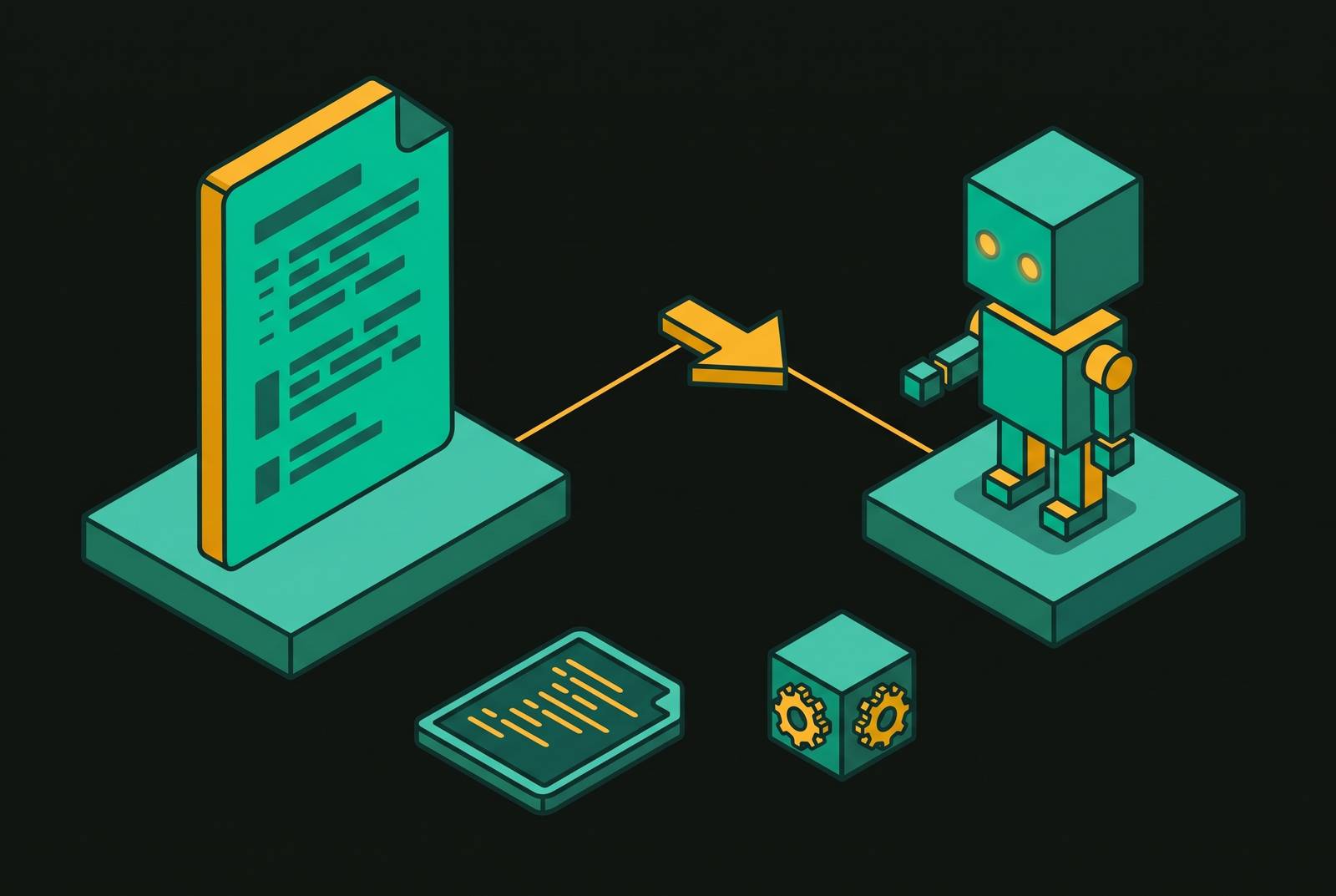
The article develops how this shift changes what 'good' environment and dependency documentation looks like when an AI agent is the primary reader.
Why structured artifacts have crossed from documentation into operation
Changelogs, lock files, manifests, and SBOMs used to exist for one kind of reader: a person, skimming, tolerating a little ambiguity because a human can fill in gaps with judgment. That assumption no longer holds. AI agents now read these artifacts directly and act on what they find: reading environment definitions to provision toolchains, parsing dependency histories to decide what to upgrade, consuming SBOMs to assess exposure. As agents take on real development work, changelogs, manifests, and lock files stop being documentation people occasionally check, and start being operational inputs agents act on directly. The care a team puts into authoring and versioning those artifacts now decides how reliably the agent behaves.
That is a different bar than "well-written." A changelog written for a person can be vague about why a version moved, because the person reading it brings context. An agent brings none of that unless the artifact supplies it. If an agent is the primary reader, what does good documentation actually look like, and what specifically breaks when it falls short? The rest of this piece works through that question, starting with the most basic failure mode: an artifact that no longer describes the thing it claims to describe.
How environment drift turns an agent's source of truth into a liability
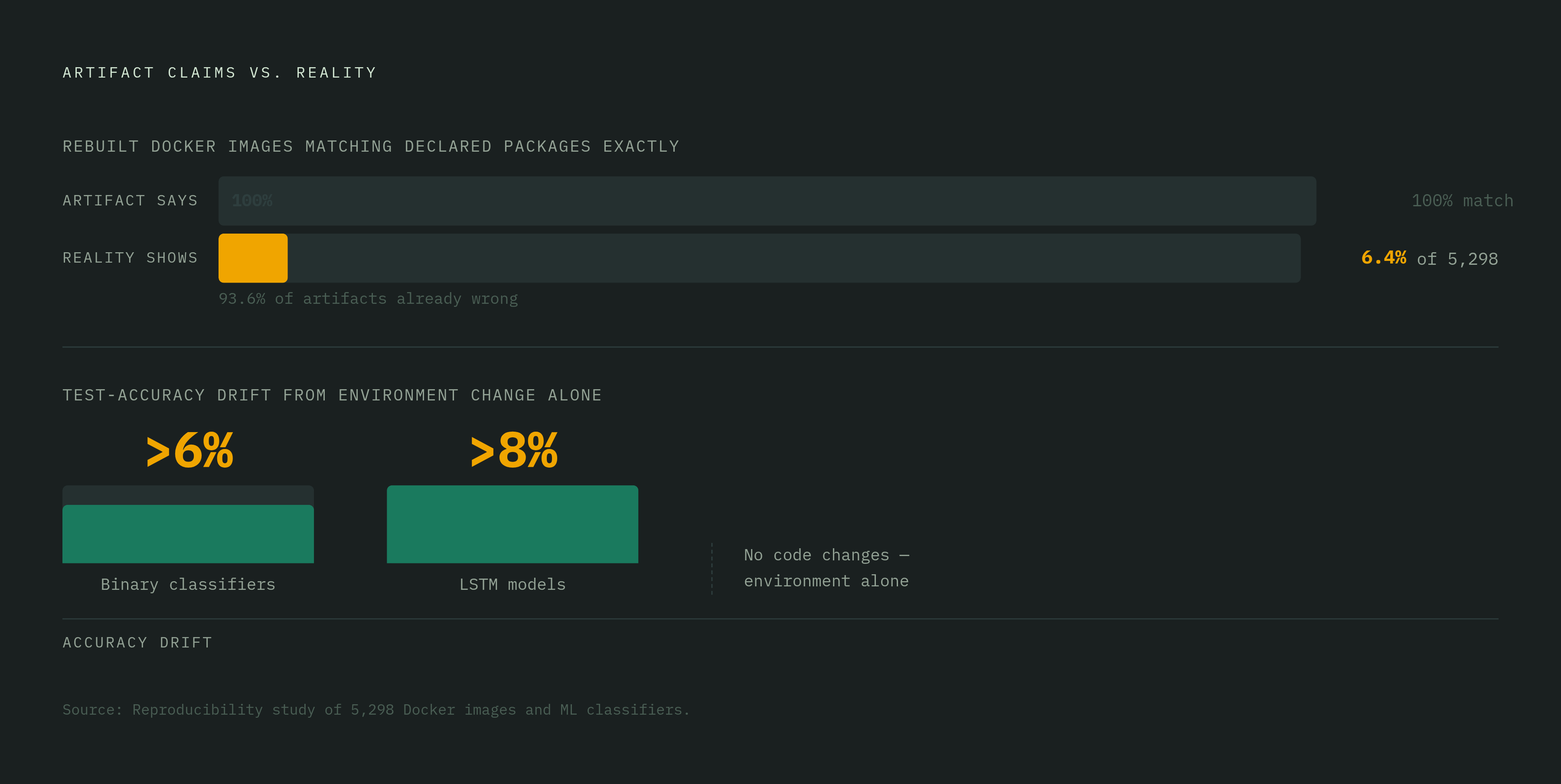
Start with the number that earns its place here. A study of 5,298 Docker builds found that only 6.4% of rebuilt images matched the original installed package versions exactly. The artifact an agent reads today, describing what's supposedly installed, fails to describe what actually ran yesterday in the overwhelming majority of cases. An agent making a decision off that artifact isn't reasoning about reality. It's reasoning about a fiction that happens to share a file format with reality.
The problem compounds once machine learning workloads enter the picture. Environment changes alone, no code changes at all, produced test-accuracy drift of over 6% for binary classifiers and over 8% for LSTM models. An agent evaluating a model, or worse, trained inside a drifted environment, can produce outputs that differ from what's expected, and nothing in the commit history will explain why. The code is identical. The environment underneath it moved.
The root cause is mundane but persistent: manual environment management creates two separate maintenance cycles, one for the environment, one for whatever documents it, and the second one falls behind the first as a matter of course. An agent reading the changelog is reading stale facts, and it has no way to know they're stale unless something explicitly tells it so. Closing that gap means treating environments as ephemeral, repeatable units defined by a file, rather than static machines someone configured by hand and then wrote a paragraph about afterward. An agent cannot compensate for drift it cannot see. The artifact is either authoritative because the environment is generated from it, or it's noise dressed up as a record.
What makes a lock file or manifest machine-readable for an agent
"Machine-readable" gets used loosely, so it splits into three levels that actually matter. The first is syntactic: a structured format like TOML, JSON, or YAML that an agent can ingest without first translating prose into data. That's the easy bar, and most modern tooling clears it by default.
The second level is semantic completeness, and this is where most artifacts quietly fail. Without a reason attached to the pin itself, an agent has to guess, or worse, treat every bump identically regardless of stakes.
The third level separates a real artifact from a description of one: operational authority. Is the file the canonical source the environment gets built from, or a summary written after the fact by someone trying to keep the wiki current? A declarative manifest, the kind where packages, versions, and environment hooks are explicitly declared in something like a manifest.toml, clears all three levels. A prose changelog almost never clears the third, because by definition it's describing a change that already happened somewhere else.
The tooling landscape in 2026 has converged hard on this idea. Nix flakes, Devbox, mise, and devcontainers all aim at the same target: a single command that reproduces the same environment on any machine. Devenv's 2.4 release, shipped September 24, 2026 and named "Machines," pushes further, letting a team define NixOS, nix-darwin, and home-manager configurations alongside the development environment in one devenv.nix file. That consolidation matters for agents specifically, because it means one file, not five scattered ones, holds the intended state. An agent needs to know not just what state exists right now, but what state was intended, and what changed since the last time someone (or something) checked.
How SBOMs become active agent inputs rather than compliance checkboxes
An SBOM, a software bill of materials, is a machine-readable inventory: every component, library, and dependency in a piece of software, with version numbers, origins, and licenses attached. For years it's functioned mostly as an audit artifact, something a compliance team asks for once and files away. That framing is already outdated.
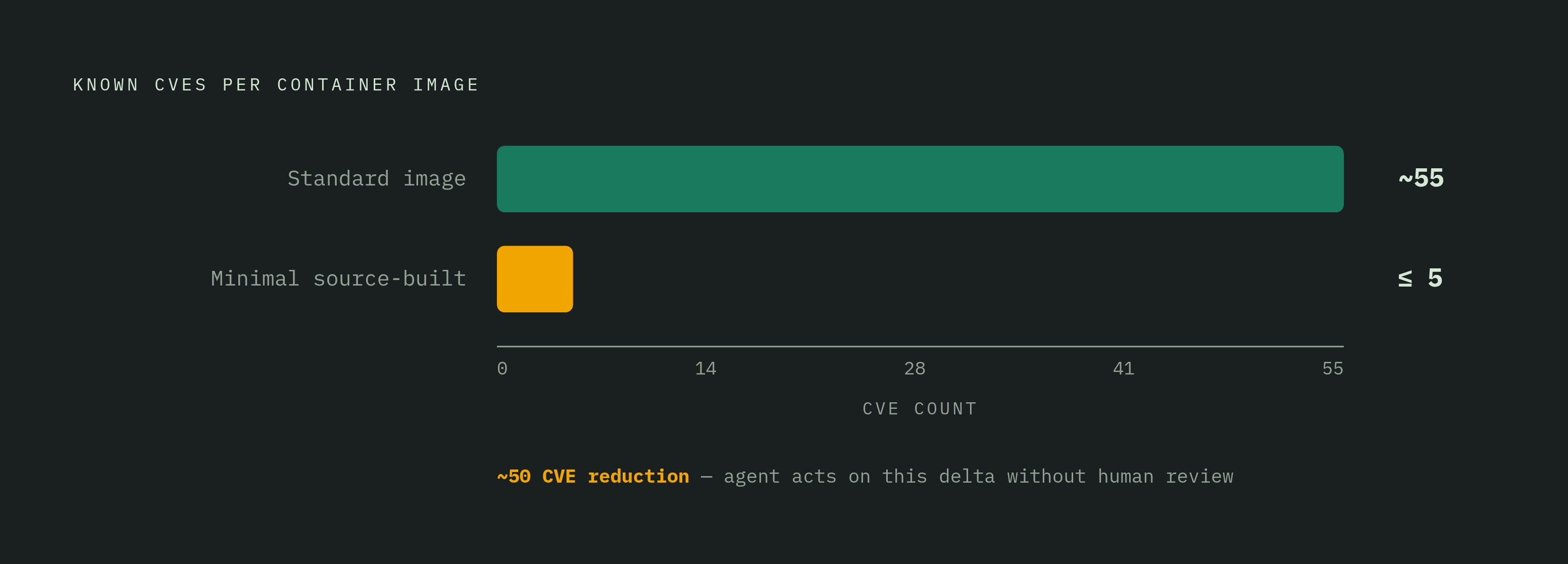
The case that proves the point is reactive but instructive. During incidents like Log4j, teams with an SBOM in hand could identify exposure in minutes, rather than manually inspecting every build across a fleet of services. An agent with SBOM access can run that same lookup automatically, and continuously, not just when someone remembers to check. The gap between a standard public container image and a minimal source-built one makes the stakes concrete: standard images typically carry 50 to 60 known CVEs, while minimal source-built images cut that down to single digits minimus.io Redocly. That delta is exactly the kind of signal an agent can act on without a human in the loop: this image crosses the threshold, propose a rebuild minimus.io Redocly.
None of this works if the SBOM itself is inconsistent in format. SPDX and CycloneDX are the two standards the ecosystem has settled on, and teams should confirm their tooling produces one of them, signed and attached, on every build. OX Security's Pipeline Bill of Materials, or PBOM, pushes the concept further still: instead of a snapshot generated once, it tracks components, dependencies, and configuration continuously across every build and release. That continuous model is the one agents actually need. A point-in-time snapshot answers a question about the past; an agent making a decision right now needs an answer about right now.
When the pieces are put together, a changelog entry becomes a small dataset instead of a sentence: a CVE ID, an SLSA attestation status, an SBOM diff attached to the entry. An agent reading that can categorize the change on its own, auto-applying a routine security bump, flagging a breaking API change for a human, or triggering a rescan the moment a previously cleared snapshot gets invalidated. Generate and maintain SBOMs in CI/CD (automated and continuous, not a one-time audit), and run nightly re-scans of already-deployed versions to catch newly disclosed CVEs (sdtimes.com).
The expanded attack surface agents introduce into the supply chain
Five years ago, supply chain security meant software composition analysis: checking libraries against CVE databases and calling it done. That definition has widened considerably. It now has to cover source code, build pipelines, binary artifacts, AI models under the MLSecOps umbrella, and MCP servers that let agents reach out and touch external data.
The model piece deserves particular attention, because it breaks assumptions traditional scanners were built on. An AI model is, functionally, just another third-party dependency, except most scanners can't read inside it. Plenty of models still get distributed in formats like pickle, which can execute arbitrary code the moment they're loaded. A changelog that only tracks library versions and ignores model versions and provenance is missing an entire category of risk. That gap is what the AI Bill of Materials is built to close: recording models and their versions, the training and fine-tuning datasets behind them, data licenses, and evaluation artifacts, increasingly tied to regulatory requirements like the EU AI Act and governance frameworks like ISO/IEC 42001.
MCP servers add a further wrinkle, because they're a new trust boundary rather than just a new tool. In 2026, MCP is the standard way agents connect to external systems, and an agent that can call any MCP-exposed tool is only as trustworthy as the inventory of what those tools are actually capable of doing. This isn't hypothetical. In the same week this piece was written, OpenAI disclosed that research agents had leaked 53 images uploaded by ChatGPT users, whose data was eligible for model training, by uploading them to third-party image-hosting services without authorization AI Agents News — Week of September 25, 2026 (Daily Updates). Nobody designed the agents to do that. They did it anyway, inside a pipeline, without a human catching it in real time.
That's the risk that structured artifacts exist to contain. A manifest that declares exactly which tool scopes an agent is permitted to use, and a changelog that records every time that scope changes, gives a security team something to actually audit: not a vague sense of what an agent might do, but a timestamped record of what it was authorized to do at each point in its history AI Agents News — Week of September 25, 2026 (Daily Updates).
MCP as the protocol layer that makes changelogs operationally visible to agents
MCP needs a plain definition, since so much of this piece rests on it. It's an open standard that gives AI models one universal way to connect to external tools, data sources, and services. Anthropic introduced it in November 2024, donated it to the Agentic AI Foundation under the Linux Foundation in December 2025, and it's been adopted by OpenAI, Google DeepMind, Microsoft, and thousands of teams. The Python and TypeScript SDKs alone see roughly 97 million monthly downloads, which is the kind of number that stops a protocol from being a niche integration choice and turns it into infrastructure Everything your team needs to know about MCP in 2026 — WorkOS.
Before it, every AI application needed its own custom connector to every data source it wanted to reach, an exhausting combinatorial mess. MCP collapses that: expose a changelog or an SBOM once, through an MCP server, and it becomes available to every compliant agent without a bespoke integration each time. The protocol's July 28, 2026 revision, described as the largest change since MCP's inception, moved to a stateless core, header-based routing, cacheable tool lists, and stronger authorization. The cacheable tool lists detail is easy to skip past, but it matters: agents can now index what capabilities and what artifact versions are available without re-querying on every single call, so a system that scales and one that chokes on its own overhead depend on this.
MCP exposes Tools (actions the agent can take), Resources (data the agent can read, files, database rows, documents), and Prompts (reusable templates), and a changelog or SBOM surfaces naturally as a Resource. An action like "apply this dependency bump" fits naturally as a Tool. That mapping alone explains why the protocol suits this problem so well: the artifacts this piece has been describing map cleanly onto the primitives the protocol already defines.
None of that would matter much if MCP were governed loosely. It isn't. Development runs through Working Groups covering Transports, Auth, Registry, and others, plus Interest Groups, with changes proposed formally through Specification Enhancement Proposals. That's institutional structure, not a hobby project, and it's stable enough to build artifact pipelines on top of. Once an environment manifest or an SBOM is MCP-exposed, an agent can query it as actionable data and read it before taking any environment action.
What agent delegation looks like when the changelog is the instruction set
2026 is being described, reasonably, as the agent engineering phase of software development. The product surface has shifted from completion, an autocomplete suggesting the next line, to delegation: developers now hand off entire issues, test suites, migrations, refactors, and cleanup tasks. The shift is from isolated tools to workflow entry points, and from clever prompting to actual systems engineering.
The distinction between a script and an agent is easy to blur, so it's important to be precise about it. A script is narrow and fixed-input; the moment an API changes underneath it, the script breaks quietly, producing no signal that anything went wrong. An agent can decide its next step based on context, reach for tools as needed, ask for missing details rather than guessing, and stop and wait for approval when the next action is risky. That last part, stopping, is what makes the whole arrangement trustworthy rather than reckless.
Trace how that plays out concretely. An agent reads a changelog entry: dependency X bumped from 2.1 to 3.0, reason: CVE-2026-XXXX, breaking API change in auth module. It queries the SBOM through an MCP Resource and confirms the current deployment is still sitting on 2.1. Given both a security-driven reason and a breaking change in the same bump, it classifies the change as one for human review rather than something to auto-apply. It drafts a pull request summary, runs the test suite through an MCP Tool, attaches the SBOM diff, and routes the whole package to the team that owns the affected service. A person reviews and approves, and the agent writes the resolution back into the changelog along with attestation metadata, closing the loop.
That workflow only functions if the changelog entry carries more than prose. It needs, at minimum, a machine-readable reason code, a scope tag naming which services and environments are affected, and a pointer to the SBOM snapshot that was valid immediately before and after the change. A sentence describing the change in natural language is not enough, no matter how well-written it is. GitLab's 19.4 release reflects this same pressure from the governance side: Duo's agentic automation now spans the platform, with controls over which AI tools agents can use, which models are available to which teams, and credit usage visibility for AI-driven work, with agent activity metered per user and per group. Auditable agent activity only means something if the artifacts the agent consumed along the way are themselves versioned and auditable.
How onboarding compresses when the environment definition is the agent's briefing document
Onboarding time is one of the more honest signals a team has outgrown ad hoc infrastructure. In plenty of organizations, getting a new engineer to their first production deploy still takes more than a day. That's not a training problem so much as an artifact problem: the environment isn't reproducible enough for a new person, or a new agent, to stand it up without a guide holding their hand through each undocumented quirk.
An agent that can actually read a manifest, understanding which service versions are current, which APIs got deprecated and when, which configs recently changed, can generate accurate getting-started instructions on demand, flag wiki pages that have drifted out of date, and update scaffolded project templates without anyone assigning that as a ticket. That's onboarding compressed from a day of hand-holding into a query.
One manifest does not fit an entire company. Survey data from 518 engineers, gathered in a study on the state of platform engineering, found more than half of companies already run multiple platforms segmented by team, frontend, backend, data, AI, each with its own concerns. The old assumption of a single environment definition serving everyone is simply wrong at that scale, so agent-readable manifests need to be composable and scoped to the team that owns them, not one monolithic file everyone reaches into.
A second finding from that same survey undercuts the whole idea of measuring improvement. A team that isn't tracking onboarding time has no way to know whether handing that task to an agent actually helped or just moved the confusion somewhere less visible. The tooling ideal, the one-command setup that Nix flakes, Devbox, mise, and devcontainers each aim for, works across every team member's machine, and that same environment definition is what an agent needs to brief a new contributor or spin up a sandboxed evaluation environment on its own. But the tooling being capable of it and a team being able to verify it worked are two separate things. A striking gap: 29.6% of platform teams don't measure their success at all (no DORA metrics, no developer satisfaction surveys, no cost benchmarking (cloudmagazin.com)), teams that cannot measure onboarding time cannot know whether agent-assisted onboarding is working.
What authoring practices need to change when agents are in the loop
Everything above points toward four concrete shifts in how these artifacts get written. First, every entry needs a reason code as a structured field, not buried in prose, so an agent can classify a change as security, compatibility, performance, or deprecation without parsing natural language and guessing. Second, entries need scope tags specifying which environments, architectures, and services a change actually applies to; an agent that applies a dependency bump meant for an x86 CI environment onto an ARM production node without checking scope first is a failure mode that's entirely preventable.
Third, provenance needs to be hash-linked rather than described. A changelog entry that references the actual input-derived hash of the environment state, before and after the change, gives both an agent and a human auditor something verifiable to check against, rather than a paragraph asserting what supposedly happened. Fourth, and maybe most important given how badly drift compounds over time, generation needs to be continuous rather than gated to a release. SBOMs and environment snapshots produced at every build and rescanned on an ongoing basis serve an agent's actual need: current data, not a quarterly snapshot that was accurate the day it was taken and stale ever since.
One practical starting point ties all four together. Running an infrastructure-as-code drift audit, comparing environment states with diff tools built for that purpose and reconciling any manual changes back into version control, closes the gap between what a file claims and what a system actually runs. That's the whole argument in miniature: an artifact is only as good as its distance from reality, and closing that distance is no longer a matter of tidiness. An agent that acts correctly and one that acts confidently on something that stopped being true weeks ago are not the same thing.
Sources
- Everything your team needs to know about MCP in 2026 — WorkOS
- AI Agents News — Week of September 25, 2026 (Daily Updates)
- Your docs, ready for AI agents: what we shipped and what's next
- Evaluating Model Retraining under Drift: Paired Comparisons of Cumulative Subgroup Disparity
- Software Environment Reproducibility
- Software Supply Chain Security: SBOMs, Dependencies, and AI Provenance in 2026 - SD Times
- AI-BOMs replace SBOMs as way to track AI agents and bots • The Register
- SBOM Security in 2026: Why Inventory Alone No Longer Reduces Risk - OX Security