Parallel CI Execution in Monorepo Pipelines
Detect affected work, cache results, and shard tests in identical environments.
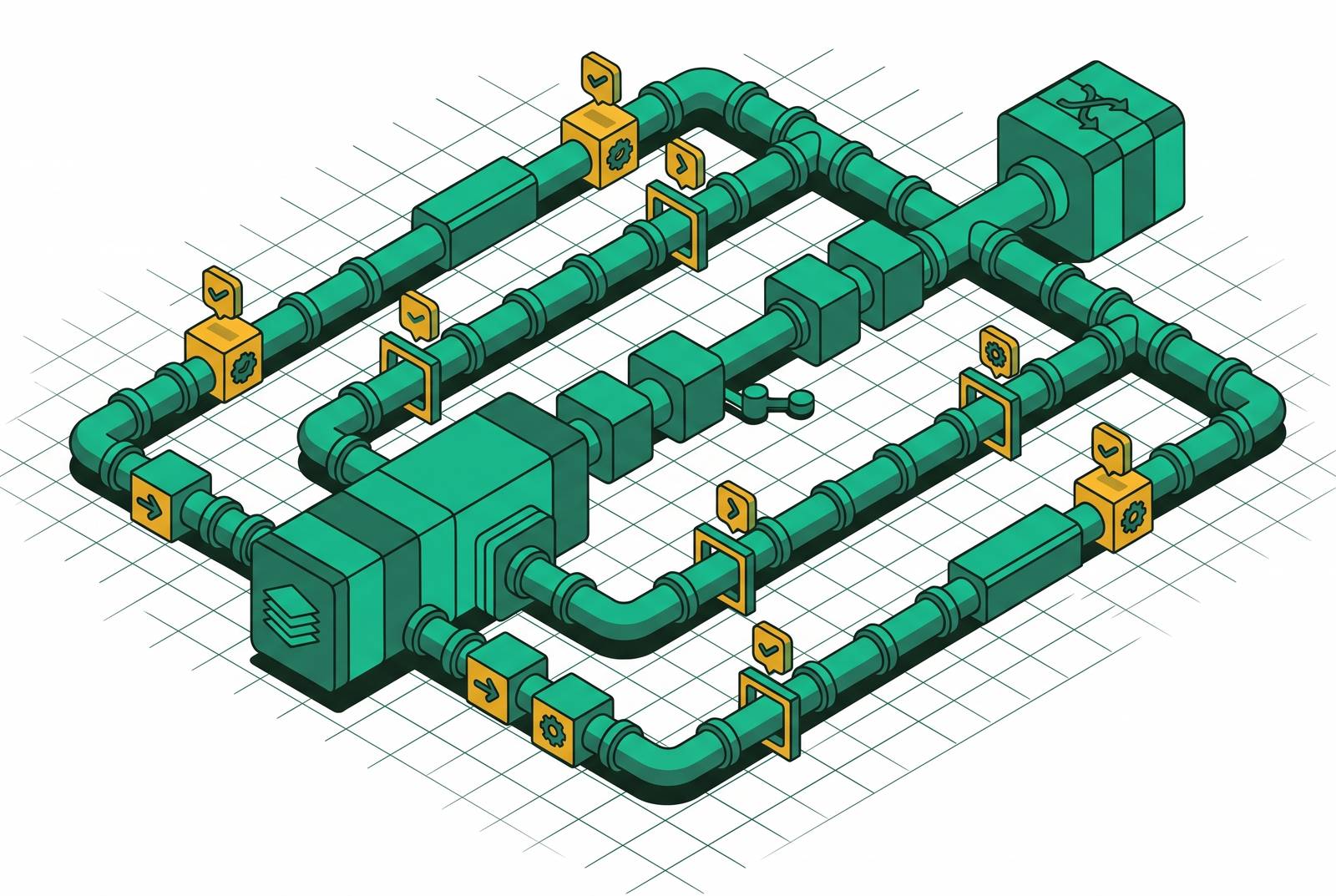
Parallel CI execution in monorepo pipelines works best when it cuts work that is not needed before spreading the rest across runners. The steps work best in this order: affected-graph detection, remote caching, and test sharding, all in bit-for-bit identical execution environments. More runners alone cannot fix an oversized workload, redundant computation, or results that change with the machine that produced them.
Why naive monorepo CI scales badly and what the fix looks like
Thirty separate repositories have thirty independent pipelines, each triggered only by changes in its own repository. A monorepo collapses that isolation into one trigger point, where the default pipeline runs every check against every package on every commit. Its CI cost therefore grows as the product of packages, commits, and cost per check. More packages add work to each commit, and more commits mean doing that larger workload more often. A change with a narrow scope can consequently carry the execution cost of the whole repository.
Running that workload across more machines can reduce waiting, but it does not remove the work that should never have run. The fix must separate work that is not needed, work that has already been done, and work that needs more parallel capacity. Those are separate problems, so a single optimization cannot resolve them all. The required structure has three ordered levers, namely selective affected-graph detection, remote caching, and test sharding. Environment parity is the fourth prerequisite, because the results those levers select, restore, and combine must remain trustworthy across runners.
Affected-graph detection: the highest-leverage step, and where it breaks down
Affected-graph detection offers the largest initial gain because it eliminates work. Its purpose is to identify the projects affected by a change, including those connected through dependencies. A path filter alone cannot represent that relationship, because the location of an edited file does not describe every project that depends on it. Dependency-graph tools avoid that blind spot by making the dependency structure part of the decision. The distinction matters for correctness as much as speed, since a smaller workload is useful only if it still contains the necessary checks.
That dependency awareness also explains why the affected set can sometimes approach the size of the repository. Nx’s documentation acknowledges that modifying a project used by a large portion of the monorepo can trigger tasks for almost all projects. A change to shared-core can therefore leave little work to exclude. Because a widely shared dependency can genuinely affect most consumers, this is the boundary of what detection alone can achieve, and it leaves a substantial workload for the next optimization layer.
Selection also depends on comparing the right commits. Nx must receive the correct base and head configuration in CI, or it falls back to rebuilding everything. Even with that range configured correctly, overly broad task inputs can erase the expected savings. When root nx.json, turbo.json, or root package.json is declared a global input to every task, an edit to an unrelated field can invalidate the entire task graph. That configuration makes a narrow change behave like a repository-wide change, so the pipeline needs both an accurate dependency graph and inputs whose scope reflects the tasks they actually affect.
Remote caching: what it actually eliminates and why environment parity is its prerequisite
Once detection has established the affected set, remote caching removes computation that has already been completed for the same inputs. Turborepo and Nx Cloud extend that reuse across machines. If a teammate has already built packages/utils on a laptop with the same inputs, a fresh CI runner can restore the artifact without recompiling it. Detection and caching therefore answer different questions. A project may be affected by a change while still containing tasks whose matching outputs are available for reuse.
However, matching declared inputs does not by itself establish that an artifact is safe to restore. The hidden assumption is that a task hash describes everything that could change the output, even when it covers task inputs but omits the execution environment. If one runner uses Node 22.1 and another uses Node 22.3, different outputs can sit behind the same cache key when that difference is absent from the hash. The resulting hit can silently return the wrong artifact. For reuse to be trustworthy, the environment that produced the cached output must be bit-for-bit identical to the environment consuming it.
Drift can also fail in the opposite direction, producing cache misses for identical source when system libraries or compiler versions differ. That wastes the computation caching was meant to eliminate rather than silently substituting an unsuitable result. Caching needs layers, starting with the package-manager cache keyed by the lockfile hash, then the build-output cache keyed by the task hash and shared remotely. Heavy dependencies, including Playwright browsers, form another cache layer. Each layer’s key must include its environment inputs, or the key does not faithfully describe the work it represents.
Nx Cloud Distributed Task Execution makes this requirement more immediate because it assigns tasks to whichever runner is available. If those runners differ, the same task can give different outputs based on where it runs. The task graph coordinator cannot resolve that ambiguity simply by knowing the dependency order. Environment parity must therefore precede distributed execution rather than become a repair applied after inconsistent results appear.
Test sharding: compressing the critical path after detection and caching have done their work
After selection and cache restoration, the remaining problem is the duration of work that genuinely has to execute. A parallel pipeline finishes when its longest dependency chain finishes. If services/billing has an uncached 40-minute test suite in the affected set, running other packages in parallel cannot make the pipeline finish in under 40 minutes. Sharding addresses this different constraint by splitting the suite across multiple runners.
Static sharding uses round-robin bucket assignment, but tests with unequal durations can leave one runner idle while another continues for much longer. The slowest shard then determines the suite’s wall-clock duration. Historical timing data provides the basis for balancing that remaining work, rather than treating the number of tests as a substitute for their cost. The objective is to shorten the longest shard.
Each shard runs on a separate runner, so inconsistent environments can make the same test behave differently depending on its assignment. A combined pass or fail signal is not trustworthy when parts of the suite execute under different conditions. The environment must therefore be locked before the suite is distributed. The order remains detection, then caching, then sharding, because each stage establishes the workload the next stage should handle, while environment parity makes their results reliable.
Why environment consistency is also a supply-chain security requirement, not just a reliability one
The same environment controls that make execution reliable also help make software provenance attestable. A cached artifact is not only an output that saves time, but an output whose production conditions matter when explaining a build. Likewise, distributed task results must belong to a consistent execution context if they are to support a coherent account of how software was produced. The infrastructure choices behind a fast pipeline also determine how clearly its outputs can be tied to their build environment.
That connection broadens the purpose of a versioned environment manifest. For execution, it defines the pinned environment that every runner must use. For provenance, its hash can be recorded with the build artifact when results are collected and attested. These are complementary uses of the same declaration, rather than separate attempts to describe the environment after execution. A pipeline that treats environment identity as an explicit input gives both cache reuse and artifact provenance a common reference.
Cloudsmith describes the 2026 shift from static SBOMs toward agentic governance, with MLSecOps for model integrity and agentic remediation. Treating AI agents as primary actors in the supply chain changes who initiates or carries out work, but it does not make execution conditions irrelevant. The environment-parity requirements that apply to human CI jobs also apply to agent-driven pipelines. As supply-chain governance grows, reproducible environments still tie a task’s inputs to how it ran and the artifact put forward for review.
Putting the three levers together: sequencing decisions and common failure patterns
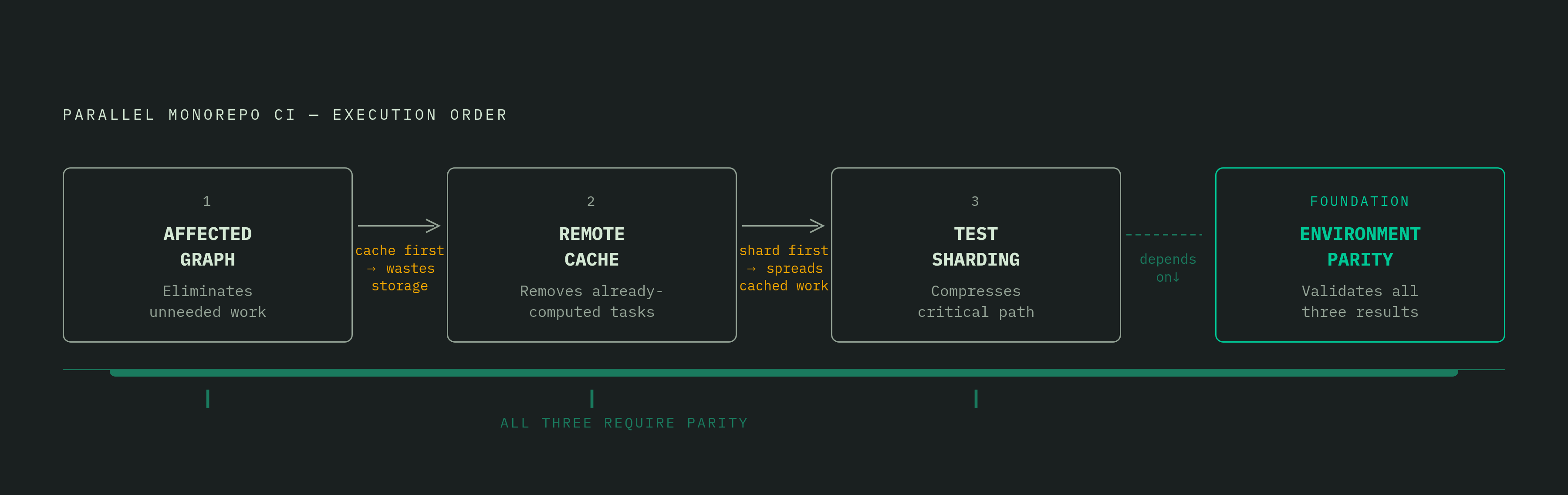
The practical decision is not which lever to choose, but which problem must be resolved before the next lever can deliver value. Caching before detection spends storage and lookup time on tasks that should have been excluded. Sharding before caching distributes work whose outputs may already be available, consuming runner-minutes without adding useful computation. Applying parallelism before either layer adds orchestration overhead to an unnecessarily large workload.
Input scope is one of the first places to examine when the layers fail to reinforce one another. A root nx.json or turbo.json declared as an input to every task allows one configuration edit to defeat both selective execution and cache reuse. The resolution is to scope configuration-file inputs to the tasks they affect. Environment inputs require the opposite treatment because they are essential to interpreting results across all runners. Declare and pin the environment in a manifest checked into the repository, then use that manifest as an explicit input to every cache key.
Parallel scheduling must also preserve dependency order after selection and cache restoration. A service cannot be tested before its required shared library is built, just as a Terraform module cannot be applied before its networking prerequisite. Nx represents this constraint through its dependency-aware task graph, while Terraform CI pipelines can express it through explicit job dependencies. More concurrency is useful only where the graph permits it. Violating those edges does not shorten a valid execution path, but replaces it with an invalid one.
In a working pipeline, a change event first triggers affected-graph calculation against the correct base commit. The affected set is then checked against the remote cache, and hits restore artifacts without rerunning their tasks. Remaining tasks are distributed through DTE or a matrix, with long test suites sharded using historical timing data. Before any task executes, every runner pulls the same pinned environment from the versioned manifest. Results are then collected and attested, with the environment hash recorded beside the build artifact, so reduced work, shorter execution, and trustworthy provenance follow from the same ordered design.